Introduction: The Pride of the South Finds Its Groove
In the world of Indian banking, flashy growth stories often grab headlines. But if you’ve been watching this sector for decades, you’ll know that the real winners are usually the quiet performers—the ones that focus on discipline, consistency, and long-term trust. City Union Bank is one such institution.
Founded in the temple town of Kumbakonam, City Union Bank has always been known for its conservative lending practices and deep-rooted relationships with MSMEs and the agricultural sector. Over the last few years, however, the bank faced a tough phase due to post-pandemic stress in its loan book. That’s why the Q4 FY26 results feel like a turning point.
The bank has delivered its highest-ever quarterly earnings per share (EPS) of ₹4.84, backed by a strong 25% jump in net profit. The stock reacted positively, closing at ₹271 with a gain of 3.3%, reflecting renewed investor confidence.
What makes this story even more interesting is the context. While large private banks are currently battling deposit pressures and global uncertainties, City Union Bank’s domestic-focused strategy is helping it stay resilient. This is a classic case of “momentum beating macro.”
Q4 FY26 Financial Scorecard: Efficiency at Its Best

The Q4 FY26 performance of City Union Bank is a textbook example of how efficiency can drive profitability. Net Interest Income (NII), which is the core earnings metric for banks, grew sharply to ₹786 crore from ₹600 crore in the same quarter last year. This represents a strong 30.9% growth.
Net profit came in at ₹360 crore, up from ₹288 crore, marking a 24.9% increase. This growth is particularly impressive because it comes after a period of elevated credit costs.
The most significant improvement, however, is in asset quality. The Gross NPA ratio dropped to 1.91% from 3.09% a year ago. This is a massive cleanup and one of the best indicators that the bank’s recovery is real and sustainable.
In addition to strong financials, the bank also declared a dividend of ₹2 per share, maintaining its track record of rewarding shareholders.
Fundamental Analysis: The Asset Quality Pivot
The NPA Miracle: A Clean Balance Sheet Returns
One of the biggest highlights of City Union Bank’s turnaround is the sharp improvement in its asset quality. The Gross NPA ratio has fallen to 1.91%, down from 2.17% in the previous quarter and significantly lower than levels seen during the pandemic years.
This improvement is not just a statistical adjustment—it reflects a genuine recovery in the bank’s core customer segments, particularly MSMEs. These businesses were hit hard during the pandemic, but their gradual recovery is now showing up in the bank’s numbers.
For investors, this is a critical signal. Lower NPAs mean lower provisioning requirements, which directly boosts profitability.
Capital Strength: Growth Without Dilution
Another key strength of City Union Bank is its strong capital position. The bank’s Capital Adequacy Ratio stands at 21.9%, which is well above regulatory requirements.
This means the bank has enough capital to support its growth plans without needing to raise additional equity. In simple terms, shareholders are unlikely to face dilution in the near future.
A strong capital base also provides a cushion against any unexpected economic shocks, making the bank a safer bet in uncertain times.
Branch Expansion: From Regional to National
City Union Bank is no longer content with being a regional player. The bank has announced plans to open 7 new branches across Uttar Pradesh, Tamil Nadu, and Karnataka.
With this expansion, the total branch network will reach 987 locations. This is a significant step toward becoming a more diversified, pan-India bank.
Branch expansion not only increases customer reach but also strengthens the deposit base, which is crucial for sustainable growth.
Technical Analysis: The Breakout from Consolidation
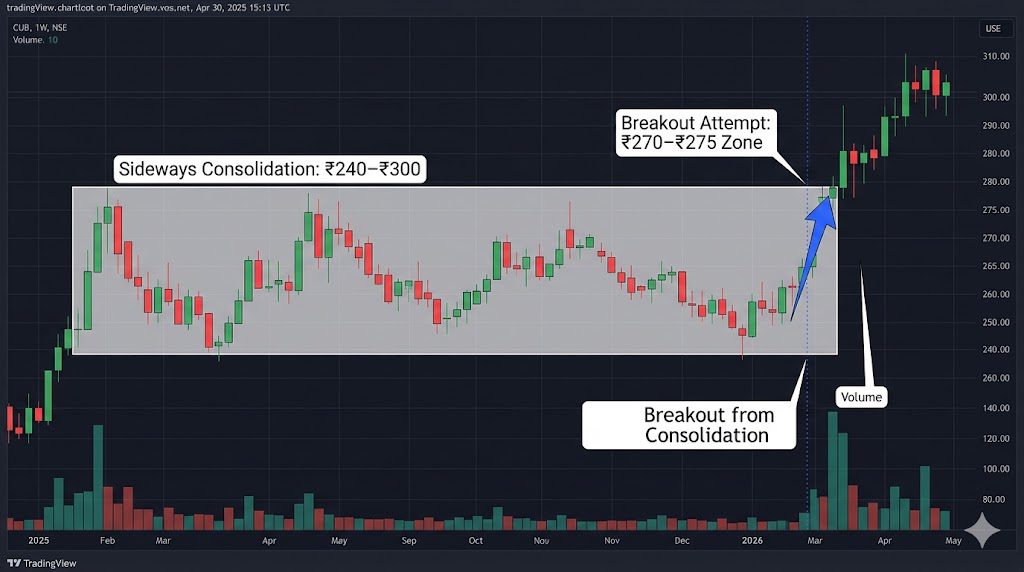
From a technical perspective, City Union Bank’s stock is showing clear signs of strength. After a period of consolidation, the stock has entered a mildly bullish phase.
The stock has successfully crossed its 50-day exponential moving average (EMA), which is often considered an early indicator of a trend reversal.
The immediate support level is around ₹262, which acted as a floor during the latest trading session. On the upside, the key resistance level is ₹324, which corresponds to the stock’s 52-week high.
Momentum indicators also support the bullish view. The RSI has moved above 60, indicating increasing buying interest.
If the bank achieves its milestone of 1,000 branches by mid-2026, it could act as a catalyst for a re-rating, potentially pushing the stock toward ₹350.
Dividend & Shareholder Value
City Union Bank continues to maintain a steady approach toward shareholder rewards. The declaration of a ₹2 per share dividend reflects the bank’s commitment to returning value to investors.
While the dividend yield of around 0.74% may appear modest, it is important to look at the bigger picture. The bank is in a growth phase, and reinvesting profits into the business can generate higher returns over time.
Given the strong profit growth of 25%, there is a possibility of higher dividend payouts in the coming years.
Management Guidance: 15% is the New Baseline
Loan Growth: Balanced and Sustainable
The management has guided for a loan growth rate of 12–16% CAGR over the next two years. This growth will be driven primarily by secured lending segments such as gold loans and MSME financing.
This approach reflects a balance between growth and risk management. By focusing on secured loans, the bank reduces the risk of defaults while still expanding its portfolio.
Cost Management: Digital Efficiency
Another area where the bank is focusing is cost efficiency. The management aims to bring the cost-to-income ratio down to around 42% through increased digital adoption.
Digital banking not only reduces operational costs but also improves customer experience. Over time, this can significantly enhance profitability.
Brokerage Sentiment & Targets: The Path to ₹325
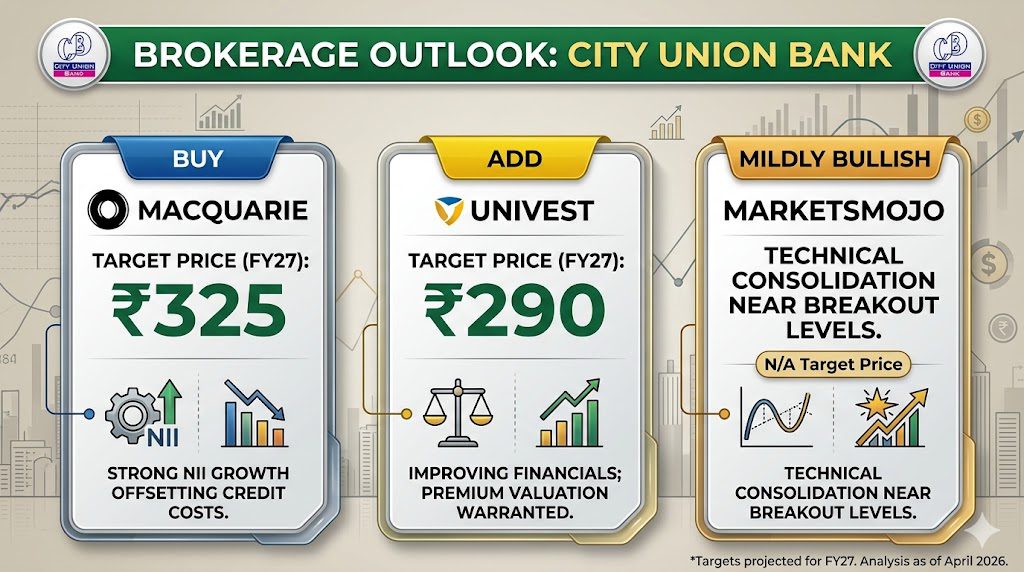
Brokerage firms have started taking note of City Union Bank’s improving fundamentals.
Macquarie has given a “BUY” rating with a target price of ₹325, highlighting strong NII growth and improving asset quality.
Other analysts maintain a more cautious stance but still acknowledge the positive trend. The overall sentiment is that the stock is entering a re-rating phase as its fundamentals strengthen.
The “30-Year” Analyst Verdict
For Long-Term Investors
City Union Bank represents a “quality at a discount” opportunity. Among old-generation private banks, it stands out for its clean balance sheet and disciplined management.
For long-term investors, this is a stock that offers stability and steady growth. It may not deliver explosive returns, but it provides a reliable compounding story.
For Traders
For traders, the stock currently offers a range-bound opportunity with an upward bias. Buying near ₹260 and targeting ₹310 provides a favorable risk-reward setup.
A breakout above ₹324 could trigger a stronger rally, making it an important level to watch.
Conclusion: The Dark Horse of 2026
City Union Bank’s Q4 FY26 results mark a significant turning point. With a 25% increase in profit and a sharp improvement in asset quality, the bank has successfully completed its turnaround phase.
The combination of strong fundamentals, expanding branch network, and improving market sentiment makes it one of the most interesting stories in the banking sector today.
What’s Your View? (CTA)
Do you see City Union Bank as the next big turnaround story, or do you prefer larger banks for stability? Share your thoughts and let’s discuss the best opportunities in the banking sector.