Introduction: The Challenger Brand’s Big Leap
If you’ve tracked India’s cement sector long enough, you’ll know it’s a game of cycles. There are times when demand surges with infrastructure spending, and then there are phases when pricing pressure tests even the strongest players. But every cycle produces a few standout performers—companies that don’t just survive volatility, but use it to strengthen their position. Dalmia Bharat is one such name.
While the market’s attention was recently captured by industry giant UltraTech Cement crossing the 200 MTPA milestone, Dalmia Bharat has quietly delivered something equally important—margin resilience. In a year marked by volatile cement prices, especially in South and East India, Dalmia has focused on efficiency, cost control, and strategic expansion.
As of April 28, 2026, the stock is trading around ₹1,850, moving in a tight consolidation range. This reflects a market that is waiting for the next trigger—most likely clarity on capacity expansion and integration of newly acquired assets.
In simple terms, if UltraTech represents scale, Dalmia represents speed and efficiency. And that’s exactly what makes this story worth watching.
Q4 FY26 Financial Scorecard: Stability in Volatility
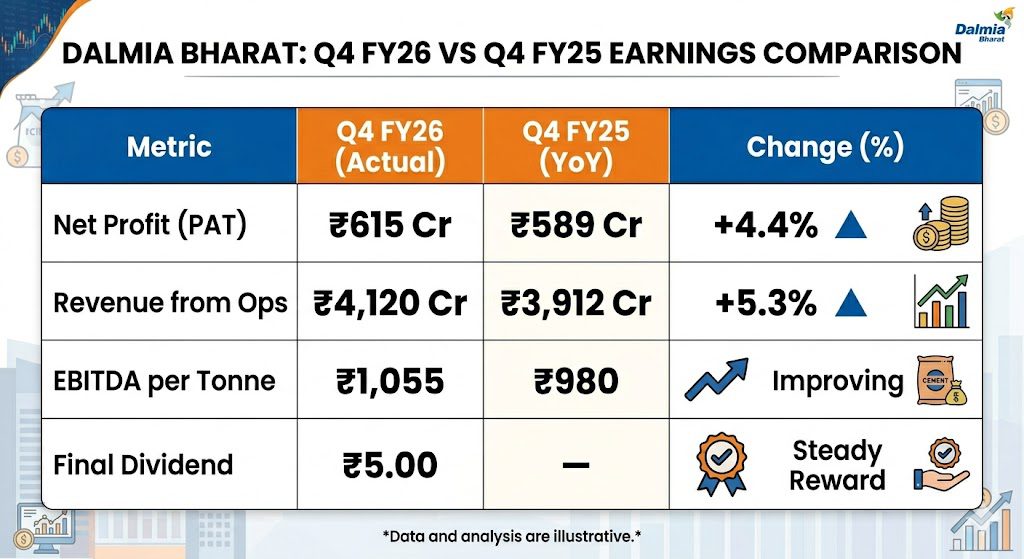
Dalmia Bharat’s Q4 FY26 results reflect stability in a challenging pricing environment. The company reported a net profit of ₹615 crore, compared to ₹589 crore in Q4 FY25, marking a modest but steady growth of 4.4%.
Revenue from operations stood at ₹4,120 crore, up from ₹3,912 crore, registering a 5.3% increase. While these numbers may not look explosive, they become impressive when you consider the volatility in cement prices during the year.
One of the most important metrics in the cement industry is EBITDA per tonne, and here Dalmia has delivered strong performance. EBITDA per tonne improved to ₹1,055 from ₹980, indicating better cost management and operational efficiency.
The company also announced a final dividend of ₹5 per share, maintaining a steady approach toward shareholder rewards even during an expansion phase.
Fundamental Analysis: The “Greener” Path to Profits
Capacity Expansion: Building for the Future
Dalmia Bharat’s growth strategy is centered around capacity expansion. The company is steadily moving toward its target of 50 MTPA capacity, which will significantly strengthen its position in the Indian cement market.
A key milestone in this journey is the commissioning of a new grinding unit in Bihar. This facility is strategically located to serve the Eastern market more efficiently, reducing logistics costs and improving margins.
In the cement business, logistics can account for a significant portion of total costs. By expanding its footprint closer to demand centers, Dalmia is building a long-term competitive advantage.
JP Associates Integration: The Hidden Growth Trigger
Another important aspect of Dalmia’s strategy is the integration of cement assets acquired from JP Associates. While these assets are still in the process of being fully integrated, they represent a significant growth opportunity.
Once the integration is complete, these assets are expected to contribute meaningfully to both volume growth and profitability. For FY27, this could act as a key earnings driver.
Investors should watch this closely, as successful integration could lead to a re-rating of the stock.
Renewable Pivot: Cost Stability Through Green Energy
One of Dalmia Bharat’s biggest strengths is its focus on sustainability. The company is a leader in “green cement,” with a strong commitment to renewable energy.
Through its RE100 initiative, Dalmia aims to source 100% of its power from renewable sources. Currently, a significant portion of its energy needs is met through solar, wind, and waste-derived fuels.
This strategy is particularly important in the current environment, where global petcoke prices have been volatile. By reducing its dependence on fossil fuels, Dalmia is protecting its margins and ensuring cost stability.
Technical Analysis: The Multi-Month Breakout Zone
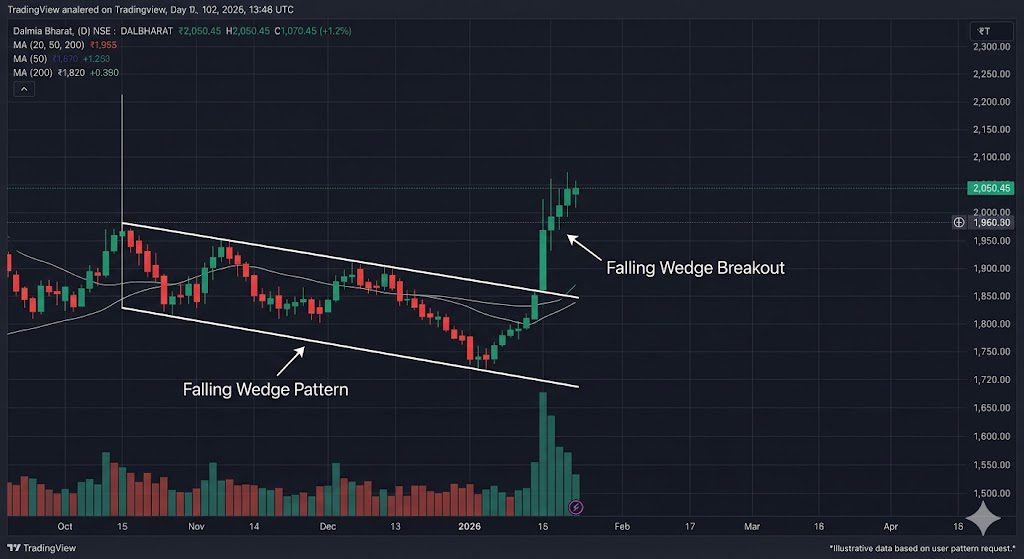
From a technical perspective, Dalmia Bharat’s stock is showing signs of a potential breakout. The stock has been forming a falling wedge pattern on the daily chart, which is typically considered a bullish reversal pattern.
The ₹1,720–₹1,750 range has emerged as a strong support zone. This is where buyers have consistently stepped in, preventing further downside.
On the upside, ₹1,960 is the key resistance level. A sustained breakout above this level, supported by strong volume, could trigger a rally toward ₹2,200.
The RSI is currently around 52, indicating that the stock is neither overbought nor oversold. However, the upward trend suggests that momentum is building.
Interestingly, the stock has underperformed the broader infrastructure index in recent months. This creates the possibility of a “catch-up rally” if fundamentals continue to improve.
Corporate Action: The Dividend Signal
Dalmia Bharat’s decision to declare a ₹5 per share dividend reflects its balanced approach to capital allocation.
While the company is investing heavily in expansion, it is also ensuring that shareholders receive a steady return. This balance between growth and reward is a hallmark of strong management.
Although the dividend yield may not be very high, the consistency of payouts adds to investor confidence.
Management Guidance: The 75 MTPA Vision
Long-Term Growth: Betting on India’s Infrastructure Boom
Under the leadership of Puneet Dalmia, the company has laid out an ambitious long-term vision.
Dalmia aims to expand its capacity to 75 MTPA and eventually reach 100–110 MTPA by 2031. This growth is aligned with India’s infrastructure development plans, which are expected to drive cement demand for years to come.
Cost Outlook: Stability Ahead
Management expects power and fuel costs to stabilize in FY27 as the share of renewable energy increases to over 35%.
This shift will not only reduce cost volatility but also improve margins over the long term. In an industry where costs can fluctuate significantly, such stability is a major advantage.
Brokerage Sentiment & Targets: The Re-Rating View
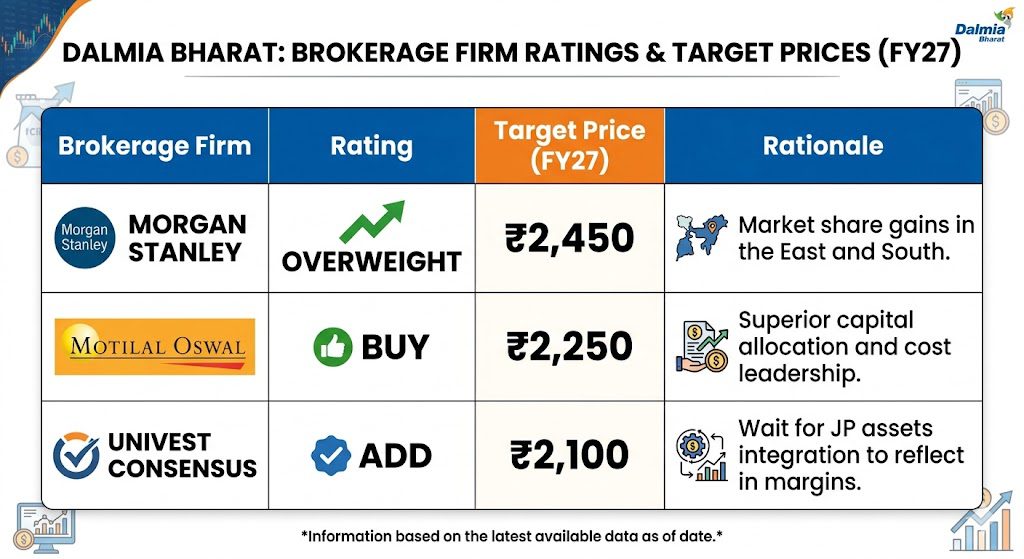
Brokerage firms remain optimistic about Dalmia Bharat’s growth prospects.
Morgan Stanley has given an “Overweight” rating with a target price of ₹2,450, citing strong market share gains in Eastern and Southern India.
Motilal Oswal Financial Services has also maintained a “BUY” rating, highlighting the company’s efficient capital allocation and cost leadership.
The consensus target range of ₹2,100–₹2,450 suggests significant upside potential from current levels.
The “30-Year” Analyst Verdict
For Long-Term Investors
Dalmia Bharat represents a “growth at a reasonable price” opportunity. It combines strong operational efficiency with aggressive expansion.
Compared to some of its peers, the stock is still available at a relatively attractive valuation. For long-term investors, this makes it a compelling addition to a diversified portfolio.
For Traders
For traders, the stock is currently in a consolidation phase, which often precedes a breakout.
Buying near current levels with a stop-loss around ₹1,700 offers a favorable risk-reward setup. On the upside, a move toward ₹2,150 is possible over the next few months.
Conclusion: Cementing Its Future
Dalmia Bharat’s Q4 FY26 results highlight a company that is executing its strategy with discipline and clarity.
Despite pricing pressure, the company has managed to improve margins, expand capacity, and maintain a strong balance sheet.
What’s Your View? (CTA)
Do you believe Dalmia Bharat can achieve its ₹2,450 target, or do you think larger players will continue to dominate the sector? Share your thoughts and let’s discuss the future of India’s cement industry.