Introduction: A Tale of Two Geographies
Spending more than three decades tracking the Indian pharmaceutical sector teaches one important lesson very quickly—headline numbers rarely tell the complete story. A quarter that initially appears weak on paper can often hide the deeper strength of a fundamentally resilient business. That is exactly what investors are witnessing today, May 13, 2026, as Cipla announced its Q4 FY26 earnings.
At first glance, the numbers appear disappointing. Consolidated net profit declined sharply by nearly 55% year-on-year, which immediately grabbed market attention. However, experienced investors know that pharmaceutical companies often go through temporary profit volatility due to pricing pressure, one-time impairments, regulatory issues, and inventory adjustments in overseas markets. The real story usually lies deeper within the business structure.
And in Cipla’s case, the deeper story is still highly encouraging. While the company faced heavy pressure in the North American market, its domestic India business delivered one of the strongest performances in recent years. The company’s “One India” segment crossed the ₹3,000 crore quarterly revenue milestone for the first time, reinforcing Cipla’s leadership in the Indian pharmaceutical market.
Despite the sharp drop in profit, investors responded positively to the results announcement. The stock closed nearly 4% higher around ₹1,344.90 on the NSE after the earnings release. The market clearly focused on the strong domestic growth story, attractive dividend announcement, and long-term recovery potential instead of only reacting to quarterly profit weakness.
In many ways, Cipla’s Q4 FY26 performance reflects the larger transformation currently taking place within the Indian pharmaceutical industry. Domestic healthcare demand is becoming stronger and more stable, while global generics markets—especially the US—remain highly competitive and volatile. Cipla is now balancing both realities simultaneously.
Q4 FY26 Performance: The Actual Numbers
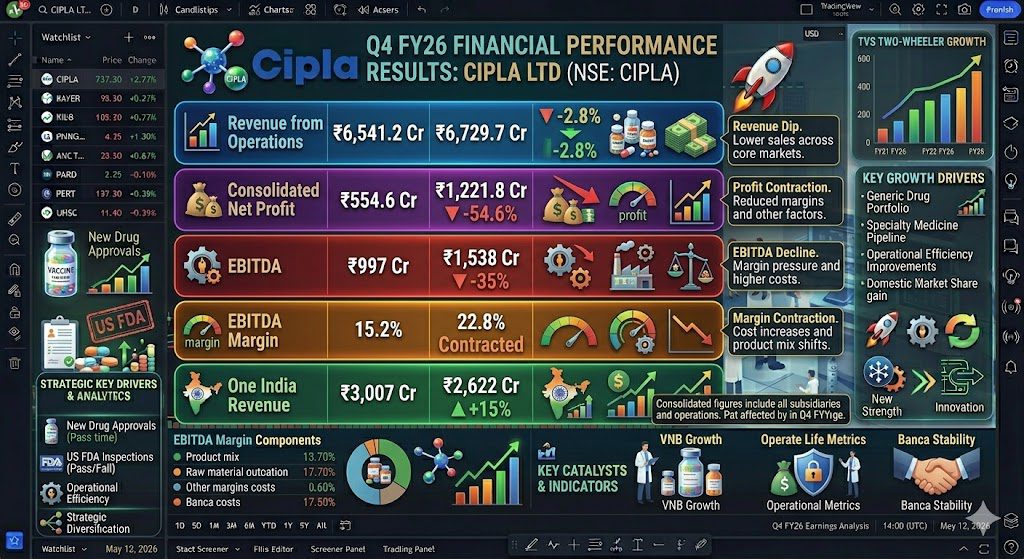
The audited results for the quarter ended March 31, 2026, reveal a mixed but strategically important quarter for Cipla. While profitability declined sharply due to international pressure and exceptional items, the domestic business continued to strengthen significantly.
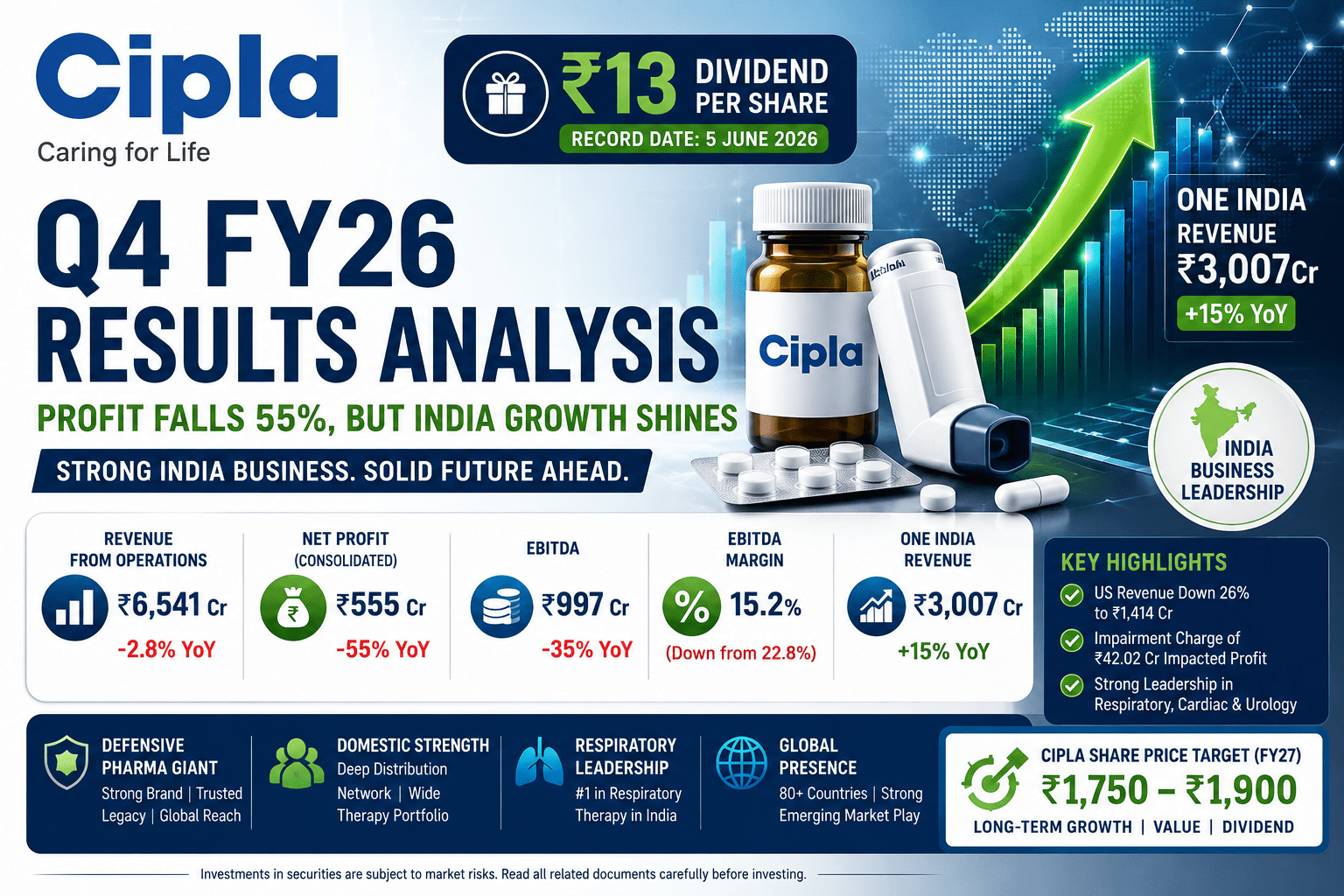
Revenue from operations for Q4 FY26 came in at ₹6,541.2 crore compared to ₹6,729.7 crore in the same quarter last year. This represents a decline of around 2.8% year-on-year. The revenue decline was primarily caused by weakness in the North American market, where pricing pressure and inventory normalization affected sales performance.
The most dramatic figure from the results was the decline in consolidated net profit. Cipla reported net profit of ₹554.6 crore compared to ₹1,221.8 crore in Q4 FY25, representing a sharp decline of approximately 54.6%.
However, investors should understand that this decline does not fully reflect deterioration in the company’s core business quality. A significant portion of the profit pressure came from one-time impairment charges and temporary international market challenges rather than structural weakness in the Indian business.
EBITDA for the quarter declined to ₹997 crore compared to ₹1,538 crore last year, while EBITDA margins contracted from 22.8% to 15.2%. Margin pressure was mainly driven by weaker US sales mix and impairment-related impacts.
The strongest positive number in the entire report came from Cipla’s “One India” business, which surged nearly 15% year-on-year to ₹3,007 crore. This milestone is extremely important because it highlights the growing strength and stability of the company’s domestic healthcare franchise.
Fundamental Deep-Dive: The Moat vs. The Storm
The India Engine Remains the Crown Jewel
The most important takeaway from Cipla’s Q4 FY26 performance is the exceptional strength of its India business. The “One India” segment crossed ₹3,000 crore in quarterly revenue for the first time, growing by nearly 15% year-on-year.
This growth clearly demonstrates that Cipla continues to maintain one of the strongest domestic pharmaceutical franchises in India. The company remains a market leader across multiple high-value therapeutic categories including respiratory care, cardiac medicine, and urology.
Respiratory therapies have historically been one of Cipla’s biggest strengths, and the company continues to benefit from rising healthcare awareness, increasing pollution-related illnesses, and long-term chronic care demand in India.
The Indian pharmaceutical market itself is undergoing structural expansion due to rising middle-class healthcare spending, growing insurance penetration, and improved access to medical treatment across smaller cities and rural areas. Cipla’s deep distribution network and strong doctor relationships position it extremely well to benefit from this long-term healthcare growth story.
For long-term investors, the domestic business is increasingly becoming more important than short-term international volatility. Stable double-digit growth in India provides a strong earnings foundation for the future.
North America Pressure Continues
While India delivered strong growth, the North American business remained under pressure during the quarter. Revenue from North America declined sharply by around 26% year-on-year to ₹1,414 crore.
The US generic pharmaceutical market has become increasingly challenging over the last few years due to aggressive pricing competition, inventory adjustments, and regulatory pressures. Even large pharmaceutical companies continue facing margin pressure in this environment.
For Cipla, the decline was primarily driven by pricing erosion and inventory normalization among channel partners. In simple terms, distributors and pharmacies reduced inventory purchases during the quarter, impacting overall sales.
However, these cycles are relatively common in the US generics industry. Investors should remember that temporary volatility in North America does not necessarily damage the long-term strength of the company’s global business model.
Future growth in the US market will depend heavily on successful new generic launches, regulatory approvals, and the company’s ability to stabilize pricing realization.
The Impairment Impact
Another major factor affecting Cipla’s profitability during Q4 FY26 was the impairment charge related to associates. The company reported an impairment impact of approximately ₹42.02 crore during the quarter.
Impairment charges are important because they directly reduce reported profit, even though they may not involve actual cash outflow during the period. This means the headline profit decline appears worse than the underlying operational reality.
Many institutional investors therefore focus more on operational trends, domestic growth, and long-term strategic positioning rather than reacting only to impairment-driven profit volatility.
Shareholder Rewards: The ₹13 Dividend
Recommended Dividend Payout
Despite the challenging quarter, Cipla’s board recommended a final dividend of ₹13 per equity share for FY26. This announcement sent a positive signal to investors because dividend continuity reflects management confidence in long-term cash flow stability.
For shareholders, dividends remain an important component of total returns, especially during periods when stock price movement becomes volatile. Cipla’s consistent payout policy reinforces its reputation as a stable large-cap pharmaceutical company.
Important Dividend Dates
The company has announced Friday, June 5, 2026, as the official record date for the dividend payout. Shareholders holding the stock before the ex-dividend date will become eligible to receive the dividend.
The dividend payment is expected within 30 days following the upcoming Annual General Meeting (AGM).
For income-focused investors, Cipla’s dividend strategy adds another layer of defensive appeal to the stock, especially in uncertain market conditions where stable cash-return businesses are often preferred.
Technical Analysis: The ₹1,300 Floor
Current Market Setup
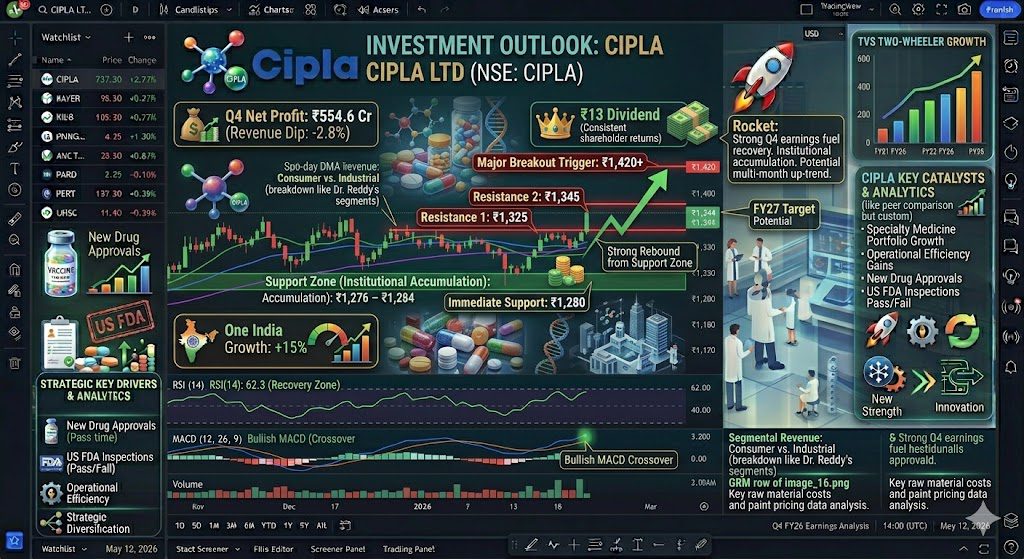
From a technical analysis perspective, Cipla stock is showing signs of stabilization after bouncing strongly from its 52-week low region. The stock has reclaimed several short-term moving averages, suggesting improving market sentiment after the earnings announcement.
Interestingly, the market reaction after results indicates that investors may have already priced in much of the bad news related to North America and impairments. Instead, traders appear to be focusing on domestic growth strength and recovery potential.
Key Support Levels
The most important technical support zone for Cipla currently lies between ₹1,276 and ₹1,284. This region is now acting as the primary short-term floor for the stock.
As long as the stock holds above this support area, technical traders believe the broader recovery structure remains intact. Institutional investors often monitor such support levels closely before increasing exposure to fundamentally strong businesses.
Resistance Levels
On the upside, immediate resistance is visible near ₹1,325 and ₹1,345. A decisive breakout above these levels could improve momentum significantly.
Technical analysts believe that a sustained breakout above ₹1,420 may trigger a much larger trend reversal and potentially open the path toward higher medium-term targets.
Valuation Perspective
One particularly interesting aspect of Cipla’s current setup is valuation. The stock is currently trading around 23–24 times earnings, which is below its three-year average valuation multiple of approximately 27.4x.
This suggests that despite the recent challenges, the stock may now offer relatively better long-term value compared to historical averages. For investors willing to tolerate short-term volatility, this valuation compression could become an attractive opportunity.
Brokerage Sentiment & Targets: FY27 Outlook
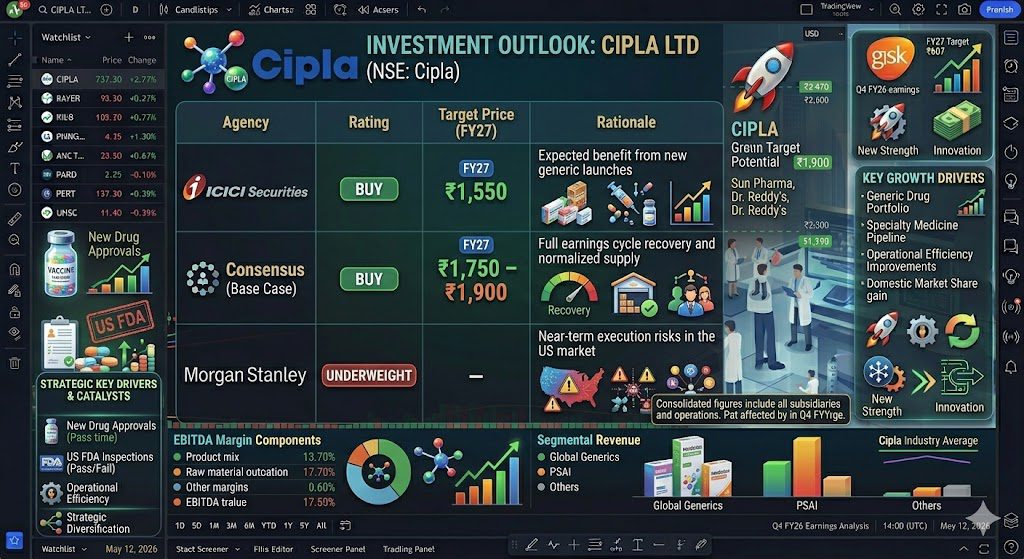
Brokerage firms remain cautiously optimistic on Cipla despite the weak Q4 FY26 profit numbers. Most analysts believe the domestic India business strength significantly offsets temporary international pressure.
ICICI Securities currently maintains a “Buy” rating on the stock with target estimates near ₹1,550. Analysts expect future growth support from new generic launches and improving operational recovery.
Broader market consensus estimates generally place Cipla’s FY27 target range between ₹1,750 and ₹1,900 under normalized earnings recovery scenarios. These projections assume gradual stabilization in North America and continued strong India growth.
However, not all brokerages remain fully bullish. Morgan Stanley currently maintains a more cautious “Underweight” view, highlighting execution risks in the US market and ongoing pricing pressure concerns.
The divergence in brokerage opinions reflects the current reality facing many Indian pharmaceutical companies—strong domestic demand combined with unpredictable global generic market conditions.
Management Guidance: The Path to Recovery
Record Annual Revenue
Despite quarterly volatility, management highlighted an important long-term achievement during the earnings announcement. Cipla’s total FY26 revenue reached ₹28,163 crore, making it the highest annual revenue in the company’s history.
This demonstrates that the overall business continues growing despite temporary quarterly disruptions. Strong India business momentum played a major role in helping the company achieve this milestone.
FY27 Strategic Focus
Management indicated that FY27 will focus heavily on strengthening flagship brands, expanding specialty healthcare products, and accelerating pipeline investments.
Another key priority remains resolving regulatory hurdles at US facilities. Regulatory clarity and smoother approvals are extremely important for restoring stronger growth momentum in international markets.
The company also plans to continue investing in complex generics and respiratory healthcare products, which remain core strategic growth areas.
The 30-Year Analyst Verdict
For Long-Term Investors
Cipla continues to remain one of the strongest “High-Yield Defensive” pharmaceutical companies in India. The headline profit decline looks alarming initially, but deeper analysis shows that the core India business remains exceptionally strong.
The 15% growth in the “One India” segment is arguably the most important number in the entire earnings report because it reflects the company’s long-term structural strength.
For investors with multi-year horizons, temporary US pricing pressure and impairment-related profit volatility are unlikely to permanently damage Cipla’s competitive position.
The company’s leadership in respiratory care, strong domestic brand portfolio, stable dividend policy, and improving valuation comfort continue supporting the long-term investment case.
For Active Traders
For traders, the current setup appears increasingly attractive from a risk-reward perspective. The stock has already absorbed much of the negative sentiment surrounding the weak quarterly profit numbers.
As long as support near ₹1,280 remains intact, the probability of a medium-term recovery toward ₹1,450 continues improving.
Short-term traders should continue monitoring broader pharmaceutical sector momentum, US FDA-related developments, and institutional activity carefully.
Conclusion & Engagement (CTA)
Cipla’s Q4 FY26 results perfectly demonstrate why experienced investors never rely only on headline profit numbers while evaluating pharmaceutical companies.
Yes, the company reported a sharp 55% decline in net profit. But underneath that temporary weakness lies a rapidly strengthening domestic healthcare franchise that continues gaining momentum.
The “One India” business crossing ₹3,000 crore in quarterly revenue is a major milestone that reinforces Cipla’s leadership position in the Indian pharmaceutical sector. Combined with stable dividends, attractive long-term valuation, and recovery potential in global markets, the company still remains a powerful long-term healthcare story.
For patient investors, the current volatility may eventually prove to be more of an opportunity than a threat.
Are you buying Cipla for the ₹13 dividend and strong India growth story, or waiting for clearer US FDA and North America recovery signals? Share your pharma investment strategy in the comments below.