
1. Introduction: The New Benchmark for PSU Banking
If you have observed the journey of Indian PSU banks over the past few decades, you would know that consistency and efficiency have often been their weakest links. However, the Bank of Maharashtra Q4 Results FY26 have completely changed that narrative. Announced on April 20, 2026, these results firmly establish MAHABANK as one of the most efficient and aggressive public sector banks in India today. The bank reported a remarkable standalone net profit of ₹2,014 crore, reflecting a strong 34.9% year-on-year growth. What makes this performance even more significant is that it comes at a time when several large banks are facing margin pressure and rising costs. Bank of Maharashtra is no longer just a mid-sized PSU bank; it is emerging as a benchmark for quality growth, backed by strong fundamentals and disciplined execution.
2. Q4 FY26 Financial Scorecard (The “Magic” Numbers)
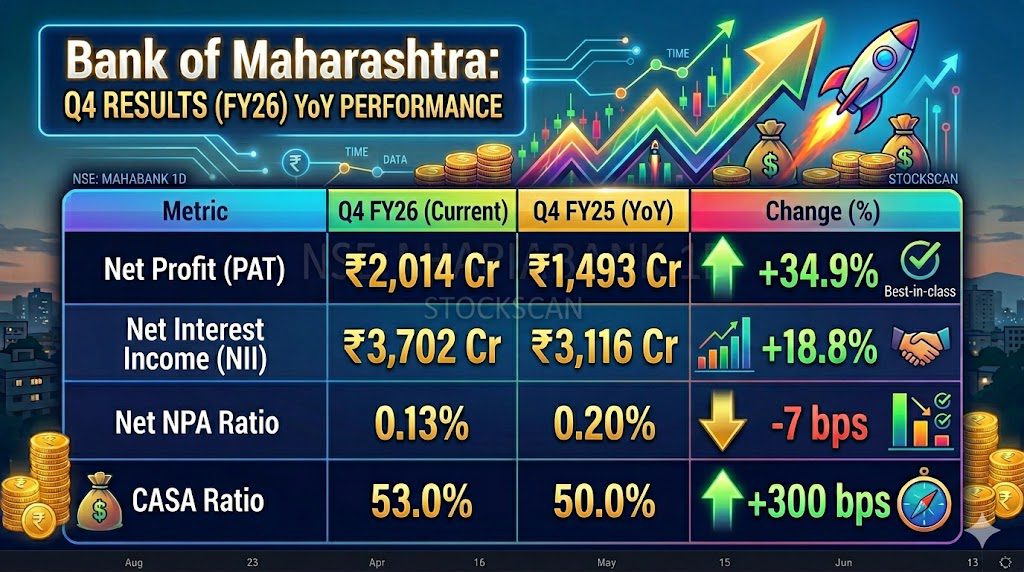
The financial performance of Bank of Maharashtra in Q4 FY26 reflects a well-balanced growth story supported by both income expansion and risk control. The bank’s net profit rose sharply to ₹2,014 crore from ₹1,493 crore in the same quarter last year, marking a 34.9% increase. Net Interest Income, which is the core earning component for any bank, grew by 18.8% to ₹3,702 crore, indicating strong lending activity and stable margins. The most impressive figure, however, is the Net NPA ratio, which declined to an extremely low 0.13% from 0.20%, showing exceptional asset quality improvement. Additionally, the CASA ratio improved significantly to 53%, highlighting the bank’s strong deposit franchise and ability to maintain low-cost funding. These numbers together demonstrate a rare combination of growth, efficiency, and stability.
3. Fundamental Analysis: The “Fortress” Balance Sheet
The real strength of Bank of Maharashtra lies not just in its growth numbers but in the quality of its balance sheet, which can be described as nothing short of a fortress. The bank has achieved a level of financial discipline that is uncommon among PSU banks, making it stand out in the current banking landscape.
Asset Quality: Practically Stress-Free
One of the most remarkable aspects of the Bank of Maharashtra Q4 Results FY26 is its asset quality. With a Net NPA ratio of just 0.13%, the bank is operating at a level that can be described as almost stress-free. In practical terms, this means the bank has negligible bad loans, significantly reducing the need for heavy provisioning and improving profitability. Such low NPAs are rarely seen in PSU banks, and this achievement reflects a disciplined lending approach and strong risk management practices.
Efficiency: Quietly Leading the Pack
Efficiency is another area where Bank of Maharashtra has quietly taken the lead. The bank reported a 16.9% growth in operating profit, indicating that it is not only growing its business but also managing its costs effectively. Its cost-to-income ratio is among the best in the PSU banking space, which means the bank is generating more income for every rupee spent. This operational efficiency is a key driver of its rising profitability and gives it a competitive edge over peers.
CASA Advantage: The Hidden Engine
The CASA ratio of 53% is one of the strongest pillars supporting the bank’s performance. CASA deposits, which include savings and current accounts, are low-cost funds that significantly reduce the bank’s cost of capital. A higher CASA ratio allows the bank to maintain better margins even when interest rates are high. In simple terms, more than half of the bank’s deposits come at a very low cost, giving it a structural advantage that many competitors struggle to achieve.
4. Technical Analysis: Breaking the ₹75 Barrier

From a technical perspective, Bank of Maharashtra’s stock is showing strong bullish momentum, supported by both price action and market sentiment. The stock has rallied around 21% in the last 30 days, indicating strong buying interest and a clear breakout from its previous consolidation phase.
Support & Resistance Levels
The stock currently has strong support around ₹69.90, with an immediate support level near ₹71.70, which acts as a pivot point for short-term movements. On the upside, the key resistance levels are ₹75.20 and the 52-week high of ₹77. A decisive breakout above ₹77 could trigger the next leg of the rally, potentially pushing the stock toward higher targets in the coming months.
Moving Averages and Trend Strength
The stock is trading well above its 200-day simple moving average, which is around ₹59.45, indicating a strong long-term uptrend. When a stock consistently trades above its long-term averages, it reflects sustained institutional interest and positive sentiment. This confirms that the current rally is not just short-term momentum but part of a broader bullish trend.
5. Shareholder Rewards & Management Guidance
Bank of Maharashtra’s strong financial performance is not only strengthening its balance sheet but also translating into meaningful rewards for shareholders. The bank has demonstrated a clear intent to share its profits while maintaining growth momentum.
The Dividend Surprise
The board has recommended a final dividend of ₹1.20 per share, which, when combined with the interim dividend of ₹1.00 already paid, brings the total dividend for FY26 to ₹2.20 per share. This represents a 22% yield on face value, making it an attractive proposition for income-focused investors. The consistent dividend payout also reflects the bank’s confidence in its financial stability.
Growth Guidance for FY27
Looking ahead, the management has guided for 18–20% business growth in FY27, with a strategic focus on the Maharashtra and Gujarat regions. These regions are among the fastest-growing economic hubs in India, offering strong opportunities for credit expansion. The bank’s targeted approach toward these high-growth corridors is expected to support its future performance.
6. Brokerage Reports & Analyst Targets
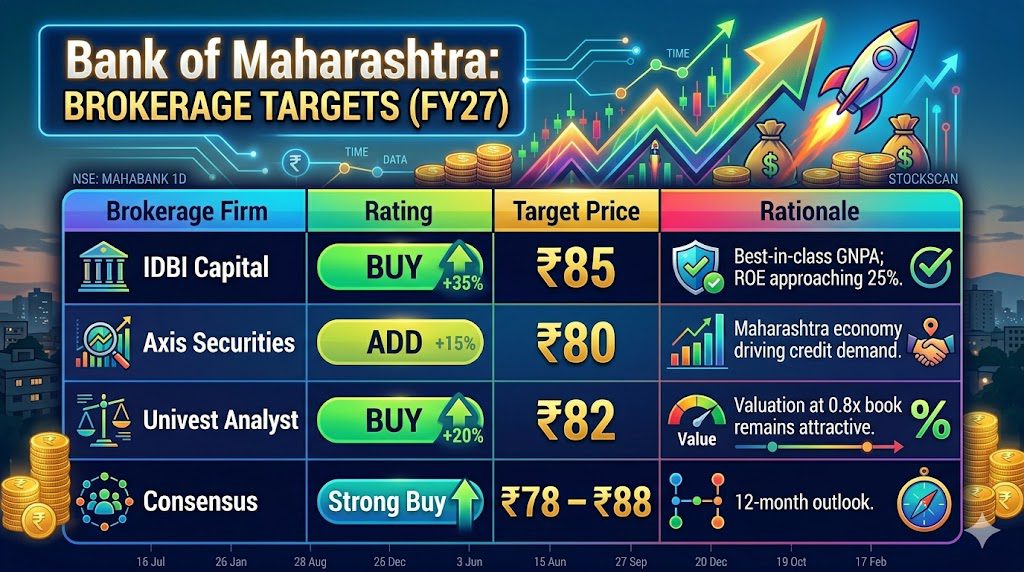
Brokerage firms have taken note of Bank of Maharashtra’s strong performance and are largely positive on the stock’s outlook. IDBI Capital has given a BUY rating with a target price of ₹85, highlighting the bank’s best-in-class asset quality and improving return ratios. Axis Securities has assigned an ADD rating with a target of ₹80, citing strong regional growth drivers. Univest analysts also remain bullish with a target of ₹82, noting that the stock is still attractively valued at around 0.8 times its book value. The overall consensus among analysts places the stock in the ₹78 to ₹88 range over the next 12 months, indicating strong upside potential.
7. The “30-Year” Analyst Verdict
After closely observing PSU banks for over three decades, it is clear that Bank of Maharashtra has reached a level of performance that sets it apart from its peers. It is no longer just another PSU bank but a leader in efficiency and profitability.
For the Investor
For long-term investors, Bank of Maharashtra offers a compelling combination of growth, stability, and income. With a return on equity of around 24%, the bank is now outperforming many private sector banks. Its strong fundamentals and consistent performance make it an ideal candidate for long-term portfolios.
For the Trader
For traders, the stock presents a slightly different opportunity. While it is currently trading near its highs, any short-term correction toward the ₹70 level could provide an attractive entry point for the next upward move. The overall trend remains bullish, but timing the entry could enhance returns.
The Risk Factor
Despite its strengths, the bank does face one key risk, which is its geographic concentration in Maharashtra. While this has been a growth driver so far, diversification across other regions will be important for sustaining long-term growth.
8. Conclusion & Engagement (CTA)
The Bank of Maharashtra Q4 Results FY26 clearly demonstrate that the bank has entered a new phase of growth and efficiency. With record profits, extremely low NPAs, a strong CASA ratio, and attractive dividends, it has positioned itself as the leading PSU bank in India. The journey from a regional player to a national-level performer is now well underway.
Are you holding MAHABANK for its ₹2.20 dividend, or are you aiming for the next price target of ₹90–₹100? Share your view in the comments and join the discussion.