
Introduction: The “Super SFB” Finds Its Footing
If you have followed the Indian banking sector closely over the last three decades, you’ll know that mergers in banking are never easy. They are complex, risky, and often take years to show results. That’s why the recent performance of AU Small Finance Bank stands out. The bank has just delivered its first full-quarter results after integrating Fincare Small Finance Bank—and the early signs are encouraging.
Think of a merger like a heart transplant. For months, the system struggles to adjust, and there’s always a risk of rejection. But once the integration settles, the combined entity can become stronger than ever. That’s exactly what we are beginning to see with AU Bank.
For Q4 FY26, the bank reported a net profit of ₹482 crore, marking a 14% year-on-year growth. This may not look explosive at first glance, but considering the integration costs and operational adjustments, it is a strong and stable outcome.
The market seems to agree. The stock is currently trading near ₹684 and has shown a relief rally of around 2.5% after the results. Investors are clearly gaining confidence that the worst of the merger-related uncertainty is now behind us.
Q4 FY26 Financial Scorecard: The Post-Merger Baseline
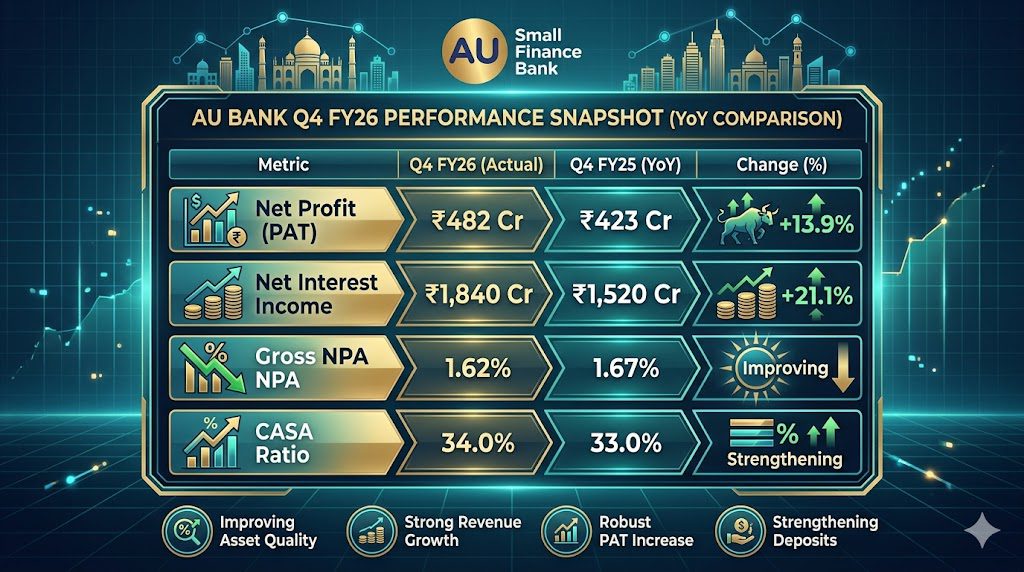
The Q4 FY26 financial performance of AU Small Finance Bank provides a clear baseline for the “new” merged entity. Net profit rose to ₹482 crore from ₹423 crore in the same quarter last year, reflecting a growth of 13.9%.
Net Interest Income (NII), which is the core earnings metric for any bank, jumped significantly to ₹1,840 crore from ₹1,520 crore. This 21.1% growth is largely driven by the expanded loan book following the Fincare merger.
Asset quality, a key concern during any merger, has shown improvement. Gross NPA declined slightly to 1.62% from 1.67%, indicating that the bank has managed to maintain control over its loan book despite the integration.
Another important metric is the CASA ratio, which improved to 34.0% from 33.0%. This indicates that the bank is successfully attracting low-cost deposits, which is crucial for maintaining profitability.
Overall, the numbers suggest that AU Bank is not just surviving the merger—it is stabilizing and preparing for the next phase of growth.
Fundamental Analysis: Synergies vs. Costs
The Merger Momentum: Growth Through Scale
The most significant impact of the Fincare merger is visible in the growth of Net Interest Income. The 21% jump in NII reflects the expanded scale of operations.
With a balance sheet now exceeding ₹1.1 lakh crore, AU Small Finance Bank is no longer “small” in the traditional sense. The merger has transformed it into a mid-sized bank with a strong retail focus.
This increased scale brings several advantages, including better diversification, improved cross-selling opportunities, and stronger market presence.
Cost-to-Income Ratio: Investment, Not Expense
One of the areas where investors might have concerns is the cost-to-income ratio, which remains elevated at around 62%. However, it is important to understand the context.
A large part of these costs is related to technology integration, branch alignment, and operational restructuring following the merger. These are one-time or short-term investments that will help the bank operate more efficiently in the future.
In simple terms, this is not wasteful spending—it is strategic investment. As these integration costs reduce over time, the bank is likely to see a significant improvement in profitability.
Microfinance (MFI) Resilience: Stability Returns
The microfinance segment, inherited from Fincare, was a key area of concern during FY25 due to industry-wide stress. However, the situation has improved significantly.
Collection efficiency has now reached 98.5%, indicating that borrowers are repaying their loans on time. This is a strong sign of stabilization in the MFI portfolio.
For investors, this is a critical development. A stable MFI book reduces credit risk and supports consistent earnings growth.
Technical Analysis: The Breakout from the Base
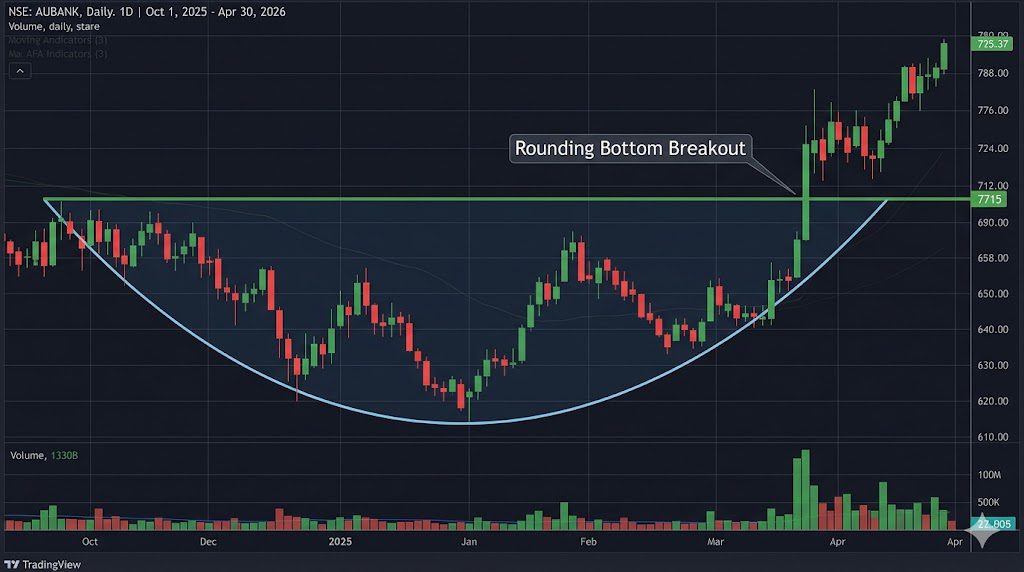
From a technical standpoint, AU Small Finance Bank’s stock is showing promising signs of a trend reversal. Over the last six months, the stock has formed a “rounding bottom” pattern, which is typically seen as a bullish indicator.
The ₹610–₹630 range has emerged as a strong support zone. This level has been tested multiple times, and each time, buyers have stepped in. This suggests that long-term investors are accumulating the stock at these levels.
On the upside, ₹715 is the key resistance level. This level coincides with the 200-day exponential moving average, making it an important technical barrier.
A breakout above ₹715, supported by strong volume, could trigger a sharp upward move toward ₹780 and potentially ₹800+.
Momentum indicators also support this view. The RSI is currently around 54, which indicates that the stock has moved out of the oversold zone and is entering a bullish phase.
Corporate Actions: The Confidence Signal
In a year marked by merger integration, AU Small Finance Bank’s decision to declare a dividend sends a strong message.
The board has recommended a final dividend of ₹1 per share. While the amount may seem modest, the timing is significant.
Declaring a dividend during an integration phase indicates that the management is confident about the bank’s cash flows and financial stability. It reassures investors that the business remains fundamentally strong.
Brokerage Sentiment & Targets: The Path to ₹820

Brokerage firms have largely maintained a positive outlook on AU Small Finance Bank, reflecting confidence in its growth potential.
Emkay Global Financial Services has taken a slightly conservative stance, giving an “ADD” rating with a target price of ₹725. The firm acknowledges the growth potential but remains cautious about credit costs.
On the other hand, more optimistic views come from global players like Bernstein, which has a bull-case target of ₹850. The firm highlights AU Bank’s strong liability franchise and retail-focused model as key strengths.
The overall consensus suggests a target range of ₹780 to ₹820, with potential upside if merger synergies are fully realized.
Management Guidance: The 25/25 Vision
Growth Ambition: Scaling Deposits and Advances
Under the leadership of Sanjay Agarwal, AU Small Finance Bank has set an ambitious target for FY27. The bank aims to achieve 25% growth in both deposits and advances.
This target reflects confidence in the bank’s ability to leverage its expanded network and customer base post-merger.
New Growth Segments: Credit Cards and Wealth
Another important area to watch is the bank’s expansion into high-margin segments such as credit cards and wealth management.
AU Bank is already one of the fastest-growing credit card issuers among mid-sized banks. This segment offers higher returns compared to traditional lending.
Similarly, wealth management services provide an opportunity to increase fee-based income, improving overall profitability.
The “30-Year” Analyst Verdict
For Long-Term Investors
AU Small Finance Bank can be seen as the “HDFC of the SFB space.” It combines a strong management track record with a disciplined approach to growth.
The merger-related challenges appear to be behind the bank. Going forward, the focus will shift to realizing synergies and improving efficiency.
For long-term investors, this represents an opportunity to invest in a bank that is transitioning into a larger, more diversified player.
For Traders
For traders, the stock currently offers a favorable setup. The key level to watch is ₹715.
A strong close above this level could trigger a breakout, making it a good opportunity for short-term trades. The upside potential toward ₹780 provides an attractive risk-reward ratio.
Conclusion: Ready for Re-Rating
AU Small Finance Bank’s Q4 FY26 results mark an important milestone in its journey. The bank has successfully navigated the complexities of a major merger and is now showing signs of stability and growth.
With improving asset quality, strong NII growth, and a clear management vision, the bank is well-positioned for the next phase.
What’s Your View? (CTA)
Do you think AU Small Finance Bank can achieve its ₹820 target, or do you prefer other mid-sized banks for stability? Share your thoughts and let’s discuss the best growth opportunities in the banking sector.