Introduction: The Listing Evolution
If you’ve followed India’s auto sector from the petrol-driven 90s to today’s electric revolution, you’ll know that very few companies manage to transition smoothly from hype to real financial performance. Ather Energy is now proving that it belongs to that rare category.
Exactly one year after its listing in May 2025, when it debuted at a price band of ₹304–₹321, Ather Energy is now trading close to its 52-week highs. That journey itself tells a powerful story—markets reward execution, not just narratives.
The Q4 FY26 results released on May 5, 2026, mark a critical turning point. The company has reduced its quarterly net loss by 57% to ₹100.23 crore, a sharp improvement from ₹234.36 crore last year. This is not just a number—it signals that the long-discussed path to profitability is finally becoming visible.
At a current price of around ₹922, with a market capitalization of approximately ₹35,209 crore, the stock is consolidating after a strong rally. Investors are now shifting their focus from “growth at any cost” to efficient, scalable growth, and Ather seems to be ticking those boxes.
Q4 & FY26 Financial Scorecard (Actual NSE Filing Data)
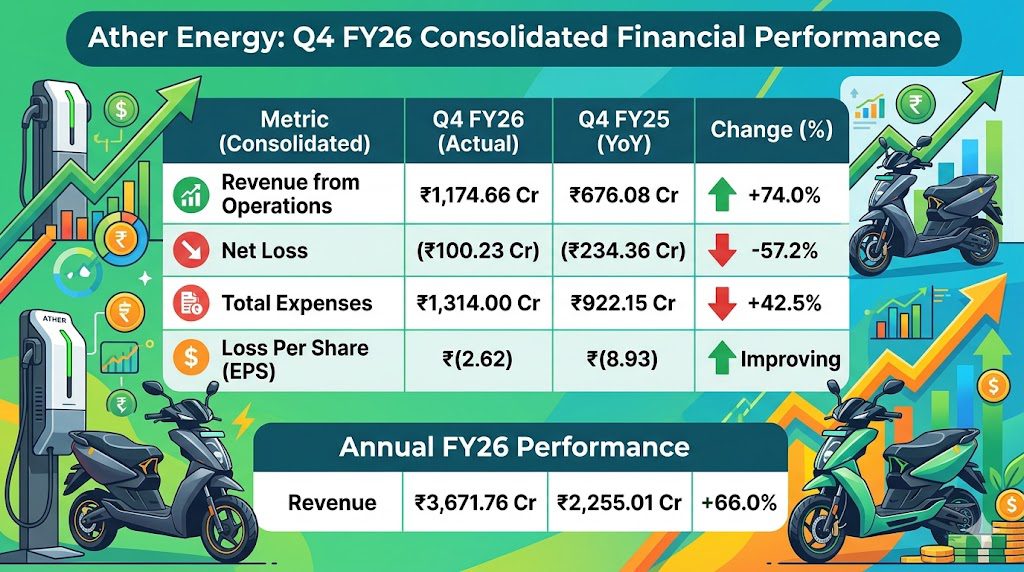
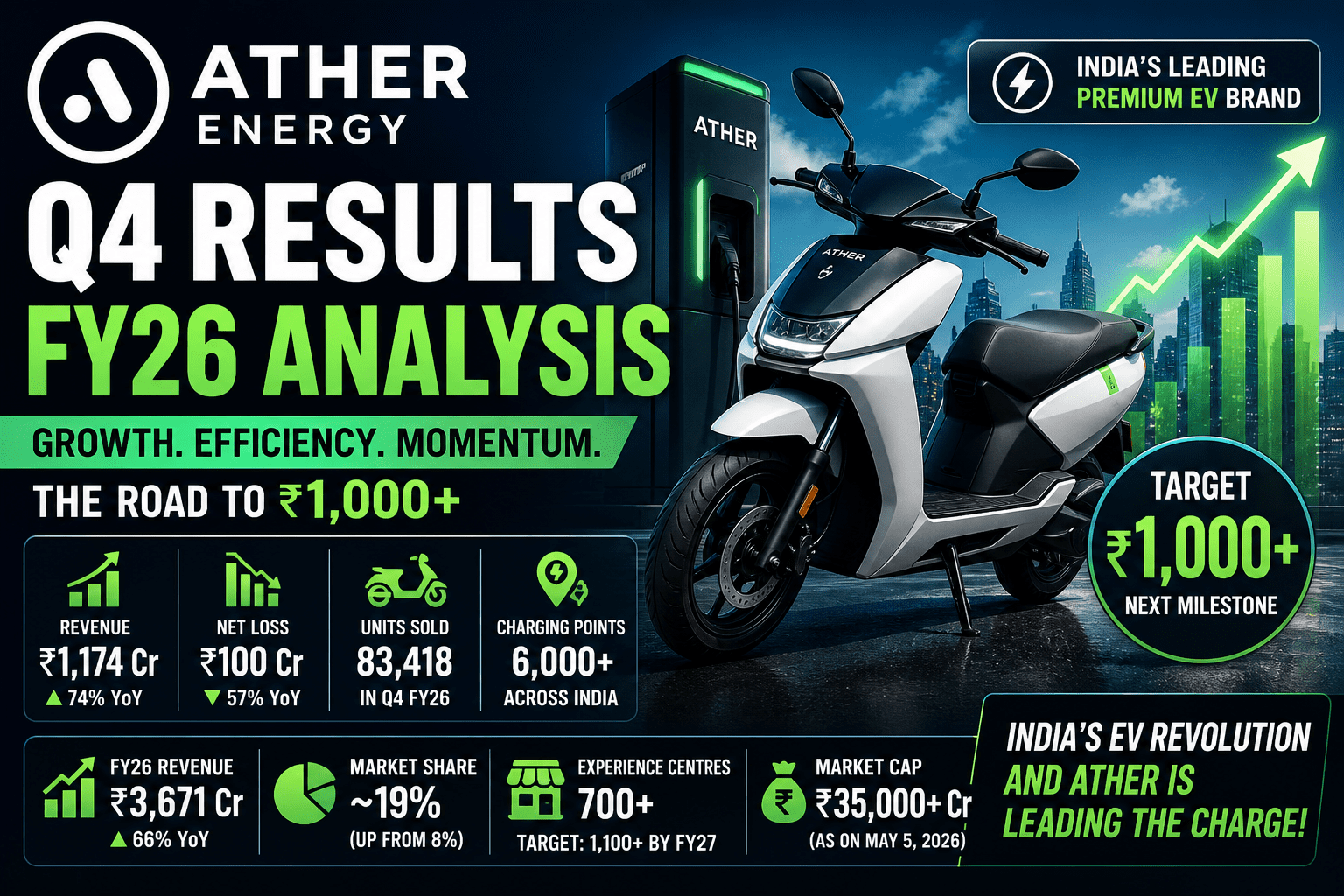
The financial performance of Ather Energy in Q4 FY26 reflects a company that is scaling rapidly while improving efficiency. Revenue from operations surged to ₹1,174.66 crore, compared to ₹676.08 crore in Q4 FY25, marking a strong 74% year-on-year growth.
At the same time, the company managed to reduce its net loss significantly to ₹100.23 crore, down from ₹234.36 crore, representing a 57.2% reduction. This combination of rising revenue and falling losses is a key indicator of improving unit economics.
Total expenses increased to ₹1,314 crore from ₹922.15 crore, but this rise is proportionately lower than revenue growth, indicating better cost management. Loss per share improved to ₹(2.62) from ₹(8.93), further reinforcing the trend of narrowing losses.
For the full financial year FY26, revenue reached ₹3,671.76 crore, compared to ₹2,255.01 crore in FY25, representing a 66% annual growth. These numbers confirm that Ather is not just growing—it is growing at scale while becoming more efficient.
Fundamental Analysis: The Efficiency Moat
Unit Economics
One of the biggest improvements in Ather’s business model is its unit economics. Adjusted gross margins have expanded to 24% in FY26, compared to 19% in FY25. This improvement reflects better cost control, improved pricing strategy, and higher operational efficiency.
This is crucial because EV companies globally have struggled with profitability. Ather’s ability to improve margins while expanding volumes places it ahead of many competitors in the Indian EV space.
Sales Momentum
Ather’s sales numbers tell a powerful story of demand. The company sold 83,418 vehicles in Q4 alone, taking the annual total to 262,942 units, which represents a 69% year-on-year growth.
This growth is not just volume-driven—it also reflects strong brand positioning in the premium EV segment. Unlike mass-market players, Ather has focused on quality and performance, which is now translating into consistent demand.
Network Expansion
The company has aggressively expanded its retail and charging infrastructure. It now operates 700+ experience centres and over 6,000 charging points across India.
This expansion is critical because infrastructure remains one of the biggest barriers to EV adoption. By building its own ecosystem, Ather is reducing this barrier and strengthening its competitive position.
Cash Flow Strength
Another major milestone for Ather is turning operating cash flow positive at ₹31.89 crore for FY26. This has been achieved using IPO proceeds of ₹2,626 crore, which were strategically deployed to scale operations and improve efficiency.
Positive cash flow is a key signal that the company is moving closer to sustainable profitability, which is often the biggest concern for investors in EV startups.
Technical Analysis: Riding the 52-Week Highs
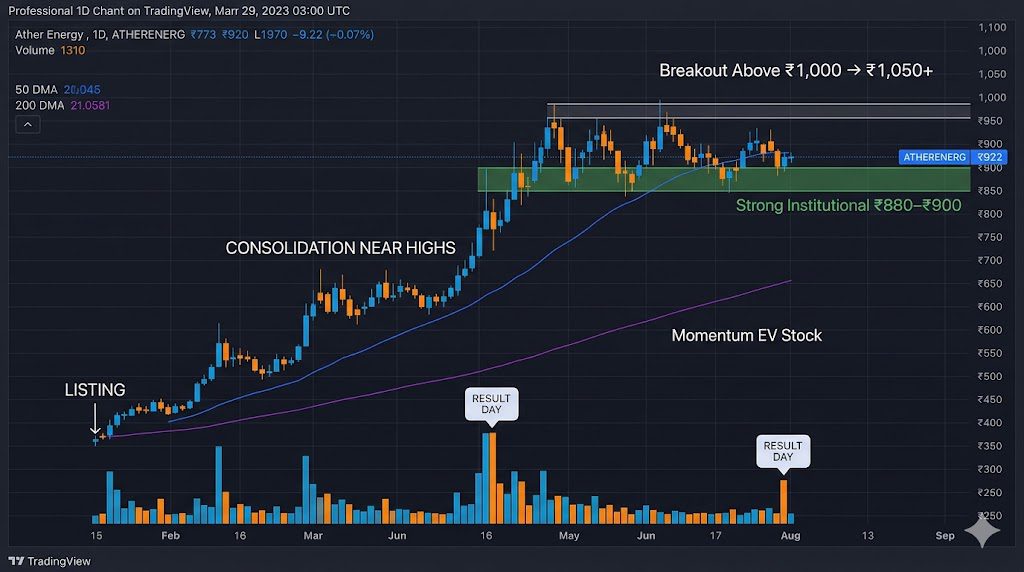
From a technical standpoint, Ather Energy is currently in a strong uptrend. Since its listing, the stock has delivered over 24% returns in 2026, reflecting strong investor confidence.
The ₹900 level acts as a major support, where institutional buying has been consistently visible. This level is crucial for maintaining the current bullish structure.
On the upside, the 52-week high of ₹971.15 remains the key resistance. A breakout above this level could push the stock toward the ₹1,000 milestone, which is both a psychological and technical target.
The stock is currently in a consolidation phase near its highs, which is typically a sign of strength. For traders, this represents a classic “buy on dips” opportunity within a broader uptrend.
Management Guidance: The 1,100 Store Goal
Expansion Target
Ather Energy has set an ambitious goal of expanding its retail network from 700 to over 1,100 stores by March 2027. This expansion will focus on Tier-2 and emerging urban markets such as Indore and Nashik.
This strategy is important because EV adoption is now moving beyond metro cities into smaller towns, where demand is rising rapidly.
Market Share
The company has already doubled its market share from 8% to around 19% in just 18 months. It is now targeting a 25% market share by FY27, which would place it among the top EV players in India.
This growth is being driven by a combination of strong product positioning, expanding distribution, and increasing consumer acceptance of electric mobility.
The EL Platform
Ather is also working on a new “EL platform,” expected to be launched in mid-FY27. This platform is designed to improve production efficiency and scalability, which will further strengthen margins and profitability.
Brokerage Sentiment & Targets (The Path to ₹1,000)
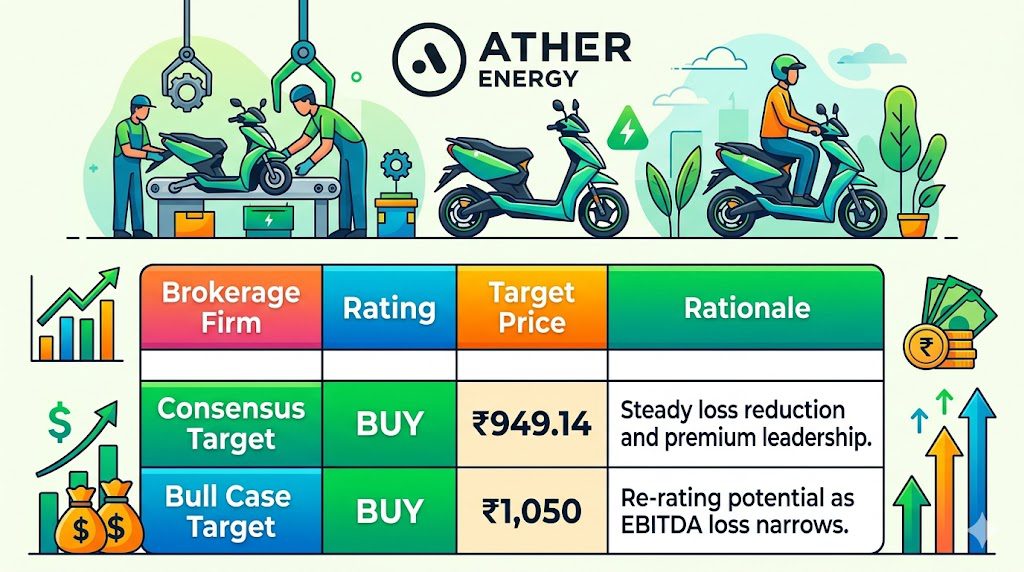
Brokerage sentiment around Ather Energy is turning increasingly positive as the company demonstrates consistent improvement in financial metrics.
The consensus target stands at around ₹949, reflecting steady progress in loss reduction and revenue growth. In a bullish scenario, targets go up to ₹1,050, driven by the expectation of further margin expansion and profitability improvements.
These targets suggest that the market is beginning to price in Ather’s transition from a loss-making startup to a scalable, profitable business.
The “30-Year” Analyst Verdict
From a long-term perspective, Ather Energy has evolved from a speculative EV startup into a quality growth company. The sharp reduction in losses, strong revenue growth, and improving cash flows indicate that the business model is becoming sustainable.
Annual losses have already narrowed to ₹517 crore from ₹812 crore, and if the current trajectory continues, the company could achieve net profitability in FY27.
For investors, this represents an opportunity to participate in India’s EV growth story through a company that is showing real financial discipline. For traders, the stock offers a strong momentum play, with clear support and resistance levels guiding short-term strategies.
Conclusion & Engagement (CTA)
Ather Energy’s Q4 FY26 performance is a clear validation of its strategy. With a 74% jump in revenue and a 57% reduction in losses, the company has demonstrated that premium positioning and operational efficiency can coexist.
The EV market in India is becoming increasingly competitive, but Ather’s focus on quality, infrastructure, and innovation gives it a strong edge.
The big question now is this—are you investing in Ather for its ₹1,000 milestone potential, or are you concerned about rising competition from established players like TVS and Bajaj?
Let’s discuss your view, because in the rapidly evolving EV space, identifying the right leader early can make all the difference.