Introduction: The Efficiency Giant
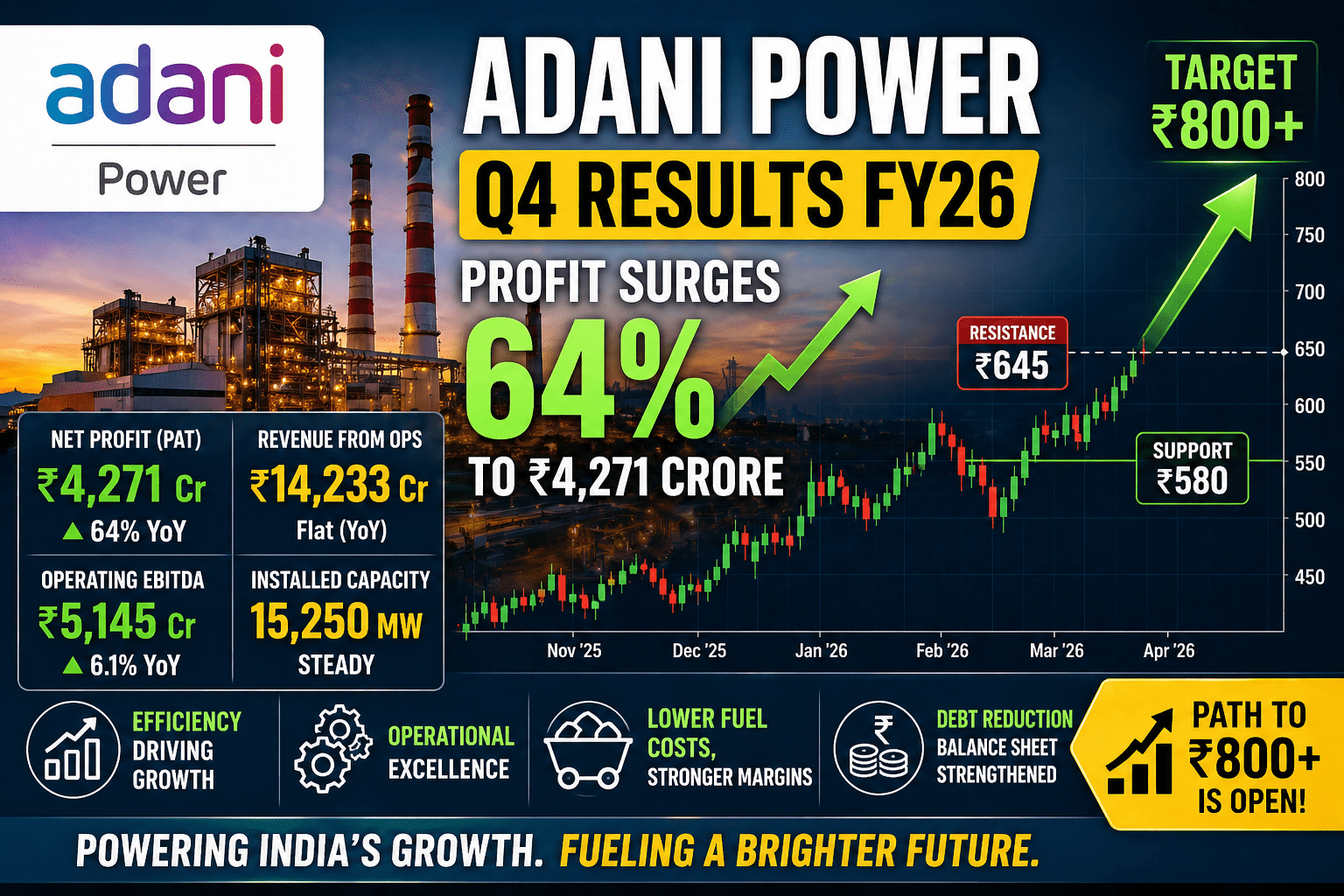
In a year when India’s power demand touched record highs, Adani Power has delivered a performance that stands out not because of expansion, but because of efficiency. Traditionally, power companies grow by adding capacity, but Adani Power has shown that optimizing existing assets can be just as powerful. The Q4 FY26 results clearly reflect this shift. Despite revenue remaining flat at ₹14,233 crore, the company reported a massive 64% jump in net profit to ₹4,271 crore. This indicates that the company is extracting more value from the same level of operations. Currently trading near ₹605, the stock is consolidating as investors evaluate whether this profit surge is sustainable or largely driven by one-off factors.
Q4 FY26 Financial Scorecard: The Margin Story
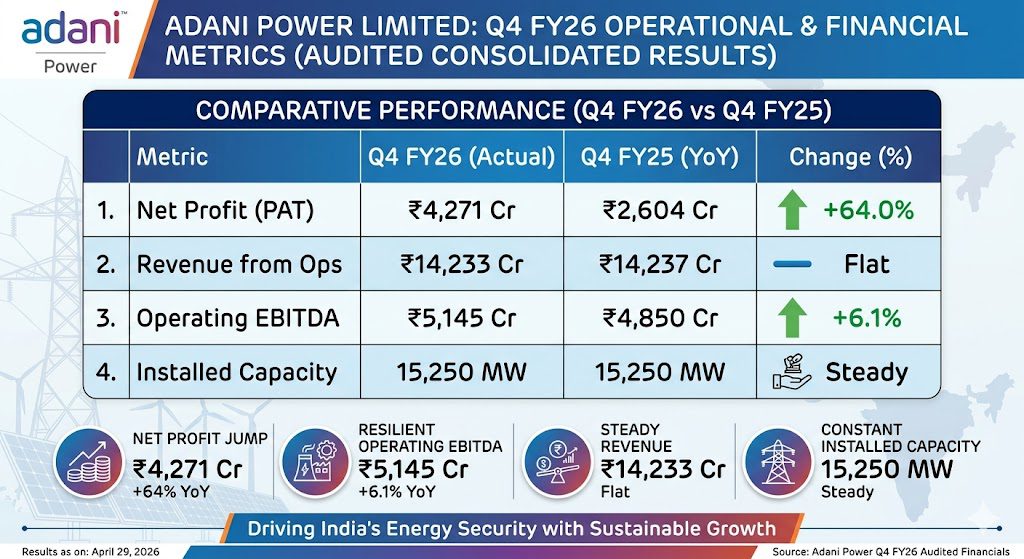
The financial performance for Q4 FY26 highlights a clear margin-driven growth story. Net profit increased sharply to ₹4,271 crore from ₹2,604 crore in the same quarter last year, reflecting strong bottom-line expansion. However, revenue remained almost unchanged at ₹14,233 crore compared to ₹14,237 crore a year ago. This divergence between profit and revenue growth indicates improved operational efficiency and cost management. Operating EBITDA rose moderately by 6.1% to ₹5,145 crore, suggesting that the core business is stable. Meanwhile, installed capacity remained constant at 15,250 MW, reinforcing the idea that this growth is not coming from expansion but from better utilization and financial optimization.
Fundamental Analysis: Decoding the Profit Surge
The “Other Income” Factor
A significant portion of the profit growth in Q4 FY26 can be attributed to higher “other income,” which includes prior-period adjustments and late payment surcharges from distribution companies. These factors have boosted the bottom line without contributing to top-line growth. While such income streams may not be consistent every quarter, they highlight the company’s ability to extract additional value from its operations. Investors, however, should be cautious in assuming that this level of profit growth will continue without similar support in future quarters.
Operational Excellence: Maximizing Plant Efficiency
Beyond accounting adjustments, Adani Power has made notable improvements in operational efficiency. The company has optimized its Plant Load Factor (PLF), ensuring that its plants run at higher efficiency levels during peak demand periods. Key facilities like Mundra and Godda are being utilized strategically to maximize output when electricity demand is highest. This targeted approach to generation allows the company to improve profitability without increasing capacity, making it a more efficient operator in a highly competitive sector.
Fuel Security: Shielding Margins from Global Volatility
Another critical factor supporting margins is the company’s shift toward domestic coal sourcing. Global coal prices have been volatile due to geopolitical tensions, particularly in West Asia. By reducing reliance on imported coal and increasing domestic linkages, Adani Power has protected itself from external price shocks. This strategy not only stabilizes costs but also improves long-term sustainability, especially in an environment where energy security is becoming increasingly important.
Technical Analysis: The ₹580 Support Zone
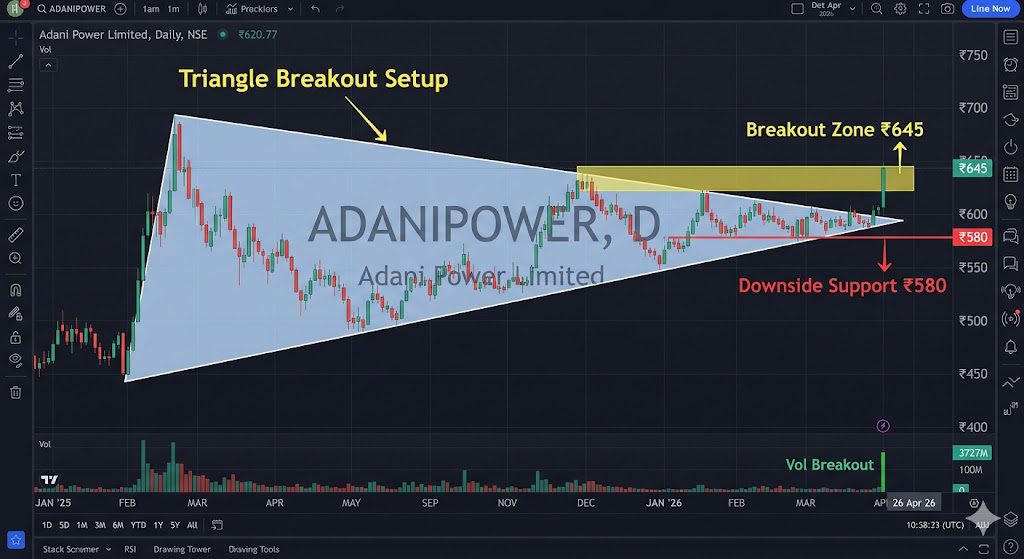
From a technical perspective, the stock is currently forming a symmetrical triangle pattern on the weekly chart, which often precedes a major breakout. The ₹580 level has emerged as a strong support zone, acting as a floor for the stock during recent corrections. As long as this level holds, the broader bullish trend remains intact. On the upside, ₹645 is the key resistance level. A decisive breakout above this level, supported by strong trading volumes, could trigger a rally toward ₹750 and beyond. The RSI is currently around 52, indicating neutral momentum and suggesting that the stock is well-positioned for a directional move.
Management Guidance & FY27 Outlook
Capacity Expansion: Preparing for Future Demand
While the current performance is driven by efficiency, the company is also preparing for future growth through capacity expansion. Brownfield projects at Mahan and Raigarh are expected to increase total capacity to 21,110 MW by 2028-29. This ensures that Adani Power is well-positioned to meet rising electricity demand in the coming years, particularly as India continues to industrialize and urbanize.
Debt Reduction: Strengthening the Balance Sheet
The company has also made significant progress in reducing its debt burden. Deleveraging has improved its financial stability and enhanced investor confidence. A stronger balance sheet allows the company to manage interest costs more effectively and provides flexibility for future investments. This focus on financial discipline is a key factor behind the improving profitability metrics.
Green Transition: Supporting Renewable Growth
Although primarily a thermal power producer, Adani Power plays a crucial role in supporting renewable energy integration. Renewable sources like solar and wind are intermittent, and thermal power provides the base load required to stabilize the grid. As India increases its renewable energy capacity, the importance of reliable thermal backup will continue to grow, ensuring that Adani Power remains relevant in the evolving energy landscape.
Brokerage Sentiment & Targets: The Path to ₹800
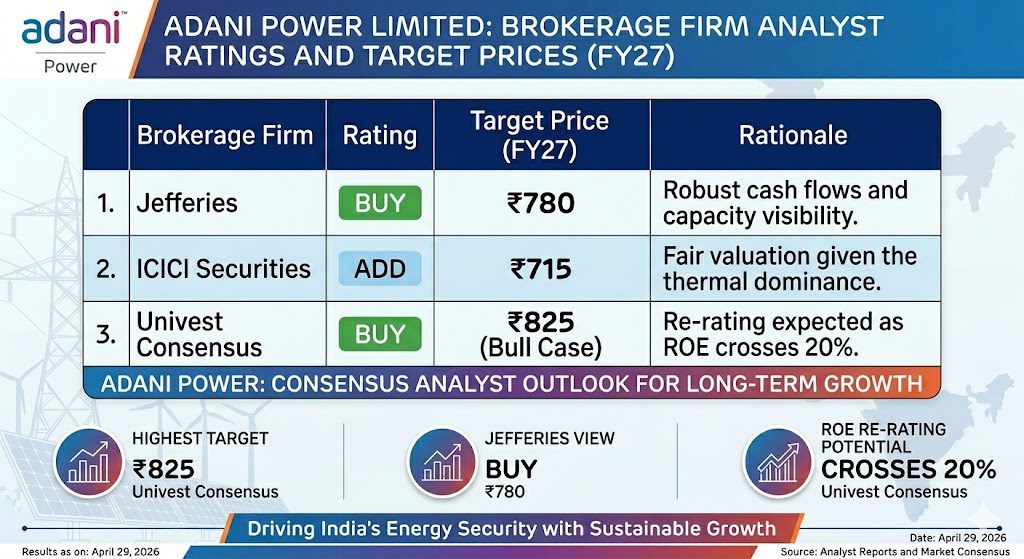
Brokerage firms have largely maintained a positive outlook on the stock. Jefferies has assigned a “BUY” rating with a target price of ₹780, citing strong cash flows and visibility of future capacity expansion. ICICI Securities has taken a more conservative stance with a target of ₹715, reflecting cautious optimism. Overall, consensus estimates suggest a potential upside toward ₹780–₹825, with further re-rating possible if the company continues to deliver strong returns on equity.
The “30-Year” Analyst Verdict
For Long-Term Investors
For long-term investors, Adani Power represents a compelling opportunity to participate in India’s growing energy demand. The company’s ability to generate strong cash flows, combined with improving operational efficiency and a strengthening balance sheet, makes it a solid long-term play. While the lack of consistent dividends may be a concern for income-focused investors, the potential for capital appreciation remains significant.
For Traders
For short-term traders, the current consolidation phase offers an attractive entry point. Accumulating the stock in the ₹580–₹595 range provides a favorable risk-reward setup. With a stop-loss at ₹555 and a target of ₹720, traders can benefit from a potential breakout while managing downside risk effectively.
Conclusion: Efficiency is the New Growth
Adani Power’s Q4 FY26 performance highlights a fundamental shift in strategy. Instead of relying solely on expansion, the company is focusing on efficiency, cost control, and smart utilization of assets. This approach is delivering strong results, even in a challenging environment where revenue growth is limited. The 64% jump in profit is a clear indication that efficiency can be as powerful as expansion in driving growth.
What’s Your View? (CTA)
Do you see Adani Power as a strong long-term play driven by efficiency, or are you concerned about the flat revenue trend? Share your perspective and let’s discuss where the stock could head next in India’s evolving power sector. 🚀