Introduction: The Unsinkable Logistics Giant
If you’ve followed India’s infrastructure journey over the last 30 years, you’ve seen a remarkable shift. There was a time when Mumbai was considered the heart of India’s trade activity. Today, that center of gravity has clearly moved—and Adani Ports and Special Economic Zone has played a massive role in that transformation.
In 1995, the biggest concern for exporters was port congestion. Ships waited for days, sometimes weeks. Fast forward to 2026, and the conversation has completely changed. We are now talking about scale, efficiency, and global competitiveness. Adani Ports is no longer just a port operator—it has become the backbone of India’s export-import (EXIM) ecosystem.
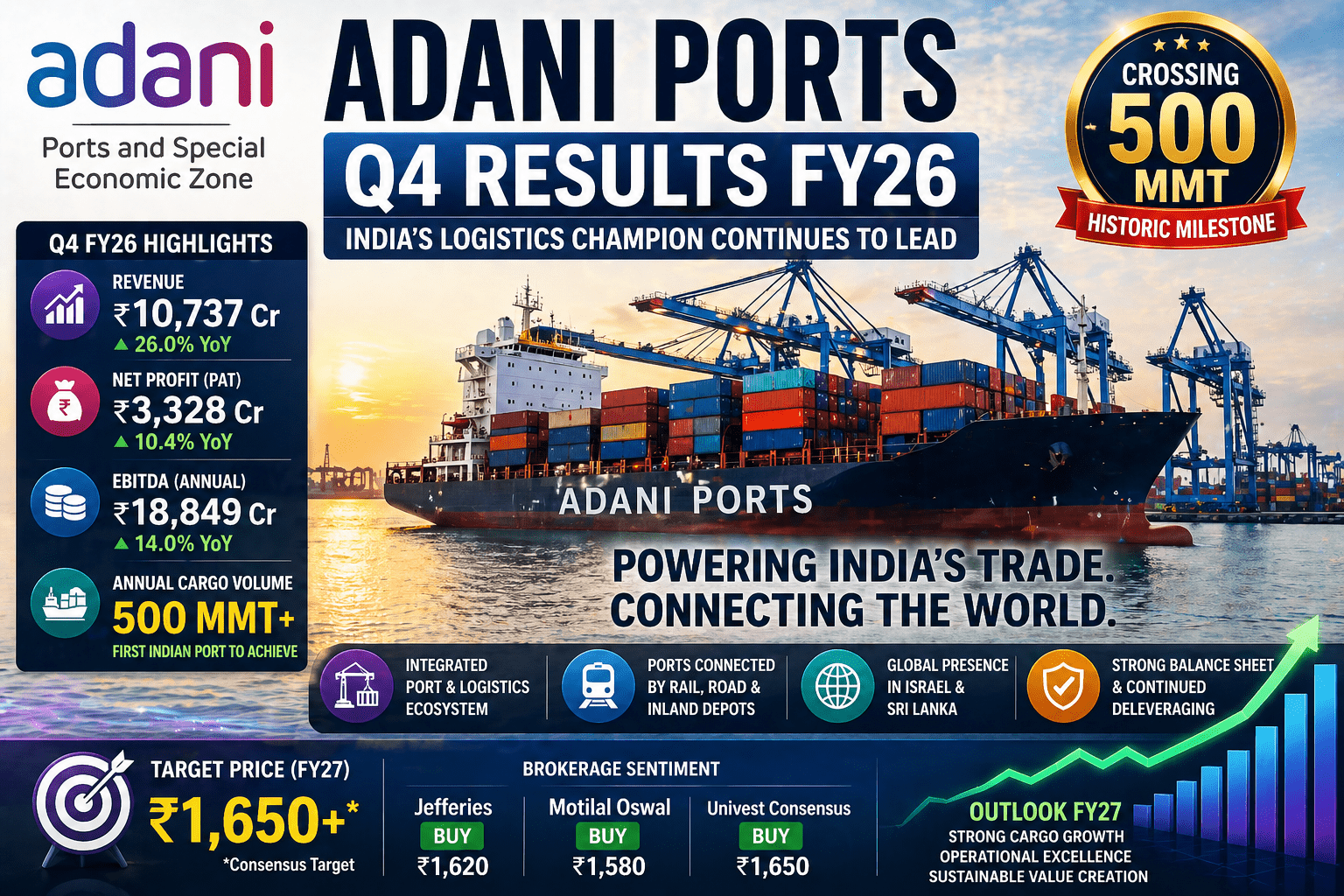
The Q4 FY26 results, released on April 30, 2026, reinforce this dominance. The company reported a net profit of ₹3,328 crore, marking a 10.4% year-on-year growth. More importantly, revenue surged 26% to ₹10,737 crore, showing strong operating momentum.
But the real headline is not just profit—it’s scale. Adani Ports has crossed the historic milestone of handling over 500 million metric tonnes (MMT) of cargo in a single year. That’s not just a number; it’s a signal that India’s logistics infrastructure has entered a new league.
At a time when global trade is facing geopolitical uncertainties, this achievement provides a strong foundation for long-term growth.
Q4 FY26 Financial Scorecard: The Power of Scale
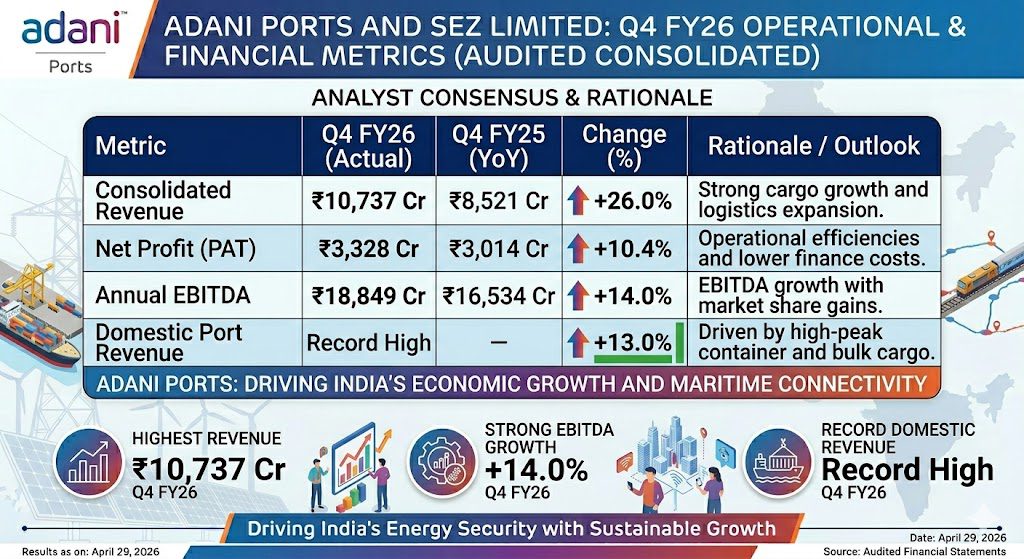
The Q4 FY26 financial performance highlights how scale is translating into profitability. The company’s consolidated revenue grew sharply to ₹10,737 crore from ₹8,521 crore in the same quarter last year. This 26% growth reflects both higher cargo volumes and improved pricing power.
Net profit increased to ₹3,328 crore from ₹3,014 crore, delivering a steady 10.4% growth. While profit growth is lower than revenue growth, it reflects a balanced approach where the company continues to invest in expansion while maintaining profitability.
On a full-year basis, EBITDA reached ₹18,849 crore, up 14% from ₹16,534 crore. This indicates strong operating efficiency and the ability to generate consistent cash flows.
Domestic port revenue also hit a record high, growing around 13%. This shows that the core business remains strong even as the company expands globally.
What stands out here is not just growth, but the quality of growth—driven by volume, efficiency, and integration.
Fundamental Analysis: The “500 MMT” Moat
Cargo Dominance: Scale That Creates Power
Crossing the 500 MMT cargo milestone is a defining moment for Adani Ports. This scale gives the company a significant competitive advantage. Larger volumes mean better utilization of assets, lower costs per unit, and stronger bargaining power with customers.
In simple terms, the bigger the port network, the more efficient it becomes. This creates a “moat” that is difficult for competitors to replicate.
Integrated Logistics: Beyond Just Ports
One of the most important aspects of Adani Ports’ strategy is its transformation into an integrated logistics player. The company is no longer limited to port operations—it now connects ports to inland destinations through its rail and logistics network.
This integration allows Adani Ports to control the entire supply chain, from ship to warehouse. For customers, this means faster delivery, lower costs, and better reliability.
For the company, it means higher margins and stronger customer relationships.
International Footprint: A Global Hedge
Adani Ports has also expanded its presence internationally, with key assets in places like Haifa (Israel) and Colombo (Sri Lanka). These assets are not just for diversification—they provide a natural hedge against domestic economic cycles.
If global trade flows shift, the company is already positioned to benefit from multiple geographies. This global footprint strengthens its long-term growth prospects.
Technical Analysis: Navigating the Multi-Year Highs
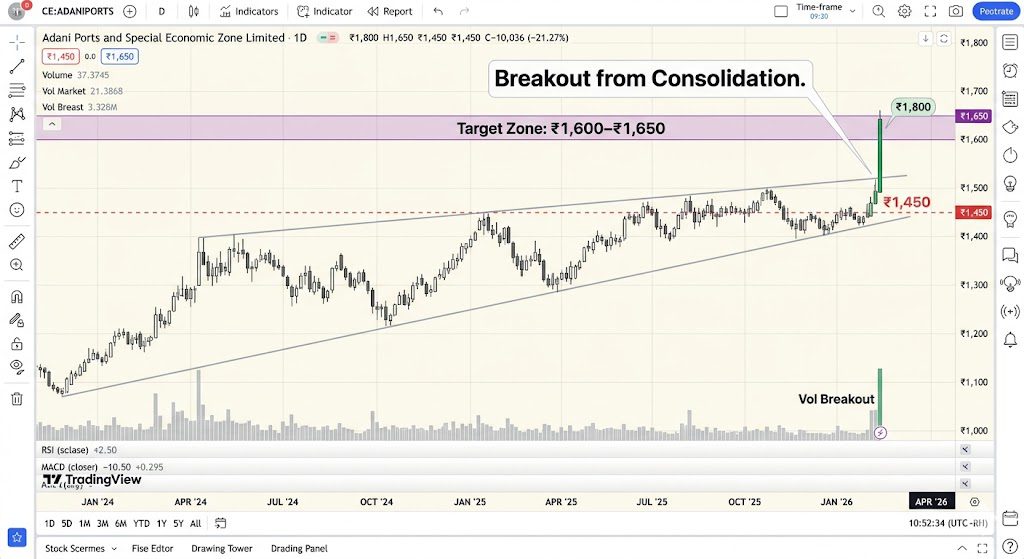
From a technical perspective, Adani Ports is showing a strong but controlled uptrend. The stock has been trading within a rising wedge pattern on the weekly charts, indicating gradual accumulation.
Recently, it found support near its 50-day exponential moving average, which suggests that buyers are stepping in at lower levels.
The ₹1,280–₹1,320 range has emerged as a strong support zone. This is where institutional investors are likely accumulating the stock.
On the upside, ₹1,450 is the immediate resistance level. A breakout above this level could trigger a rally toward ₹1,600 and potentially ₹1,650.
The RSI is currently around 54, which is a neutral zone. This means the stock is not overbought and still has room for further upside.
For traders, this setup offers a favorable risk-reward ratio.
Management Guidance: The Vision for FY27
Efficiency Gains: Unlocking Hidden Potential
Management is focusing on improving efficiency across its network. One key strategy is leveraging the synergy between East Coast and West Coast ports.
Currently, some eastern ports are underutilized. By diverting more container traffic to these ports, the company can increase overall efficiency and reduce congestion at western ports.
Deleveraging: Strengthening the Balance Sheet
Another important focus area is reducing debt. The company has been steadily improving its Net Debt to EBITDA ratio, which reflects disciplined capital management.
This is crucial because infrastructure companies often carry high debt. By reducing leverage, Adani Ports is making its business more resilient and attractive to investors.
Brokerage Sentiment & Targets: The Path to ₹1,650
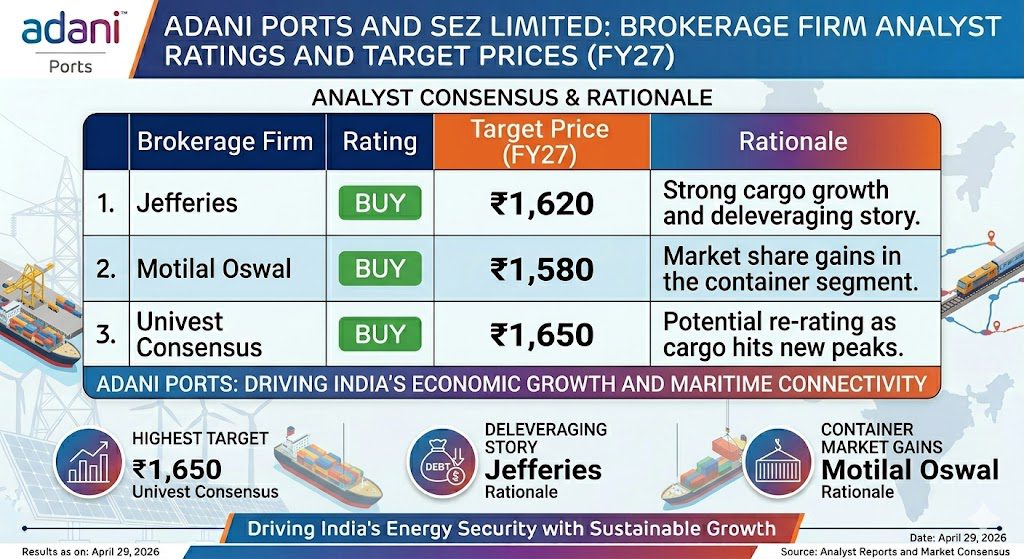
Brokerage firms remain bullish on Adani Ports.
Jefferies has given a “BUY” rating with a target price of ₹1,620, citing strong cargo growth and improving balance sheet.
Motilal Oswal Financial Services has set a target of ₹1,580, highlighting market share gains in container handling.
The broader consensus suggests a target range of ₹1,600 to ₹1,650, indicating significant upside potential from current levels.
The “30-Year” Analyst Verdict
For Long-Term Investors: A Portfolio Anchor
Adani Ports is not just a stock—it’s a proxy for India’s economic growth. As trade volumes increase, the company benefits directly.
For long-term investors, this makes it a strong “portfolio anchor”—a stock that provides stability and steady growth.
For Traders: Buy on Dips Strategy
For traders, the strategy is straightforward. The stock is in an uptrend, and dips toward support levels can be used as buying opportunities.
With clear support and resistance levels, the risk-reward setup remains attractive.
Conclusion: Sailing in High-Growth Waters
Adani Ports has delivered a performance that reflects both strength and vision. A 500 MMT cargo milestone, double-digit profit growth, and a strong balance sheet all point toward a company that is leading India’s logistics revolution.
In a world where trade routes are constantly shifting, Adani Ports has positioned itself as a stable and dominant player.
What’s Your View? (CTA)
Are you investing in Adani Ports for its long-term growth story, or are you concerned about global trade uncertainties? Share your thoughts and let’s discuss where India’s logistics sector is headed next. 🚢📈