1. Powerful Introduction
In the sweltering heat of late May 2026, Indian Home Minister Amit Shah stood in Bikaner, Rajasthan, and delivered a stark geopolitical directive: India’s borders must become technologically impenetrable. Within weeks, similar directives echoed across the marshlands of Gujarat’s Sir Creek and the riverine stretches of West Bengal. The Ministry of Home Affairs (MHA) had accelerated the rollout of a multi-billion dollar “Smart Border” security framework.
But in the corridors of New Delhi, political analysts and opposition leaders are asking a critical question: Is this sudden, desperate rush strictly a matter of national security, or is it the infrastructural precursor to the deeply controversial National Register of Citizens (NRC)?
For international observers, India’s border management is not merely a domestic administrative issue. The subcontinent sits at the nexus of South Asian stability. With political volatility brewing in neighboring Bangladesh, an ongoing hybrid proxy war with Pakistan, and the looming shadow of Chinese influence in the Indian Ocean, India’s borders are the fault lines of global geopolitics.
Understanding the “Smart Border” initiative requires untangling a complex web of advanced Artificial Intelligence (AI), electoral arithmetic, constitutional maneuvering, and the bitter political turf wars in border states like West Bengal. Is the Indian government fortifying the nation against external threats, or preparing for an unprecedented domestic demographic audit?
2. Executive Summary
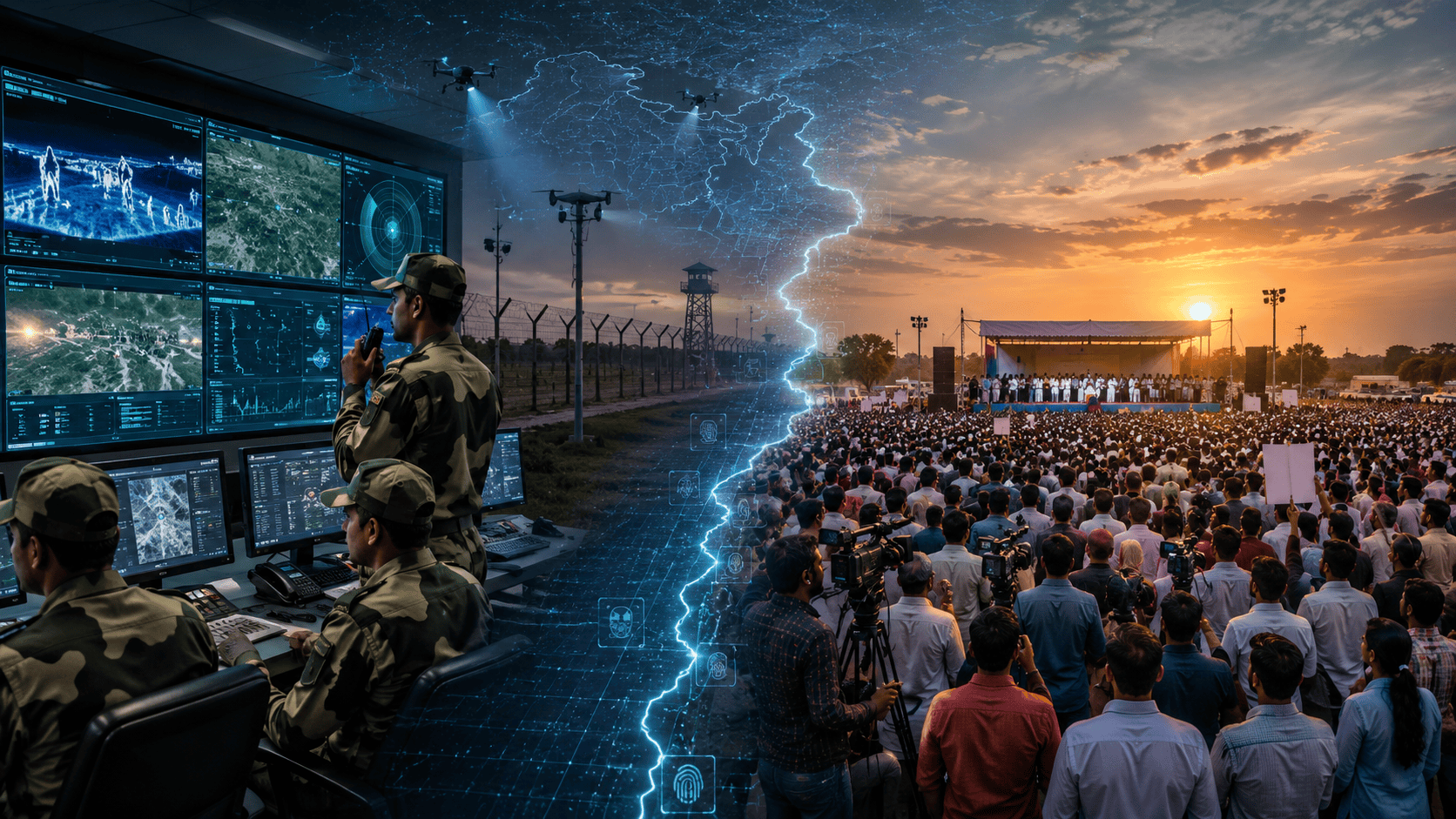
The Initiative: The “Smart Border” is a high-tech overhaul of India’s porous boundaries, utilizing AI, thermal imaging, ground surveillance radars (GSR), underground seismic sensors, and drone technology to create a 24/7 unbreachable virtual wall.
The Catalyst: The 2026 acceleration is driven by fears of regional instability, particularly the potential political upheaval in Bangladesh and ongoing infiltration networks through West Bengal (Malda, Murshidabad) and Gujarat (Sir Creek, Harami Nala).
The Architecture: It operates on a “Quadrangular Security Grid” uniting the Border Security Force (BSF), the Indian Army, State Police, and Civil Administration under a centralized command center.
The Political Context: The ruling NDA government is simultaneously consolidating parliamentary power, specifically targeting the opposition Trinamool Congress (TMC) in West Bengal, raising suspicions of impending, large-scale legislative action.
The NRC Connection: Critics argue the Smart Border is step one of a sequence: seal the borders to prevent deported individuals from returning, implement the Uniform Civil Code (UCC) and Citizenship Amendment Act (CAA), and finally roll out the NRC to identify non-citizens.
Geopolitical Risks: Instability in Dhaka—fueled by the potential return of exiled leaders and Chinese strategic investments at Mongla Port—poses a severe refugee crisis threat reminiscent of 1971.
Economic Strategy: Border fortification is also tied to combating narco-terrorism and smuggling, aligning with India’s broader economic resilience goals, including energy independence (ethanol blending) amidst global de-dollarization.
Global Parallels: The project mirrors “virtual wall” concepts in the United States and Israel, though applied to vastly more complex and varied terrains.
Key Takeaway: The Smart Border is simultaneously a legitimate national security upgrade against modern hybrid warfare and a highly politicized infrastructural project intrinsically linked to India’s domestic citizenship debates.
3. Background: The Geography of Vulnerability
To understand the urgency of 2026, one must examine the staggering complexity of India’s borders. India shares a 4,096 km border with Bangladesh and a 3,323 km border with Pakistan.
Historically, these borders have defied conventional fencing. In the West, the Rann of Kutch presents shifting salt marshes. The infamous “Harami Nala” (Rogue Channel) is a 25-kilometer tidal estuary near Sir Creek that flows between India and Pakistan. Its treacherous, marshy terrain makes physical fencing impossible, providing a traditional blind spot for smugglers, terrorists, and illegal fishing syndicates.
In the East, the Indo-Bangladesh border is even more formidable. Intersected by hundreds of rivers, dense mangrove forests (the Sundarbans), and densely populated villages that literally straddle the zero-line, human movement is fluid. Districts like Malda, Murshidabad, and North 24 Parganas in West Bengal have historically been the epicenters of illegal immigration, cattle smuggling, and human trafficking.
The specter of 1971 looms large in the MHA’s strategic memory. During the Bangladesh Liberation War, an estimated 10 million refugees poured into India, permanently altering the demographic and political landscape of India’s northeastern states, particularly Assam. As geopolitical tides shift in 2026, the Indian defense establishment is deeply wary of history repeating itself.
4. What Is the Smart Border Initiative?
The Smart Border initiative—an evolution of the Comprehensive Integrated Border Management System (CIBMS) initiated in 2018—is a pivot from physical barbed wire to a technology-driven “virtual fence.”
The Technological Arsenal
According to official MHA blueprints and recent addresses by the Home Minister, the architecture includes:
AI and Machine Learning: Algorithms process data from thousands of nodes to distinguish between a stray animal, a local fisherman, and a coordinated infiltration attempt, drastically reducing false alarms.
Thermal and Infrared Cameras: Deployed for pitch-black, all-weather visibility, crucial for the fog-heavy winters of Punjab and the dense jungles of the Northeast.
Ground Surveillance Radars (GSR): Capable of detecting human movement miles away, providing early warning to rapid response teams.
Seismic Sensors and Fiber Optics: Underground cables detect vibrations from footsteps or tunneling attempts.
BOLD-QIT (Border Electronically Dominated QRT Interception Technique): Specifically designed for the riverine borders of the Brahmaputra and Bengal deltas where physical fences wash away during monsoons.
Centralized Command and Control: A unified hub that synthesizes data in real-time, directing drone swarms and BSF Quick Reaction Teams (QRTs) to breach points.
The Quadrangular Security Grid
Technology is only half the equation. The government is implementing a structural overhaul known as the Quadrangular Security Grid:
Tier 1: BSF at the zero-line for immediate interception.
Tier 2: The Indian Army on standby for military-grade escalation.
Tier 3: State Police managing hinterland law and order, investigating the local networks that facilitate smugglers.
Tier 4: Civil Administration tasked with developing border villages (Vibrant Villages Programme) to prevent out-migration, ensuring locals remain as the “first line of intelligence.”
Did You Know? The Harami Nala channel in Gujarat is highly coveted by Pakistani fishermen for its rich prawn catch. However, security agencies routinely seize abandoned boats here, fearing it could be used for a 26/11-style maritime infiltration.
5. Why Is NRC Being Mentioned?
If the Smart Border is a defense mechanism, why is it dominating domestic political debates regarding the National Register of Citizens (NRC)?
The NRC is a proposed nationwide register to identify genuine Indian citizens and expel illegal immigrants. While an NRC was conducted in Assam in 2019—resulting in 1.9 million people being excluded and sent to detention centers—a nationwide rollout has been stalled due to massive protests in 2019-2020.
The Chronology of Policy
Critics, independent policy analysts, and opposition leaders point to the chronological urgency. In recent rallies in West Bengal, Amit Shah explicitly tied border security to citizenship laws, promising the swift implementation of the Citizenship Amendment Act (CAA)—which fast-tracks citizenship for non-Muslim refugees from neighboring countries—and the Uniform Civil Code (UCC).
The opposition argument, articulated by leaders like Asaduddin Owaisi, suggests a three-step masterplan:
Seal the Exits/Entrances: Build the Smart Border to ensure that once individuals are designated as “illegal” and deported, they cannot simply walk back across porous riverine borders.
Filter the Population: Use the CAA to protect specific refugee demographics, followed by a nationwide NRC (or equivalent proxy like the National Population Register, NPR) to identify undocumented immigrants.
Detain and Deport: Without an impenetrable border, deportation is a revolving door. The Smart Border is the prerequisite for the NRC’s enforcement.
While the government insists the border tech is strictly for national security and combating narco-terrorism, the political rhetoric explicitly targets “ghuspaithiye” (infiltrators) altering local demography, making the link impossible to ignore.
6. Political Analysis: The Battle for Bengal
Border security is intrinsically linked to Centre-State dynamics, nowhere more fiercely than in West Bengal.
The ruling Trinamool Congress (TMC), led by Mamata Banerjee, has governed West Bengal for 15 years. The BJP accuses the TMC of cultivating a “vote bank” of illegal immigrants from Bangladesh, turning a blind eye to demographic shifts in border districts.
In 2026, the political landscape is shifting dramatically:
TMC Defections: Several TMC Members of Parliament (Rajya Sabha) and MLAs have abruptly resigned, joining the BJP. This engineered attrition reduces the opposition’s strength in the Upper House of Parliament, giving the ruling National Democratic Alliance (NDA) the numbers required to pass contentious constitutional amendments.
White Papers and Corruption: The central government is preparing a “White Paper” on 15 years of alleged TMC corruption, structurally dismantling the party’s credibility.
Central Dominance: By extending the jurisdiction of the BSF (traditionally 15 km, expanded to 50 km in border states), the Central government bypasses State police, severely straining federal relations.
The BJP’s expansion of parliamentary power is viewed by constitutional experts as preparation for winter 2026—when major, sweeping legislation regarding citizenship, delimitation (redrawing electoral maps), or border administration may be introduced.
7. Legal & Constitutional Analysis
The deployment of the Smart Border and its associated policies trigger several constitutional flashpoints:
Federalism (Article 246): Public order and police are “State subjects” under the Indian Constitution, while border security is a “Union subject.” The expansion of BSF jurisdiction and the imposition of the Quadrangular Grid forces State police to operate under Central frameworks, which opposition states view as an assault on federalism.
Privacy and Surveillance (Article 21): The deployment of AI, facial recognition, and drone surveillance over border civilian populations raises severe Right to Privacy concerns. The lack of a robust, standalone statutory framework governing military-grade domestic surveillance is a subject of impending Supreme Court litigation.
Citizenship and Due Process (Article 14 & 21): If the border sealing precedes a nationwide NRC, the burden of proof lies on the marginalized. In Assam, the Foreigners Tribunals have faced intense scrutiny for opaque processes and arbitrary detentions.
Why This Matters: In India, federal friction is not just political theater; it determines whether policies actually function on the ground. If State police refuse to cooperate with Central agencies, the “Smart Border” intelligence grid collapses.
8. International Comparison
India is not the first nation to turn to algorithms to solve geographical realities.
| Country / Region | Initiative Name | Core Technologies Used | Primary Objective |
| United States | Autonomous Surveillance Towers (Anduril) | AI, Solar-powered radar, Laser tracking | Prevent cartel smuggling and illegal crossings at the US-Mexico border. |
| Israel | Iron Wall / Smart Fence | Seismic sensors, remote-controlled machine guns, UAVs | Counter-terrorism and preventing tunnel infiltrations (Gaza/Lebanon). |
| European Union | Frontex “Smart Borders” Package | Biometrics, EES (Entry/Exit System), Drone maritime surveillance | Track non-EU nationals, prevent Mediterranean human trafficking. |
| India | CIBMS / Smart Border | BOLD-QIT, Thermal, GSR, AI command centers | Stop hybrid warfare, narco-terrorism, and mass demographic shifts. |
The Indian Distinction: While the US deals mostly with economic migration and cartels, and Israel deals with active terror paramilitaries, India faces a unique combination of both: state-sponsored narco-terrorism (Pakistan) and massive socioeconomic migration networks (Bangladesh).
9. Data & Evidence: The Numbers Behind the Wall
Data sourced from Parliamentary standing committee reports and MHA unclassified briefings (Projections up to 2026).
Total Border Length Targeted for Tech Upgrade: ~2,500 km (areas where physical fencing is unviable).
Recent Arrests: In July 2026, Karnataka police apprehended a cell of undocumented immigrants who had seamlessly crossed through Murshidabad, highlighting the failure of legacy border management.
Seizures (2025-26): BSF reports indicate a 40% rise in drone-dropped heroin seizures in the Punjab sector, necessitating the immediate deployment of anti-drone frequency jammers.
Financial Outlay: The CIBMS rollout involves multi-year capital expenditures running into hundreds of millions of dollars, heavily contracting private indigenous defense tech firms under the “Make in India” initiative.
10. Stakeholder Analysis
Border Communities: Those living on the zero-line face severe restrictions on movement, farming, and fishing. They are caught between BSF regulations and smuggler syndicates.
Security Agencies (BSF/Army): Welcome the technology as it reduces human fatigue and casualties in extreme weather conditions (e.g., Rajasthan at 50°C).
State Governments: States like West Bengal and Punjab (ruled by opposition parties) view the centralized tech infrastructure as a surveillance tool designed to undermine local autonomy.
Human Rights Organizations: Amnesty International and local NGOs warn that the combination of militarized borders and the NRC will create a stateless population with nowhere to go.
11. Expert Perspectives
The Security Hawks:
Former intelligence officers argue that with global instability, particularly a volatile caretaker or military-influenced regime potentially emerging in Bangladesh, India cannot afford a porous eastern flank. They point to the weaponization of migration as a recognized tactic of hybrid warfare.
The Constitutional Scholars:
Legal experts warn that technology outpaces legislation. “We are deploying autonomous surveillance on our own citizens in border villages without a localized privacy charter,” notes a senior Supreme Court advocate. Furthermore, they argue that the political weaponization of the border issue alienates neighboring allies.
The Technology Specialists:
Defense tech researchers acknowledge that while BOLD-QIT is impressive on paper, hardware maintenance in high-humidity, flood-prone regions like Assam remains a massive logistical nightmare. “Algorithms don’t rust; cameras do,” quips one defense contractor.
12. Myth vs Fact
| Claim / Narrative | Classification | The Evidence |
| “The Smart Border is purely for stopping terrorists.” | Partially True | While counter-terrorism is a core goal, official political rhetoric explicitly includes stopping undocumented economic migrants. |
| “The NRC is coming immediately after the border is sealed.” | Unverified / Speculation | There is no official MHA timeline for a nationwide NRC, though political maneuvering suggests legislative prep work is underway. |
| “Smart borders mean zero physical fences.” | Myth | Technology supplements physical fences. In areas like Sir Creek, it replaces it entirely, but barbed wire remains the primary deterrent elsewhere. |
| “Millions of immigrants enter India daily.” | Exaggeration | While undocumented migration is substantial, claims of “millions daily” are political hyperbole. Actual apprehension data is in the thousands annually. |
| “TMC is being dismantled to pass border laws.” | Political Analysis | The attrition of opposition MPs factually aids the ruling party in Parliament, but the explicit motive is subject to political interpretation. |
13. Risks & Opportunities
Opportunities
Combating Narco-Terrorism: Advanced drone-detection can cripple the heroin pipelines dropping payloads into Punjab and Kashmir.
Economic Resilience: Securing borders reduces the shadow economy of smuggled goods, ensuring tax compliance and stabilizing local markets.
Diplomatic Leverage: A secure border forces neighbors to engage diplomatically rather than utilizing proxy infiltration.
Risks
The “False Positive” Paradox: AI systems trained poorly can misidentify local farmers as infiltrators, leading to tragic civilian casualties at the hands of automated alerts.
Diplomatic Fallout: Aggressive rhetoric regarding “infiltrators” severely strains relations with Dhaka. Bangladesh is a crucial ally in countering Chinese influence in the Bay of Bengal (e.g., the Mongla Port development). Alienating Dhaka drives them closer to Beijing.
The Statelessness Crisis: If the border is sealed and the NRC is implemented, millions deemed “illegal” will be trapped. Bangladesh refuses to accept them, creating a massive domestic humanitarian and detention crisis.
14. Future Outlook: The Winter of 2026
If the current trajectory holds, the period between November 2026 and early 2027 will be critical. Intelligence assessments suggest the government is bracing for multiple scenarios:
Scenario A (The Geopolitical Shock): A sudden regime change or civil unrest in Bangladesh triggers a mass exodus. The newly minted Smart Border is put to an immediate, brutal stress test.
Scenario B (The Legislative Blitz): With a secured upper house, the NDA introduces an omnibus citizenship and census bill (NPR/NRC) in the Winter Session of Parliament, using the operationalized Smart Border as proof that deportations will be permanent.
Scenario C (The Economic Pivot): The border narrative shifts toward economic security, coinciding with India’s massive push for de-dollarization, ethanol blending, and securing trade routes amidst prolonged Middle Eastern conflicts.
Regardless of the scenario, the military and political mobilization currently underway is unprecedented in its speed and scope.
15. Editorial Opinion: Security Without Alienation
(Editorial transparency: This section represents analytical synthesis based on current geopolitical trends.)
A sovereign nation has an undeniable right, indeed a constitutional duty, to secure its borders. The deployment of AI, thermal imaging, and systemic grids to replace archaic barbed wire is a necessary modernization in an era of drone warfare and cyber-smuggling. Amit Shah’s infrastructural push is, on an administrative level, long overdue.
However, the peril lies in the political packaging. By inextricably linking border security to domestic partisan politics—specifically the rhetoric surrounding the NRC and the targeted dismantling of opposition state governments—New Delhi risks weaponizing its own defense infrastructure.
A border should be a shield against hostile states, not a sieve to filter out targeted demographics. Furthermore, India cannot afford to alienate Bangladesh. As Beijing quietly expands its maritime and economic footprint in Dhaka, New Delhi must ensure that its domestic electoral narratives do not sabotage its primary strategic partnerships in South Asia. True “Smart” border management requires diplomatic intelligence, not just artificial intelligence.
16. Conclusion
The rush to construct India’s Smart Border in 2026 is a multifaceted masterstroke of administration, security, and politics. While the Ministry of Home Affairs points to the very real threats of narco-terrorism, hybrid warfare, and potential neighborhood instability, the timing and political maneuvering suggest a broader agenda.
As the Quadrangular Security Grid activates and AI cameras boot up along the marshes of Sir Creek and the rivers of Bengal, India is not just locking its doors; it is fundamentally redefining the architectural concept of Indian citizenship. Whether this leads to a fortress of national security or an inescapable crisis of statelessness will be decided in the turbulent months ahead.