1. Introduction: The Fuel in Your Tank is Changing
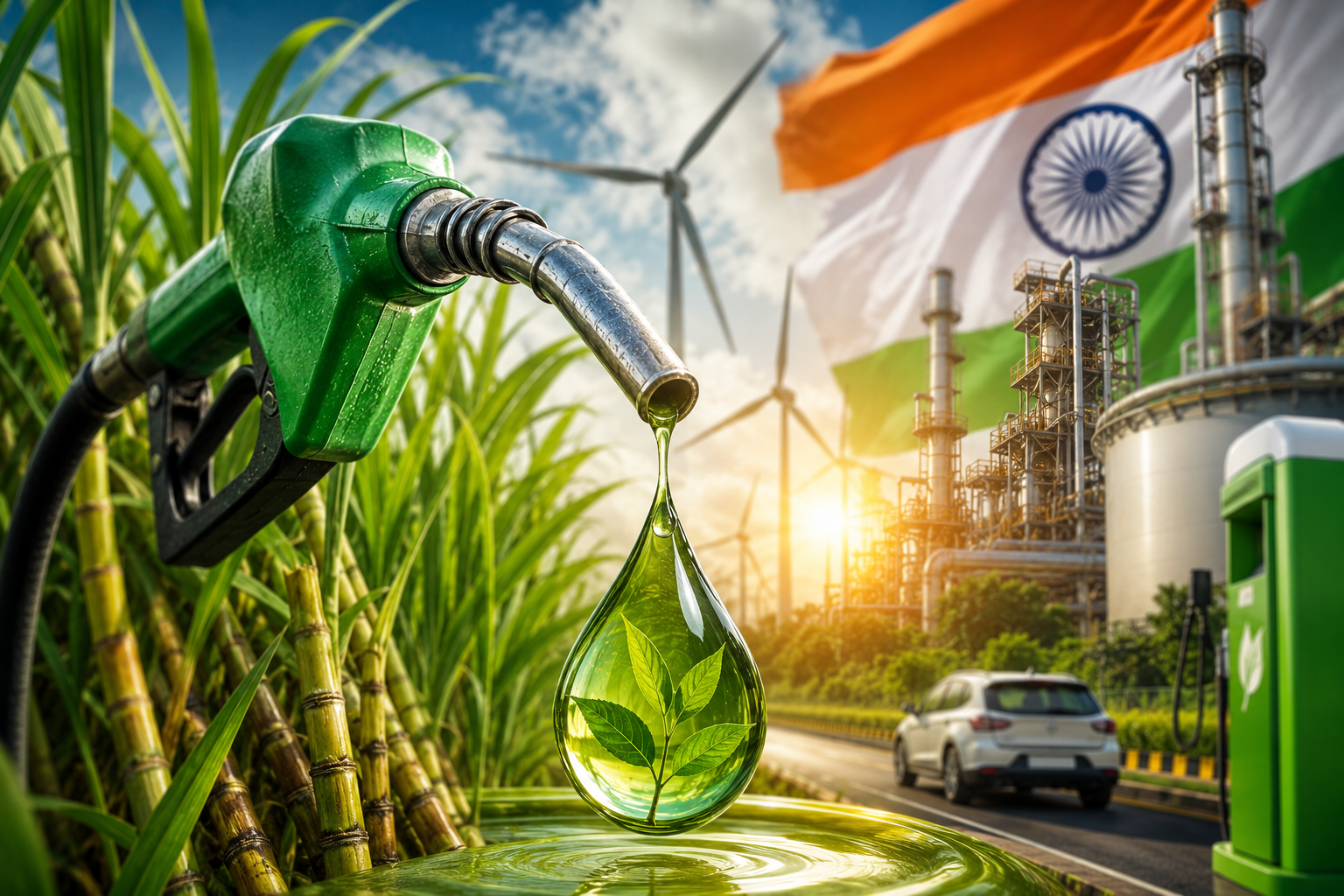
If you have pulled up to a retail fuel station in India recently, the petrol powering your vehicle is fundamentally different from what it was a few years ago. Unbeknownst to many drivers, nearly a fifth of every litre pumped into passenger cars and two-wheelers is no longer derived from fossil crude oil. Instead, it is bioethanol—a clear, renewable alcohol fermented from sugarcane, broken rice, and damaged food grains.
+-------------------------------------------------------------+
|                     KEY NUMBERS AT A GLANCE                 |
|                                                             |
|  * 20%     : Target ethanol blending in petrol by 2025-26.  |
|  * 15%+    : Current average blending level reached across  |
|              India (up from less than 2% in 2014).          |
|  * $100B+  : India's annual crude oil import bill, making  |
|              energy security a macroeconomic priority.      |
|  * 85%+    : Total share of domestic crude oil demand met  |
|              through foreign imports.                       |
+-------------------------------------------------------------+
India’s rapid pivot toward bioethanol represents one of the most aggressive energy transitions in modern industrial history. Driven by the flagship Ethanol Blended Petrol (EBP) Programme, the central government has compressed its timeline to achieve a nationwide E20 (20% ethanol, 80% petrol) blend by the 2025–2026 supply year, moving the original deadline forward by a full five years.
For a nation that relies on foreign imports to satisfy over 85% of its crude oil requirements, the structural motivations behind this shift are clear:
Shielding the macroeconomic balance sheet from volatile global oil markets.
Preserving precious foreign exchange reserves.
Cutting urban tailpipe emissions to meet global climate pledges.
Creating a structural floor price for domestic agrarian output.
Yet, as the country races toward this landmark transition, a complex web of economic, agricultural, and environmental trade-offs has emerged. Critics and policy researchers increasingly ask a fundamental question: Is this massive macro-experiment an unmitigated win for a developing economy, or is it an expensive policy intervention that risks disrupting food security and depleting critical groundwater assets?
2. Executive Summary: The Core Takeaways
Accelerated Target: India has advanced its target for 20% ethanol blending in petrol (E20) to the 2025–26 marketing year. The national average blending rate has already crossed the 15% mark, up from a mere 1.5% in 2014.
Macroeconomic Impact: At full implementation, E20 blending is projected to save India upwards of ₹30,000 crore ($4 billion) annually in foreign exchange outlays by displacing crude oil imports.
The Feedstock Shift: To mitigate localized sugar surpluses and meet massive volume requirements, India has diversified its feedstock strategy from primary sugarcane molasses to starchy grains, including damaged food grains and broken rice.
The Food vs. Fuel Dilemma: Diverting millions of tonnes of food grains and agricultural land toward fuel production raises significant policy challenges regarding domestic food inflation, buffer stock stability, and nutritional security.
Water and Ecological Footprint: Sugarcane and rice are highly water-intensive crops. Producing one litre of first-generation sugarcane ethanol in India requires thousands of litres of irrigation water, intensifying stress on critically depleted aquifers in states like Maharashtra and Uttar Pradesh.
Automotive Re-engineering: Shifting the national fuel standard to E20 requires substantial engineering updates from automakers to prevent material corrosion and engine degradation caused by the hygroscopic (water-attracting) nature of ethanol.
The Rural Economy Floor: The EBP Programme acts as a vital financial stabilizer for the sugar sector, ensuring timely payments to millions of cane farmers and reducing the cyclical accumulation of unpaid dues by sugar mills.
Advanced Biofuel Necessity: Transitioning to second-generation (2G) biofuels derived from non-edible agricultural residues (like paddy straw) is crucial for eliminating the food-versus-fuel conflict, though high capital expenditures continue to hinder rapid commercialization.
3. Demystifying the Terminology: What is Ethanol?
To accurately evaluate the policy, it helps to establish clear definitions for the fuels, feedstocks, and blending standards driving the conversation.
Ethanol (Ethyl Alcohol): A clear, colorless chemical compound with the molecular formula $C_2H_5OH$. It is volatile, flammable, and acts as a high-octane fuel when blended with petrol.
Bioethanol: Ethanol produced biologically by fermenting the naturally occurring sugars and starches found in organic biomass, distinguishing it from synthetic ethanol derived from petroleum fractions.
Fuel Ethanol: Highly purified, anhydrous (water-free) bioethanol with a purity profile of at least 99.5%, specifically denatured to make it unfit for human consumption before being blended with automotive fuels.
Ethanol Blending: The physical process of mixing anhydrous fuel ethanol with commercial motor spirit (petrol). The numeric suffix denotes the percentage volume of ethanol in the mix:
E5: 5% ethanol, 95% petrol.
E10: 10% ethanol, 90% petrol.
E20: 20% ethanol, 80% petrol (The target national standard).
E100: 100% pure fuel ethanol, deployed in specialized mono-fuel power units.
Flex-Fuel Vehicles (FFVs): Vehicles equipped with internal combustion engines modified with updated fuel systems and powertrain control modules. This allows them to run seamlessly on any arbitrary combination of petrol and ethanol, ranging from E20 up to E85 or E100.
4. The Architecture of India’s Ethanol Blending Programme (EBP)
India’s journey toward an ethanol-driven economy is structured by clear policy goals and shifting timelines. Originally launched as a pilot scheme in 2003, the Ethanol Blended Petrol (EBP) Programme struggled for over a decade due to volatile domestic feedstock pricing, cyclical sugarcane gluts, and a lack of dedicated supply chain infrastructure.
The program gained momentum in 2018 with the notification of the National Policy on Biofuels. This framework categorized eligible feedstocks into distinct structural generations:
1G (First Generation): Edible biomass sources containing direct sugars and starches, including sugarcane juice, B-heavy molasses, C-heavy molasses, damaged food grains, maize, and surplus rice stocks from the Food Corporation of India (FCI).
2G (Second Generation): Non-edible lignocellulosic agricultural waste products, such as rice straw (parali), wheat straw, bagasse, and corn stover.
3G (Third Generation): Advanced algal biomass and engineered municipal solid waste inputs.
+-----------------------------------------------------------------+
|               CHRONOLOGICAL EVOLUTION OF EBP TARGETS            |
|                                                                 |
|  2014: National average blending hovers around a minor 1.5%.   |
|  2018: National Policy on Biofuels sets a 20% target for 2030.  |
|  2021: NITI Aayog releases the Roadmap for Ethanol Blending,     |
|        advancing the 20% target deadline to 2025-26.            |
|  2026: E20 distribution expands across thousands of retail      |
|        outlets, with national blending exceeding 15%.           |
+-----------------------------------------------------------------+
Administratively, the program relies on a regulated system where the central government fixes remunerative prices for ethanol based on the specific feedstock used. Oil Marketing Companies (OMCs)—such as Indian Oil Corporation (IOCL), Bharat Petroleum (BPCL), and Hindustan Petroleum (HPCL)—enter into long-term supply agreements with domestic distilleries. This ensures predictable revenue for producers and secures steady supply volumes for fuel blending.
5. The Strategic Imperatives: Why India is Promoting Ethanol
The aggressive rollout of the EBP Programme is driven by three main strategic priorities: macroeconomic security, climate commitments, and rural economic stability.
Shoring Up Macroeconomic Vulnerabilities
India’s dependency on imported crude oil makes its economy vulnerable to geopolitical risks and commodity price spikes. When global crude prices rise, India’s current account deficit expands, putting pressure on the Indian Rupee. By replacing 20% of its pool of imported motor spirit with domestically manufactured bioethanol, India can reduce its annual oil import bill by an estimated ₹30,000 crore, building resilience against external economic shocks.
Honoring International Climate Pledges
Under its updated Nationally Determined Contributions (NDCs) submitted under the Paris Climate Agreement, India is committed to reducing the emissions intensity of its GDP by 45% by 2030 from 2005 levels. Bioethanol burns more cleanly than pure fossil fuels because its chemical structure includes bound oxygen, which promotes more complete combustion within engine cylinders. This helps lower tailpipe emissions of carbon monoxide (CO), hydrocarbons (HC), and particulate matter in densely populated urban centers.
Supporting the Rural Farm Economy
The sugar industry in India supports millions of farmers across major agricultural states like Uttar Pradesh, Maharashtra, Karnataka, and Tamil Nadu. Historically, the sector has faced regular production cycles of surplus supply, which depressed market prices and led to sugar mills accumulating unpaid dues to farmers for their cane.
The EBP Programme addresses this by creating a reliable alternative market for surplus cane juice and molasses. By diverting these inputs into ethanol production, sugar mills can improve their cash flows and ensure more timely payments to farmers.
6. Industrial Processing: How Ethanol is Produced
The industrial production of fuel ethanol requires distinct pathways depending on whether the starting feedstock is sugar-based or grain-based.
SUGARCANE/GRAINS ---> CRUSHING/MILLING ---> FERMENTATION (Yeast) ---> DISTILLATION ---> DEHYDRATION (99.5%+) ---> MOTOR FUEL
The Sugar-to-Ethanol Pathway
When utilizing sugarcane, the process varies based on the extraction stage:
Direct Sugarcane Juice: Raw juice is extracted directly from crushed cane and routed straight to fermentation tanks, bypassing sugar crystallization entirely.
B-Heavy Molasses: A thick, dark brown byproduct obtained from the first crystallization stage of sugar processing. It contains significant residual sugars and is highly valued for producing high-quality ethanol.
C-Heavy Molasses: The final, low-grade byproduct remaining after extracting the maximum possible sugar crystals. It has the lowest sugar content and yields less ethanol per tonne than B-heavy molasses.
The Grain-to-Ethanol Pathway
With the introduction of grain-based feedstocks, distilleries process starchy materials like broken rice, damaged grains, and maize. The grain is milled into a fine flour, liquefied, and treated with enzymes to break down complex starches into fermentable simple sugars. Once saccharified, the mash is fermented using specialized yeast strains (Saccharomyces cerevisiae) to produce a broth containing raw alcohol.
The Refining Phase
The fermented broth undergoes multi-stage fractional distillation to yield rectified spirit at roughly 95% purity. Because automotive fuel must be completely free of water to prevent phase separation when mixed with petrol, this rectified spirit passes through a Molecular Sieve Dehydration (MSDH) unit. This system filters out residual moisture on a molecular scale, producing anhydrous fuel ethanol at a minimum purity of 99.5%, ready for blending.
7. Economic Analysis: Winners, Losers, and Structural Realities
Evaluating the total economic impact of the ethanol transition requires looking at both macroeconomic gains and microeconomic costs.
The Impact on Sugar Mills and Farmers
The EBP Programme has substantially altered the financial health of India’s sugar sector. By providing a fixed, government-regulated pricing structure for ethanol, the policy has turned seasonal sugar mills into dual-revenue biorefineries. The steady cash flow from selling ethanol directly to public sector OMCs has helped mills pay farmers more reliably, reducing the political and economic friction caused by unpaid cane arrears.
The Fiscal Math for State Oil Marketing Companies (OMCs)
While the macroeconomic benefits of lower oil imports are clear, the financial burden shifts in part to OMCs and consumers. Ethanol has a lower energy density than petrol, meaning it yields fewer megajoules of energy per litre.
Because ethanol delivers roughly one-third less energy per unit volume than petrol, a vehicle running on an E20 blend experience a 6% to 7% drop in fuel efficiency compared to pure petrol. If retail prices remain identical, the end consumer effectively pays the same price for less net energy per litre.
Additionally, OMCs face large upfront capital costs to build dedicated ethanol storage tanks, specialized blending infrastructure, and separate distribution pipelines across their retail networks.
8. Environmental Footprint: A Balanced Life-Cycle Assessment
The environmental impact of bioethanol is more nuanced than simple tailpipe emissions reductions suggest. A comprehensive assessment must evaluate emissions across the entire life cycle, along with its effects on water and land use.
Decarbonization and Air Quality
On a life-cycle basis, bioethanol can reduce net greenhouse gas emissions compared to fossil fuels because the crops absorb carbon dioxide via photosynthesis while growing. At the tailpipe level, E20 blends show notable improvements in urban air quality metrics:
Carbon Monoxide (CO): Emissions are reduced by roughly 30% to 50% in two-wheelers and passenger cars due to the oxygenated nature of the fuel.
Hydrocarbons (HC): Emitted unburnt hydrocarbons drop by approximately 20%.
However, emissions of Nitrogen Oxides ($NO_x$) can fluctuate or slightly increase depending on engine calibration and operating temperatures, as the higher oxygen levels can lead to hotter combustion zones.
The Water Scarcity Challenge
The most critical environmental concern for India’s ethanol program is its high water footprint. India is already facing significant water stress, yet its primary ethanol feedstocks—sugarcane and rice—are highly water-intensive crops.
Data from the Commission for Agricultural Costs and Prices (CACP) indicates that producing one kilogram of sugar requires between 1,500 and 3,000 litres of water, depending on the region. As a result, every litre of first-generation sugarcane-based ethanol produced in India consumes substantial amounts of irrigation water, much of it drawn from depleted groundwater aquifers in states like Maharashtra and Uttar Pradesh.
+-------------------------------------------------------------+
|               WATER CONSUMPTION WATERFALL                   |
|                                                             |
|  [1 Litre 1G Sugarcane Ethanol]                             |
|        │                                                    |
|        └──> Requires ~2,500 Litres of Irrigation Water      |
|                                                             |
|  * Compares to less than 10 Litres for refining an          |
|    equivalent litre of fossil petrol.                       |
+-------------------------------------------------------------+
Diverting intensive irrigation toward fuel production places a heavy burden on regions already dealing with over-exploited groundwater tables. Without a shift toward rain-fed feedstocks or less water-intensive options like maize, the current scaling model presents long-term ecological risks.
9. Automobile Industry Analysis: Engine Compatibility and Readiness
The shift to high-percentage ethanol blends requires significant engineering adjustments from the automotive industry.
The Chemical Challenges of Ethanol
Ethanol is highly hygroscopic, meaning it naturally absorbs moisture from the surrounding air. If water accumulates in a vehicle’s fuel tank, it can trigger phase separation, causing the water-ethanol mix to settle at the bottom of the tank, separate from the petrol. This can lead to engine stalling and rough idling.
Furthermore, ethanol is corrosive to certain materials commonly used in older automotive fuel systems, such as natural rubber seals, zinc-plated fuel lines, and aluminum components. It can degrade these materials over time, leading to leaks and fuel pump wear.
Industry Adaptations and Consumer Impacts
To handle E20 blends safely, Indian vehicle manufacturers have updated their product lines by replacing vulnerable components with more resilient materials like stainless steel, high-density polyethylene (HDPE), and fluorocarbon elastomers.
MATERIAL UPGRADES FOR E20 COMPLIANCE:
- Fuel Tanks     : Steel/Low-Grade Plastics  ==> High-Density Polyethylene (HDPE)
- Fuel Lines     : Standard Rubber           ==> Fluorocarbon Elastomers / Stainless Steel
- Engine Valves  : Standard Alloys           ==> Hardened Valve Seats & Anti-Corrosive Coatings
While most new passenger vehicles sold in India are certified as E20-compliant, hundreds of millions of older vehicles remain on the road. Running high-ethanol blends in these older engines can cause gradual material degradation and performance issues over time.
Additionally, because ethanol has a lower energy content, drivers using E20 fuel will see a minor but noticeable drop in fuel economy, effectively increasing their real per-kilometer fuel costs.
10. Agricultural Analysis: The Food vs. Fuel Debate
As India scales its ethanol production beyond the limits of surplus molasses, the program has increasingly relied on grain feedstocks. This shift introduces a complex policy trade-off: balancing energy security against food security.
Diverting Grains from Food to Fuel
To meet its ambitious blending targets, the policy permits the diversion of food grains—such as broken rice from FCI warehouses, corn, and damaged wheat—into distillation networks. Agricultural economists raise concerns that using fertile land and food crops for fuel production could pressure domestic food security.
During periods of erratic monsoons or localized crop failures, diverting millions of tonnes of grain to fuel production can tighten domestic food supplies. This dynamic can contribute to food price inflation, affecting volatile essential commodities like rice and maize, which serves as a staple livestock feed.
+-------------------------------------------------------------+
|             THE GRAIN DIVERSION RIPPLE EFFECT               |
|                                                             |
|  Diverting Grains to Distilleries                           |
|        │                                                    |
|        ├──> Lowers public grain buffer stocks               |
|        ├──> Pushes up prices for broken rice & maize        |
|        └──> Increases input costs for poultry & livestock   |
+-------------------------------------------------------------+
The Impact on Cropping Patterns
The guaranteed price structure for ethanol feedstocks provides strong financial incentives for farmers to expand cultivation of sugarcane and rice. However, this runs counter to long-term agricultural goals aimed at encouraging crop diversification.
India has actively tried to incentivize farmers to move away from water-intensive monoculture toward oilseeds, pulses, and millets. The attractive, fixed returns of the ethanol market can unintendedly keep farmers tied to water-heavy crops, complicating efforts to reform national water and land-use patterns.
11. International Comparison: India, Brazil, and the United States
India’s ethanol policy can be better understood by comparing it with the world’s leading biofuel economies.
| Parameter | India | Brazil | United States |
| Primary Feedstock | Sugarcane (Molasses/Juice), Broken Rice, Maize | Sugarcane Juice (Direct) | Yellow Dent Corn |
| Current Blending Level | ~15% average (Targeting 20% by 2026) | 27% mandatory blend (E27), up to E100 at pumps | 10% standard blend (E10), expanding E15 access |
| Fleet Adaptation | Rolling out E20 compliance; FFV prototypes | Over 80% of new cars sold are Flex-Fuel | Widespread E10 compatibility; high FFV adoption |
| Water Risk Profile | High; heavy reliance on groundwater | Low; predominantly rain-fed sugarcane areas | Moderate; reliance on Ogallala aquifer |
| Primary Driver | Forex savings & rural price stability | Domestic energy resilience & export leadership | Agricultural subsidies & energy independence |
Key Lessons from Global Leaders
Brazil: Brazil’s biofuel program succeeds largely because its sugarcane production is concentrated in rain-fed regions, avoiding the groundwater depletion issues faced by India. Brazil also uses a flexible production model, allowing mills to shift their output between sugar and ethanol in real time based on global market prices.
United States: The U.S. relies on its massive corn surplus to produce ethanol. However, this model faces ongoing criticism from environmental researchers who argue that the high carbon footprint of intensive corn farming, combined with fertilizer runoff, limits the net lifecycle benefits of corn-based ethanol.
12. Policy Balance Sheet: Advantages vs. Challenges
Evaluating India’s ethanol roadmap requires weighing its clear structural advantages against its operational risks.
The Practical Advantages
Foreign Exchange Savings: Directly reduces outlays for imported crude oil, strengthening the national balance sheet.
Industrial Cash Flows: Provides a reliable secondary revenue stream for sugar mills, helping them pay farmers more consistently.
Urban Emission Reductions: Lowers tailpipe emissions of carbon monoxide and unburnt hydrocarbons, improving urban air quality.
Rural Investment: Encourages capital investment in rural areas through the construction and expansion of modern distillation facilities.
The Operational Challenges
Groundwater Depletion: Increases usage of water-intensive crops, putting extra strain on vulnerable aquifers.
Food Market Pressures: Diverting grain stocks to fuel production can lead to supply shortages and price inflation for food staples.
Consumer Efficiency Losses: The lower energy density of ethanol reduces vehicle fuel economy, raising costs for drivers.
Supply Chain Logistics: Requires substantial investments from OMCs to build out separate storage, transport, and blending infrastructure nationwide.
13. Fact-Checking the Ethanol Narrative: Myths vs. Facts
Clear up common misconceptions regarding India’s transition to higher ethanol blends.
| Myth | Real-World Fact |
| Myth 1: Any car on Indian roads can run on E20 fuel without issue. | Fact: Older vehicles lack the specialized seals and calibrated engines needed for high-ethanol blends, exposing them to potential material corrosion over time. |
| Myth 2: Ethanol blending delivers a huge reduction in net carbon emissions. | Fact: The real carbon reduction depends heavily on production choices. When accounting for fossil fuels used in farming, transport, and energy-intensive distillation, the net life-cycle emissions reduction is much lower than tailpipe data indicates. |
| Myth 3: Using ethanol saves consumers money at the fuel pump. | Fact: Because ethanol has a lower energy density than petrol, drivers will experience a 6% to 7% drop in fuel economy, which increases their overall cost per kilometer unless E20 is priced significantly lower than standard fuel. |
| Myth 4: India has plenty of excess grain to sustain the E20 mandate indefinitely. | Fact: Agricultural surpluses vary from year to year. A poor monsoon or an export surge can quickly turn grain surpluses into shortages, making a fixed blending mandate difficult to maintain without risking domestic food inflation. |
14. Real-World Implementations: Case Studies in the Ethanol Transition
Case Study 1: The Co-operative Sugar Mill Transformation in Maharashtra
A major co-operative sugar refinery in western Maharashtra updated its operations to shift from traditional sugar production to an integrated bio-refinery model. By installing a modern distillation unit capable of switching between sugarcane juice and B-heavy molasses, the mill successfully insulated itself from fluctuating global sugar prices.
During years of low sugar prices, the mill diverts its excess input into ethanol production for state OMCs. This steady source of income has allowed the co-operative to clear its farmer payments within the mandated 14-day window, demonstrating how the program can support financial stability in rural communities.
Case Study 2: The Grain Distillery Shift in Bihar
To balance its regional supply, the government encouraged the setup of grain-based distilleries in states like Bihar, which do not produce large amounts of sugarcane but have high yields of maize and broken rice.
Several new facilities have begun operating, creating a direct market for local grain farmers. However, these plants face regular challenges due to seasonal price swings in the local maize market. When poultry feed demand rises, maize prices fluctuate, highlighting how grain-based ethanol production is closely tied to broader food and agricultural markets.
15. Expert Perspectives: Multiple Viewpoints on the Policy
“The advancement of the E20 target is a significant milestone for India’s energy policy. It reduces our vulnerability to global oil market shocks and provides a clear pathway for domestic manufacturing investment.”
— Senior Representative, Ministry of Petroleum and Natural Gas
“We must be cautious about scaling up crop-based first-generation biofuels. India is a water-stressed nation, and allocating massive amounts of groundwater to grow fuel crops rather than food staples presents long-term environmental risks.”
— Water Resource Analyst & Climate Researcher
“For the automotive industry, E20 compliance requires substantial re-engineering. While we have updated our current lineups, the long-term performance of the older vehicle fleet remains an operational concern that requires close monitoring.”
— Technical Executive, Indian Automotive Association
16. Risk Matrix: Short, Medium, and Long-Term Scenarios
Evaluating the long-term potential of the EBP Programme requires examining future pathways under different operating conditions.
Scenario Analysis
Best-Case Scenario: Second-generation (2G) lignocellulosic technology commercializes rapidly, allowing India to shift its ethanol feedstock away from food crops to agricultural waste like rice straw. This maintains the 20% blending rate, achieves significant carbon reductions, avoids food security trade-offs, and resolves seasonal crop residue burning issues.
Worst-Case Scenario: Erratic monsoon cycles cause repeated crop failures for sugarcane and grains, forcing the government to choose between scaling back its ethanol mandate or importing expensive food grains to manage domestic inflation. Meanwhile, groundwater levels in key farming states drop further, and older vehicles suffer fuel-system issues.
Most Likely Scenario: India stabilizes its blending rate between 15% and 20% using a combination of sugarcane and grain feedstocks. The government dynamically adjusts feedstock allocations based on annual crop yields to manage food inflation, while 2G biofuel facilities scale up gradually due to high initial capital costs.
17. Future Outlook: Beyond the E20 Roadmap
As India approaches its initial E20 milestones, the policy focus is expanding toward broader biofuel applications and alternative energy technologies.
Advanced Biofuels and 2G Infrastructure
To resolve the trade-offs between food and fuel production, long-term policy success will depend on scaling second-generation (2G) refineries. These facilities convert non-edible agricultural waste, such as crop stalks and straw, into ethanol. While several public sector OMCs are investing in commercial-scale 2G plants, high processing costs and complex logistics for collecting biomass mean these advanced options will take time to replace 1G inputs.
+-------------------------------------------------------------+
|               THE NEXT BIOFUEL FRONTIERS                   |
|                                                             |
|  * Sustainable Aviation Fuel (SAF): Blending bio-jets into  |
|    commercial aviation infrastructure to cut emissions.     |
|  * Green Hydrogen: Utilizing renewable power to displace    |
|    industrial fossil inputs entirely.                       |
|  * Flex-Fuel Fleet: Expanding vehicle platforms capable of  |
|    running on higher ethanol blends up to E85.              |
+-------------------------------------------------------------+
Expanding into New Transport Sectors
The experience gained from the EBP Programme is helping shape India’s approach to other transport sectors. The government is laying the groundwork for Sustainable Aviation Fuel (SAF) mandates, aiming to blend bio-based jet fuels into commercial aviation supplies.
Additionally, efforts are underway to introduce ethanol options to the diesel sector and support the adoption of dedicated Flex-Fuel Vehicles. By positioning ethanol as a transitional fuel alongside electrification and green hydrogen, India aims to build a more diversified and resilient energy network.
18. Analytical Commentary: The Balancing Act of Energy Policy
Analysis & Commentary
The rapid rollout of India’s Ethanol Blended Petrol Programme is an instructive case study in modern industrial policy, showing how energy security goals can intersect with agricultural realities.
From a purely macroeconomic perspective, the program addresses a key vulnerability. For a developing country with a large trade deficit, converting domestic agricultural output into transport fuel serves as a useful economic shield. It helps protect the national balance sheet from volatile global oil prices and reduces foreign exchange outflows.
However, a complete economic analysis must look beyond import substitution to evaluate the broader structural costs. The current system relies heavily on first-generation feedstocks like sugarcane and broken rice, which creates friction between energy mandates and resource constraints.
India’s agriculture is highly dependent on groundwater, meaning the E20 policy effectively trades imported oil for domestic water and land resources. Diverting intensive irrigation to grow fuel crops in water-stressed regions presents a clear ecological trade-off.
THE STRUCTURAL POLICY CONFLICT:
Macro-Economic Goal <===========> Micro-Ecological Reality
(Save Foreign Exchange)           (Deplete Local Groundwater)
Furthermore, linking transport fuel supply to food grain markets introduces long-term risks. When energy policies create a fixed, high-volume demand for grains, food supply chains can become more vulnerable during years with poor monsoons or low crop yields. This dynamic can lead to food price volatility, impacting lower-income consumers.
To build a resilient biofuel program, India will need to gradually shift its feedstock mix. The long-term sustainability of the policy depends on moving away from water-intensive food crops and accelerating the transition to second-generation agricultural residues.
Until advanced, non-food biofuels can be commercialized at scale, the ethanol program will remain a delicate balancing act—one that requires dynamically managing the competing demands of the energy grid, the agricultural sector, and the food supply.
19. Conclusion: Finding the Sustainable Path Forward
India’s transition toward an E20 fuel standard represents a major shift in the nation’s energy policy. The program has delivered clear benefits, including multi-billion dollar savings in foreign exchange outlays, improved cash flows for the rural sugar sector, and a measurable reduction in urban tailpipe emissions. These achievements show how targeted policy interventions can help address deep-seated macroeconomic challenges.
Yet, scaling a nationwide biofuel mandate requires managing complex economic and environmental trade-offs. The program’s reliance on water-intensive crops like sugarcane and food grains highlights the need to carefully balance energy security against groundwater preservation and food price stability.
The future success of India’s ethanol roadmap will depend on its flexibility. By prioritizing second-generation agricultural waste, optimizing water management, and adjusting blending mandates based on seasonal crop yields, India can build a more sustainable framework.
Managed carefully, the bioethanol program can serve as a vital transition tool, helping guide the country toward a more secure, balanced, and low-carbon energy economy.
20. Comprehensive FAQ Section
Q1: What is the primary difference between E10 and E20 fuel?
A: The number represents the percentage volume of anhydrous fuel ethanol mixed into the petrol. E10 contains 10% ethanol and 90% petrol, while E20 contains 20% ethanol and 80% petrol. E20 has a lower energy density than E10, resulting in a minor reduction in vehicle fuel economy.
Q2: Can I use E20 fuel in my older motorcycle or car safely?
A: Older vehicles not explicitly certified for E20 can experience issues over time. Ethanol’s corrosive nature can degrade standard rubber seals, gaskets, and metallic components within older fuel systems. It can also absorb atmospheric moisture, potentially causing fuel separation in the tank.
Q3: Why does ethanol blending lead to lower vehicle mileage?
A: Fuel ethanol has roughly one-third less energy density per unit volume compared to pure commercial petrol. As the blending ratio increases to 20%, the engine requires a slightly larger volume of fuel to deliver the same power output, resulting in a 6% to 7% drop in overall fuel efficiency.
Q4: How does the ethanol mandate support domestic Indian farmers?
A: The program provides a government-regulated alternative market for sugarcane derivatives and surplus grains. This diversifies revenue for sugar mills and processing plants, helping them stabilize their cash flows and ensure more timely payments to farmers for their crops.
Q5: What is the “Food vs. Fuel” debate regarding India’s ethanol policy?
A: The debate focuses on the social and economic trade-offs of using arable land and food staples—like broken rice and maize—to produce transport fuel. Critics argue that during years with erratic monsoons, diverting large volumes of food grains to distilleries can tighten food supplies and contribute to domestic food inflation.
Q6: What are second-generation (2G) biofuels, and how do they help?
A: 2G biofuels are produced from non-edible agricultural waste, such as rice straw, wheat stalks, and sugarcane bagasse. They help resolve the food-versus-fuel conflict by using crop residues instead of food grains, while also providing an alternative to seasonal stubble burning.
Q7: Does ethanol blending completely eliminate vehicle emissions?
A: No, it does not eliminate emissions, but it helps reduce them. Because ethanol contains bound oxygen, it promotes more complete fuel combustion. This significantly reduces tailpipe emissions of carbon monoxide and unburnt hydrocarbons, though emissions of nitrogen oxides ($NO_x$) can vary depending on engine tuning.
Q8: Why don’t we switch immediately to 100% ethanol (E100) vehicles?
A: Operating on pure E100 requires dedicated flex-fuel or mono-fuel engines designed to handle high compression ratios and prevent cold-start issues. It also requires a separate, nationwide distribution infrastructure and a much larger supply of ethanol than India currently produces.
Q9: How does the water footprint of India’s ethanol compare to other countries?
A: India’s ethanol water footprint is relatively high because its primary feedstocks—sugarcane and rice—rely heavily on groundwater irrigation. In contrast, major producers like Brazil grow sugarcane primarily in rain-fed regions, causing less strain on local aquifers.
Q10: Are public sector Oil Marketing Companies (OMCs) prepared for the E20 rollout?
A: OMCs are investing heavily in updating their logistics infrastructure, including dedicated storage facilities, specialized blending units at supply terminals, and updated retail pump materials to handle high-ethanol blends safely.
Q11: What happens if a vehicle tank experiences “phase separation”?
A: Phase separation occurs if water enters the fuel tank. Because ethanol binds easily with water, the water-ethanol mixture can separate from the petrol and sink to the bottom of the tank. If this mixture enters the fuel lines, it can cause rough idling, misfires, or engine stalling.
Q12: How does the NITI Aayog Roadmap plan to adjust feedstock usage over time?
A: The roadmap aims to diversify feedstocks by expanding the use of less water-intensive crops like maize and accelerating the adoption of second-generation lignocellulosic biomass, reducing the long-term reliance on primary sugarcane juice.
Q13: Will the expansion of electric vehicles (EVs) phase out the need for ethanol blending?
A: The government views ethanol blending and vehicle electrification as complementary strategies. While EVs are expanding in the two-wheel and urban passenger car segments, ethanol serves as a practical transitional fuel for the existing internal combustion fleet and heavy transport sectors.
Q14: Is E20 fuel more expensive at the pump for consumers?
A: Currently, retail prices for E20 and standard petrol blends remain uniform at most stations. However, because E20 delivers fewer kilometers per litre due to its lower energy density, the real cost per kilometer is slightly higher for the consumer.
Q15: Where can I check if my vehicle is compatible with E20 fuel?
A: Compatibility information is typically located on the inside of the fuel filler lid, within the manufacturer’s owner manual, or via official vehicle registration databases for models manufactured after 2023–2024.