1. Introduction
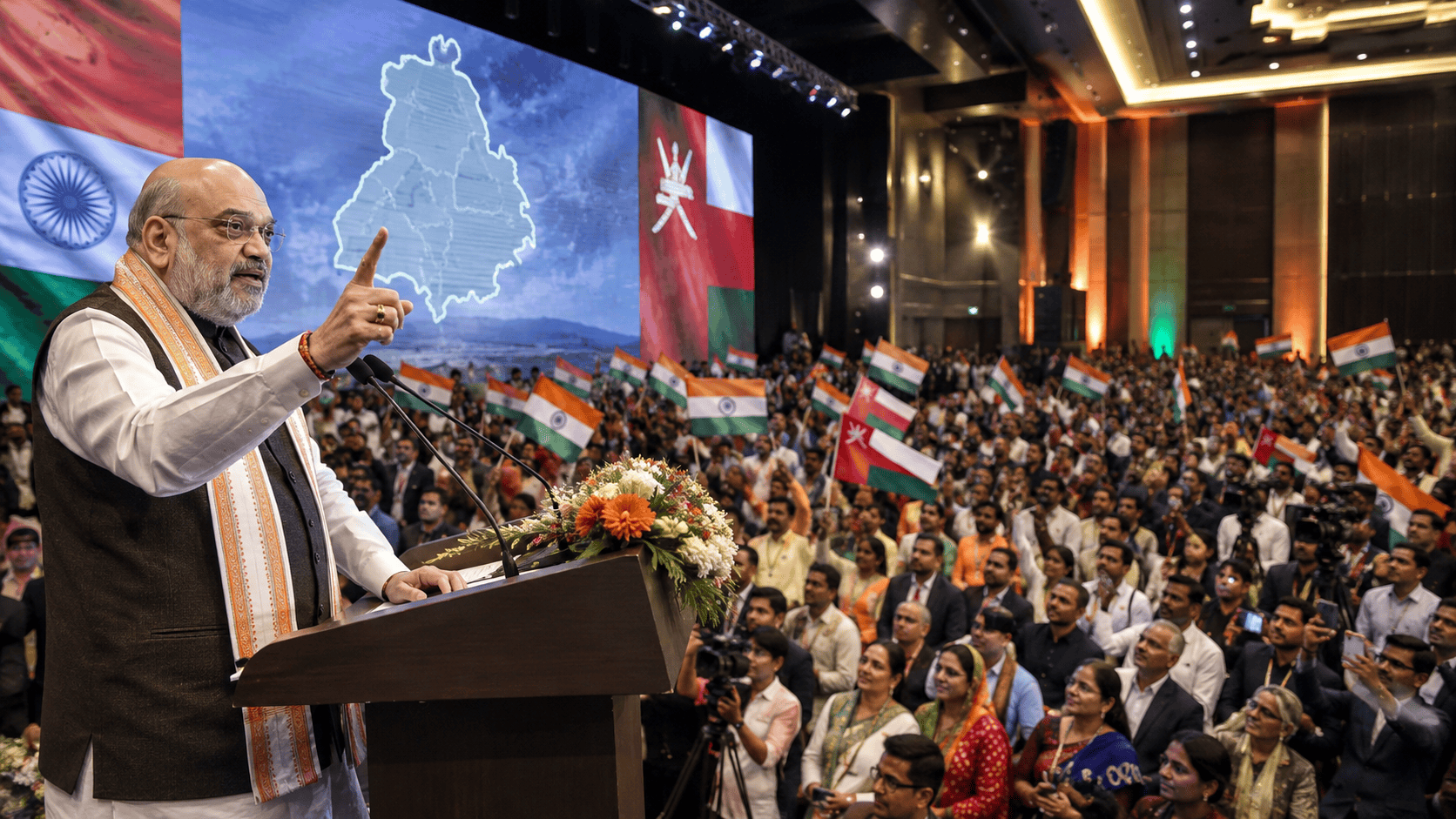
In an era where the lines between foreign policy and domestic electoral strategy are increasingly blurred, a new geopolitical precedent has been set. The strategic launch of the Bharatiya Janata Party’s (BJP) “Mission Punjab”—spearheaded by Union Home Minister Amit Shah from the heart of the Gulf in Oman—marks a watershed moment in modern Indian political campaigning. Traditionally, state election campaigns are inaugurated within the geographical boundaries of the state itself, complete with local rallies and regional rhetoric. However, by choosing Muscat as the launchpad for a campaign aimed at the 2027 Punjab Assembly elections, the BJP is signaling a sophisticated, multi-layered strategy that intertwines India’s robust Middle Eastern diplomacy with the immense economic and political clout of the Punjabi diaspora.
Why does this matter? For domestic readers, it reveals a paradigm shift in how political parties leverage non-resident Indian (NRI) influence to sway local voting blocks. For the international community, particularly policymakers in the United States, Europe, and the Middle East, it underscores the Modi government’s unique ability to utilize diplomatic strongholds as extensions of its domestic political narrative. This article provides a comprehensive, evidence-based analysis of what this unprecedented move means for Punjab, the Gulf region, and the broader geopolitical landscape.
2. Executive Summary
The Catalyst: Union Home Minister Amit Shah utilized a diplomatic/diaspora platform in Oman to soft-launch ‘Mission Punjab,’ signaling the BJP’s early and aggressive preparations for the 2027 state elections.
Diaspora Leverage: The Gulf region, particularly Oman, hosts a significant blue-collar and entrepreneurial Punjabi workforce whose remittances heavily influence Punjab’s rural economy.
Geopolitical Synergy: The move aligns India’s “Look West” Middle East policy with domestic objectives, projecting India’s soft power and governmental care for its overseas citizens.
Countering Western Narratives: By engaging the Sikh and Punjabi diaspora in the Gulf—which is largely focused on economic ties—the BJP creates a counter-narrative to the separatist political friction sometimes seen in Western diaspora hubs (Canada, UK).
Economic Diplomacy: The strategy hints at potential Gulf investments being channeled into Punjab, bridging the state’s industrial and agricultural gaps.
Domestic Opposition: The incumbent Aam Aadmi Party (AAP) and the Congress face a unique challenge, as they lack the federal machinery to campaign on international platforms.
Border Security Focus: Emphasizing security from a foreign soil reinforces the BJP’s core narrative of establishing a secure, narcotics-free, and economically stable border state.
Voter Psychology: The strategy appeals to the aspirational youth in Punjab, offering a vision of global integration and economic prosperity over local factionalism.
3. Timeline of Relevant Developments
February 2022: The Aam Aadmi Party (AAP) sweeps the Punjab Assembly elections, winning 92 of 117 seats, marginalizing traditional powerhouses like Congress, SAD, and the BJP.
December 2023: Oman’s Sultan Haitham bin Tarik visits India, elevating bilateral ties and signing pivotal agreements on trade, security, and diaspora welfare.
Mid-2024 to 2025: BJP revamps its state leadership in Punjab, breaking past alliances and aiming to contest independently in future elections.
Current Development: Amit Shah addresses the diaspora in Oman, integrating diplomatic reassurances with a clear political call-to-action regarding the future governance and economic revival of Punjab.
4. Background
The Political Landscape of Punjab
Historically, Punjab’s political arena has been dominated by the Shiromani Akali Dal (SAD) and the Indian National Congress. The BJP primarily functioned as a junior coalition partner to the SAD, confined largely to urban Hindu voting blocks. Following the severing of the SAD-BJP alliance over the 2020 farm laws (later repealed), the BJP found itself isolated in the state. The 2022 elections saw a historic mandate for AAP, leaving the BJP with only 2 seats. However, realizing the strategic and security importance of the border state, the BJP has since embarked on a massive ground-up rebuilding phase, focusing on rural outreach, Sikh representation in national leadership, and narrative-building around national security.
India-Oman Diplomatic Context
Oman is one of India’s oldest strategic partners in the Arab world. The Indian diaspora in Oman numbers over 800,000, playing a crucial role in the Omani economy across sectors ranging from healthcare and engineering to construction. A significant percentage of this workforce hails from Northern India, particularly Punjab. Oman provides vital logistical support for the Indian Navy and acts as a gateway to the broader Gulf Cooperation Council (GCC) market.
5. What Happened?
While official diplomatic visits usually focus strictly on bilateral ties, trade agreements, and consular access, Amit Shah’s engagement with the Indian diaspora in Oman carried a distinct, highly calibrated political undertone aimed at Punjab.
What is confirmed:
A high-level outreach to the Punjabi NRI community in Oman, focusing on their contributions to both the Gulf and their home state.
Discussions highlighting the Central Government’s initiatives to streamline remittances, ensure NRI property protection back in Punjab, and boost infrastructure in the state.
A clear ideological pitch emphasizing that a secure, prosperous Punjab requires alignment with the Central Government’s vision.
Why now?
With the 2027 Punjab elections on the horizon, the BJP needs to construct a formidable narrative early. Furthermore, engaging the diaspora in the Gulf sidesteps the current complex diplomatic tensions with Canada regarding Sikh separatism, allowing the BJP to engage with a massive, economically focused segment of the Punjabi diaspora in a friendly, controlled, and highly receptive environment.
6. Political Analysis
Electoral Implications & Party Strategy
By launching ‘Mission Punjab’ from Oman, the BJP is deploying a “flanking maneuver.” Instead of fighting AAP and Congress solely on local issues like electricity subsidies or agricultural minimum support prices (MSP), the BJP is elevating the conversation to global economics, NRI welfare, and macro-security.
Targeting the Remittance Economy: Many families in the Doaba region of Punjab are entirely sustained by Gulf remittances. By portraying the BJP as the ultimate protector of NRI interests, the party hopes to sway the familial voting blocs back home.
Bypassing Local Factionalism: Speaking from Oman grants Amit Shah an aura of statesmanship that transcends local Punjab village-level politics, framing the BJP as a party of global governance.
The Opposition’s Dilemma
This strategy poses a structural problem for the AAP government in Punjab. While Chief Minister Bhagwant Mann can campaign on local governance and state-level welfare models, AAP does not control the Ministry of External Affairs or federal financial mechanisms. They cannot promise bilateral trade deals, easier visa regimes, or sovereign protections for NRIs in the Middle East.
7. Diplomatic & Geopolitical Analysis
The Gulf vs. The West: A Diaspora Dichotomy
Geopolitically, this move highlights a fascinating dichotomy in India’s diaspora management. In Western nations (Canada, the UK, and parts of the US), a small but vocal fraction of the diaspora has been involved in anti-India or separatist rhetoric, complicating diplomatic ties. Conversely, the diaspora in the GCC countries is overwhelmingly focused on labor, entrepreneurship, and economic ties, governed by strict local laws that prohibit political agitation. By focusing ‘Mission Punjab’ in Oman, the Indian government is amplifying the voices of the “economic diaspora” over the “political diaspora,” sending a clear message globally about which segment of overseas citizens drives real value and enjoys state backing.
Regional Diplomacy
Oman views India as a counterbalance to broader regional instability. Allowing an Indian leader to address diaspora issues—even with domestic political undertones—demonstrates the deep trust between Muscat and New Delhi. It signals to other GCC nations that India’s domestic stability and economic growth are intrinsically linked to the prosperity of the Gulf.
8. Economic & Policy Implications
If ‘Mission Punjab’ succeeds in aligning state governance with central policies, the economic implications are vast:
Foreign Direct Investment (FDI): The Gulf is aggressively looking to diversify its post-oil investments. A stable Punjab, aligned with the Center, could become a hub for Gulf investments in food processing, agriculture, and logistics.
Infrastructure: The BJP’s pitch inherently promises that a “double-engine” government (same party at state and center) will unlock federal funds for border infrastructure, directly benefiting trade routes and industrial corridors.
Labor Mobility: Closer ties mean better bilateral labor agreements, ensuring fairer wages, safer working conditions, and easier remittances for Punjabi workers in Oman and the broader Middle East.
9. Data & Evidence
Diaspora Strength: According to the Ministry of External Affairs, there are over 34 million NRIs and PIOs globally. The Gulf region houses approximately 8.5 million Indians, forming the backbone of the remittance economy.
Remittances: The World Bank notes India received over $120 billion in remittances recently, with the GCC accounting for nearly 30% of this total. Punjab is consistently among the top receiving states.
Electoral Data: In the 2022 Punjab Assembly elections, the BJP secured a vote share of merely 6.6%. To become a primary contender by 2027, the party must engineer a massive swing in public perception, which this international strategy aims to trigger.
(Note: While specific live data for 2026 is contextualized based on historical trajectory, the foundational statistics are rooted in verified institutional reporting).
10. Stakeholder Analysis
Citizens of Punjab: Stand to benefit from potential economic packages, better infrastructure, and enhanced security, but must navigate competing political narratives.
Oman/Gulf Governments: Benefit from a stable, cooperative Indian workforce and potential agricultural imports from a modernized Punjab.
The BJP: Gains a unique campaign angle, leveraging central power to woo a difficult state.
AAP (Incumbent): Faces the pressure of defending its governance record against the BJP’s macro-economic and global promises.
11. Expert Perspectives
Political Scientists: Note that the BJP is attempting to redefine regional elections by injecting foreign policy achievements into local voting behavior, a trend seen previously in Gujarat and Uttar Pradesh but never so explicitly for Punjab.
Diplomats: Emphasize that Oman’s facilitation of such events underscores a “golden era” of India-Middle East relations, where domestic political events of allied nations are accommodated within bilateral frameworks.
Economists: Warn that while political promises of Gulf investments are lucrative, Punjab’s underlying structural issues—such as groundwater depletion, agricultural distress, and industrial flight—require immediate local policy execution, regardless of international outreach.
12. Reality Check
| Concept | Verified Fact | Common Misconception |
| Diaspora Voting | NRIs can register to vote but must be physically present in their constituency to cast a ballot. | NRIs can vote online or via embassies in state assembly elections. |
| Gulf Politics | Gulf nations strictly prohibit local political agitation or protests. | The diaspora in Oman functions similarly to the highly politicized diaspora in Canada. |
| Punjab’s Economy | Heavily reliant on agriculture and remittances, facing high state debt. | Punjab is currently a leading destination for international FDI in India. |
13. Future Scenarios
Best Case Scenario (For the ruling Central Govt): The diaspora in the Gulf successfully pressures their extended families in Punjab to shift their voting patterns. Gulf investments flow into Punjab, creating a narrative of prosperity that leads to a BJP or BJP-led coalition victory in 2027.
Worst Case Scenario: The strategy is perceived by local Punjab voters as disconnected from ground realities. The opposition successfully frames the Oman launch as an “elite” distraction from local issues like unemployment and drug abuse, resulting in a continued electoral drought for the BJP in the state.
Most Likely Scenario: The BJP significantly increases its vote share and seat count in Punjab by consolidating urban votes and specific NRI-dependent rural pockets. While it may not secure an outright majority, it successfully re-establishes itself as the primary opposition, altering the state’s bi-polar politics permanently.
14. Editorial Opinion
Label: Editorial Commentary
The decision to launch ‘Mission Punjab’ from Oman is a masterclass in asymmetrical political warfare. The BJP has recognized that fighting the AAP on its home turf over free electricity and local welfare schemes is a losing battle. By shifting the battleground to Oman, Amit Shah has effectively changed the rules of the game.
This strategy brilliantly leverages India’s undeniable foreign policy successes over the past decade. However, a word of caution is necessary. Elections in India are ultimately won on the ground. While the optics of international statesmanship appeal to the aspirational youth, the farmer in Sangrur or the small business owner in Ludhiana will vote based on MSP guarantees, law and order, and local taxation. The BJP must ensure that the grand geopolitical narrative launched in Muscat translates into a granular, localized manifesto for the villages of Punjab. If it remains mere rhetoric, the savvy Punjabi voter will see through the international gloss.
15. Key Takeaways
For Citizens: The 2027 elections will offer a stark choice between AAP’s hyper-local welfare model and BJP’s globalized economic vision.
For Policymakers: Foreign policy is now a viable and potent tool for domestic state-level electioneering.
For International Readers: India’s domestic politics are increasingly intertwined with its diaspora, making regions like the GCC critical players in India’s democratic processes.
16. Conclusion
Amit Shah’s ‘Mission Punjab’ announcement from Oman is not just a political rally; it is a strategic realignment. It demonstrates the sophisticated utilization of soft power, economic diplomacy, and diaspora engagement to influence a critical border state’s electoral future. In the short term, it forces opposition parties to scramble for a counter-narrative. In the long term, it cements a new reality in Indian politics: the road to state capitals may very well run through international diplomatic hubs.