1. Powerful Introduction
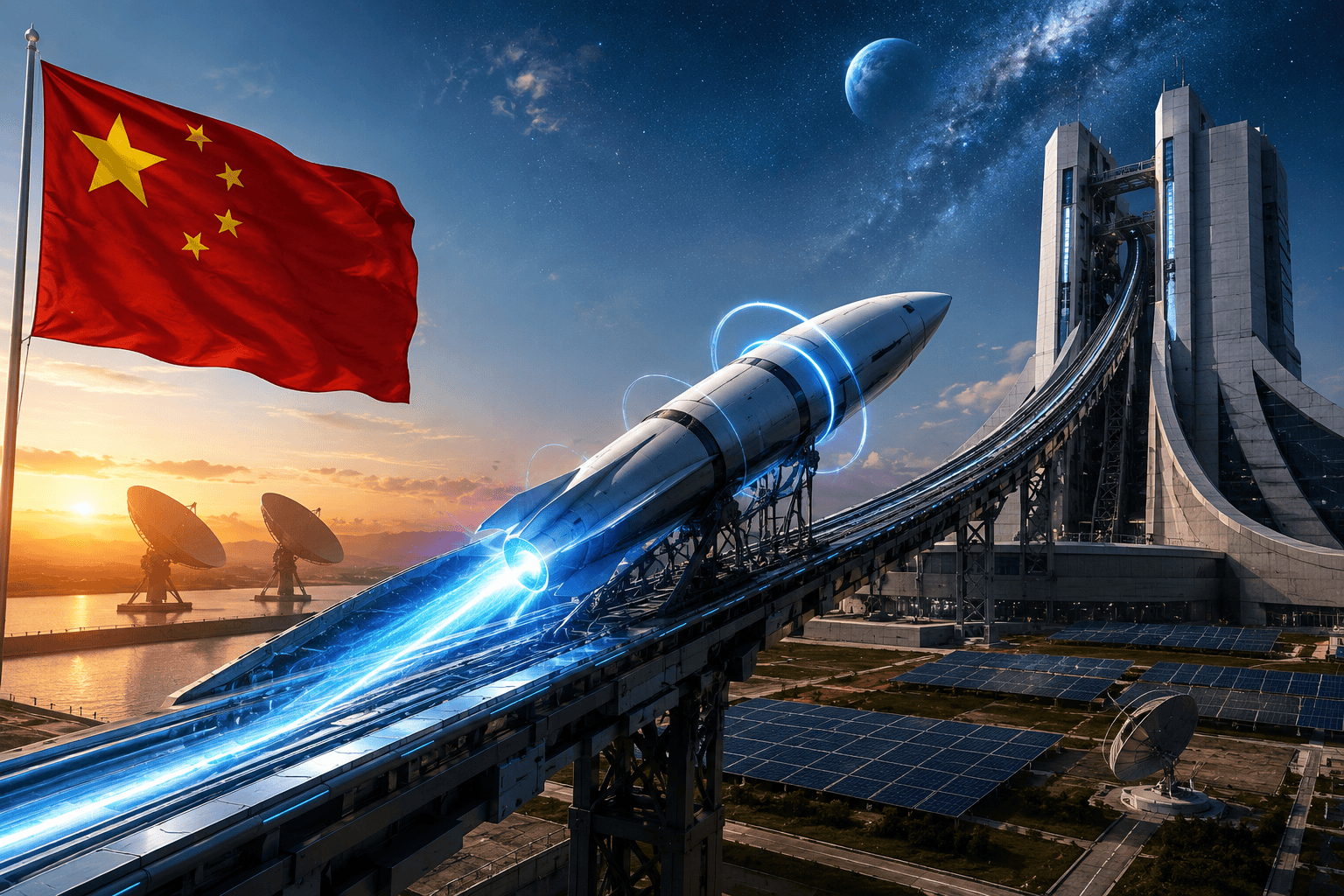
Imagine launching an orbital rocket into the sky without the deafening, earth-shaking roar of traditional chemical boosters, and completely free of the signature massive plume of fire and toxic smoke. Instead, picture a spacecraft slicing through the atmosphere, accelerated quietly along a track at supersonic speeds using nothing but high-intensity electricity and magnetic fields. This is no longer just a concept confined to the pages of science fiction.
In a bold development that has sent ripples through the global aerospace community, China has accelerated its development of an Electromagnetic Launch Catapult (sometimes referred to as a space railgun or maglev launcher). A master plan tracking upwards of $60 billion in structural research, patents, and testbeds has steadily come to light. Grounded in patent filings dating back to 2019 by prominent defense engineers like Ma Weiming, and backed by recent July 2026 test demonstrations involving mobile, truck-mounted electromagnetic launchers for drones, China is paving a radically different path toward ultra-cheap, mass-scale access to space.
While the United States, via Elon Musk’s SpaceX, has fundamentally altered space economics through the mechanical reuse of vertical-takeoff rockets like the Falcon 9, Beijing is placing a multi-billion-dollar bet on eliminating the need for massive initial stages of chemical propellant altogether. By utilizing magnetic levitation (maglev) principles to defeat gravity during the most fuel-intensive first minute of flight, this technology holds the potential to transform satellite deployment into something resembling an on-demand, airport-like taxi service. If successful, it could fundamentally reorder the geopolitical, military, and commercial balance of the outer space domain.
2. Executive Summary
The Core Technology: China is constructing an electromagnetic catapult designed to accelerate spacecraft along a massive magnetic levitation (maglev) track on the ground, launching them into upper altitudes before onboarding traditional chemical propulsion.
Fuel Elimination: The system addresses the biggest bottleneck in aerospace engineering: the first minute of launch. Traditionally, the overwhelming majority of a rocket’s weight consists of fuel expended just to overcome earth’s initial gravity and dense low-altitude air.
The Strategic Shift: While SpaceX lowered orbital costs through vehicle recovery (reusable rocket boosters), China aims to lower costs by removing a substantial portion of the rocket’s heavy first-stage structural mass and fuel payload.
Geopolitical Realities: Observers project that if scaled successfully, the system could allow Beijing to deploy constellations of reconnaissance and communications satellites with unprecedented frequency, posing severe tracking challenges to international competitors.
The Timeline & Private Play: Backed by state-level engineering patents, Chinese commercial entities like Galactic Energy are targeting initial operational phases as early as 2028.
The Core Challenges: The system demands an unprecedented concentration of electrical power storage, extreme structural track tolerances, and spaceplanes capable of surviving intense friction and G-forces within the lower atmosphere.
The Global Counter-Response: While Western agencies like NASA have explored similar frameworks (such as railguns and “SpinLaunch” rotational kinetic setups), India is simultaneously addressing the low-cost launch market by rapidly scaling its domestic private space sector through firms like Skyroot Aerospace.
3. Background
Historical Context and the Fuel Problem
Since the dawn of the Space Age, every mission to orbit has been bound by the strict dictums of Tsiolkovsky’s Rocket Equation. Simply put, to carry payload into space, a rocket must carry fuel; to carry that fuel, it must carry more fuel to lift the fuel itself. This creates an exponential weight penalty.
Approximately 80% to 90% of a traditional rocket’s total mass at launch consists entirely of propellant. The vast majority of this energy is burned away within the first 60 to 90 seconds of flight, simply fighting the thickest layers of Earth’s atmosphere and breaking static inertia.
Previous Alternate-Launch Attempts
Engineers have spent over half a century trying to bypass this chemical barrier:
NASA Maglev Studies (1990s): NASA spent millions exploring magnetic launch tracks at the Marshall Space Flight Center. However, the immense initial capital requirements, limits in power-switching electronics, and the post-Cold War pivot toward the Space Shuttle program caused the agency to shelf the projects in favor of traditional configuration.
Kinetic Catchments (SpinLaunch): Modern American startups have experimented with vacuum-sealed centrifuges to spin a projectile at hypersonic speeds before releasing it into the sky. While innovative, it subjects payloads to thousands of G-forces, rendering it highly impractical for delicate electronics or human spaceflight.
The U.S. Navy’s EMALS: The closest successful cousin to a space catapult is the Electromagnetic Aircraft Launch System (EMALS) used on modern U.S. Navy supercarriers like the USS Gerald R. Ford. EMALS replaces steam pistons with linear induction motors to launch heavy fighter jets over short distances, proving that electromagnetic mass acceleration works reliably at scale.
+-------------------------------------------------------------------------+
|                  CHRONOLOGY OF NON-CHEMICAL ACCELERATION                |
+-------------------------------------------------------------------------+
| [1970s]  -> NASA conducts initial theoretical work on mass drivers.     |
| [1990s]  -> Marshall Space Flight Center builds small maglev test tracks.|
| [2019]   -> Chinese military engineer Ma Weiming patents EM ejection systems|
| [2020]   -> US Navy deploys EMALS carrier catapult systems operationally.|
| [2022]   -> NASA partners with SpinLaunch for kinetic projectile testing.  |
| [2026]   -> China demonstrates mobile truck-based tactical EM catapults. |
| [2028]*  -> Target window for China's first scaled maglev rocket test.  |
+-------------------------------------------------------------------------+
(*Anticipated future milestone)
4. What Happened?
The international aerospace community has paid increasing attention to a series of strategic milestones out of China regarding large-scale electromagnetic ejection systems.
The Core Patent (2019): Senior Chinese military engineer and academician Ma Weiming—celebrated for developing China’s naval electromagnetic catapults for their Type 003 aircraft carriers—filed a fundamental architecture patent. The document detailed a system utilizing ground-based electromagnetic tracks to accelerate massive, multi-ton aerospace vehicles to high supersonic velocities prior to firing internal rocket stages.
The Strategic Plan Unveiled: Chinese state laboratories and commercial space entities outlined a projected long-term investment horizon matching an estimated value of $60 billion. This framework is explicitly directed toward establishing fixed high-altitude electromagnetic infrastructure alongside advanced power-grid reserves.
The July 2026 Demonstrations: In early July 2026, official channels showcased highly advanced, real-world iterations of this technology. Multi-vehicle, truck-mounted mobile electromagnetic launchers were shown successfully firing mid-to-large-scale fixed-wing military drones. Rather than relying on traditional jet-assisted takeoffs (JATO) or long asphalt runways, these vehicles were pneumatically and magnetically ejected into immediate, stable flight profiles from short mobile platforms.
Commercial Timelines: Private-public entities in China, including launch developer Galactic Energy, have integrated these targets into their operational roadmaps, pointing to physical infrastructure scaling tests targeting the late 2020s (roughly 2028).
5. Investigation & Reality Check
When assessing a project of this magnitude, it is vital to separate verified engineering milestones from aspirational state programming.
Verified Milestones: China has definitively solved the synchronization electronics required for high-mass electromagnetic linear propulsion. This is verified by the operational integration of electromagnetic catapults on their latest naval supercarriers and the recent 2026 deployments of truck-mounted tactical drone catapults. The underlying switching speeds, power storage, and magnetic core designs are real, working hardware.
Official Claims Under Development: The scale-up from a 30-ton fighter jet or a 1-ton drone to an orbital launch vehicle weighing hundreds of tons remains an unverified capability. Statements regarding immediate cost drops to a fraction of Falcon 9 pricing are projections, not current realities.
Geographic Speculation: Aerospace analysts note that Chinese researchers have actively scouted and modeled launch lines along the Tibetan Plateau. Launching from an average elevation of 4,000 meters above sea level reduces aerodynamic drag by roughly 40% because the atmosphere is significantly thinner. While mathematically sound, constructing a massive, precision-aligned high-power maglev facility in a seismically active, harsh high-altitude climate presents unprecedented engineering friction.
6. Science & Technology Explained
To understand why this is a potential paradigm shift, we must look at how an electromagnetic space catapult operates compared to a standard launch vehicle.
The Physics of Maglev Launching
Traditional rockets are self-contained chemical bombs. They carry all their energy with them. An electromagnetic catapult uncouples the launch energy from the vehicle, placing the “engine” directly on the ground as permanent infrastructure.
The system relies on two main components:
Linear Synchronous Motors (LSM): Instead of spinning a rotor inside a stator to turn a wheel, a linear motor flattens the stator along a track. When electricity passes through the track, it generates a moving magnetic wave that pulls the launch carriage (cradle) forward.
Magnetic Levitation: High-powered electromagnets suspend the launch vehicle a few centimeters above the guide track. This completely eliminates mechanical friction. The only resistance remaining is the air in front of the vehicle.
The Operational Sequence
Instead of lighting a massive first-stage booster on a launch pad, the process follows a precise sequence:
Phase 1: The Ground Acceleration. The spaceplane or rocket capsule sits inside an electromagnetic cradle on a long, gently inclined track. The power grid unleashes gigawatts of stored energy into the track, accelerating the craft down the line.
Phase 2: Supersonic Release. Within kilometers, the craft reaches velocities between Mach 1.5 and Mach 3. At the end of the track, the cradle holds back while the vehicle is launched cleanly into the air.
Phase 3: High-Altitude Ignition. Because the vehicle is already moving at supersonic speeds and passing through thin air, it only needs to ignite a relatively small, highly optimized rocket engine to complete its journey into Low Earth Orbit (LEO).
The Analogous Principle: Think of throwing a stone. If you try to push a stone upward using a tiny attached firecracker, it requires a complex mechanism. But if you use a mechanical slingshot (the ground catapult) to throw it high into the air first, you only need a tiny pop of energy at the peak of its arc to keep it moving forward indefinitely.
7. Global Strategic Impact
The realization of ground-based kinetic launch systems completely alters the chess board of space security and space superiority.
       TRADITIONAL LAUNCH                         ELECTROMAGNETIC CATAPULT
   ==========================                    ==========================
   [Heavy Fuel Tank Restraints]                  [Ground-Based Infrastructure]
               │                                              │
               ▼                                              ▼
    Intensive Launch Window                       Rapid, Continuous Launching
               │                                              │
               ▼                                              ▼
   Low Orbital Re-supply Rates                   High-Volume Satellite Replenishment
On-Demand Space Constellations: Currently, if a country loses a military reconnaissance satellite during a geopolitical crisis, replacing it requires weeks or months of preparation, fuel loading, and launchpad staging. An electromagnetic catapult system behaves more like a runway. Satellites could be loaded onto modular spaceplanes and launched sequentially within hours.
The “Uberization” of Low Earth Orbit: This rapid-fire capability allows a nation to achieve real-time, persistent global surveillance. By launching hundreds of small, cheap, short-lived low-orbit satellites continuously, a state could monitor global naval movements, troop deployments, and communications channels without worrying about individual satellite decay.
The Weaponization Risk: A ground-based system capable of throwing heavy objects at supersonic speeds into sub-orbital trajectories has an inherent dual-use nature. The underlying technology could easily pivot between civilian satellite logistics and global kinetic strike or anti-satellite weapon deployments.
8. Economic & Industry Impact
The economic battle lines in modern aerospace are drawn squarely between Variable Cost Reduction and Fixed Infrastructure Investment.
Fixed vs. Variable Cost Paradigms
The SpaceX Model (Low Fixed Cost, Moderate Variable Cost): Building a Falcon 9 launchpad is relatively inexpensive compared to a cross-country maglev track. However, every single flight requires buying hundreds of tons of liquid oxygen and refined kerosene, along with intensive inspections of the recovered Merlin or Merlin-Vacuum engines.
The Chinese Catapult Model (Extreme Fixed Cost, Near-Zero Variable Cost): Spending $60 billion to build a high-altitude maglev track creates a massive initial financial hurdle. However, once built, the cost per launch drops drastically. The primary “fuel” is electricity drawn directly from the regional power grid or localized nuclear and hydroelectric plants, costing only thousands of dollars per shot.
| Metric | SpaceX Falcon 9 (Current Standard) | China EM Catapult (Projected) |
| Launch Mechanism | Vertical Chemical Propulsion | Horizontal Maglev Ground Acceleration |
| Primary Fuel Source | RP-1 Kerosene / Liquid Oxygen | Grid Electricity (Nuclear / Hydro / Solar) |
| First-Stage Hardware | Recoverable Liquid-Fuel Booster | Permanent Earth-Based Maglev Track |
| Turnaround Time | Days to Weeks (Refurbishment Focus) | Hours (Continuous Rail-Taxi Operation) |
| Initial Capital Expense | Moderate | Extreme (Estimated $60 Billion) |
| Cost Per Kilogram to LEO | Approx. $1,500–$2,500 | Projected under $500 (At high volume) |
9. Data Analysis & System Specifications
Engineering physics dictates strict limits for an electromagnetic launch system. Based on public documentation surrounding Ma Weiming’s structural patents and high-velocity maglev behavior, the following figures represent the baseline requirements for an operational orbital catapult system.
Projected Engineering Specifications
Track Length Requirement: 10 to 15 Kilometers (Assuming an acceleration limit tolerable for robust cargo, roughly 3 to 5 Gs).
Target Exit Velocity: Mach 1.6 to Mach 2.5 (~550 to 850 meters per second) at launch release point.
Peak Power Requirement: >1.2 Gigawatts per launch event (Requires dedicated high-capacity capacitor banks similar to naval energy storage systems).
Atmospheric Density Offset: -40% structural air resistance if built at elevations above 3,500 meters (e.g., Tibetan fringe locations).
10. Real-World Case Studies: The Global Landscape
To evaluate China’s probability of success, we must examine similar global aerospace developments.
1. SpaceX Falcon 9 and Starship (United States)
Strategy: Vertical takeoff, vertical landing (VTVL) via retro-propulsion.
Outcome: Highly successful. SpaceX captured the global commercial launch market by proving that steering a spent booster back to a landing pad mechanically is viable.
Lesson for China: SpaceX proved that the market wants reusability and frequency. China is attempting to match this launch frequency while completely bypassing the volatile fuel supply chains that SpaceX relies on.
2. India’s Commercial Space Pivot (Skyroot & Agnikul)
Strategy: Maximizing manufacturing efficiency and low-cost labor through 3D printing and solid/liquid hybrid engines.
Outcome: Rapidly maturing. Skyroot Aerospace achieved international recognition with its Vikram-S private rocket, and its upcoming Vikram-1 orbital launcher represents a highly optimized, ultra-affordable traditional launch architecture.
Lesson for China: While China chases high-concept, multi-billion-dollar infrastructure, regional competitors like India are capturing immediate market share by making traditional chemical launches as cheap and structurally simple as possible.
11. Expert Perspectives
The global aerospace community remains divided over the long-term feasibility of orbital electromagnetic catapults.
“The engineering behind linear motors is mature. We see it every day in bullet trains. However, moving a vehicle at Mach 2 at sea level means hitting a wall of air. The thermal friction and aerodynamic shockwaves experienced by the vehicle while still attached to a ground track present an incredibly difficult structural engineering problem.”
— Dr. Arpan Verma, Aerodynamics Specialist
Areas of Consensus
Power Delivery: Most power grid and electrical engineers agree that building the energy storage systems (such as advanced flywheel arrays or super-capacitors) needed to dump gigawatts of power in a few seconds is entirely possible with current technology.
Payload Limits: Experts agree that this system is initially restricted to ruggedized payloads—such as fuel tanks, structural supplies, and robust communication satellites. It cannot safely launch humans or highly sensitive space telescopes without using an incredibly long, prohibitively expensive track to keep G-forces low.
12. Risks & Challenges
Technical Hurdles
The “Thermal Wall”: When a vehicle travels at Mach 2+ at low altitudes, the surrounding air compresses rapidly, creating extreme heat. Traditional rockets experience their highest speeds in the vacuum of space. A maglev rocket experiences its highest speeds in the thickest part of the atmosphere right at the end of the track.
Track Alignment Maintenance: To prevent a multi-ton vehicle from derailing at supersonic speeds, the maglev track must remain aligned within fractions of a millimeter. Thermal expansion from mountain weather or minor seismic shifting along the Tibetan Plateau could warp the track and cause catastrophic failure during a launch.
Strategic Scenarios
Best-Case Scenario: By 2030, China successfully opens a medium-scale electromagnetic launch track at a high altitude. It cuts launch costs for small cargo payloads by 60%, allowing them to maintain a massive orbital satellite network at a fraction of current global prices.
Worst-Case Scenario: The structural stress of supersonic atmospheric friction repeatedly damages the launch vehicles upon exit. After spending tens of billions of dollars, the facility is relegated to launching sub-orbital military targets or light drones, proving uneconomical for actual space orbit.
Most Likely Scenario: China successfully deploys the system as a specialized, niche launch architecture. It doesn’t fully replace traditional chemical rockets, but acts as a highly effective, rapid-deployment system for small military and communication satellite constellations, working alongside their standard rocket fleets.
13. Future Outlook: What to Watch Next
As we look toward 2028 and beyond, the progress of this technology will be marked by several clear indicators:
High-Altitude Track Construction: Watch for satellite imagery showing long, straight cleared pathways and massive electrical substations near the mountain ranges of western China.
Materials Science Breakthroughs: Look for research papers and industrial announcements regarding new heat-resistant carbon-matrix composites designed to survive prolonged supersonic friction at low altitudes.
The Scale of Mobile Catapults: The continued deployment of larger, truck-mounted or ship-mounted electromagnetic launchers for heavier drone classes will serve as a direct indicator of how well their power-scaling systems are performing.
14. Opinion Section (Editorial Analysis)
Changing the Rules of the Space Race
For the past decade, Western space strategy has operated under the assumption that whoever builds the best reusable vertical rocket wins the space economy. SpaceX’s Starship and Falcon programs are built entirely around this idea.
China’s heavy investment in electromagnetic launch technology shows an attempt to leapfrog this paradigm entirely. If you look at space travel not as an exploration mission but as a high-volume logistics problem, relying on massive chemical explosions begins to look outdated. By shifting the primary acceleration mechanism to permanent, ground-based electrical infrastructure, China is treating space travel like a high-speed rail network.
However, this strategy relies on immense state spending that private companies cannot match. It is a classic geopolitical strategy: using massive state capital to build infrastructure that completely rewrites the economic rules of the domain. Whether it succeeds or fails technically, it forces the rest of the world to look past traditional rocket designs and take alternative launch architectures seriously.
15. Practical Takeaways
For Policy Makers & Defense Strategists: Space defense strategies can no longer be based solely on tracking standard, highly visible launchpads. The arrival of rapid-fire, low-signature electromagnetic launch options demands more resilient, flexible orbital monitoring networks.
For Engineers & Materials Scientists: The future of aerospace engineering is shifting toward thermal management and structural survival inside thick atmospheres at high speeds. Mastering electromagnetic linear motors and advanced power-switching systems will be a highly valuable skillset.
For Commercial Space Investors: While reusable liquid-fuel rockets dominate the current market, long-term capital should monitor infrastructure-driven alternative launch methods. They could severely disrupt the market for launching small satellites within the next decade.
16. Conclusion
China’s multi-billion-dollar push into electromagnetic rocket launching represents a fascinating structural shift in human spaceflight. By attempting to replace volatile chemical propellants with clean, ground-based maglev acceleration, Beijing is aiming directly at the most expensive bottleneck in aerospace engineering.
While significant technical hurdles remain—particularly regarding atmospheric friction and track stability—the underlying technology is backed by real-world applications in naval systems and recent drone deployments. As the deadline for their initial scaled tests approaches in the late 2020s, the global community must recognize that the future of space access may not belong to bigger explosions, but to smarter grids and stronger magnets.