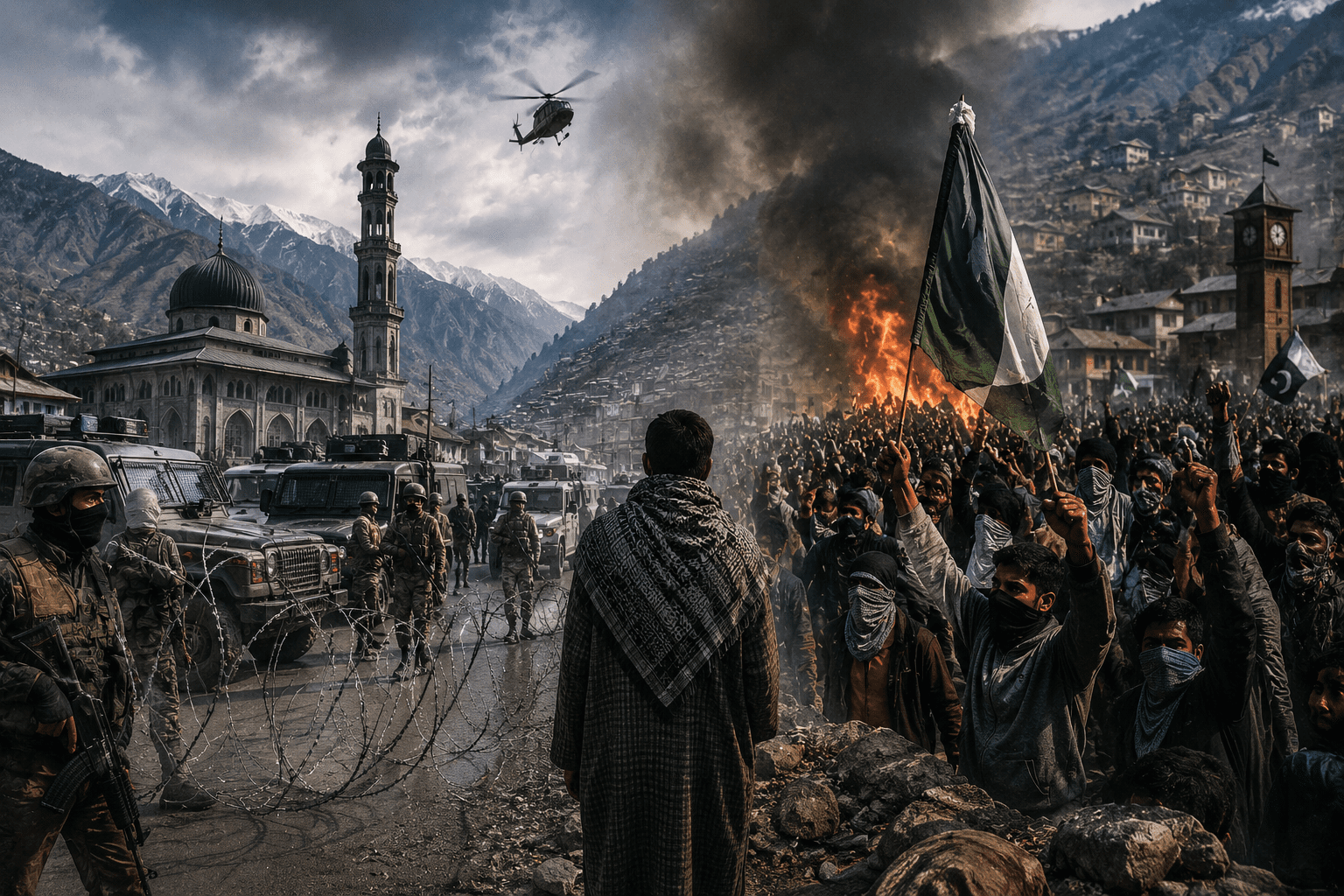
The geopolitical stability of South Asia has long hinged on the delicate and highly militarized Line of Control (LoC) separating India and Pakistan. However, in June 2026, the primary threat to this equilibrium did not emerge from cross-border shelling or conventional military maneuvers. Instead, an unprecedented wave of mass civil unrest has completely destabilized Pakistan-administered Jammu and Kashmir (commonly referred to as Azad Jammu and Kashmir, or PoK/PoJK).
The crisis reached a tipping point following a historic decree by the local Home Department proscribing the region’s largest grassroots civil-society coalition—the Jammu Kashmir Joint Awami Action Committee (JAAC)—under the Anti-Terrorism Act (ATA). This heavy-handed security response to a year-long mobilization over economic inflation, resource exploitation, and unfair political representation has ignited a firestorm of “uncontrolled protests.”
With more than 20 civilian casualties reported during intense clashes with law enforcement and paramilitary forces, the unrest has spilled over its administrative borders. It is triggering massive solidarity protests among displaced populations in Jammu and attracting intense scrutiny from global intelligence and policy circles. What began as a localized boycott against soaring electricity bills has rapidly mutated into a profound existential challenge to Islamabad’s administrative and constitutional grip over its disputed northern frontier.
Executive Summary
The Proscription Catalyst: On June 5, 2026, the regional government officially banned the Jammu Kashmir Joint Awami Action Committee (JAAC) under anti-terror legislation, shifting the crisis from an economic dispute to an open political confrontation.
The 12-Seats Flashpoint: Beyond core economic demands, the movement has unified around a highly contentious political issue: the complete abolition of the 12 reserved seats in the Legislative Assembly for Kashmiri refugees living outside the region in mainland Pakistan.
Resource Exploitation Grievance: Protestors demand that electricity generated from local Himalayan rivers (such as the Mangla Dam) be provided to residents at its baseline production cost, highlighting a structural disconnect where the region generates cheap power but faces exorbitant tariffs and rolling blackouts.
Severe Security Crackdown: A total communications blackout, including the suspension of mobile internet across major hubs like Muzaffarabad and Rawalakot, has failed to suppress coordinated strikes and deep-seated public anger.
Geopolitical Spillover: The unrest has completely altered the regional dynamic. India has actively highlighted the human rights situation across the LoC, while international observers view the breakdown of order as a symptom of Pakistan’s broader macroeconomic distress.
Chronological Evolution of the Unrest
To understand how a regional trade and civic alliance successfully challenged a nuclear-armed state’s security apparatus, it is essential to trace the operational timeline of the JAAC’s mobilization from localized economic grievances to widespread civil disobedience.
The Core Flashpoints: Deciphering the JAAC’s Demands
The architecture of the current unrest rests upon a 38-point Charter of Demands championed by the JAAC. While early international reporting focused primarily on the surface-level economic triggers—namely inflation and subsidy cuts—the movement has fundamentally evolved into a structural critique of how the territory is governed.
1. The Hydropower Pricing Paradox
The region serves as a crucial hydrological lifeline for Pakistan, producing over 3,000 megawatts of clean, inexpensive hydroelectricity via infrastructure like the Mangla Dam. This output accounts for nearly a third of Pakistan’s entire national power generation capability.
Despite this massive contribution, local consumers have historically been charged power tariffs up to five times higher than the actual cost of production. This inflation is driven by federal transmission levies, administrative surcharges, and debt-servicing costs passed down from Islamabad. The JAAC’s demand is clear and non-negotiable: electricity must be sold to local residents at its baseline generation cost, recognizing their inherent ownership rights over their natural resources.
2. The 12 Reserved Seats Controversy
The structural trigger that completely derailed recent negotiations is the layout of the regional Legislative Assembly. Out of the assembly’s total seats, 12 are explicitly reserved for Kashmiri refugees who fled conflicts in 1947, 1965, and 1971 but currently reside across various provinces in mainland Pakistan (such as Punjab and Sindh).
Regional Legislative Assembly Structure
┌────────────────────────────────────────────────────────┐
│  Local Constituencies (Voted by residents)             │
├────────────────────────────────────────────────────────┤
│  12 Reserved Refugee Seats (Voted in mainland Pakistan) │ ---> JAAC demands complete abolition
└────────────────────────────────────────────────────────┘
The JAAC and local civil society demand the complete abolition of these 12 seats due to structural flaws in how they impact local governance:
Political Manipulation: Because these voters reside in mainland Pakistan, the political party in power in Islamabad can easily manipulate these 12 seats. Winning this external bloc almost automatically guarantees the ability to form the regional government in Muzaffarabad, effectively bypassing the democratic choices of the actual residents living in the territory.
Dilution of Sovereignty: Local protestors argue that individuals who do not reside within the territory, pay taxes there, or endure its chronic infrastructural deficits should not hold the balance of power in their local parliament.
3. The Dismantling of Elite Privileges
As Pakistan navigated structural adjustments mandated by the International Monetary Fund (IMF) throughout 2024 and 2025, the burden of austerity fell heavily on ordinary citizens through subsidy cuts and tax hikes.
In sharp contrast, regional ministers, senior bureaucrats, and retired military personnel continued to enjoy extensive state-funded luxuries, including free electricity, premium fuel allocations, and elite official vehicles. The JAAC’s insistence on a comprehensive judicial commission to strip away these elite perks turned the movement into a populist struggle against deeply entrenched systemic corruption.
Geopolitical Analysis: The Regional Power Balance
The “uncontrolled” nature of these protests has fundamentally altered the strategic calculations of both Islamabad and New Delhi, creating immediate ripples across the wider subcontinent.
The Pakistan Dilemma: Internal Security vs. Geopolitical Narrative
For decades, Pakistan’s foreign policy has relied heavily on portraying the region under its control as a peaceful, self-governing entity (“Azad” or Free Kashmir) in stark contrast to the heavy security footprint in Indian-administered Jammu and Kashmir. The deployment of the Punjab Rangers, the implementation of total communications blackouts, and the categorization of local civil rights leaders as “terrorists” under the ATA has severely compromised this international narrative.
Furthermore, these protests coincide with deep economic instability within Pakistan. The federal government is trapped in a difficult cycle of meeting stringent IMF fiscal discipline targets while simultaneously trying to fund expensive local subsidies to prevent full-scale civil revolt.
The Indian Stance: A Proactive Diplomatic Pivot
Following India’s constitutional changes in August 2019, which revoked the special autonomous status of Jammu and Kashmir under Article 370, New Delhi has steadily increased its strategic focus on the territories across the LoC.
The June 2026 civilian casualties in Muzaffarabad have given India a major diplomatic opening. Massive solidarity rallies organized by displaced persons in Jammu have been used by India’s foreign policy establishment to shift international attention toward governance deficits and human rights conditions within Pakistan-administered territory.
Geoeconomic Analysis: Supply Chains and Macro Stress
The economic impact of the prolonged strikes, border closures, and general blockades across the territory has severely disrupted key regional trade routes and local markets.
| Economic Indicator | Pre-Protest Baseline | Current Crisis Impact (2026 Data) |
| Cross-Border Transit | Smooth flow of essential goods from Punjab hubs | Near-total paralysis; supply lines blocked for weeks |
| Local Inflation Rate | Stood at an already high 18-22% | Spiked past 35% due to severe artificial supply shortages |
| Hydropower Revenue | Steady financial transfers to federal grid | Disrupted by localized strikes and non-payment campaigns |
| Small Business Solvency | Gradual post-pandemic recovery for MSMEs | Widespread bankruptcies driven by weeks of forced shutdowns |
The IMF Conflict: The core of the issue is an irreconcilable macroeconomic contradiction. The IMF strictly prohibits Pakistan from deploying unbudgeted, untargeted subsidies. However, the JAAC’s non-negotiable demand for cheap flour and power means Islamabad must choose between violating its international loan conditions or facing total administrative collapse in a vital frontier region.
Procedural Response: The Security State’s Strategy
When confronted with massive civic defiance, the regional state apparatus systematically implemented a structured protocol designed to suppress the movement’s operational capabilities.
The State Suppression Playbook
Strategic Risks and Future Scenarios
As the JAAC leadership operates from underground and security forces maintain a strict lockdown, the crisis is rapidly moving toward three distinct potential outcomes.
1. The Best-Case Scenario: Structured Devolution
The federal government bypasses the local assembly’s elite structure to negotiate a direct, long-term economic package. This would involve legally binding guarantees on local hydropower royalties, a gradual phase-out of the 12 reserved refugee seats over future election cycles, and a mutual stand-down of security forces and protest organizers.
2. The Worst-Case Scenario: Full Administrative Collapse
The anti-terror ban completely eliminates any opportunity for peaceful dialogue, forcing the civic movement to transform into a more radical, armed underground resistance. In response, Islamabad would be forced to suspend the regional constitution and impose direct federal or military rule, creating a volatile security vacuum directly along the highly sensitive Line of Control.
3. The Most Likely Scenario: Chronic, Controlled Instability
The federal government will likely deploy temporary financial stop-gaps to lower prices just enough to fracture the protest coalition’s unity. Meanwhile, security forces will maintain selective communication blackouts and keep top leaders detained. This approach treats the immediate symptoms of the unrest without ever fixing the deeper structural flaws in how the region is governed.