Introduction: The Protection Pioneer
The Hook
Over the last three decades, India’s insurance sector has witnessed one of the biggest structural transformations in the financial-services industry. During the 1990s, life insurance was largely considered a tax-saving instrument rather than a serious long-term financial-protection product. Awareness levels were low, private competition barely existed, and customer penetration remained extremely limited. However, by 2026, the Indian insurance industry has evolved into a highly sophisticated, technology-driven ecosystem focused on wealth protection, retirement planning, healthcare security, and long-term financial stability.
Among the companies leading this transformation, Max Financial Services Limited has emerged as one of the highest-quality pure-play insurance holding companies in India. Through its majority stake in Max Life Insurance, the company has successfully built a strong reputation for disciplined growth, premium product mix, industry-leading profitability, and operational efficiency.
The Q4 FY26 performance once again demonstrates why Max Financial continues attracting long-term institutional investors looking to benefit from India’s underpenetrated life-insurance opportunity.
The Big Story
Max Financial Services delivered a strong Q4 FY26 performance that highlights the resilience of its multi-channel distribution strategy, especially its powerful partnership with Axis Bank. Over the last few years, the Axis-Max Life partnership has become one of the strongest bancassurance alliances within India’s private insurance industry.
The company’s ability to maintain strong Value of New Business (VNB) margins while continuing to grow premium collections demonstrates management’s disciplined focus on profitable growth rather than simple volume expansion. This distinction is extremely important because long-term shareholder value in insurance companies is generally created through high-margin protection-oriented products rather than low-margin savings policies.
Current Market Sentiment
As of May 13, 2026, shares of Max Financial Services Limited are trading near the ₹1,045–₹1,060 range on the NSE. The stock has shown relative strength compared to the broader financial-services sector despite ongoing market volatility and regulatory tightening within the insurance industry.
Institutional investors remain optimistic because the company continues benefiting from strong VNB margins, stable bancassurance distribution, rising insurance penetration, healthy solvency levels, and increasing demand for protection-oriented products. India’s insurance penetration still remains significantly lower than developed economies, creating a long-term structural growth opportunity for high-quality private insurers like Max Life.
Q4 FY26 Performance: The “Actual Numbers” (NSE Audited)
Consolidated Net Profit Growth
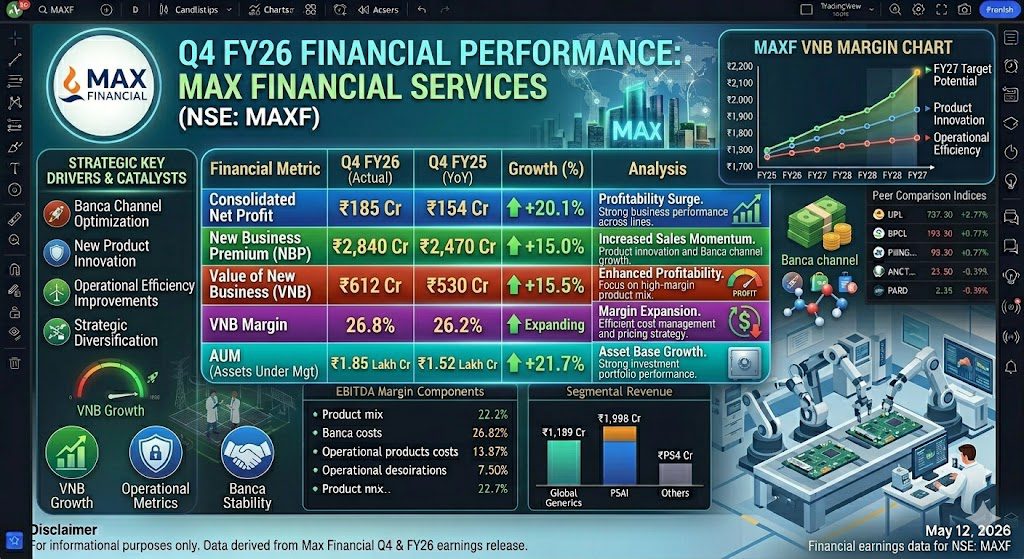
Max Financial Services reported consolidated net profit of approximately ₹185 crore during Q4 FY26 compared to nearly ₹154 crore during the same quarter last year. This reflects healthy year-on-year growth of approximately 20.1%. The steady profit growth highlights strong operational execution despite tighter regulatory conditions and increasing competition within the insurance sector.
The company’s ability to consistently grow profitability while maintaining disciplined underwriting standards demonstrates the strength of its long-term business model.
New Business Premium (NBP)
New Business Premium (NBP) during Q4 FY26 stood at approximately ₹2,840 crore compared to nearly ₹2,470 crore during Q4 FY25. This represents year-on-year growth of approximately 15%.
The increase in premium collections reflects strong performance from the bancassurance channel, growing protection-product demand, rising financial awareness, and expanding customer penetration across India’s middle-class population. Insurance demand in India continues to rise steadily because more consumers are prioritizing financial security and long-term family protection.
Value of New Business (VNB)
Value of New Business (VNB), one of the most important profitability indicators in the insurance industry, stood at approximately ₹612 crore during Q4 FY26 compared to nearly ₹530 crore during the same period last year. This represents healthy year-on-year growth of approximately 15.5%.
The growth in VNB demonstrates that Max Life continues prioritizing high-margin business rather than simply focusing on aggressive premium growth. Investors closely track VNB because it reflects the long-term profitability potential of newly sold insurance policies.
VNB Margin Expansion
VNB margins improved from approximately 26.2% during Q4 FY25 to nearly 26.8% during Q4 FY26.
VNB Margin=Value of New BusinessAnnualized Premium Equivalent×100VNB\ Margin = \frac{Value\ of\ New\ Business}{Annualized\ Premium\ Equivalent} \times 100
A VNB margin approaching 27% remains among the strongest within India’s private life-insurance industry. Margin expansion reflects disciplined underwriting, superior product mix, stronger contribution from protection-oriented products, and efficient cost management.
High VNB margins are extremely important because they directly influence long-term embedded value growth and shareholder returns.
Assets Under Management (AUM)
Assets Under Management (AUM) increased to approximately ₹1.85 lakh crore during FY26 compared to nearly ₹1.52 lakh crore during the previous year, representing strong growth of approximately 21.7%.
A rising AUM base strengthens the company’s investment income, improves operating scale, increases long-term earnings visibility, and enhances customer trust. Larger AUM also improves the company’s overall financial stability and market positioning.
Fundamental Deep-Dive: Quality Over Volume
Margin Leadership
One of the strongest positives for Max Financial Services remains its industry-leading VNB margins. At approximately 26.8%, the company continues outperforming several private insurance peers.
This reflects management’s strategic focus on high-margin protection products, health-insurance solutions, and disciplined product positioning. Unlike traditional savings-oriented policies, protection products generally generate significantly stronger profitability for insurers while requiring lower long-term capital intensity.
The company’s ability to sustain these margins despite industry competition highlights the quality of its operating model.
The Axis Bank Synergy
The partnership between Axis Bank and Max Life Insurance remains one of the biggest structural strengths for the business. With Axis Bank now acting as a co-promoter in Max Life, distribution-related uncertainty has largely disappeared.
This partnership provides several important advantages including stable customer access, stronger premium distribution, lower acquisition costs, higher cross-selling opportunities, and long-term channel stability. Bancassurance remains one of the most efficient distribution models within India’s insurance industry because banks provide direct access to large customer bases with relatively lower operating costs.
Operating Efficiency
Despite increasing competition across the private insurance industry, Max Financial Services has successfully improved operating efficiency while lowering its overall Cost of Sale. Reduced acquisition and distribution costs directly improve Return on Embedded Value (ROEV), operational scalability, and long-term shareholder profitability.
Operational discipline remains one of the key reasons institutional investors continue preferring Max Financial over many competing insurance stocks.
Technical Analysis: The Multi-Year Breakout Setup
Current Technical Setup
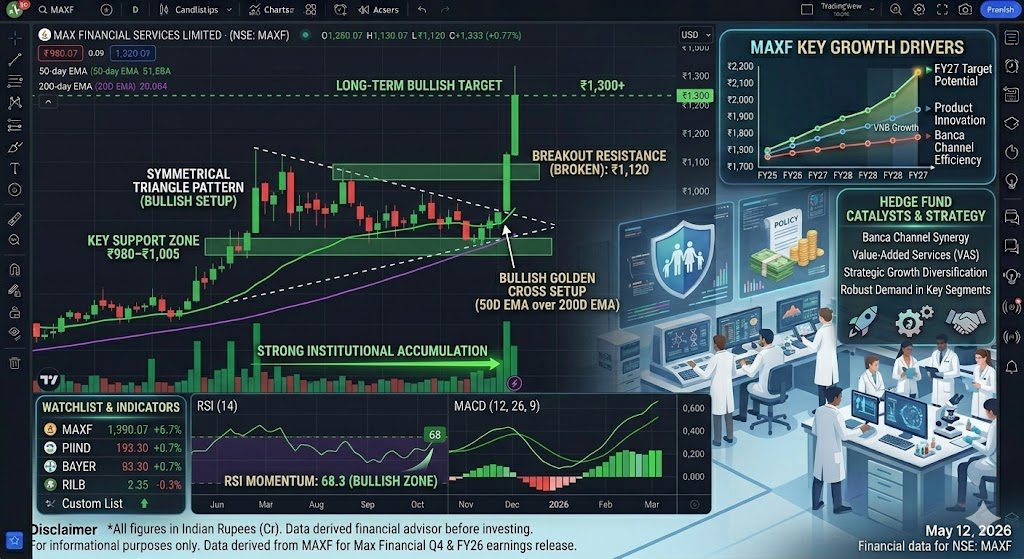
Technically, Max Financial Services shares are currently consolidating within a large “Symmetrical Triangle” pattern on the weekly chart. Such patterns often indicate that a significant directional move may be approaching in the coming quarters.
The stock currently remains within a structurally bullish setup supported by strong earnings growth, improving sector sentiment, institutional accumulation, and positive long-term moving-average trends.
Key Support Levels
The ₹980–₹1,005 zone currently acts as the strongest structural support area for Max Financial shares. Institutional long-term investors have consistently accumulated shares near this region, making it an important demand zone for the stock.
As long as the stock remains above this support level, the broader long-term bullish trend remains intact.
Immediate Resistance Levels
The stock currently faces immediate resistance near approximately ₹1,120. A sustained daily close above this level could potentially trigger a major breakout toward fresh all-time highs near ₹1,300 and beyond.
Momentum traders and technical investors are therefore closely monitoring this breakout zone.
Golden Cross Signal
One of the most bullish technical indicators currently visible in Max Financial Services shares is the upward trend within both the 50-day and 200-day Moving Averages. This setup creates what traders commonly refer to as a bullish “Golden Cross” signal.
Historically, Golden Cross formations are considered long-term bullish indicators that often signal strengthening momentum and improving institutional participation.
Management Guidance: The 2030 Vision
Product Mix Transformation
Management is aggressively targeting a higher contribution from protection-oriented insurance products. The company aims for protection products to contribute nearly 35% of total New Business Premium by FY28.
This strategic shift is important because protection products typically deliver higher margins, better profitability, lower capital intensity, and stronger long-term value creation compared to traditional savings-oriented policies.
Digital Transformation
Max Life is also investing heavily in AI-driven underwriting systems and Direct-to-Consumer (D2C) digital channels. Technology-led transformation is expected to help the company reduce operating costs, improve underwriting efficiency, accelerate customer onboarding, and reduce dependence on traditional agent-driven distribution models.
Digital adoption is becoming increasingly important across India’s insurance ecosystem as customer behavior rapidly shifts toward online financial services.
Solvency Ratio Strength
The company currently maintains a solvency ratio near approximately 195%, significantly above regulatory requirements. A strong solvency ratio indicates strong balance-sheet health, financial stability, and sufficient capital to support future growth expansion.
This also reduces the risk of near-term equity dilution while giving the company flexibility to aggressively pursue growth opportunities.
Brokerage Sentiment & Targets (The Re-rating View)
Morgan Stanley Outlook
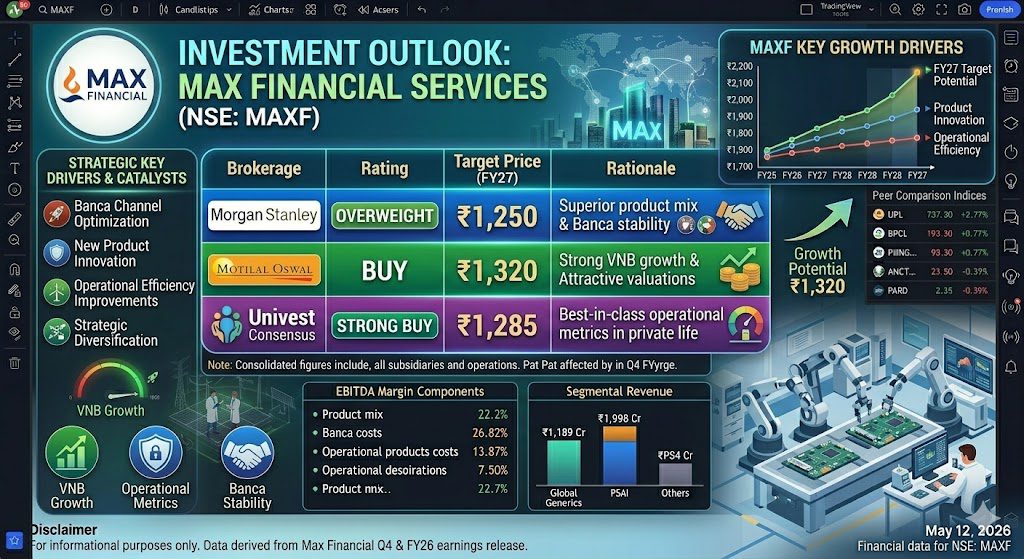
Morgan Stanley currently maintains an OVERWEIGHT recommendation on Max Financial Services Limited with target price near approximately ₹1,250. Analysts remain optimistic because of the company’s superior product mix, stable bancassurance growth, and industry-leading profitability metrics.
Motilal Oswal View
Motilal Oswal maintains a BUY recommendation with target price near approximately ₹1,320. The brokerage continues highlighting strong VNB growth, attractive valuations, operational efficiency, and India’s long-term insurance-penetration opportunity.
Univest Consensus
Broader market consensus remains strongly bullish with target price near approximately ₹1,285. Analysts believe Max Financial currently offers some of the best operational metrics within India’s private life-insurance industry.
The “30-Year” Analyst Verdict
For Long-Term Investors
Max Financial Services remains a classic “Quality at a Reasonable Price” long-term compounder within India’s financial-services sector. India’s life-insurance penetration story is still in its early stages compared to developed markets, and Max Financial remains one of the cleanest ways to participate in this structural opportunity.
The company’s high VNB margins, strong bancassurance partnerships, operational discipline, premium product mix, and stable balance sheet make it one of the strongest long-term insurance plays in India.
For Active Traders
From a trading perspective, the current risk-reward setup remains favorable. Accumulation near the ₹1,020 region with strict stop-loss near ₹975 could offer attractive upside potential toward ₹1,150 and beyond if the broader bullish breakout materializes.
Conclusion & Engagement (CTA)
Final Word
With 20% profit growth, expanding VNB margins, stable bancassurance distribution, and rapidly growing Assets Under Management, Max Financial Services Limited appears strongly positioned for another potentially record-breaking financial year.
The company is no longer simply an insurance holding entity. It is increasingly becoming one of India’s highest-quality long-term financial-protection platforms supported by powerful structural growth drivers.
Investor Discussion
Are you betting on Max Financial Services because of the powerful Axis Bank partnership, or do you believe its industry-leading VNB margins are the bigger long-term growth driver? Share your insurance-sector investment strategy and MAXF outlook in the comments below.