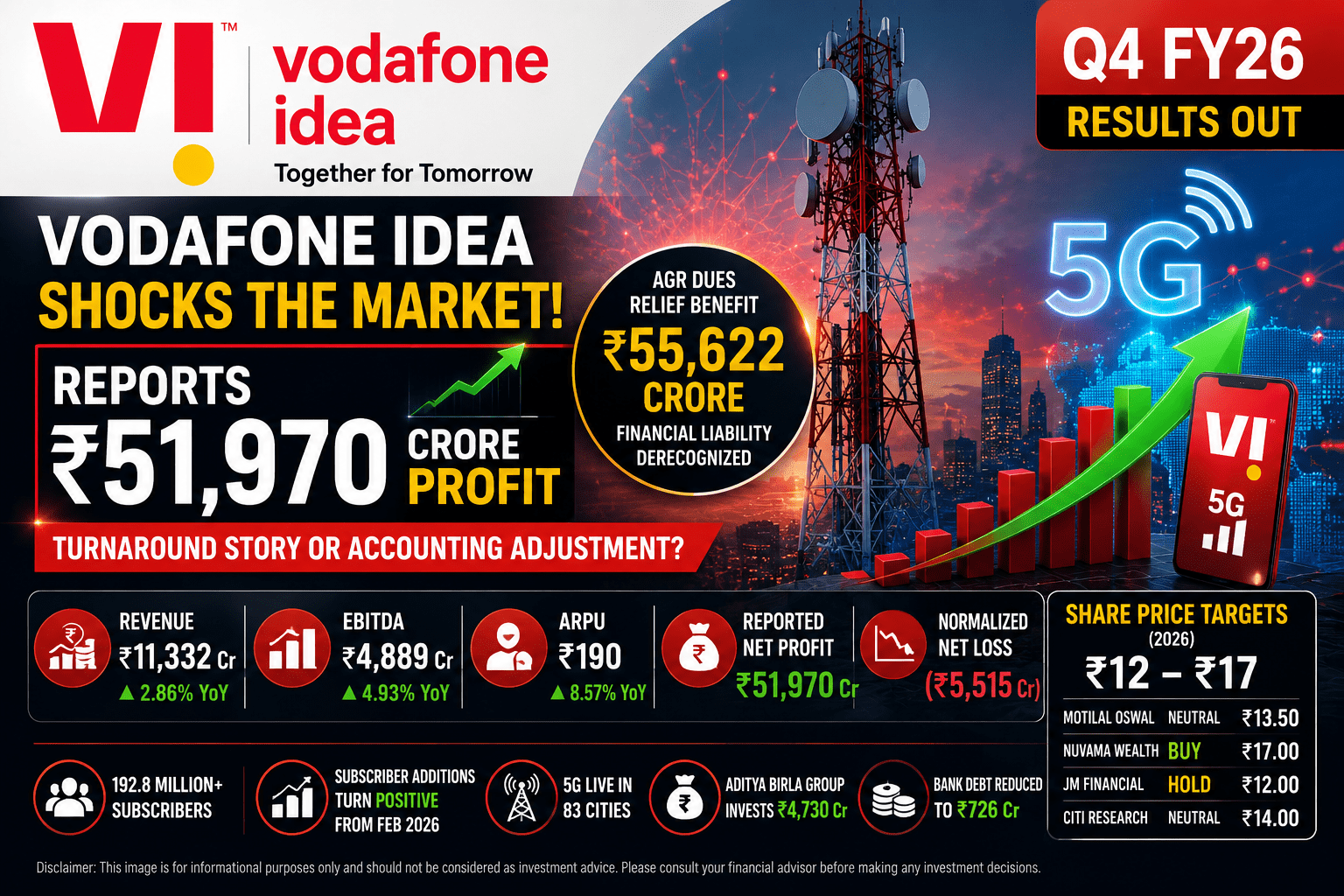
Vodafone Idea Limited shocked the Indian stock market after announcing its Q4 FY26 earnings on May 16, 2026. After struggling with continuous losses for almost six years, the telecom company suddenly reported a massive consolidated net profit of ₹51,970 crore. The number immediately became one of the biggest financial headlines in the Indian market because many investors initially believed such a huge profit looked impossible for a company that has spent years battling debt, subscriber losses, and survival concerns.
However, the reported profit is real. But the deeper reality behind the number is far more complex than the headline itself. The company’s massive profit was primarily driven by a one-time accounting adjustment linked to reassessed AGR liabilities rather than a sudden explosion in operational profitability. Even so, the quarterly report still contains several important positive signals that suggest Vodafone Idea’s long-term survival and turnaround prospects may now be improving.
With the stock becoming one of the highest-volume counters in the market on Monday, May 18, 2026, investors and traders are now trying to determine whether Vodafone Idea is finally entering a genuine recovery phase or whether the excitement surrounding the headline profit is temporary.
Quick Summary of Vodafone Idea Q4 FY26 Results
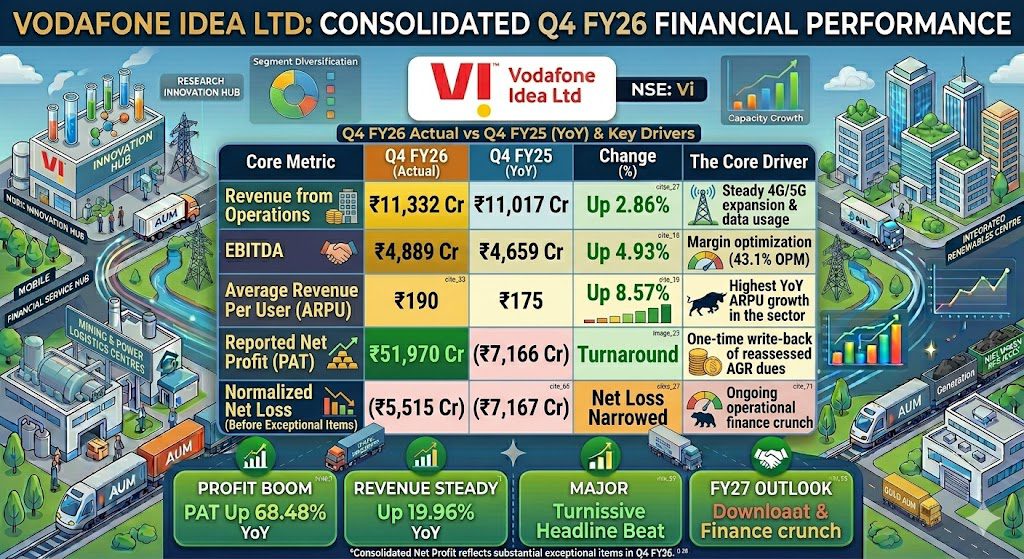
Vodafone Idea Limited reported consolidated revenue from operations of ₹11,332 crore during Q4 FY26 compared to ₹11,017 crore during the same quarter last year. This reflected moderate year-on-year growth of around 2.86%.
The company’s operational performance also showed improvement. EBITDA increased to ₹4,889 crore compared to ₹4,659 crore during Q4 FY25, while operating margins improved to 43.1%. One of the strongest positive developments came from ARPU, or Average Revenue Per User, which increased sharply to ₹190 compared to ₹175 last year. This represented the highest year-on-year ARPU growth among major Indian telecom operators during the quarter.
The biggest headline was the reported net profit after tax of ₹51,970 crore compared to a net loss of ₹7,166 crore during the same quarter last year.
However, investors must clearly understand that this massive profit was mainly created by a one-time accounting adjustment related to AGR liability reassessment.
If exceptional items are excluded, Vodafone Idea still reported a normalized net loss of ₹5,515 crore during the quarter. Even so, this operational loss was lower than the ₹7,167 crore loss reported during the previous year, indicating gradual operational improvement.
Company Profile: India’s Telecom Survival Story
Vodafone Idea Limited was formed in 2018 through the merger of Vodafone India and Idea Cellular. The merger was originally designed to create a stronger telecom player capable of competing against the rapidly growing dominance of Reliance Jio Infocomm Limited and Bharti Airtel Limited.
However, instead of creating a stable telecom giant, the merged company soon became trapped under enormous financial pressure. Aggressive price wars, rising network investment requirements, spectrum liabilities, and huge AGR dues pushed Vodafone Idea into one of the most difficult corporate situations in India’s telecom history.
Over the last several years, the company continuously lost subscribers while facing serious challenges in raising fresh capital and maintaining network competitiveness. Many market participants even questioned whether Vodafone Idea could survive long term.
Despite these challenges, the company still retains a massive subscriber base of approximately 192.8 million customers. This remains strategically important because the Indian government strongly prefers maintaining a three-player telecom structure rather than allowing a complete duopoly between Jio and Airtel.
The Government of India itself now holds a significant equity stake in Vodafone Idea after converting part of the company’s liabilities into equity. This effectively provides a powerful structural support system for the company’s long-term survival prospects.
Understanding the ₹51,970 Crore Profit
The most important aspect of Vodafone Idea’s Q4 FY26 results is understanding exactly how the company suddenly reported such a massive profit.
The primary reason was the reassessment of historical AGR liabilities by the Department of Telecommunications (DoT).
Earlier, Vodafone Idea’s AGR liabilities were estimated at approximately ₹87,695 crore. However, after reassessment, the liabilities were reduced to around ₹64,046 crore.
This reduction triggered a major accounting adjustment under Ind AS 109 accounting standards. As a result, Vodafone Idea derecognized approximately ₹55,622 crore worth of financial liabilities, and this amount was directly credited into the company’s profit-and-loss statement.
This accounting adjustment transformed the company’s reported numbers from a large net loss into a huge profit.
However, the operational business itself still remains under pressure. After removing exceptional accounting gains, Vodafone Idea continued reporting a quarterly operational net loss of ₹5,515 crore.
Even so, there is an important positive signal hidden inside this number. The operational loss narrowed meaningfully compared to the ₹7,167 crore loss reported during the same quarter last year. This indicates that while the company still faces financial challenges, the core operational business is gradually stabilizing.
Fundamental Analysis: Why the Turnaround Story Is Becoming Stronger
For years, Vodafone Idea was viewed mainly as a distressed survival trade. However, several structural developments are now slowly improving the company’s long-term outlook.
One of the biggest positives from the latest results was subscriber stabilization. Management confirmed that monthly subscriber additions turned net positive starting from February 2026. This is extremely important because continuous subscriber losses had become one of the company’s biggest long-term concerns.
The stabilization suggests that network improvements and expanding 4G and 5G services are gradually helping the company retain and attract customers again.
ARPU growth also emerged as a major positive factor. Average Revenue Per User increased sharply to ₹190 from ₹175 last year. This indicates that customers are increasingly upgrading toward premium 4G and newly launched 5G plans, improving revenue quality.
The company’s 4G and 5G data-user base also expanded to approximately 128.9 million subscribers during the quarter.
Another important development came from the Aditya Birla Group, which announced a fresh equity infusion of ₹4,730 crore through fully convertible warrants following the earnings release.
This capital commitment sends a strong confidence signal to lenders, institutional investors, and the broader market. It also improves Vodafone Idea’s ability to negotiate additional financial support from banks and other institutions.
The company also managed to reduce its bank debt sharply. Bank debt reportedly fell by nearly two-thirds and now stands near ₹726 crore. Although overall spectrum liabilities remain extremely large, this reduction still represents meaningful financial progress.
Technical Analysis: Key Trading Levels Investors Should Watch
Technically, Vodafone Idea remains one of the most volatile telecom stocks in the Indian market.
The stock closed last week near the ₹12.95–₹13.10 range and is currently witnessing extremely high trading volumes as retail investors react aggressively to the massive profit headline.
The most important technical pivot level remains ₹12. As long as the stock continues trading above this level, the broader bullish reversal structure remains intact.
Immediate resistance exists near the 52-week high zone around ₹13.33. A decisive breakout above this level could potentially trigger another momentum rally toward ₹15.50.
Beyond that, the next major structural resistance zone remains near ₹18.
On the downside, immediate support exists near ₹12.40 followed by ₹11.20. The strongest long-term accumulation zone remains near ₹8, which previously acted as a major support base during extended consolidation phases.
From a trading perspective, volatility is likely to remain extremely high because retail enthusiasm regarding the headline profit is directly colliding with institutional caution regarding the company’s still-heavy liabilities.
Management Guidance: Aggressive 5G Expansion Plans
Management commentary following the earnings release focused heavily on future network expansion and 5G rollout execution.
Vodafone Idea confirmed that commercial 5G services are now scaling across 83 cities. Management plans to aggressively expand services across all 17 priority telecom circles within the next six months.
The company’s annual capital expenditure target currently stands near ₹8,742 crore.
Management’s primary objective remains expanding 4G population coverage beyond 95% while simultaneously monetizing premium enterprise-focused 5G services.
This strategy is extremely important because Vodafone Idea’s long-term survival depends heavily on improving network quality and reducing the service gap compared to competitors like Jio and Airtel.
Brokerage Outlook and Institutional Target Prices
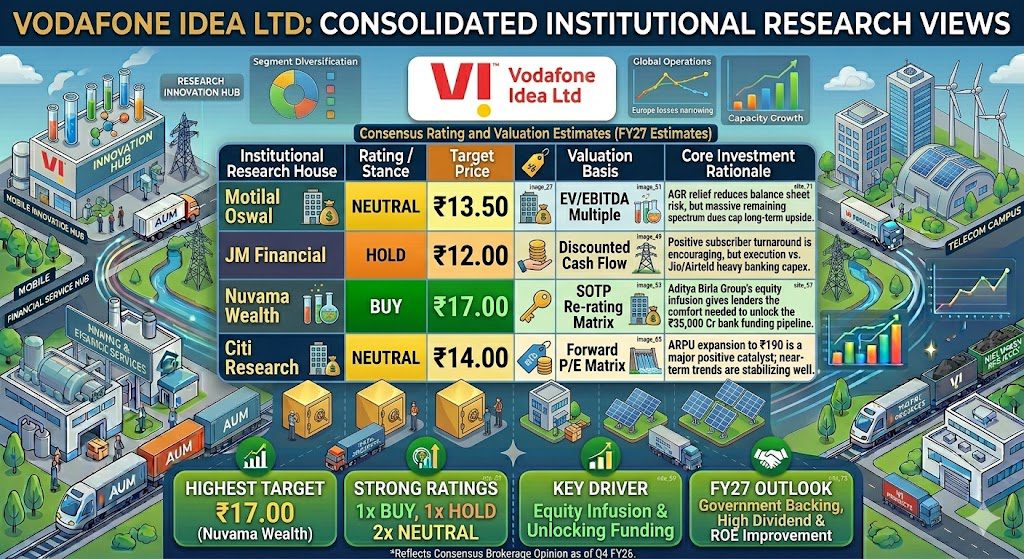
Institutional brokerage views on Vodafone Idea Limited remain sharply divided despite the sensational profit announcement.
Motilal Oswal currently maintains a NEUTRAL rating with a target price of ₹13.50, arguing that AGR relief significantly reduces balance-sheet risks but large remaining spectrum liabilities still limit long-term upside.
JM Financial maintains a HOLD rating with a target price near ₹12, highlighting improving subscriber trends while warning that competing effectively against Jio and Airtel still requires enormous future capital expenditure.
Nuvama Wealth remains one of the more bullish brokerage firms with a BUY rating and a target near ₹17. The brokerage believes the Aditya Birla Group’s fresh capital infusion could unlock additional banking support and strengthen future network expansion.
Citi Research maintains a NEUTRAL stance with a target near ₹14, highlighting improving ARPU growth and stabilizing operational trends.
Overall, institutional target prices currently remain concentrated between ₹12 and ₹17, reflecting improving optimism alongside continuing structural risk concerns.
Should You Buy, Hold, or Sell Vodafone Idea Shares?
For high-risk investors, Vodafone Idea’s latest quarterly results may represent the beginning of a genuine structural turnaround story.
The combination of AGR relief, subscriber stabilization, improving ARPU, promoter capital infusion, debt reduction, and ongoing government support significantly improves the company’s long-term survival probability.
However, investors must also remain realistic because Vodafone Idea still carries enormous spectrum liabilities and continues reporting operational losses even after excluding exceptional accounting gains.
For long-term speculative investors willing to tolerate very high volatility and risk, gradual accumulation during corrections may offer attractive turnaround potential over the coming years.
For short-term traders, discipline remains extremely important. Blindly chasing sharp rallies near resistance zones could become risky because the stock remains highly sentiment-driven and volatile.
A healthier strategy may involve waiting for consolidation near the ₹12 pivot zone before considering fresh momentum entries with proper risk management.
For official company disclosures and exchange filings, investors can also monitor updates through NSE India Official Website.