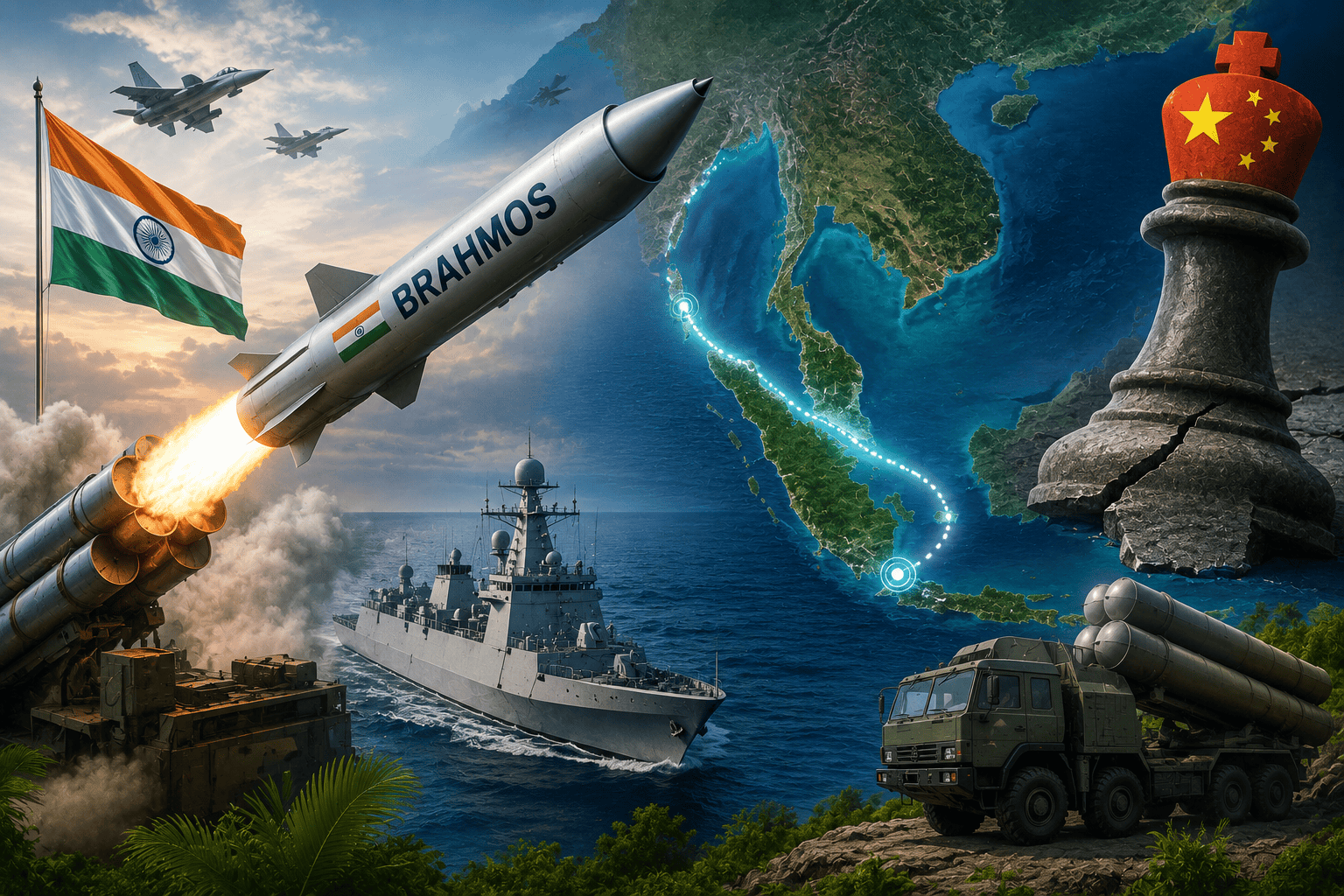
Geography is the oldest determinant of geopolitics. Look at a map of the Indo-Pacific, and your eyes will inevitably be drawn to a narrow, 550-mile stretch of water separating the Malay Peninsula from the Indonesian island of Sumatra: the Strait of Malacca.
Through this natural chokepoint flows roughly 30% of all global maritime trade and approximately 80% of China’s oil imports. For Beijing, it is a vital artery; for strategic planners in Washington, London, and New Delhi, it is China’s ultimate Achilles’ heel.
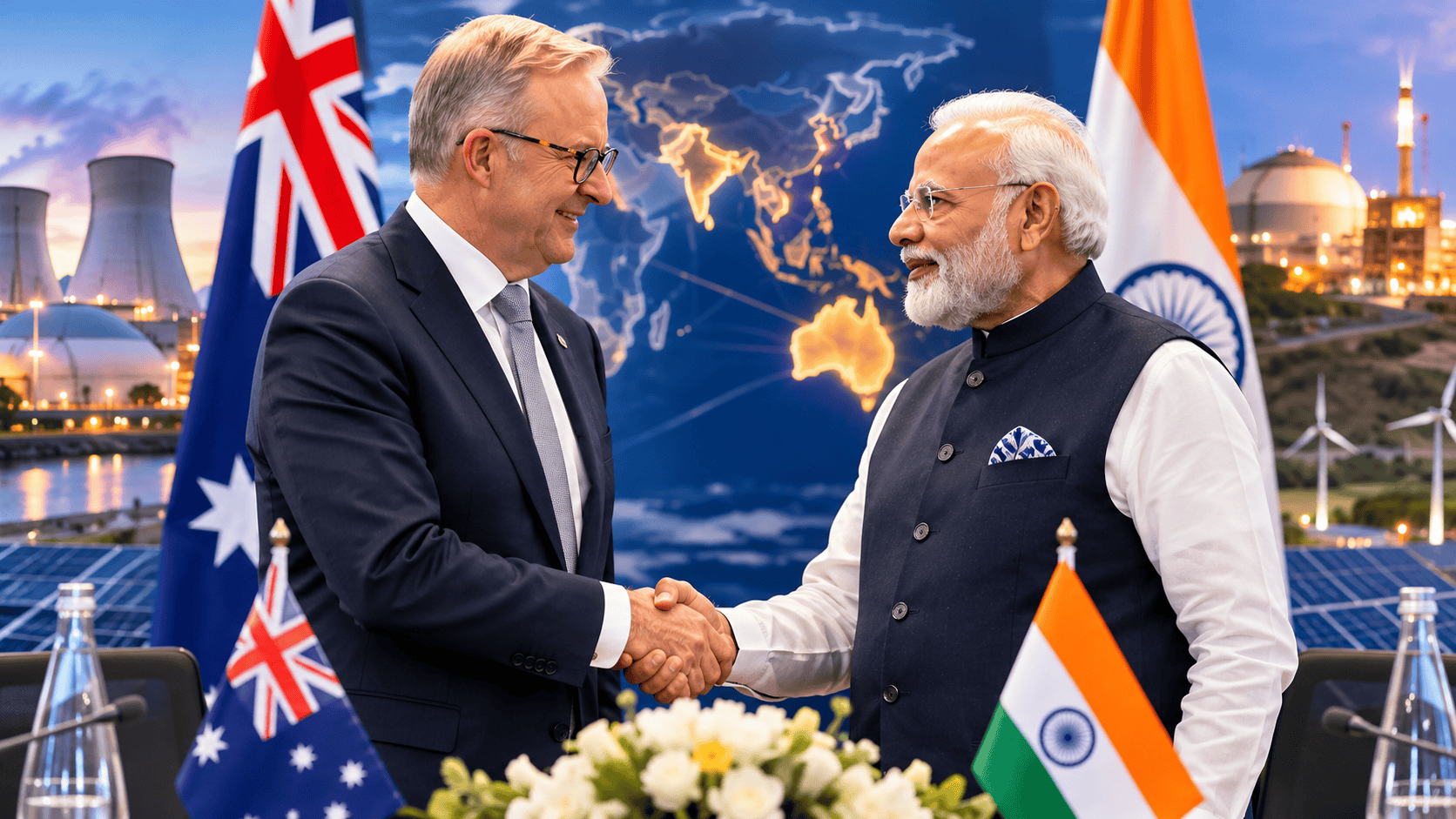
Currently, a quiet but profound strategic convergence is taking place precisely at the mouth of this strait. The Republic of India and the Republic of Indonesia—the two largest democracies in the region—are intertwining their maritime and defense architectures. Driven by New Delhi’s access to the deep-water port of Sabang (Indonesia) and Jakarta’s advanced interest in acquiring India’s lethal BrahMos supersonic cruise missiles, this alignment is generating shockwaves in diplomatic circles.
But is this the geopolitical masterstroke that popular defense commentators claim it is? Is India genuinely building a maritime chokehold to counter China’s aggressive Himalayan postures, or is the reality more nuanced? In this comprehensive investigation, we strip away the nationalist rhetoric to analyze the verified data, the geoeconomic stakes, and the true strategic consequences of the Sabang-BrahMos equation for the United States, Europe, and the broader Indo-Pacific.
1. Executive Summary: 10 Key Strategic Findings
- The Geographic Masterkey: Sabang Port sits at the northern entrance of the Malacca Strait, just 80 nautical miles from India’s Andaman and Nicobar Islands, creating a potential cross-strait surveillance and deterrence umbrella.
- The “Malacca Dilemma”: China remains structurally vulnerable to any naval blockade in the Malacca Strait. A coordinated Indo-Indonesian maritime posture directly exploits this vulnerability.
- BrahMos as a Game Changer: If Indonesia finalizes the procurement of the BrahMos cruise missile, it gains an Anti-Access/Area Denial (A2/AD) capability capable of targeting naval assets within a 290-kilometer radius of its shores.
- Commercial vs. Military Use: Current verified agreements regarding Sabang pertain to commercial deep-sea port development and connectivity, not a sovereign Indian military base, despite frequent media mischaracterization.
- ASEAN Hedging: Indonesia is utilizing Indian defense cooperation to hedge against Chinese coercion in the Natuna Sea without defaulting to a formal U.S. military alliance, preserving “ASEAN Centrality.”
- India’s Defense Export Push: The potential BrahMos sale to Indonesia (following a successful $375M deal with the Philippines) signals India’s transition from the world’s largest arms importer to a net security provider in Southeast Asia.
- Supply Chain Security: For the US, UK, and Europe, a stable Malacca Strait managed by democratic allies ensures the uninterrupted flow of trillions of dollars in electronics, energy, and manufactured goods.
- The “Necklace of Diamonds”: Sabang represents a critical node in India’s unofficial counter-strategy to China’s “String of Pearls” maritime encirclement.
- Economic Integration: The defense pacts are moving in tandem with geoeconomic agreements, including local currency trade settlements and critical mineral (nickel) supply chains.
- The Uncertainty Factor: Indonesia’s deep economic reliance on Chinese infrastructure investments (Belt and Road Initiative) serves as a natural brake on how far Jakarta will push military cooperation with New Delhi.
2. Historical Background & Timeline
To understand the current dynamics, one must look at the evolution of the India-Indonesia strategic partnership. Both nations share civilizational links dating back millennia to the Chola Dynasty, and they were founding pillars of the Non-Aligned Movement (NAM) in the 1950s. However, their modern defense convergence is a direct response to 21st-century power shifts.
Timeline of Strategic Convergence:
- 2018: Indian Prime Minister Narendra Modi visits Jakarta. Ties are elevated to a “Comprehensive Strategic Partnership.” Crucially, the two nations agree to develop connectivity between the Andaman & Nicobar Islands and Aceh (where Sabang is located).
- 2019: Indian naval vessels begin making port calls at Sabang. An Indian naval ship, INS Sumitra, becomes the first to berth at the port following the 2018 agreement, signaling growing interoperability.
- 2020-2021: The Galwan Valley clashes between India and China prompt New Delhi to aggressively seek asymmetric leverage against Beijing. Simultaneously, Chinese coast guard incursions into Indonesia’s Exclusive Economic Zone (EEZ) in the Natuna Sea push Jakarta to modernize its military.
- 2022: India successfully signs a $375 million contract to export BrahMos shore-based anti-ship missiles to the Philippines, breaking the psychological barrier of exporting lethal offensive weaponry to ASEAN nations.
- 2023-Present: Advanced negotiations are reported between BrahMos Aerospace (an Indo-Russian joint venture) and the Indonesian Ministry of Defense under Prabowo Subianto for the acquisition of the missile system.
3. What Actually Happened? (Confirmed Facts vs. Proposals)
In geopolitical analysis, precision is paramount. The narrative surrounding Sabang and BrahMos is often clouded by sensationalism. Here is the verified reality:
The Sabang Port Agreement:
- Verified Fact: India and Indonesia have agreed to jointly develop the deep-sea port of Sabang for commercial, logistical, and economic connectivity.
- Verified Fact: Indian naval ships possess permission to make logistical port calls at Sabang for refueling and resupply.
- What is Unconfirmed/False: India is not building a sovereign naval base in Sabang. Indonesia’s constitution and foreign policy strictly prohibit foreign military bases on its soil.
The BrahMos Missile Negotiations:
- Verified Fact: Indonesia’s Ministry of Defense has expressed formal interest in acquiring the BrahMos missile system. Technical delegations have visited India.
- Verified Fact: Indonesia has been actively modernizing its navy and coastal defenses, buying Rafale jets from France and frigates from Italy and the UK.
- What is Unconfirmed: As of the latest official public records, a definitive, signed, and financially cleared contract for BrahMos delivery to Indonesia is pending final budgetary approvals in Jakarta.
💡 Key Takeaway for Defense Professionals: The power of the Sabang-BrahMos dynamic lies not in a formal military alliance, but in strategic ambiguity and interoperability. The mere existence of logistical access and potential missile deployments alters the risk calculus for any hostile navy entering the Malacca Strait.
4. Deep Geopolitical Analysis: The Malacca Dilemma & A2/AD
To understand why this matters to policymakers in Washington, London, and Brussels, we must analyze the naval architecture of the Indo-Pacific.
China’s Malacca Dilemma Coined in 2003 by then-Chinese President Hu Jintao, the “Malacca Dilemma” refers to China’s deep strategic vulnerability. If a major conflict were to break out (for instance, over Taiwan), the US Navy, potentially aided by the Indian Navy, could blockade the Strait of Malacca. Because alternative routes (like the Sunda or Lombok straits) are longer and ecologically restricted for supertankers, a Malacca blockade would literally starve China’s economy of energy within months.
The “Necklace of Diamonds” Counter-Strategy For a decade, China has pursued a “String of Pearls” strategy—building commercial ports with dual-use military potential in Myanmar, Sri Lanka, Pakistan, and Djibouti to encircle India. In response, India has cultivated its own “Necklace of Diamonds” strategy. By securing access to Duqm (Oman), Changi (Singapore), Agalega (Mauritius), and now Sabang (Indonesia), India is ensuring it can project power and monitor choke points across the entire Indian Ocean Region (IOR).
The A2/AD Bubble If Indonesia acquires the BrahMos missile, it fundamentally alters the tactical environment. The BrahMos is a Mach 3 (supersonic) cruise missile with a range of approximately 290 kilometers. If shore-based BrahMos batteries are deployed by the Indonesian military (TNI) along the Sumatran coast or near the Natuna Sea, they create an Anti-Access/Area Denial (A2/AD) “bubble.”
- The Strategic Result: Any hostile naval task force attempting to transit the straits or operate in Indonesia’s EEZ would be within the immediate crosshairs of a missile that is nearly impossible to intercept with current ship-borne defense systems.
5. Deep Geoeconomic Analysis
The Sabang-BrahMos convergence is not solely about war-gaming; it is a geoeconomic mechanism designed to protect global wealth.
Securing Sea Lines of Communication (SLOC) Nearly 100,000 vessels transit the Malacca Strait annually, carrying roughly $3.5 trillion in global trade. For the European Union and the United States, this strait is the primary conduit for semiconductor exports from Taiwan and South Korea, electronics from Southeast Asia, and energy flows from the Middle East to East Asia. If the strait is destabilized by piracy, terrorism, or state-sponsored gray-zone coercion, maritime insurance premiums would skyrocket. A joint Indo-Indonesian security umbrella stabilizes this vital economic artery, indirectly subsidizing global supply chain resilience.
India’s Defense Industrial Base Geoeconomically, exporting the BrahMos represents a paradigm shift for India. For decades, India was the world’s largest arms importer, heavily reliant on Russia and the West. Securing big-ticket exports to ASEAN nations (Philippines, potentially Indonesia and Vietnam) brings in vital foreign exchange, achieves economies of scale for India’s Defense Research and Development Organisation (DRDO), and binds ASEAN security directly to India’s defense industrial base.
The Blue Economy & Infrastructure Sabang’s development is intended to spur the “Blue Economy.” Enhancing Sabang allows for better deep-sea fisheries management, tourism, and potentially the laying of secure, non-Chinese undersea data cables linking the booming tech hubs of Bangalore and Hyderabad directly to Southeast Asia.
6. Country-by-Country Impact
- India: Upgrades its status from an Indian Ocean power to a credible Indo-Pacific security provider. It gains asymmetric leverage to deter Chinese aggression in the Himalayas by holding China’s maritime lifeline at risk.
- Indonesia: Strengthens its strategic autonomy. Jakarta gains advanced deterrent capabilities against illegal fishing and coercion in the Natuna Sea without having to sign a restrictive defense treaty with the United States.
- China (PRC): Faces a significant strategic complication. The PLA Navy (PLAN) is rapidly expanding its aircraft carrier fleet, but those carriers must pass through the Malacca or Sunda straits to enter the Indian Ocean. An Indo-Indonesian “wall” of radar, P-8I surveillance planes (from the Andamans), and supersonic missiles vastly increases the risk to Chinese naval assets.
- United States: A massive strategic win. The US Indo-Pacific Command (INDOPACOM) is stretched thin. If democratic partners like India and Indonesia can secure the Indian Ocean and Malacca on their own, the US Navy can concentrate its forces on the First Island Chain (Taiwan, Japan, Philippines).
- European Union & UK: Aligns with the EU’s Indo-Pacific strategy, which emphasizes freedom of navigation, supply chain security, and the rule of international maritime law (UNCLOS).
7. Data Analysis: The Metrics of the Strait
(Note: Data points are derived from global maritime databases such as the UNCTAD Review of Maritime Transport and IEA reports).
| Metric | Estimated Data | Geopolitical Implication |
|---|---|---|
| Malacca Strait Traffic | ~90,000 to 100,000 vessels/year | The highest density shipping lane globally; any disruption causes immediate global supply chain shocks. |
| China’s Oil Reliance | ~80% of oil imports via Malacca | Beijing’s economy remains highly vulnerable to a maritime blockade at this chokepoint. |
| Sabang to Andamans | ~80 Nautical Miles | Close enough for overlapping maritime patrol radar, ensuring total visibility of surface vessel movements. |
| BrahMos Range | 290 km (Export Variant) | Shore batteries in Sumatra could theoretically range across the entire width of the Malacca Strait. |
| BrahMos Speed | Mach 2.8 – 3.0 | Kinetic energy upon impact is immense; extremely difficult for standard point-defense systems to intercept. |
8. Expert Perspectives: The Debate
International relations scholars and maritime strategists are divided on the ultimate impact of the Sabang-BrahMos dynamic.
The Strategic Optimists (e.g., Think tanks like CSIS, ORF): They argue that India is finally shedding its historical hesitations. By weaponizing geography (the Andaman-Sabang axis) and exporting advanced technology (BrahMos), India is enforcing a balance of power in Asia. They view this as the perfect realization of “minilateralism”—small, issue-specific partnerships that bypass the paralyzed UN system.
The Economic Realists: Economists caution against overstating the military threat. They point out that Indonesia’s economy is deeply intertwined with China. Beijing is Indonesia’s largest trading partner and a massive investor in its nickel processing and high-speed rail (e.g., the Jakarta-Bandung line). Realists argue that Jakarta will never allow its soil or weapons to be used in a US-China or India-China proxy war because the economic blowback from Beijing would crash the Indonesian economy.
The Maritime Skeptics: Naval purists argue that while BrahMos is potent, missiles alone do not win wars. Maintaining a persistent blockade of the Malacca Strait requires a massive, sustained naval presence, anti-submarine warfare (ASW) capabilities, and the political will to sink commercial shipping—a massive escalation that no nation will take lightly.
9. Reality Check: Myths vs. Verified Facts
- Myth: India and Indonesia have a mutual defense treaty.
- Fact: They share a “Comprehensive Strategic Partnership.” Neither nation is bound by a NATO-style Article 5 collective defense treaty. They are cooperating based on aligned interests, not binding military obligations.
- Myth: The BrahMos missile allows India to attack China from Indonesia.
- Fact: If exported, the BrahMos missiles would belong to the Indonesian Armed Forces (TNI), operated by Indonesian personnel for Indonesian sovereign defense. India does not control the weapons post-sale.
- Myth: China can easily bypass Malacca by building pipelines through Myanmar or Pakistan (CPEC).
- Fact: While China has built pipelines to reduce reliance on Malacca, the volumetric capacity of these overland pipelines is a mere fraction of what Supertankers (VLCCs) can carry. Malacca remains indispensable to Beijing.
10. Future Scenarios (2026–2030)
The Best-Case Scenario (Stable Deterrence): India and Indonesia successfully develop Sabang into a thriving commercial hub with robust dual-use logistics. Indonesia procures the BrahMos and integrates it into a coastal defense network. The presence of this deterrent establishes a “new normal,” dissuading Chinese maritime militia or naval incursions into the Natuna Sea, leading to a stable, rules-based balance of power in Southeast Asia.
The Worst-Case Scenario (Economic Retaliation & Escalation): China perceives the Sabang-BrahMos cooperation as an unacceptable threat to its survival. Beijing retaliates geoeconomically by sanctioning Indonesian nickel exports and pulling infrastructure funding. Simultaneously, the PLAN increases submarine deployments in the Indian Ocean, triggering a dangerous arms race and frequent close-calls between Indian, Indonesian, and Chinese naval vessels.
The Most Likely Scenario (Pragmatic Hedging): Progress remains steady but slow. Indonesia buys a limited number of BrahMos batteries specifically for defense of its own EEZ, explicitly denying that they are aimed at China. Sabang sees increased commercial traffic and occasional Indian naval port calls, but Jakarta meticulously balances the optics to assure Beijing that it remains economically open and militarily non-aligned.
11. Editorial Analysis
This section represents an analytical synthesis based on current geopolitical evidence.
The narrative that India has found China’s “Achilles’ Heel” is an oversimplification, but it contains a profound strategic truth.
The Sabang-BrahMos dynamic represents the end of an era in Asian geopolitics. For decades, the security architecture of the Indo-Pacific was viewed through a binary lens: the United States versus China. What India and Indonesia are demonstrating is the rise of a multipolar Asia where middle and major powers are asserting their own agency.
By combining India’s technological and naval capacity with Indonesia’s vital geography, the Global South is proving it does not need to choose between a “Pax Americana” and a “Pax Sinica.”
However, Western analysts must not misinterpret this as Indonesia joining a US-led containment ring against China. Jakarta’s ultimate goal is internal stability and economic growth. The BrahMos missile and the Sabang port access are tools of deterrence, not aggression. They are designed to raise the cost of Chinese coercion just enough to maintain the status quo. In the high-stakes chess match of the Indo-Pacific, India has successfully advanced its pieces to control the center of the board, but the game is far from over.
12. Key Takeaways
- For US & European Policymakers: Support Indo-Indonesian integration. A secure Malacca Strait managed by democratic Asian powers relieves pressure on Western naval assets and ensures supply chain security.
- For Investors & the Maritime Industry: Monitor the development of Sabang port. If infrastructure improves, it could become a lucrative node for regional transshipment, shipping insurance, and the blue economy.
- For Defense Professionals: The proliferation of advanced supersonic cruise missiles (like BrahMos) to Southeast Asian nations fundamentally alters the A2/AD environment, making traditional blue-water naval projection highly dangerous for any invading force.
- For General Readers: The biggest shifts in global power are not always marked by wars; they are often defined by who controls the ports, the straits, and the technology that guards them.
13. Conclusion
The geographical reality of the Strait of Malacca ensures that whoever monitors its waters holds immense leverage over the global economy. As India deepens its footprint in Sabang and facilitates the export of lethal deterrents like the BrahMos to Indonesia, New Delhi is shifting from a defensive posture in the Himalayas to an offensive maritime strategy in the Indian Ocean.
While it may not completely sever China’s Achilles’ heel, the Sabang-BrahMos axis places a very sharp blade right against it. Over the next decade, the management of this strategic chokepoint by India and Indonesia will be one of the most critical determinants of peace, prosperity, and power in the Indo-Pacific.
Sources & Further Reading:
- Ministry of External Affairs, Government of India: Bilateral Briefs on India-Indonesia Relations.
- Stockholm International Peace Research Institute (SIPRI): Arms Transfers Database.
- Center for Strategic and International Studies (CSIS): Asia Maritime Transparency Initiative (AMTI) Reports on the South China Sea and Malacca Strait.
- United Nations Conference on Trade and Development (UNCTAD): Review of Maritime Transport.
Editorial Transparency Note: This article provides an analytical assessment based on the latest publicly available, verified information regarding diplomacy, defense negotiations, and maritime trade statistics at the time of writing. Evolving geopolitical events, classified defense contracts, and shifting economic policies may alter strategic outcomes as new official information becomes available.