
1. Introduction: The Bittersweet Beat
If you’ve followed PSU banks over the last few decades, you’ll know that they often deliver surprises—but not always the kind investors expect. The Union Bank of India Q4 Results FY26 Analysis is a perfect example of this paradox.
The Hook
On paper, the results look solid. The bank reported a ₹5,316 crore net profit, beating expectations. But within hours, the stock dropped nearly 8% intraday. This is where the market teaches an important lesson—not all profit growth is equal.
The Reality Check
The stock fell sharply to around ₹178, and that drop tells you more than the headline profit number. Retail investors may celebrate profit growth, but institutional investors—the so-called “smart money”—are looking deeper. Their concern? A 1.1% decline in Net Interest Income (NII), which is the core earning engine of any bank.
Analyst Note
This quarter is best understood as a “margin squeeze story.” Banks across India are facing rising deposit costs, and Union Bank is no exception. The cost of attracting deposits is increasing faster than the returns on loans, putting pressure on margins.
2. Q4 FY26 Financial Scorecard: Profit vs. Core Income
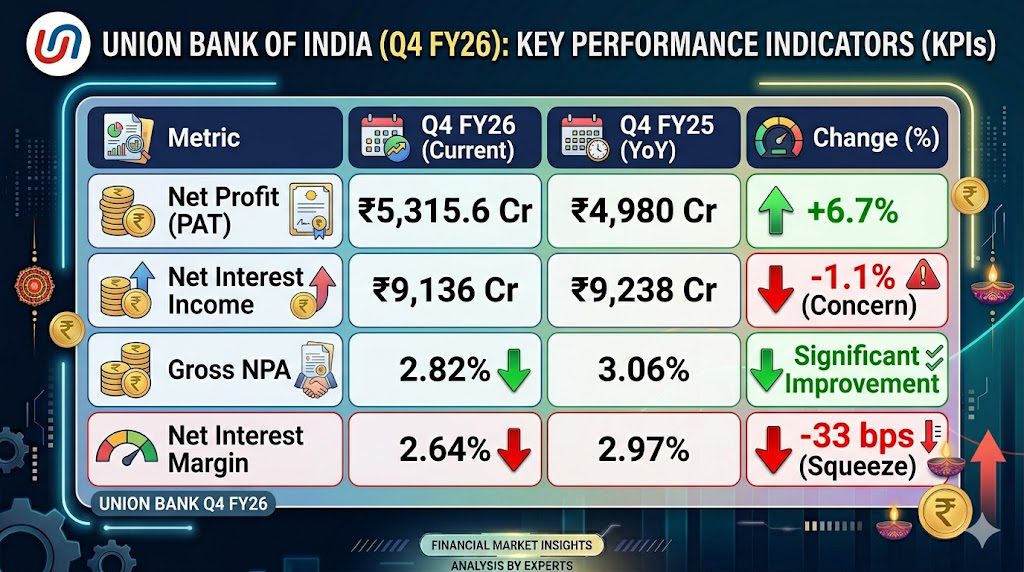
Let’s break down the numbers to understand what really happened.
Union Bank reported a net profit of ₹5,315.6 crore, showing a 6.7% year-on-year growth. This is a healthy increase, but not extraordinary.
However, the key concern lies in Net Interest Income (NII), which came in at ₹9,136 crore, down 1.1% from ₹9,238 crore last year. This is significant because NII reflects the bank’s core lending business.
The Net Interest Margin (NIM) also declined to 2.64% from 2.97%, a drop of 33 basis points. This clearly indicates margin pressure.
On the positive side, asset quality has improved significantly. The Gross NPA ratio fell to 2.82% from 3.06%, showing that the bank is managing its loan book more efficiently.
In simple terms, the bank is becoming safer, but its core profitability engine is under pressure.
3. Fundamental Analysis: The Asset Quality “Silver Lining”
The Cleaning Service
One of the most impressive aspects of Union Bank’s performance is its improvement in asset quality. The Gross NPA ratio at 2.82% is one of the lowest levels the bank has achieved in years.
This indicates that the bank has done a strong job in cleaning up its balance sheet, which is crucial for long-term stability.
Provisions Spike
Interestingly, the bank increased its provisions to around ₹1,050 crore, nearly three times higher than usual. At first glance, this may seem negative, but it is actually a sign of prudence.
By setting aside more money for potential bad loans, the bank is strengthening its balance sheet. However, this also reduces short-term profitability, which partly explains the negative market reaction.
RAM Segment Growth
Another positive factor is the strong growth in the Retail, Agriculture, and MSME (RAM) segment. These segments are critical for future growth because they offer higher yields and better diversification.
As the RAM portfolio expands, it has the potential to improve margins over time.
4. Technical Analysis: The 200-DMA Test
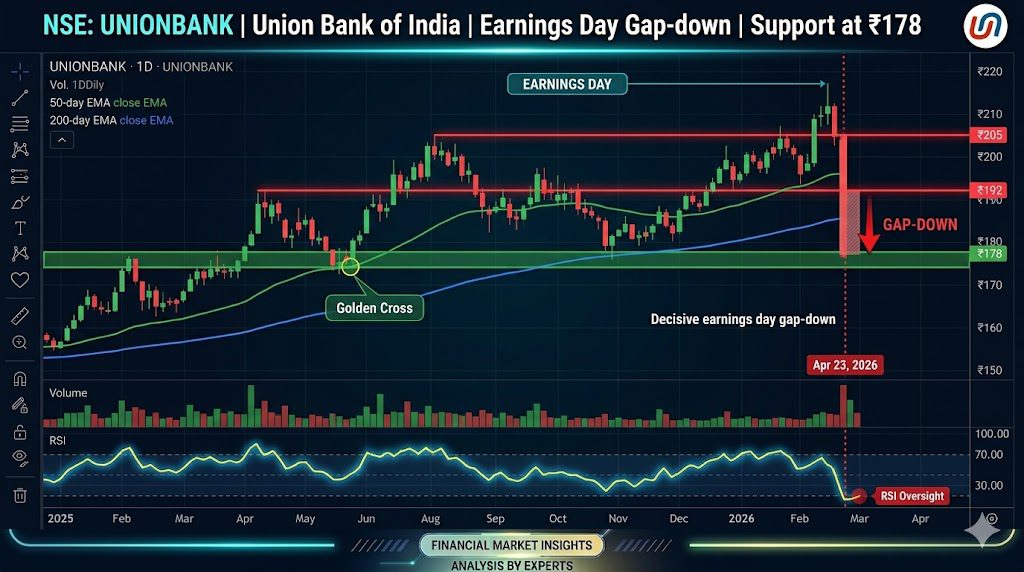
The Breakdown
From a technical perspective, the stock has taken a hit. The 8% fall wiped out the entire pre-earnings rally, and the stock broke its immediate support level around ₹192.
This indicates a shift in short-term sentiment.
Key Support Zones
The stock is currently hovering near a crucial support zone of ₹175–₹178, which is acting as a floor. If this level holds, the stock could stabilize.
However, a breakdown below ₹172 could lead to further downside, potentially toward ₹155.
Analyst Pro-Tip
The Relative Strength Index (RSI) has dropped sharply from 65 to around 38 in just two sessions. This suggests that the stock is approaching oversold territory.
For traders, this creates an interesting setup—high risk but potentially high reward near support levels.
5. Dividend & Management Guidance
The Payout
Union Bank has announced a ₹5 per share dividend, which translates to a yield of around 2.8% at current prices. For a PSU bank, this is a reasonably attractive payout.
FY27 Outlook
Management has guided for 11–13% credit growth in FY27, indicating continued expansion in lending.
However, they have also warned that Net Interest Margins (NIMs) may remain under pressure for the next two quarters, as high-cost deposits continue to impact profitability.
This suggests that the margin pressure seen in Q4 FY26 is not a one-time issue.
6. Brokerage Sentiment: Post-Result Targets
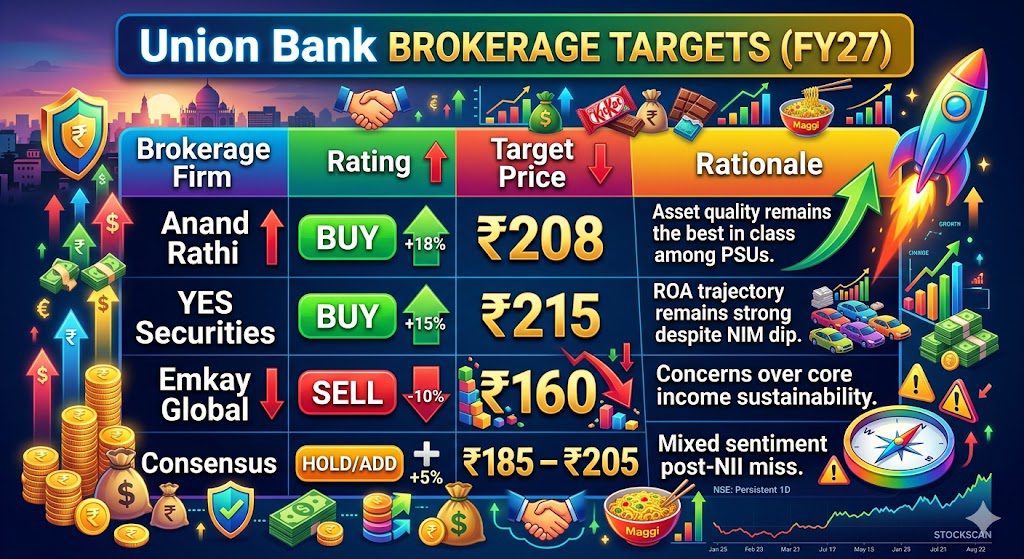
Brokerage firms have given mixed reactions to the results, reflecting the uncertainty around the bank’s future performance.
Anand Rathi remains optimistic with a “BUY” rating and a target price of ₹208, highlighting strong asset quality.
YES Securities is also positive, with a target of ₹215, citing a stable return on assets (ROA) trajectory.
On the other hand, Emkay Global has taken a cautious stance with a “SELL” rating and a target of ₹160, pointing to concerns about core income sustainability.
The overall consensus falls in the ₹185–₹205 range, indicating moderate upside potential.
7. The 30-Year Analyst Verdict
For the Investor
From a long-term perspective, this looks like a “buy on fear” opportunity. The NII decline is not unique to Union Bank—it is a sector-wide issue affecting most banks.
However, the improvement in asset quality is specific to Union Bank and represents a structural positive.
If you are a long-term investor, this dip could be an opportunity rather than a warning sign.
For the Trader
For traders, patience is key. The stock is currently in a “falling knife” phase, and entering too early can be risky.
If the stock holds the ₹175 level for a few sessions, there is a high probability of a bounce toward ₹195.
8. Conclusion & Engagement (CTA)
The Union Bank of India Q4 Results FY26 Analysis highlights an important market lesson—headline profit numbers do not always tell the full story.
While the bank has delivered profit growth and improved asset quality, the decline in NII and margin pressure have raised concerns about the sustainability of earnings.
At the same time, the bank is fundamentally stronger than before, with a cleaner balance sheet and growing loan book.
🔥 Final Thought (CTA)
So here’s the big question for you 👇
👉 Is this 8% dip in Union Bank a golden buying opportunity or a warning signal for PSU banks?
💬 Share your strategy—are you buying the dip, holding, or waiting for clarity? Let’s discuss!