Introduction: The Phoenix of Small Finance
India’s banking system has changed dramatically over the last three decades. In the 1990s, microfinance institutions were viewed mainly as social lending platforms focused on helping low-income borrowers. Very few investors believed that these institutions could eventually become profitable, technology-driven financial businesses capable of competing with mainstream banks. Today, the story is completely different. Small finance banks have evolved into serious players within India’s banking ecosystem, serving millions of customers across urban, semi-urban, and rural India.
Among these emerging financial institutions, UJJIVANSFB has become one of the most closely watched names in the sector. On Friday, May 8, 2026, Ujjivan Small Finance Bank announced its Q4 FY26 results, and the numbers immediately grabbed the attention of investors and analysts across Dalal Street.
The bank reported a massive 238.1% year-on-year jump in net profit to ₹281.97 crore, signaling a major turnaround in profitability and operational efficiency. The stock reacted positively and traded near ₹63.99, rising over 2% after the results announcement. Investors also responded positively to the bank’s approval for a ₹2,000 crore equity capital raise aimed at supporting future growth.
However, the real story behind these results is much bigger than the profit surge alone. Ujjivan is currently undergoing a major strategic transformation by reducing dependence on traditional unsecured microfinance lending and increasing exposure to secured loans such as affordable housing, MSME financing, and gold loans.
This shift is fundamentally changing the bank’s long-term risk profile. Investors who once viewed microfinance-heavy institutions as risky and volatile are now beginning to see Ujjivan as a more diversified and stable retail banking franchise.
For long-term investors, Q4 FY26 may eventually be remembered as the quarter where Ujjivan’s transformation story became impossible to ignore.
Q4 FY26 Financial Scorecard (The Actual NSE Numbers)
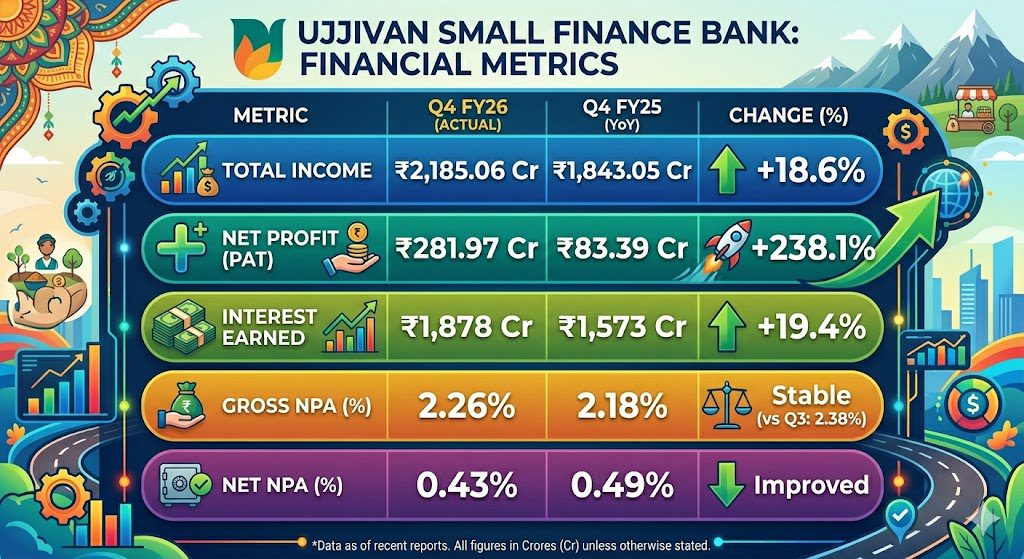
Ujjivan Small Finance Bank delivered one of its strongest quarterly performances in recent years during Q4 FY26. The bank’s financial numbers show healthy business growth combined with significantly improved profitability.
Total income for the quarter increased to ₹2,185.06 crore compared to ₹1,843.05 crore during Q4 FY25, reflecting solid year-on-year growth of 18.6%. This increase was supported by healthy loan book expansion, rising interest income, and improving operational scale.
The most impressive number, however, was the dramatic jump in profitability. Net profit after tax surged to ₹281.97 crore from just ₹83.39 crore during the same quarter last year. This represents explosive growth of 238.1% and highlights the bank’s improving earnings quality and operational efficiency.
Interest earned during the quarter also increased strongly to ₹1,878 crore compared to ₹1,573 crore in Q4 FY25, reflecting healthy loan demand across multiple lending segments.
Asset quality remained stable despite rapid business expansion. Gross NPA stood at 2.26% compared to 2.18% a year earlier, but importantly, it improved sequentially from 2.38% reported during Q3 FY26. Net NPA improved to 0.43% compared to 0.49% in the same quarter last year.
| Metric | Q4 FY26 | Q4 FY25 | YoY Change |
|---|---|---|---|
| Total Income | ₹2,185.06 Cr | ₹1,843.05 Cr | +18.6% |
| Net Profit (PAT) | ₹281.97 Cr | ₹83.39 Cr | +238.1% |
| Interest Earned | ₹1,878 Cr | ₹1,573 Cr | +19.4% |
| Gross NPA | 2.26% | 2.18% | Stable |
| Net NPA | 0.43% | 0.49% | Improved |
These results clearly show that Ujjivan is not simply growing aggressively — it is also improving profitability while maintaining healthy credit discipline.
Fundamental Analysis: The “Secured” Pivot
Secured Lending Is Changing the Business Model
The most important long-term development inside Ujjivan Small Finance Bank is its strategic shift toward secured lending. Historically, microfinance-heavy institutions were considered highly vulnerable because unsecured lending tends to face greater volatility during economic disruptions, rural stress periods, or collection challenges.
To reduce these risks, UJJIVANSFB has aggressively expanded secured lending categories. Today, secured loans account for nearly 49% of the bank’s total loan book.
This is a major structural transformation because secured loans provide collateral-backed protection and typically result in lower long-term credit risk. The shift toward secured assets also improves portfolio stability and reduces dependence on cyclical microfinance lending.
For investors, this transition is extremely important because it changes the bank’s overall risk profile and improves confidence regarding future earnings stability.
MSME Lending Is Emerging as a Key Growth Driver
One of the strongest-performing business segments during FY26 was MSME lending. Ujjivan’s MSME loan portfolio expanded approximately 58% year-on-year to ₹3,230 crore.
India’s small business ecosystem continues to experience strong credit demand due to increasing formalization, expanding entrepreneurship, digitalization, and rising working capital requirements.
Micro, small, and medium enterprises remain one of the largest underserved financing categories within India’s banking sector. Ujjivan appears to be positioning itself aggressively within this space, which could become a major long-term growth engine for the bank.
Strong MSME growth also helps diversify the bank’s loan book beyond traditional microfinance exposure.
Affordable Housing Portfolio Continues Growing Strongly
Affordable housing has become another major pillar of Ujjivan’s secured lending strategy. The affordable housing portfolio increased approximately 35% year-on-year to ₹8,900 crore during FY26.
India’s housing finance market continues benefiting from rapid urbanization, rising middle-class aspirations, government housing support programs, and increasing home ownership demand.
Affordable housing loans are generally considered more stable compared to unsecured lending products because they are backed by physical assets and typically demonstrate stronger repayment behavior.
This segment is expected to remain an important long-term growth driver for Ujjivan as India’s housing demand continues expanding.
Gold Loans Deliver Explosive Growth
One of the biggest surprises during Q4 FY26 was the extraordinary growth within the gold loan segment. Ujjivan’s gold loan portfolio surged nearly 292% year-on-year to ₹769 crore.
Gold loans remain highly attractive for financial institutions because they are secured by physical collateral and generally involve lower credit risk compared to unsecured personal lending.
India’s enormous household gold ownership creates massive long-term opportunities for banks operating within this segment. Ujjivan’s rapid expansion into gold loans reflects management’s broader strategy of building a more diversified and safer lending portfolio.
Deposit Growth Strengthens the Liability Franchise
The bank’s deposit franchise also showed healthy growth during FY26. Deposits increased to ₹45,668 crore compared to ₹37,630 crore during FY25.
Strong deposit growth is extremely important because it helps reduce funding costs, improve liquidity, strengthen balance sheet stability, and support future loan growth.
As Ujjivan continues expanding its deposit base, the bank may gradually improve its Net Interest Margins and overall operational efficiency.
A stronger liability franchise is often a key sign that a small finance bank is evolving into a more mature retail banking institution.
Technical Analysis: Breaking Out of the Range
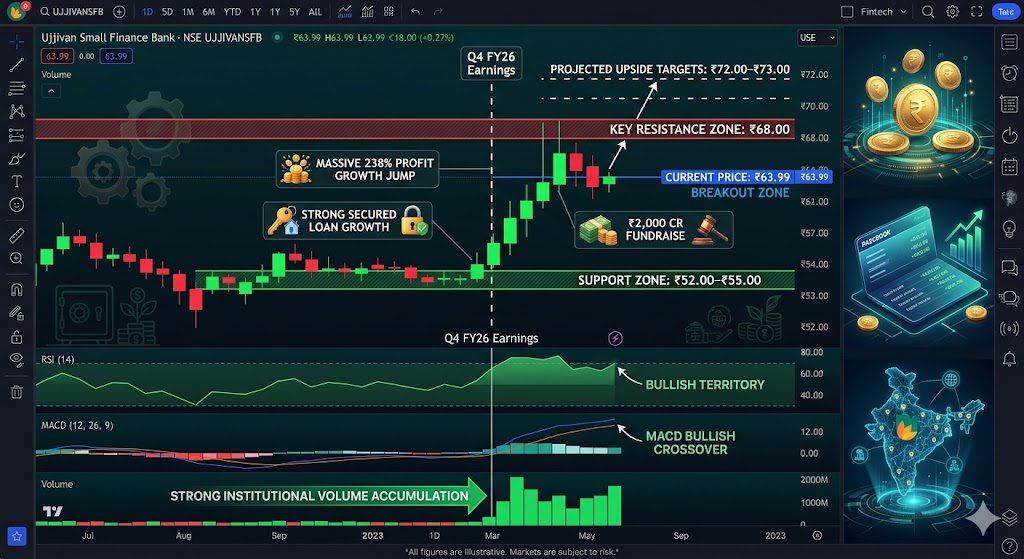
Long-Term Bullish Trend Remains Intact
From a technical analysis perspective, UJJIVANSFB currently remains within a healthy long-term bullish setup.
The stock is trading comfortably above its 200-day Exponential Moving Average (EMA) near ₹52.88, which is generally considered an important indicator of long-term trend strength.
Stocks trading above major long-term moving averages often attract stronger institutional interest because they signal improving momentum and positive market sentiment.
This technical structure suggests that the broader bullish trend remains intact despite short-term market volatility.
Major Support Levels Remain Strong
The key support zone for Ujjivan currently lies between ₹52 and ₹55. This range has historically acted as an important institutional accumulation area where strong buying interest has emerged during corrections.
As long as the stock remains above this support range, the long-term bullish structure is likely to remain stable.
If broader market conditions weaken temporarily, long-term investors may closely monitor this zone for fresh accumulation opportunities.
Resistance Near ₹68 Could Trigger Breakout Momentum
On the upside, the next major resistance level lies near ₹68, which also represents the stock’s recent 52-week high.
A decisive breakout above ₹68 supported by strong trading volumes could trigger the next phase of the rally toward ₹72–₹73 levels over the medium term.
Momentum traders are closely monitoring this level because breakout stocks often witness accelerated price movement once major resistance zones are crossed successfully.
Institutional Participation Appears to Be Improving
One encouraging technical signal is the stock’s improving delivery percentage, which currently remains close to 55%.
Higher delivery-based trading activity often indicates genuine institutional accumulation rather than short-term speculative trading.
The stock’s Momentum Score of approximately 65.9 out of 100 also suggests a moderately bullish technical setup.
Overall, the technical indicators point toward gradually improving investor confidence in Ujjivan’s long-term growth story.
Management Guidance & Corporate Action
₹2,000 Crore Equity Fundraise Signals Aggressive Growth Plans
One of the biggest announcements alongside the Q4 FY26 results was the board’s approval to raise up to ₹2,000 crore through equity capital.
This fundraising plan is strategically important because it provides the bank with additional financial strength to support future growth, expand lending operations, improve capital adequacy, and strengthen its balance sheet.
For fast-growing financial institutions, strong capital availability often becomes the fuel required for long-term expansion.
The fundraising also signals management confidence regarding future business opportunities and loan growth potential.
Asset Quality Outlook Remains Stable
Management has guided that credit costs are expected to remain within the range of 1.4% to 1.5% going forward.
This guidance suggests that the bank remains confident regarding collection efficiency, portfolio quality, and risk management despite rapid growth across multiple lending categories.
Maintaining stable asset quality remains extremely important for small finance banks because sudden increases in bad loans can quickly impact profitability and investor sentiment.
Net Interest Margins Expected to Stay Strong
Ujjivan expects Net Interest Margins to remain resilient near 8.2% going forward. The bank anticipates lower cost of funds as liability repricing improves operational efficiency over time.
High NIMs remain one of the biggest profitability advantages for small finance banks compared to larger commercial banks.
If Ujjivan successfully maintains strong margins while continuing its shift toward secured lending, long-term earnings growth could remain healthy for several years.
Brokerage Sentiment & Targets: The Path Toward ₹73
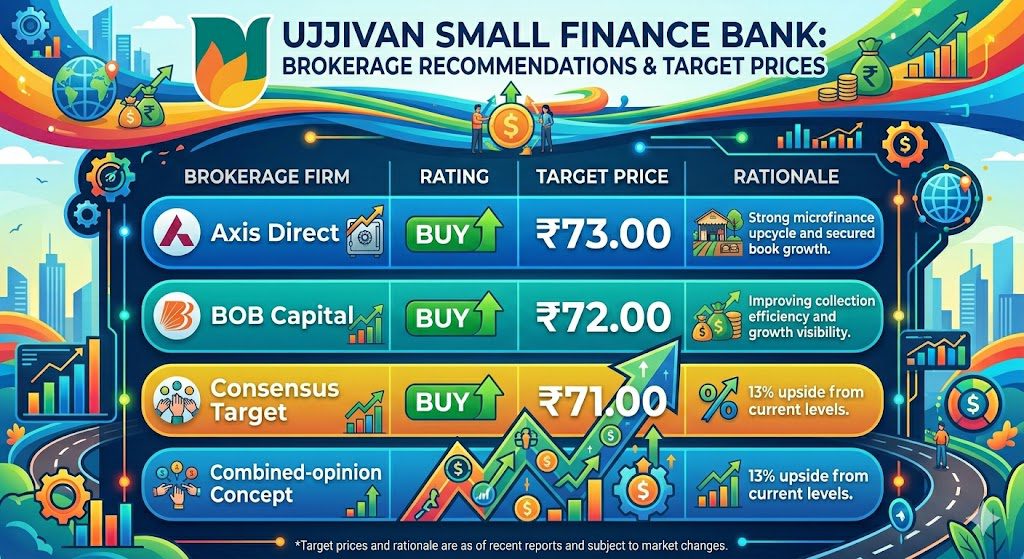
Institutional brokerages remain optimistic regarding Ujjivan’s long-term growth outlook following the strong Q4 FY26 performance.
| Brokerage Firm | Rating | Target Price | Rationale |
|---|---|---|---|
| Consensus Target | BUY | ₹71 | Strong growth outlook |
| Axis Direct | BUY | ₹73 | Secured book expansion |
| BOB Capital | BUY | ₹72 | Improving collections & growth |
Most analysts believe that Ujjivan’s transition toward a diversified secured lending portfolio could eventually result in a significant valuation re-rating within the banking sector.
If the bank continues executing its growth strategy successfully while maintaining asset quality discipline, further upside potential may remain possible over the next few years.
The “30-Year” Analyst Verdict
For Long-Term Investors
For long-term investors, Ujjivan currently appears to be one of the more interesting “re-rating” candidates within India’s small finance banking space.
The shift toward a nearly 50% secured loan book fundamentally changes the bank’s long-term risk profile and improves earnings stability.
Historically, investors assigned lower valuations to microfinance-focused lenders because of their higher exposure to economic cycles and unsecured credit risk. However, Ujjivan is increasingly evolving into a more diversified retail banking institution with stronger operational stability and lower long-term credit volatility.
The ₹2,000 crore equity raise could also provide the financial strength required to accelerate future expansion plans.
For Traders
For traders, Ujjivan currently remains a “Buy on Strength” setup.
If the stock closes decisively above ₹65 with strong trading volumes, the probability of a rally toward ₹72–₹73 increases significantly.
Momentum indicators remain supportive, while improving institutional participation suggests that investor confidence is gradually returning.
However, traders should continue monitoring broader banking sector sentiment and overall market conditions carefully.
Conclusion & Engagement (CTA)
Ujjivan Small Finance Bank has delivered one of the strongest Q4 FY26 performances within India’s small finance banking sector.
A massive 238% surge in profits, improving asset quality, expanding secured lending exposure, and a ₹2,000 crore growth war chest together indicate that the bank is entering a completely new phase of growth and transformation.
The biggest story is not simply the rise in profits — it is the structural evolution of the business model itself. Ujjivan is gradually transitioning from a traditional microfinance-focused lender into a diversified retail banking platform with stronger long-term stability and lower risk exposure.
The key question now is whether the market will fully re-rate UJJIVANSFB as this transformation continues over the coming years.
Are you buying Ujjivan for its ₹73 target, or do you believe the ₹2,000 crore fundraise could unlock an even bigger long-term growth story?