
1. Introduction: The Strategic Backbone of India’s Telecom Dream
If you have followed India’s telecom journey over the last 20–25 years, you would know that most of our network infrastructure has depended on foreign companies. But now, things are changing. India is slowly building its own telecom ecosystem, especially in 4G and 5G technology. And at the center of this shift is Tejas Networks, a company that has become even more important after becoming part of the Tata Group.
As of April 2026, Tejas Networks is not just another telecom company—it is one of the few Indian firms working on end-to-end telecom equipment, including 4G and 5G solutions. This is a big deal because countries around the world are trying to reduce dependency on imports in sensitive sectors like telecom.
The company has played a key role in BSNL’s nationwide 4G rollout, which is one of the largest government-backed telecom projects in India. However, while the long-term story looks strong, the short-term financial numbers are showing pressure. This creates confusion for investors.
The Q4 FY26 results, announced on April 15, 2026, clearly show this gap between present challenges and future potential. So the big question is—should investors focus on current losses or future growth?
2. Q4 FY26 Result Analysis: Revenue Drop but Strong Future Pipeline
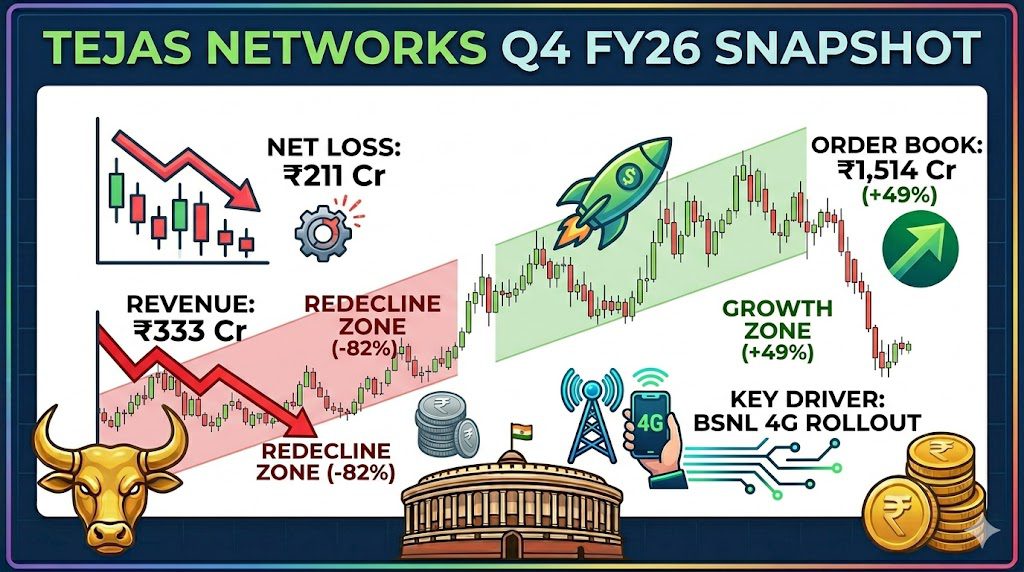
Let’s start with the numbers, because they tell the real story.
In Q4 FY26, Tejas Networks reported a net loss of ₹211.3 crore, which is significantly higher than last year’s loss of ₹71.8 crore. At first glance, this looks negative and naturally worries investors.
But the bigger shock came from revenue. The company’s revenue dropped sharply by 82.6% year-on-year to ₹333 crore. This kind of decline is not common and needs to be understood properly.
👉 Why did this happen?
The main reason is that last year, Tejas had a large one-time billing from BSNL 4G equipment supply. That phase is now largely completed, so revenue appears lower this year. This is not necessarily a sign of weakness—it is more about the timing of large projects.
Now let’s look at the positive side.
The company’s order book grew by 49% year-on-year to ₹1,514 crore. This is a very important number because it shows future revenue visibility.
👉 In simple terms:
- Current revenue ↓ (temporary)
- Future orders ↑ (long-term positive)
This is typical for infrastructure companies where revenue comes in cycles.
3. Fundamental Analysis: Tata Backing and Government Support
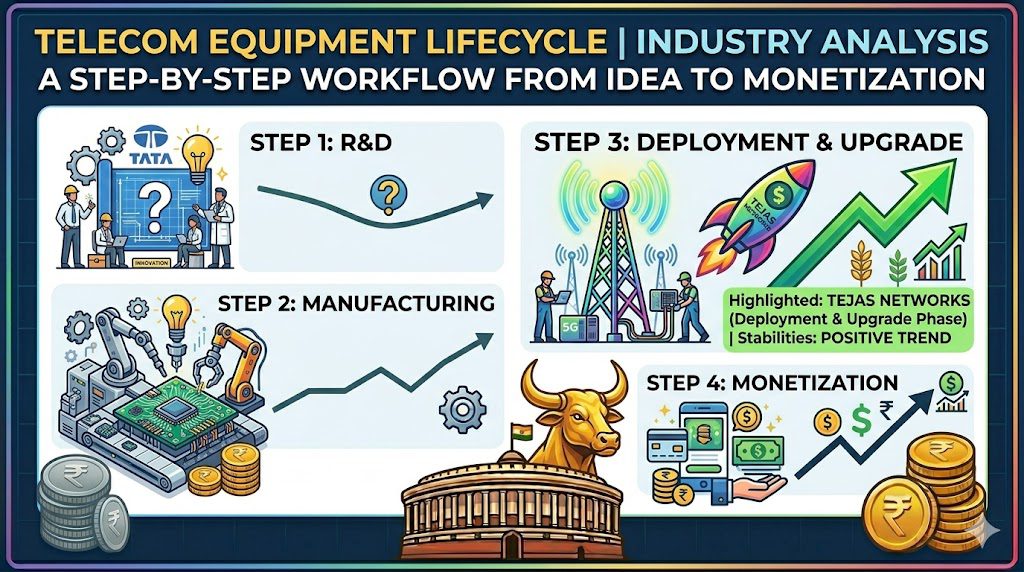
When you analyze a company like Tejas Networks, you cannot look at it like a normal profit-making business. It is more like an investment phase company, where growth comes first and profits come later.
One of the biggest strengths of Tejas is its backing from the Tata Group, through Panatone Finvest (a Tata Sons entity). This means:
- The company has strong financial support
- There is no immediate survival risk
- Long-term projects can be executed without pressure
Another major advantage is the PLI (Production Linked Incentive) scheme by the Indian government. Tejas is a key beneficiary of this scheme, which supports domestic telecom manufacturing.
In Q4 FY26 alone, the company filed 63 patents, showing strong focus on innovation. This is important because telecom technology is a high-entry-barrier sector.
The company also shipped over 17,000 IP/MPLS routers for BharatNet, which shows real execution on the ground.
Since the company is currently making losses, traditional metrics like P/E ratio are not useful. Instead, investors look at:
- Price-to-Book (P/B): ~2.5x
- Order book growth
- Technology capabilities
👉 This is a classic case of “investing in future potential, not current earnings.”
4. Technical Analysis: Sharp Fall but Strong Support Nearby
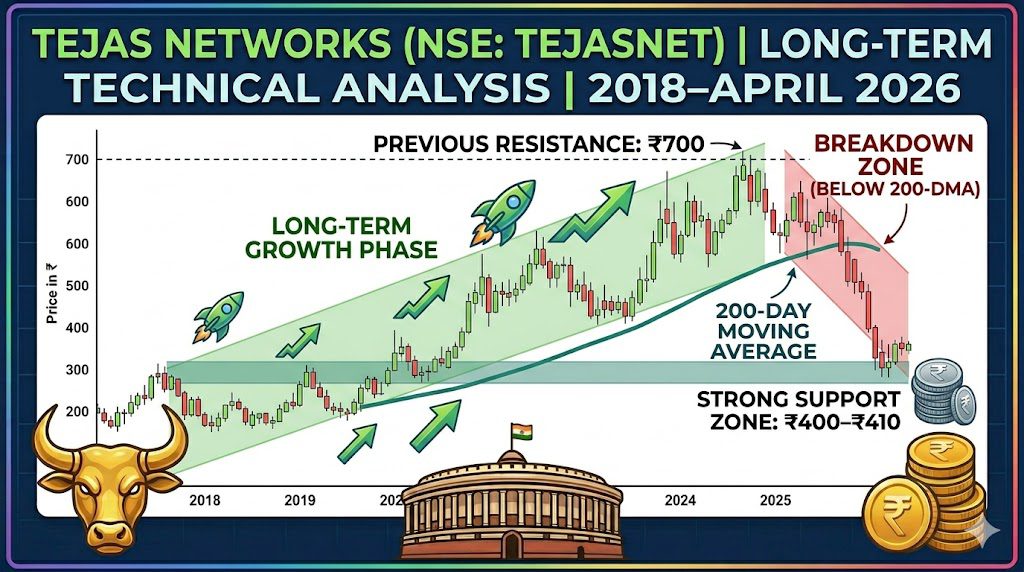
After the Q4 results, the stock reacted negatively.
On April 16, 2026, the stock saw a 5% gap-down opening and fell below its 200-day moving average, which is generally considered a bearish signal in the short term.
The stock touched an intraday low of around ₹423.5, indicating panic selling.
However, from an experienced investor’s perspective, this kind of move is not unusual in high-growth stocks. It often represents a “shakeout phase”, where weak hands exit and stronger investors start accumulating.
The stock is now approaching a strong support zone of ₹400–₹410, which has historically acted as a base.
The RSI (Relative Strength Index) is around 32, which means the stock is in an oversold zone.
👉 What does this mean?
- Short-term: Weak sentiment
- Medium-term: Possible bounce or consolidation
- Long-term: Depends on fundamentals
For traders, it is better to wait for confirmation signals like a bullish candle pattern before entering.
5. Result Analysis: What Really Matters Beyond Profit Numbers
One of the biggest mistakes investors make is focusing only on profit or loss numbers. For companies like Tejas Networks, this approach does not work.
Instead, you need to focus on operational metrics.
Order Book Strength
The ₹1,514 crore order book shows that demand is strong and future revenue is secured.
Project Execution
Completion of major contracts like South Asian 4G RAN deployment shows execution capability.
Global Partnerships
The company’s partnership with Rakuten Symphony for Open RAN solutions is a big step. Open RAN is the future of telecom networks globally.
Export Potential
Tejas is slowly moving from a domestic player to a global supplier, which can significantly increase its growth potential.
👉 These factors matter more than short-term losses because they define the company’s future.
6. Forward Outlook FY27: Big Opportunities Ahead
| Source | Rating | Target Price | View | Key Reason |
|---|---|---|---|---|
| Emkay Global | HOLD | ₹780 | Bullish LT | Order book + govt push |
| Bernstein | Cautious Buy | ₹435–₹460 | Short-term cautious | Losses, weak earnings |
| Consensus Analysts | Mixed | ₹450–₹500 avg | Neutral | Execution uncertainty |
| Global Models | Mixed | ₹762 avg | Volatile | 5G growth potential |
| Fair Value Models | Positive | ₹780 | Bullish LT | Structural telecom growth |
Looking ahead, FY27 could be a turning point for Tejas Networks.
One of the biggest triggers is the BSNL 5G upgrade opportunity, where existing 4G sites can be upgraded to 5G. This alone can create a large revenue opportunity.
Another major factor is BharatNet Phase III, where Tejas has won 7 out of 12 packages, making it a key player in India’s rural broadband expansion.
This project alone provides revenue visibility for the next 2 years.
Globally, the telecom industry is also moving towards:
- 5G expansion
- Open RAN technology
- Indigenous network solutions
Tejas is well-positioned in all these areas.
👉 However, investors should be patient because:
- Profitability may take time
- Execution risks remain
- Market sentiment can stay volatile
7. Final Verdict: High Risk, High Potential Investment
Tejas Networks is not a typical stock. It is a long-term story built on India’s telecom independence.
👉 Strengths:
- Strong order book
- Tata Group backing
- Government support (PLI + BharatNet)
- Growing global opportunities
👉 Risks:
- Continuous losses
- Execution delays
- High volatility
👉 Final Call:
ACCUMULATE for long-term investors (3–5 years horizon)
This stock is not for short-term traders—it is for those who believe in India’s telecom future.
8. Bull vs Bear Summary (Very Important for SEO + Engagement)
| Bull Case | Bear Case |
|---|---|
| Strong order book growth | Rising losses |
| Tata Group backing | Revenue volatility |
| BharatNet + BSNL opportunity | Execution risk |
| Export potential |