Tata Steel Limited delivered one of the strongest quarterly performances in the Indian metal sector during Q4 FY26 and completely surprised the Street with a massive jump in profitability. The company announced its results after market hours on May 15, 2026, and the earnings report immediately became one of the most discussed developments across the Indian stock market.
The steel giant reported a stunning 147% year-on-year increase in consolidated net profit, supported by strong domestic demand, expanding operating margins, lower raw material costs, and record quarterly deliveries in India. At a time when global steel companies continue facing uncertainty because of weak European demand and international commodity volatility, Tata Steel managed to deliver one of its strongest operational performances in recent years.
The latest earnings report also comes at an important time for investors because the stock had already touched a fresh 52-week high before the announcement. Now the market is trying to determine whether the company still has further upside potential or whether short-term profit booking may emerge after the sharp rally. For long-term investors, traders, and anyone tracking India’s infrastructure and manufacturing growth story, Tata Steel’s latest quarterly performance provides several powerful signals about the future direction of the company and the broader steel sector.
Quick Summary of Tata Steel Q4 FY26 Results
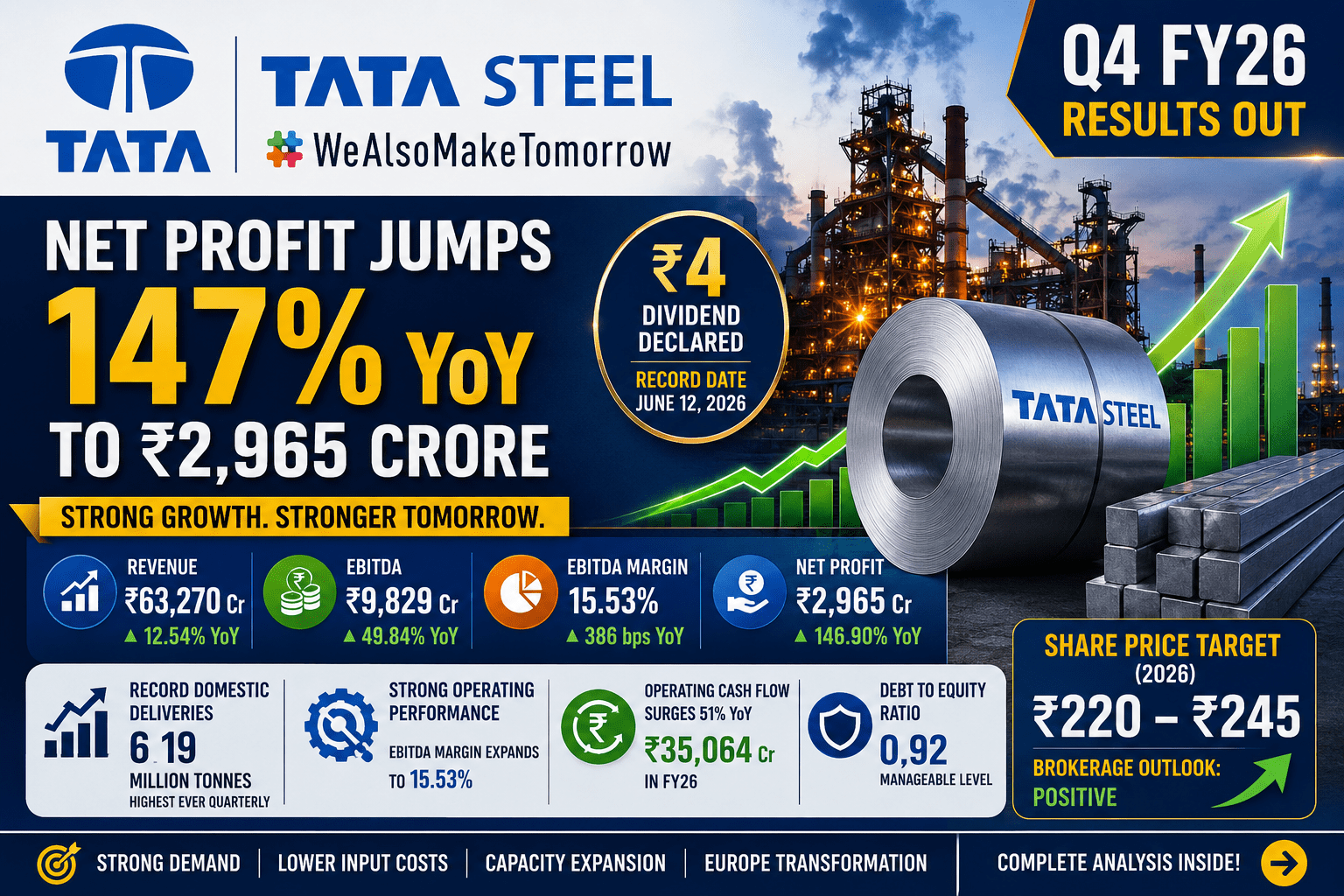
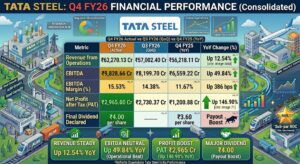
Tata Steel Limited reported consolidated revenue from operations of ₹63,270.13 crore during Q4 FY26 compared to ₹56,218.11 crore in the same quarter last year. This represented strong year-on-year growth of around 12.5%.
The company’s operating performance improved even more sharply. EBITDA surged to ₹9,828.66 crore compared to ₹6,559.22 crore during Q4 FY25, representing a strong increase of nearly 50%. EBITDA margins expanded from 11.67% to 15.53%, showing a significant improvement in operational efficiency and profitability.
The biggest positive surprise came from the bottom line. Consolidated net profit after tax jumped to ₹2,965 crore compared to ₹1,200.88 crore during the same quarter last year. This represented a massive 146.9% year-on-year surge and significantly exceeded market expectations.
Sequentially, the company also showed strong momentum compared to Q3 FY26, when revenue stood at ₹57,002.40 crore and net profit was ₹2,730.37 crore.
The board additionally recommended a final dividend of ₹4 per equity share, higher than the ₹3.60 dividend declared during the previous financial year.
Corporate Profile: India’s Global Steel Powerhouse
Tata Steel Limited remains one of the most influential steel companies globally and currently stands as the second-largest steel producer in India. The company operates large manufacturing and downstream facilities across India, the Netherlands, and the United Kingdom.
One of Tata Steel’s biggest structural strengths lies in its integrated business model. Unlike several steel companies that remain highly dependent on external raw material markets, Tata Steel controls a large portion of its own iron ore supply through captive mines located mainly in Jamshedpur and Kalinganagar.
This integration provides major protection against volatility in raw material prices. During periods of rising iron ore or coking coal prices, integrated steel companies like Tata Steel generally perform much better than non-integrated competitors because they have greater control over production costs.
Over the years, Tata Steel has evolved beyond being just a traditional commodity steel producer. Today, the company supplies advanced steel products to sectors including automobiles, infrastructure, railways, construction, engineering, renewable energy, defense manufacturing, and industrial machinery.
Earnings Analysis: What Drove the Massive Profit Explosion?
The biggest reason behind Tata Steel’s extraordinary Q4 FY26 performance was the combination of strong domestic demand, expanding production volumes, lower input costs, and improved operational leverage.
One of the most important highlights was the company’s record domestic steel production. Tata Steel reported domestic crude steel production of 6.25 million tonnes during the quarter, while domestic deliveries reached an all-time quarterly high of 6.19 million tonnes.
This strong growth was driven largely by India’s expanding infrastructure activity and rising automobile demand. Government capital expenditure, railway modernization, road construction, urban infrastructure projects, and increased automotive production significantly boosted steel consumption during the quarter.
The improvement in EBITDA margins became another major positive factor. Margins expanded sharply from 11.67% to 15.53%, reflecting an improvement of nearly 386 basis points.
Several reasons contributed to this expansion. Global coking coal prices moderated significantly compared to earlier elevated levels, reducing one of the company’s largest production costs. At the same time, strong domestic steel realizations in India supported revenue growth despite continued volatility in global metal markets.
The company’s integrated mining operations also helped maintain stable raw material costs during the quarter. Because of these combined factors, a large portion of incremental revenue directly converted into higher profitability.
The company’s full-year recovery was equally impressive. For FY26, consolidated net profit surged to ₹10,885.82 crore compared to only ₹3,173.78 crore during FY25. This represented an extraordinary annual growth of around 242%, strongly indicating that the worst phase of the global steel downturn may now be over for Tata Steel.
Dividend Analysis: Strong Reward for Shareholders
Tata Steel Limited also rewarded shareholders with a higher dividend payout following the strong quarterly performance.
The board recommended a final dividend of ₹4 per equity share with a face value of ₹1. This represents an increase compared to the ₹3.60 dividend distributed during the previous financial year.
The official record date for dividend eligibility has been fixed as Friday, June 12, 2026.
For long-term investors, the higher dividend carries strong importance because it reflects management confidence regarding future earnings visibility and cash-flow stability. Commodity companies generally increase dividends only when they believe the operational recovery cycle has become sustainable rather than temporary.
Fundamental Analysis: Strong Cash Flows and Improving Financial Strength
From a long-term investment perspective, Tata Steel’s overall financial profile improved significantly during FY26.
One of the strongest positives was the company’s operating cash-flow generation. Operating cash flows surged 51% during FY26 and reached ₹35,064 crore. Strong cash-flow generation is extremely important for capital-intensive industries like steel manufacturing because it supports debt reduction, future expansion projects, dividends, and modernization investments.
At the current market capitalization above ₹2.75 lakh crore, Tata Steel trades near a trailing P/E ratio of around 27.38 times earnings. Although this may initially appear premium for a cyclical metal company, the valuation still looks attractive compared to peer JSW Steel Limited, which trades at substantially higher valuation multiples.
The premium valuation is largely justified because Tata Steel now generates stronger operating cash flows, maintains integrated mining advantages, and possesses a significantly stronger domestic market position.
The company’s debt profile also remains manageable. Tata Steel’s debt-to-equity ratio currently stands around 0.92, while management continues focusing on gradual deleveraging and improving balance-sheet quality.
Technical Analysis: Key Trading Levels for This Week
Technically, Tata Steel currently remains one of the strongest stocks within the Indian metal sector.
Before the earnings announcement, the stock had already touched a fresh 52-week high near ₹222.40 on May 14, 2026. The stock also continues trading comfortably above its 20-day, 50-day, and 200-day Exponential Moving Averages, indicating a strong bullish trend structure.
The most important immediate breakout level now remains ₹224.40. A strong and sustained move above this zone could potentially trigger another momentum rally.
Immediate resistance targets are placed near ₹228 and ₹235. On the downside, immediate support exists near ₹216 followed by ₹210. The strongest long-term structural support zone remains around ₹185.
From a swing trading perspective, the technical structure remains bullish as long as the stock continues defending the ₹216 support level. If broader market sentiment remains supportive and global commodity markets remain stable, momentum traders may continue targeting the ₹228–₹235 range during the near term.
Management Guidance and Future Growth Strategy
Management commentary during the earnings announcement highlighted two major strategic priorities for the company.
The first remains the transformation of European operations. Tata Steel confirmed that the transition of the UK Port Talbot facility toward Electric Arc Furnace (EAF) technology continues progressing smoothly. This modernization program is extremely important because it aims to reduce long-term cash burn, improve environmental compliance, and lower carbon emissions.
The company is also continuing modernization efforts within the Netherlands operations to improve efficiency and reduce future operational risks.
The second major priority remains domestic expansion in India. Tata Steel continues ramping up capacity at the Kalinganagar plant, which will help the company capture growing demand for high-margin automotive-grade and value-added specialty steel products during FY27 and beyond.
India’s expanding infrastructure spending, railway modernization, electric vehicle manufacturing growth, and renewable energy expansion continue creating large long-term steel demand opportunities for the company.
Brokerage Outlook and Institutional Target Prices
Most institutional brokerage firms currently maintain positive long-term views on Tata Steel Limited following the blockbuster Q4 FY26 earnings report.
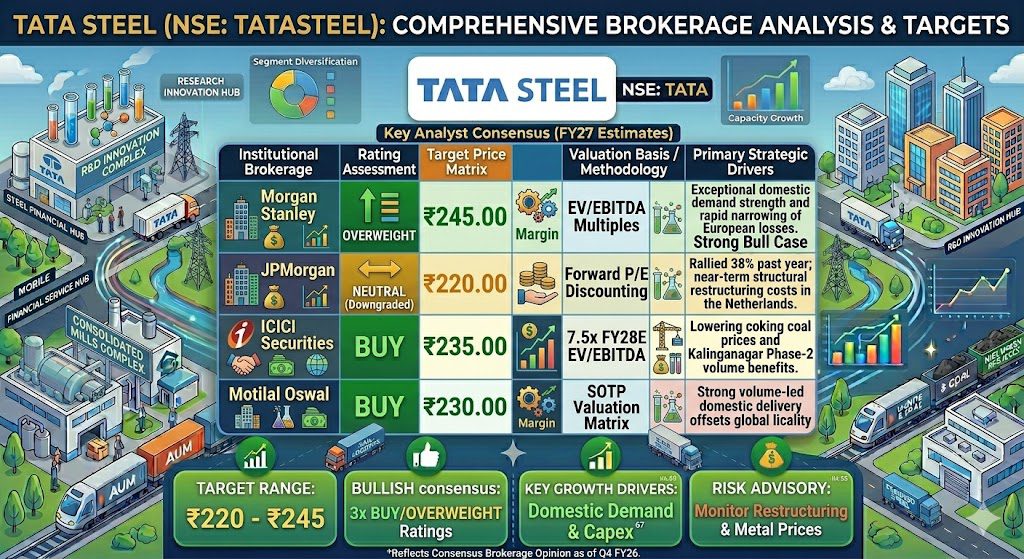
Morgan Stanley maintains an OVERWEIGHT rating with a target price of ₹245, highlighting strong domestic demand and narrowing European losses as major growth drivers.
JPMorgan Chase & Co. currently maintains a NEUTRAL rating with a target near ₹220 because the stock has already rallied significantly over the last year and may still face short-term restructuring costs within Europe.
ICICI Securities maintains a BUY rating with a target price of ₹235 based on lower coking coal costs and volume growth benefits from the Kalinganagar expansion.
Motilal Oswal also remains bullish with a target near ₹230, citing strong domestic deliveries and improving earnings quality.
Overall, institutional target prices currently remain concentrated within the ₹220–₹245 range, reflecting broad confidence in the company’s long-term recovery story.
Should You Buy, Hold, or Sell Tata Steel?
For long-term investors, Tata Steel’s latest quarterly performance strongly indicates that the company has emerged from the worst phase of the global steel downturn.
The combination of a 147% surge in quarterly profit, expanding EBITDA margins, strong domestic demand, improving operating cash flows, and higher dividend payouts creates a very attractive long-term investment profile.
Investors with long-term horizons may continue gradually accumulating the stock during short-term market corrections.
For short-term traders, the technical setup currently remains bullish. As long as the stock sustains above the ₹216 support zone, momentum traders may continue targeting the ₹228 and ₹235 levels during the near term.
However, investors and traders should continue monitoring global commodity markets carefully because steel-sector stocks remain highly sensitive to international metal prices, Chinese demand trends, and broader global economic conditions.
For official exchange filings and company disclosures, investors can also track updates through NSE India Official Website.