
Scope Outline
Introduction: The Architect of India’s Green Future
The Hook
Over the last three decades, India’s energy sector has gone through one of the biggest transformations in its economic history. In the 1990s, companies in the power sector were almost entirely dependent on coal-based electricity generation and centralized power grids. Renewable energy was considered expensive, unreliable, and commercially impractical. Fast forward to 2026, and the situation has completely changed. Today, solar energy, EV charging infrastructure, battery storage, green hydrogen, and decentralized power systems are driving the future of India’s energy economy. Among the companies leading this transition, Tata Power Company Limited has emerged as one of the strongest and most aggressive players in the renewable-energy revolution. The company’s Q4 FY26 performance reflects not just quarterly earnings but a larger long-term transformation toward becoming a fully integrated green-energy powerhouse.
The Big Headline
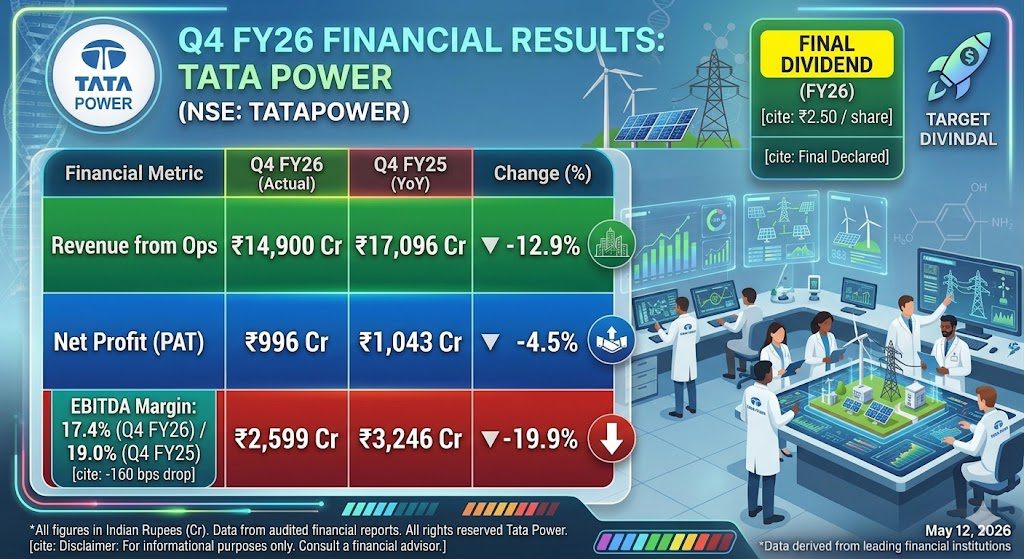
Tata Power reported a consolidated net profit of approximately ₹996 crore during Q4 FY26. Although profit growth remained slightly lower compared to the previous year, the market is focusing less on short-term earnings volatility and more on the company’s long-term renewable-energy expansion plans. The business is currently going through a high-capex transition phase, where heavy investments in solar manufacturing, renewable projects, EV charging infrastructure, and distribution businesses are temporarily impacting margins. However, such investment cycles are often necessary for companies building long-term structural advantages in emerging industries.
Real-Time Context
As of May 12, 2026, shares of Tata Power Company Limited are trading near the ₹380 level on the NSE. Despite quarterly volatility, the stock continues showing resilience because institutional investors remain optimistic about the company’s renewable-energy pipeline and future capacity additions. Several structural trends are currently supporting Tata Power’s long-term outlook, including India’s renewable-energy expansion targets, rising electricity demand, EV adoption, domestic solar manufacturing growth, and government incentives for green infrastructure. Investors increasingly view Tata Power as a long-term “green-energy compounder” rather than a traditional utility stock.
Q4 FY26 Financial Scorecard (The Actuals)
Revenue from Operations
Tata Power reported revenue from operations of approximately ₹14,900 crore during Q4 FY26 compared to nearly ₹17,096 crore during the same quarter last year. This reflects a year-on-year decline of approximately 12.9%. The decline was mainly caused by lower fuel pass-through revenues, weaker thermal business realization, and temporary delays in renewable project commissioning. Despite the lower revenue figure, the company continues investing aggressively in renewable-energy infrastructure, which management believes will generate significantly stronger earnings over the coming years.
Net Profit Performance
Consolidated Net Profit After Tax during Q4 FY26 stood at approximately ₹996 crore compared to nearly ₹1,043 crore during Q4 FY25, reflecting a modest decline of approximately 4.5%. While short-term profit growth remained under pressure, the market appears largely comfortable because investors understand that Tata Power is currently prioritizing future growth over near-term profitability optimization. Long-term institutional investors are therefore focusing more on renewable capacity additions, solar manufacturing expansion, EV charging infrastructure, and distributed energy opportunities rather than quarterly earnings fluctuations.
EBITDA Performance
EBITDA during Q4 FY26 stood at approximately ₹2,599 crore compared to nearly ₹3,246 crore during the same period last year.
EBITDA Margin=EBITDARevenue×100EBITDA\ Margin = \frac{EBITDA}{Revenue} \times 100EBITDAMargin=RevenueEBITDA×100
The decline in EBITDA was mainly caused by elevated capex spending, renewable project integration costs, and operational transition expenses associated with the company’s large-scale renewable expansion strategy.
EBITDA Margin Analysis
EBITDA margins declined from approximately 19.0% during Q4 FY25 to nearly 17.4% during Q4 FY26, representing contraction of approximately 160 basis points. Although margins remain under temporary pressure, management expects operating leverage and renewable-scale benefits to gradually improve profitability over the next several years. Margin compression during expansion phases is relatively common among companies undergoing major infrastructure transitions.
Final Dividend Announcement
The company announced a final dividend of approximately ₹2.50 per share for FY26. Despite ongoing aggressive capital expenditure plans, the dividend announcement reflects management’s confidence regarding future cash-flow generation and financial stability. Tata Power continues balancing growth investments with shareholder rewards, which remains an important factor for long-term investors.
Fundamental Analysis: The Renewable Multiplier
The 7.3 GW Renewable Milestone
One of the most important long-term growth drivers for Tata Power is its rapidly expanding renewable-energy portfolio. The company is currently on track to achieve approximately 7.3 GW of renewable capacity by FY26, including nearly 5.6 GW of solar capacity and approximately 1.7 GW of wind-energy capacity. This milestone significantly strengthens Tata Power’s position within India’s clean-energy ecosystem. India itself has established aggressive renewable-energy goals exceeding 500 GW by 2030, and Tata Power is expected to remain one of the biggest beneficiaries of this transition.
Backward Integration Strategy
The commissioning of Tata Power’s 4 GW solar-cell and module manufacturing facility in Tirunelveli represents one of the most strategically important developments for the company. This backward integration strategy helps reduce import dependence, improve supply-chain control, protect margins, and reduce geopolitical risks associated with foreign solar imports. Domestic solar manufacturing is becoming increasingly important because global supply chains continue facing volatility, pricing disruptions, and geopolitical uncertainty.
EV Charging Infrastructure Expansion
Tata Power is also aggressively expanding its electric-vehicle charging ecosystem across India. The company currently targets approximately 100,000 EV charging points over the coming years. This first-mover advantage could become extremely valuable because India’s EV adoption cycle is still in its early stages but is expected to accelerate significantly over the next decade. EV charging infrastructure creates long-term opportunities in smart-energy management, grid services, mobility infrastructure, and distributed electricity systems, positioning Tata Power as more than just a utility company.
Technical Analysis: The Multi-Year Consolidation
Current Technical Setup
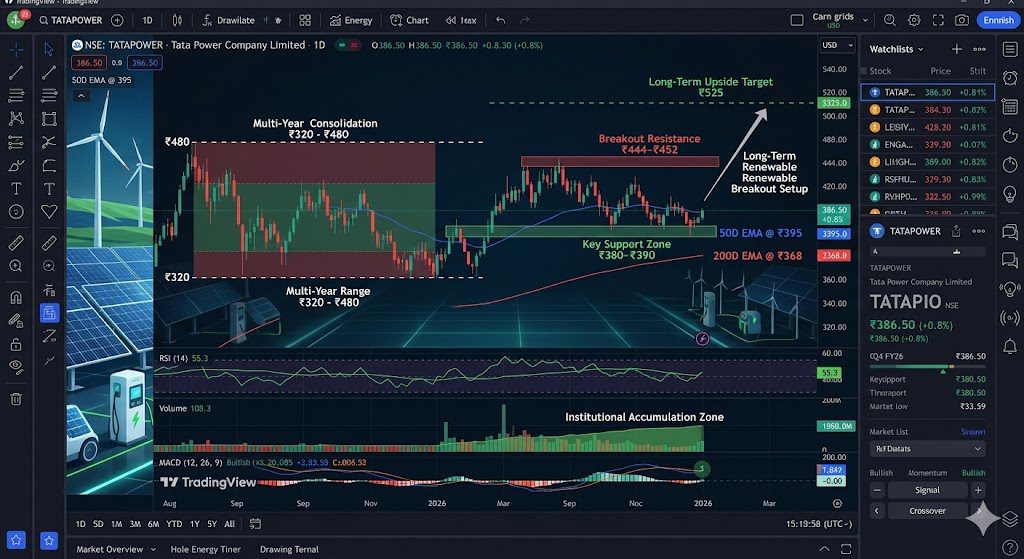
Technically, Tata Power shares have remained range-bound between approximately ₹320 and ₹480 over the past several quarters. The stock is currently testing a key technical pivot zone near the 50-day Exponential Moving Average around ₹412. This consolidation phase reflects investor caution surrounding renewable capex intensity, regulatory uncertainty, project execution timelines, and earnings volatility during the transition toward green energy. However, long-term consolidation phases often act as the foundation for larger structural breakouts.
Major Support Levels
The ₹380–₹390 zone currently acts as the strongest structural support range for Tata Power shares. Institutional accumulation has historically remained strongest within this region, making it an important demand zone for long-term investors. As long as the stock continues holding above this range, the broader long-term bullish structure remains intact.
Immediate Resistance Levels
The stock currently faces immediate resistance near approximately ₹444–₹452. A sustained breakout above this zone could potentially trigger fresh bullish momentum toward the stock’s previous highs. Technical traders therefore continue closely monitoring the ₹450 breakout area for confirmation of stronger upward momentum.
RSI Momentum Analysis
The Relative Strength Index (RSI) currently remains near approximately 55, indicating neutral momentum conditions. This suggests that the stock is neither overbought nor oversold and still has sufficient room for a meaningful upward move if management guidance and renewable execution remain strong during FY27.
Management Guidance: The Road to 33 GW
Expansion Plans
Management currently targets adding approximately 2.5–3 GW of renewable capacity during FY27. This aggressive expansion strategy reflects confidence regarding India’s long-term renewable-energy demand growth. Renewable-energy investments remain one of the biggest structural opportunities for Tata Power over the next decade.
Project Pipeline Visibility
Tata Power currently maintains a substantial renewable project pipeline of approximately 5.2 GW scheduled over the next two years. This provides strong revenue visibility through FY28 and significantly improves long-term earnings predictability. Large renewable pipelines also improve institutional confidence because they create stable long-term cash-flow visibility.
Strategic Business Pivot
The company increasingly expects businesses such as Odisha Discom operations, rooftop solar, distributed energy systems, and EV charging infrastructure to contribute a larger share of EBITDA by FY27 and beyond. This gradual diversification away from legacy thermal businesses significantly improves Tata Power’s long-term business quality and reduces dependence on traditional power-generation cycles.
Brokerage Sentiment & Targets (The Path to ₹525)
Analyst Consensus View
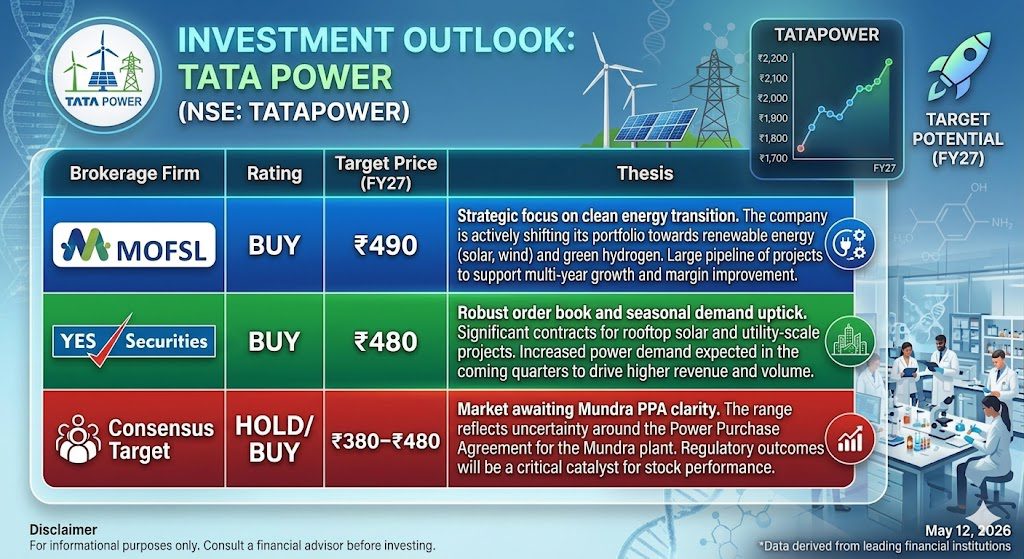
Broader analyst consensus currently maintains Buy/Hold recommendations with average target prices near approximately ₹414. Analysts remain optimistic because of Tata Power’s renewable-capacity expansion, EV ecosystem leadership, solar manufacturing integration, and long-term clean-energy opportunity.
Bullish High Estimates
Several bullish analysts currently maintain aggressive target prices near ₹525. These estimates primarily reflect the long-term valuation potential of solar manufacturing expansion, renewable operating leverage, EV charging monetization, and distributed-energy leadership.
Conservative Estimates
Some analysts remain cautious with target prices near ₹300 because of concerns regarding regulatory delays, thermal-business exposure at Mundra, high capex intensity, and execution risks. Nevertheless, long-term institutional sentiment continues remaining broadly positive.
The “30-Year” Analyst Verdict
For Long-Term Investors
Tata Power remains one of the strongest long-term quality compounders within India’s energy sector. In utility businesses, long-term cash-flow growth eventually follows capacity expansion. With its 4 GW manufacturing capability, massive renewable pipeline, EV charging leadership, and green-energy diversification strategy, the current correction phase could actually represent a strategic accumulation opportunity for patient long-term investors.
For Active Traders
From a trading perspective, Tata Power currently behaves as a range-bound momentum stock. The ₹380–₹450 corridor remains the primary trading zone until a structural breakout occurs. Swing traders may therefore continue using support and resistance levels for tactical positioning opportunities.
Conclusion & Engagement (CTA)
Final Word
A slightly lower quarterly profit is often the short-term price companies pay while building long-term infrastructure dominance. Tata Power Company Limited is currently investing aggressively toward India’s renewable-energy future through solar manufacturing, EV charging infrastructure, distributed-energy systems, and large-scale renewable projects. With ambitious targets toward 33 GW capacity, Tata Power is positioning itself at the center of India’s clean-energy transformation story.
Investor Discussion
Are you holding Tata Power mainly for its ₹2.50 dividend, or are you more bullish on its long-term renewable-energy expansion and EV infrastructure opportunity? Share your green-energy investment strategy and Tata Power outlook in the comments below.