1. Introduction
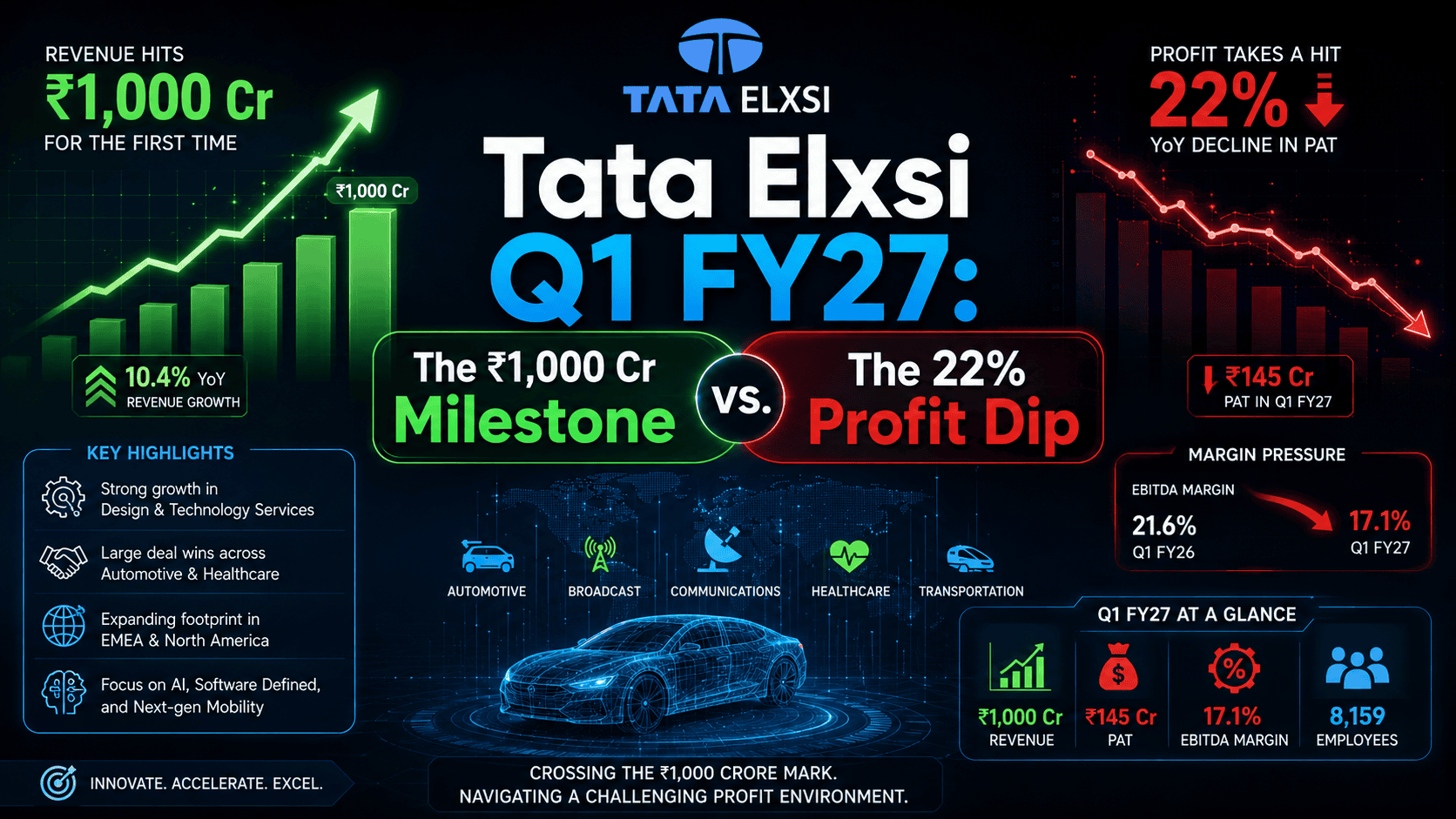
In a quarter characterized by a complex macroeconomic environment, Tata Elxsi has crossed a historic threshold, reporting an operating revenue of over Rs. 1,000 crores for the very first time in Q1 FY27. However, the market’s reaction is likely to be a tug-of-war between this impressive top-line milestone and a noticeable contraction in bottom-line profitability.
While the company delivered a robust 14.5% Year-over-Year (YoY) growth in reported revenue, reaching Rs. 1,021.1 Cr, its Profit After Tax (PAT) witnessed a sharp sequential decline of 22.6% from the previous quarter. This presents a classic dilemma for investors: Is the company sacrificing short-term margins for long-term capability building, particularly in the realm of Artificial Intelligence (AI)?
This comprehensive analysis will break down Tata Elxsi’s Q1 FY27 performance, examining which segments fired on all cylinders, why margins contracted, what management has signaled for the future, and what this means for Indian retail and long-term investors.
2. Executive Summary
For investors short on time, here are the most critical takeaways from Tata Elxsi’s Q1 FY27 earnings report:
Historic Revenue Milestone: Revenue from operations reached Rs. 1,021.1 Cr, marking a 2.8% Quarter-on-Quarter (QoQ) and 14.5% YoY growth.
Constant Currency (CC) Growth: The company posted a revenue growth of 1.3% QoQ and 6.5% YoY in constant currency terms.
Margin Contraction: EBITDA (Earnings Before Interest, Taxes, Depreciation, and Amortization) margin contracted to 21.2% in Q1 FY27, down from 24.6% in Q4 FY26.
Profitability Dip: Profit After Tax (PAT) stood at Rs. 170.6 Cr, a significant 22.6% drop from Rs. 220.4 Cr in the preceding quarter (Q4 FY26).
Segment Divergence: The Media & Communications segment was the standout performer, growing strongly by 4.7% QoQ. Conversely, Healthcare & Life Sciences saw a slight dip of 0.3% CC QoQ amid a muted industry environment.
Strategic Shift to AI: Management highlighted FY27 as a “year of future focus,” heavily investing in specialized talent, AI-powered platforms, and infrastructure.
Major Partnerships: A landmark partnership was announced with JSW Motors to establish the JNEXT technology center in Pune for next-generation mobility solutions.
Rising Attrition: Employee attrition ticked up slightly to 16.0%, continuing a gradual upward trend over the last four quarters.
Key Takeaway: Q1 FY27 was a quarter of top-line strength and strategic AI investment, which effectively weighed on short-term operating margins and net profit.
3. Company Overview
Before diving into the numbers, it is essential for beginners to understand what Tata Elxsi actually does.
Business Model & Core Services Incorporated in 1989, Tata Elxsi is a premier provider of design and technology services. Unlike traditional IT service companies that focus on software maintenance and backend infrastructure, Tata Elxsi specializes in Engineering Research & Development (ER&D). They help global brands design, develop, and test new physical products and software platforms.
Revenue Streams & Client Industries
The company operates primarily through three core verticals under its Software Development & Services (SDS) banner:
Transportation: Assisting Auto Original Equipment Manufacturers (OEMs) with software-defined vehicles, electrification, and autonomous driving tech.
Media and Communications: Working with broadcasters and telecom operators on network transformation and digital media platforms.
Healthcare & Life Sciences: Developing compliance tools, MedTech devices, and software for the medical industry.
Competitive Positioning Tata Elxsi differentiates itself by combining “deep domain expertise with over 30 years of technology and product development experience”. Their strategy relies heavily on integrating human-centric design with advanced digital technologies like IoT, Cloud, and now, Artificial Intelligence.
4. Q1 FY27 Results Snapshot
Note: All figures are in INR Crores unless stated otherwise. Data sourced from official company investor presentation.
Earnings Snapshot Table
| Financial Metric | Q1 FY27 | Q4 FY26 | QoQ Growth | Q1 FY26 | YoY Growth |
| Revenue from Operations | 1,021.1 | 993.8 | -2.8% | 892.1 | 14.5% |
| Other Income | 41.5 | 50.6 | -18.0% | 38.5 | 7.8% |
| Total Income | 1,062.6 | 1,044.3 | 1.7% | 930.6 | 14.2% |
| EBITDA | 216.0 | 244.6 | -11.7% | 186.7 | 15.7% |
| EBITDA Margin | 21.2% | 24.6% | -340 bps | 20.9% | +30 bps |
| PBT (Profit Before Tax) | 232.5 | 267.8 | -13.2% | 196.3 | 18.4% |
| PAT (Profit After Tax) | 170.6 | 220.4 | -22.6% | 144.4 | 18.2% |
| PAT Margin | 16.1% | 21.1% | -500 bps | 15.5% | +60 bps |
| Basic EPS (Rs.) | 27.38 | 35.37 | -22.6% | 23.18 | 18.1% |
Educational Note: “bps” stands for basis points. 100 basis points equal 1%. Therefore, a 340 bps drop means a 3.4% decline in margin.
5. Segment-wise Performance
Tata Elxsi’s business is heavily skewed towards Software Development & Services (SDS), which accounted for 96.9% of total revenue in Q1 FY27. The remaining 3.1% comes from System Integration & Support, which saw excellent YoY CC growth of 29.2%.
Let’s break down the massive SDS business:
A. Transportation (55.3% of SDS Revenue)
Growth: The segment reported a slight QoQ decline of 0.4% in CC terms, but grew 6.7% YoY in CC. On a reported basis, it grew 13.3% YoY.
Drivers: Growth was driven by accelerated OEM engagements, which now constitute 78% of automotive revenues. Strategic wins were also recorded in the off-road and aerospace segments.
Key Deals: Secured engagements with a leading Japanese auto OEM for connected mobility and a US aerospace provider for safety-critical embedded platforms.
B. Media and Communications (33.4% of SDS Revenue)
Growth: This was the star performer, growing 2.9% CC QoQ and 11.5% CC YoY. On a reported basis, it surged 22.2% YoY.
Drivers: The growth was aided by “strategic long-term deals and deal ramp-ups” globally.
Key Deals: Won a Gen AI-powered transformation deal for a large-scale AdTech ecosystem.
C. Healthcare & Life Sciences (9.2% of SDS Revenue)
Growth: A slightly muted quarter, showing a -0.3% CC QoQ decline and a severe -22.1% CC YoY contraction. (Note: However, the summary bullet points in the source state Healthcare grew 1.7% QoQ amidst a muted industry environment. This slight discrepancy between the chart’s CC QoQ figure and the bullet point’s reported QoQ figure reflects the impact of currency fluctuations).
Drivers: The broader MedTech industry is facing a sluggish macro environment, impacting client spending.
Key Deals: A leading global MedTech company chose Tata Elxsi’s ViTel platform to address compliance and traceability.
Key Takeaway: The diversification of Tata Elxsi is paying off. While the usually dominant Transportation sector saw flat QoQ growth, the Media segment stepped up to drive the overall revenue higher.
6. Management Commentary
Understanding management’s perspective is crucial to contextualize raw data. Here is what CEO and MD Manoj Raghavan had to say regarding the Q1 FY27 performance:
On the Revenue Milestone:
“Tata Elxsi delivered a healthy growth of 14.5% YoY, supported by strong deal execution and continued momentum in large strategic engagements. We also crossed a key milestone of reporting operating revenue of more than Rs. 1,000 crores in the current quarter.”
On the Margin Contraction & Future Strategy:
The CEO clearly explained the reason behind the margin drop—heavy investments into Artificial Intelligence.
“FY27 marks a year of future focus for the company, as we prepare and equip ourselves for a world reshaped by AI. We are making targeted investments in specialized talent, AI powered platforms, tools and infrastructure, to pivot to a Domain + AI future.”
On Future Outlook:
“We are firmly focussed on sustainable growth, deepening our engagements with key customers and positioning ourselves to shape and win strategic long-term deals… even as we protect and improve upon our industry-leading margins”.
Independent Analysis: Management is telegraphing a classic “short-term pain for long-term gain” scenario. By intentionally absorbing lower margins now to build AI platforms (like AnaTel and ViTel), they aim to maintain their premium pricing power and structural moat in the future.
7. Financial Analysis
Let’s unpack the financial health of the company using plain English.
1. Revenue Growth: Tata Elxsi continues to show resilience on the top line. A 14.5% YoY reported growth in the current global macroeconomic climate (where many IT peers are struggling with flat or negative growth) is commendable.
2. Profitability & Margins (The Elephant in the Room):
EBITDA: Operating profit fell from Rs. 244.6 Cr to Rs. 216.0 Cr sequentially.
Why? The contraction in EBITDA margin to 21.2% (from 24.6% in Q4) is the primary reason. Management explicitly tied this to “targeted investments in specialized talent, AI powered platforms, tools and infrastructure”.
Educational Note: Operating margin indicates how much profit a company makes on a dollar of sales after paying for variable costs like wages. A drop indicates rising costs relative to revenue.
3. Delivery Mix (Onsite vs. Offshore): The offshore delivery mix stood at 74.1% in Q1 FY27, down slightly from 75.0% in Q4 FY26. Correspondingly, onsite revenue increased to 25.9%. An increase in onsite work typically puts downward pressure on margins because overseas salaries are higher than Indian salaries.
4. Employee Metrics & Attrition: Headcount has been steadily decreasing over the past 5 quarters, from 12,127 in Q1 FY26 to 11,336 in Q1 FY27. Concurrently, attrition has slowly crept up from 15.0% to 16.0% over the same period. This indicates a focus on higher utilization of existing employees rather than aggressive fresh hiring, though the rising attrition bears watching.
8. Valuation Analysis
Note: As an analyst, I must clarify that stock price metrics change daily. This analysis is based on the fundamental EPS reported in Q1 FY27.
Earnings Per Share (EPS): The basic and diluted EPS for Q1 FY27 was Rs. 27.38.
Annualized Run Rate: If we simply annualize this quarter’s earnings (multiply by 4), the forward EPS estimate sits around Rs. 109.52.
Valuation Context: Tata Elxsi has historically commanded a premium valuation (high Price-to-Earnings or P/E multiple) compared to broader IT services companies because it operates in the niche, high-margin ER&D space.
Market Reaction Logic: If the market was pricing in expanding margins and receives contracting margins instead, the P/E multiple is usually penalized in the short term. Investors must assess if the current market price reflects the transient nature of these AI investments or if it signals a longer-term structural margin reset.
9. Peer Comparison
While specific Q1 FY27 competitor data is required for an exact real-time table, we can analyze how Tata Elxsi’s metrics compare to industry standards for Indian ER&D companies (like L&T Technology Services or KPIT Tech).
| Metric Focus | Tata Elxsi Q1 FY27 | Industry Standard Context |
| EBITDA Margin | 21.2% | Traditionally, Tata Elxsi operates at the top tier of industry margins (often 25%+). The drop to 21.2% brings them closer to the ER&D industry average. |
| Client Concentration | Top 5: 44.7% | High concentration. The industry prefers to see the Top 5 client reliance reduced to minimize risk. |
| Offshore Ratio | 74.1% | Very healthy. Most premium ER&D players aim for a 70%+ offshore ratio to maintain profitability. |
10. Industry Analysis
The ER&D industry is undergoing a massive transformation.
Technology Disruption: The launch of Generative AI is forcing ER&D companies to adapt. Tata Elxsi’s launch of platforms like AnaTel (an AI-native software development platform for healthcare) and ViTel (a material intelligence solution powered by AI) demonstrates the industry’s shift toward autonomous engineering.
Automotive Shift: The transportation sector is pivoting to “connected, multi-powertrain and AI powered mobility”. Tata Elxsi’s partnership with JSW Motors to build the JNEXT Technology Centre is a direct response to this industry trend towards software-defined vehicles (SDVs).
11. Macroeconomic Analysis
The Q1 FY27 results do not exist in a vacuum. They are influenced by broader economic currents:
Geographic Exposure: Tata Elxsi generates 42.2% of its revenue from the Americas and 31.7% from Europe. Any economic slowdown, prolonged high interest rates, or tech-spending cuts in the US or Eurozone directly impacts their top line.
Currency Fluctuations: The difference between reported growth (14.5% YoY) and constant currency growth (6.5% YoY) highlights how exchange rates (like the INR depreciating against the USD/EUR) can inflate reported rupee earnings.
12. Risks
Company & Execution Risks
Margin Recovery Delay: The biggest risk is that the investments in AI platforms take longer than expected to monetize, keeping margins depressed for several quarters.
Client Concentration: With 44.7% of revenue coming from just 5 clients, the loss or budget cut of a single mega-client could severely impact revenues.
Rising Attrition: Attrition climbing to 16.0% suggests wage pressures might persist, further threatening margins.
Bull vs. Bear Case
Bull Case: AI investments (AnaTel, ViTel) create highly scalable, non-linear revenue streams. The JSW Motors partnership scales massively, and EBITDA margins return to ~25% by Q4 FY27.
Bear Case: Global macro headwinds cause the US aerospace/auto OEMs to slash R&D budgets. AI investments become sunk costs, and operating margins permanently rebase to the 18-20% range.
Base Case: Steady top-line growth driven by the Media and Transportation segments, while margins remain compressed in the near term (21-22%) before gradually recovering in FY28.
13. Future Outlook
Management has laid out a clear roadmap for the future:
Strategic Shift: The company is pivoting to a “Domain + AI future”.
Product Launches: The recent launches of AnaTel and ViTel in the MedTech space indicate a shift toward platform-based revenue, which is more scalable than traditional time-and-material billing (which currently stands at 42.2% of contracts).
Transportation Expansion: The JNEXT center with JSW Motors positions them strongly for the Indian EV and connected car boom.
Telecom Automation: Expanding the NEURON platform with Sky to modernize network provisioning and achieve “60-70% cost efficiencies” for telecom providers offers a strong growth runway.
14. Investor Takeaways
Educational Disclaimer: This section is for informational and educational purposes only and does not constitute personalized investment advice.
For Long-Term Investors: The structural story of Tata Elxsi remains intact. The company is investing in the right technologies (AI, SDVs, MedTech compliance) to secure future growth. If you believe in management’s ability to execute this “Domain + AI” pivot, short-term margin dips are standard corporate lifecycle events.
For Swing / Positional Traders: The 22.6% QoQ drop in PAT provides a negative headline shock. Expect volatility. The market may re-rate the stock’s high P/E multiple downwards until margin stability is proven.
For Beginners: Watch the EBITDA margin over the next two quarters. If it stays around 21%, the company is in a heavy investment phase. If it drops further, it may signal pricing pressure from clients.
15. Conclusion
Tata Elxsi’s Q1 FY27 is a tale of two realities. On one hand, crossing the Rs. 1,000 Crore operating revenue milestone is a testament to their exceptional sales engine, sticky client relationships, and deep domain expertise in Transportation and Media.
On the other hand, the stark drop in profitability (PAT down 22.6% QoQ) is a clear signal that the rules of the IT and ER&D game are changing. Management’s conscious decision to sacrifice short-term margins to fund aggressive AI platform development is a bold, necessary move to prevent technological obsolescence. Investors must now exercise patience, allowing the seeds planted in AnaTel, ViTel, and JNEXT to bear fruit in the coming years.