Introduction: The Delivery Giant’s New Discipline
India’s startup ecosystem has transformed dramatically over the last three decades. In the early years of liberalization, businesses focused mainly on profitability because capital was limited and investors valued stability over rapid expansion. But after the rise of venture capital funding and the digital economy, many internet companies shifted toward a “growth at any cost” strategy where market share became more important than profits. Over the years, investors watched several technology startups burn billions of rupees chasing aggressive expansion. Some succeeded, while others disappeared under the pressure of rising losses and intense competition. Among the companies that survived and evolved, Swiggy has become one of the biggest names in India’s digital consumption economy.
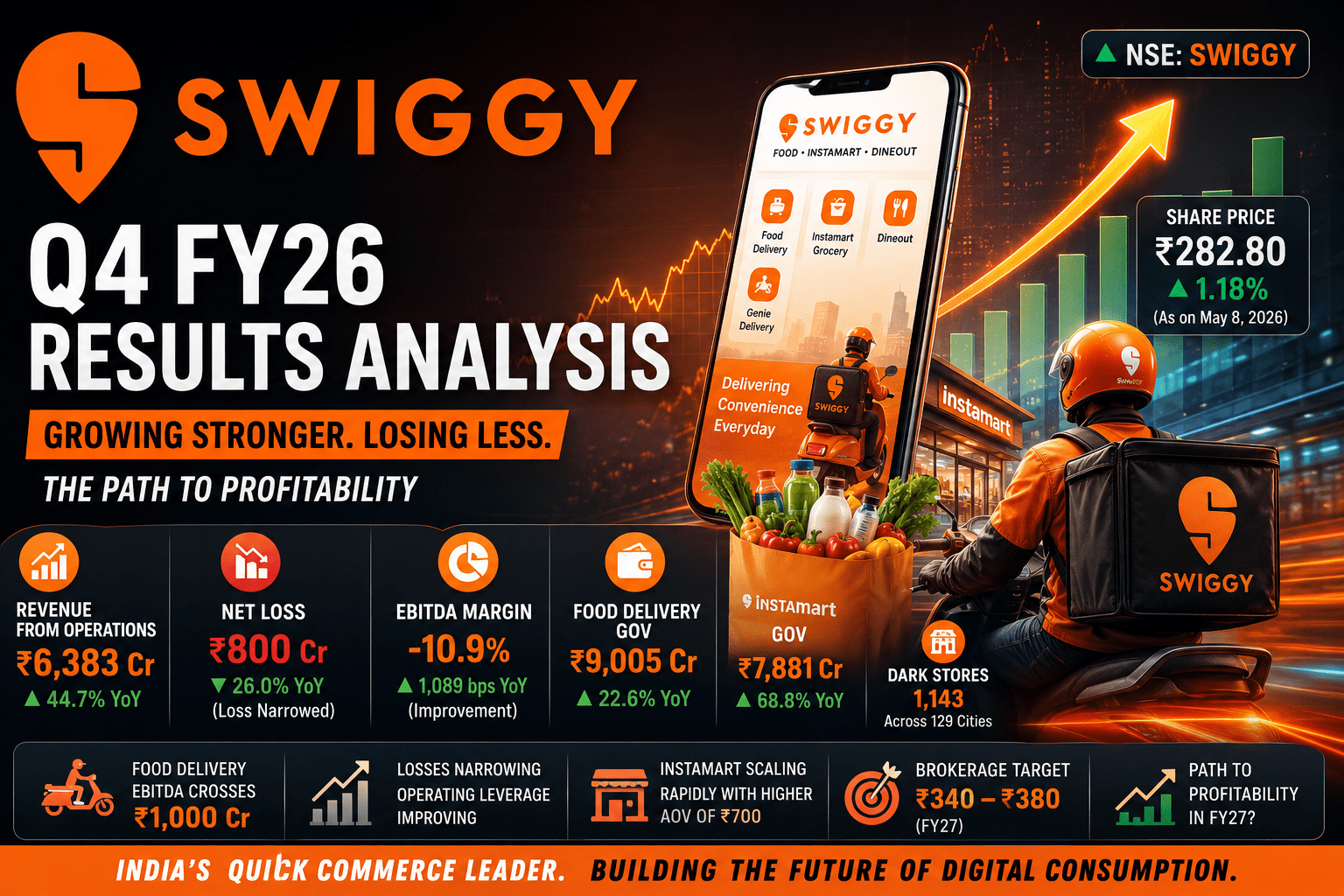
What began as a simple food delivery platform has now evolved into a large multi-service ecosystem that includes food delivery, grocery delivery through Instamart, dining-out experiences, and logistics infrastructure. On May 9, 2026, Swiggy released its Q4 FY26 results, and the numbers suggest that the company is finally moving toward a more disciplined growth strategy. Revenue surged nearly 45% year-on-year to ₹6,383 crore, while losses narrowed significantly from ₹1,081 crore to ₹800 crore. Investors responded positively because these results indicate that Swiggy is beginning to achieve operational leverage after years of heavy spending.
The stock settled near ₹282.80 on Friday with a gain of around 1.18% as the market reacted to improving margins and stronger business execution. Although the company still faces intense competition in quick commerce, the latest results suggest that Swiggy is gradually transitioning from uncontrolled cash burn toward more sustainable long-term growth.
Q4 FY26 Performance: The “Hard Numbers” (NSE Actuals)
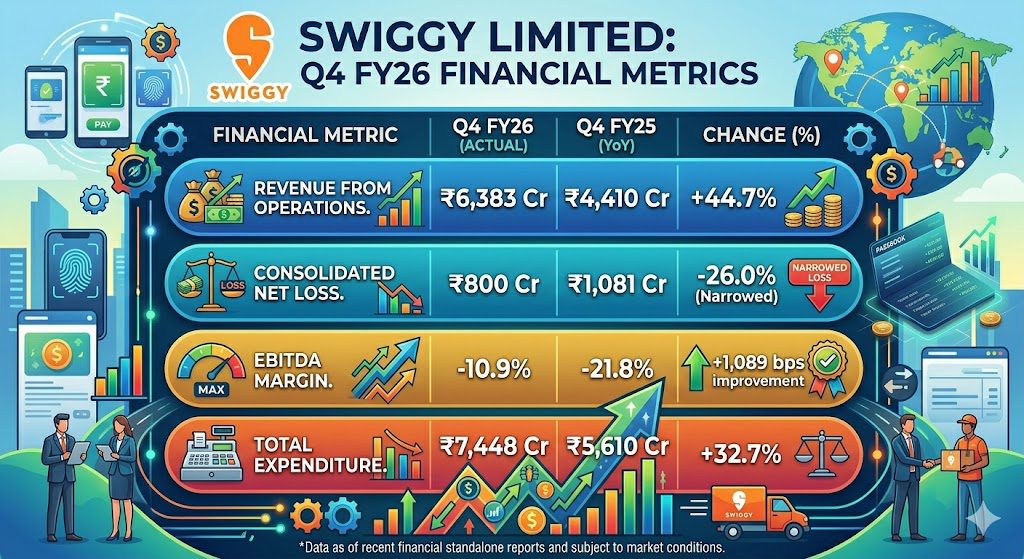
Swiggy delivered one of its strongest operational quarters during Q4 FY26 as the company continued scaling revenue while reducing losses. Revenue from operations increased sharply to ₹6,383 crore compared to ₹4,410 crore during the same quarter last year, representing strong year-on-year growth of approximately 44.7%. This growth was supported by expansion across food delivery, quick commerce, and other consumer-focused services.
The company’s consolidated net loss narrowed significantly to ₹800 crore compared to ₹1,081 crore in Q4 FY25. This means losses reduced by nearly 26%, which is a major improvement for a high-growth technology platform still investing heavily in expansion.
One of the biggest positives came from EBITDA margin improvement. EBITDA margin improved to negative 10.9% compared to negative 21.8% last year, reflecting a substantial improvement of more than 1,000 basis points. This indicates that the company is finally beginning to benefit from scale efficiencies and stronger operational discipline.
At the same time, total expenditure rose to ₹7,448 crore compared to ₹5,610 crore last year as Swiggy continued investing in dark stores, logistics infrastructure, customer acquisition, delivery networks, and quick-commerce expansion.
| Financial Metric | Q4 FY26 | Q4 FY25 | Growth |
|---|---|---|---|
| Revenue from Operations | ₹6,383 Cr | ₹4,410 Cr | +44.7% |
| Consolidated Net Loss | ₹800 Cr | ₹1,081 Cr | Loss Narrowed 26% |
| EBITDA Margin | -10.9% | -21.8% | Improved |
| Total Expenditure | ₹7,448 Cr | ₹5,610 Cr | +32.7% |
The overall numbers clearly show that Swiggy is entering a new operational phase where scale and efficiency are beginning to improve financial performance.
Fundamental Analysis: The Two-Engine Strategy
Food Delivery Has Become the Profit Engine
One of the strongest highlights from Swiggy’s Q4 FY26 results was the continued profitability improvement in its food delivery business. The segment recorded its highest growth in nearly four years with Gross Order Value (GOV) reaching ₹9,005 crore, reflecting growth of approximately 22.6% year-on-year.
More importantly, the food delivery business has now become a significant profit-generating engine for the company. The segment’s annual adjusted EBITDA crossed the ₹1,000 crore milestone for the first time, proving that the core business model can generate sustainable profitability at scale.
Over the last few years, Swiggy has focused heavily on improving operational efficiency through better route optimization, higher delivery density, improved restaurant partnerships, and stronger customer retention. These improvements are now translating into healthier margins and better profitability.
For investors, this is extremely important because a profitable food delivery business provides a stable financial foundation while the company continues investing aggressively in newer segments like quick commerce.
Instamart Remains the Growth Engine
While food delivery is driving profitability, Instamart continues functioning as Swiggy’s largest long-term growth engine. Quick-commerce Gross Order Value surged approximately 68.8% year-on-year to ₹7,881 crore during Q4 FY26.
This growth reflects changing consumer behavior in India, especially in urban areas where customers increasingly prefer ultra-fast delivery for groceries, daily essentials, and household products.
One of the most encouraging trends was the increase in Average Order Value (AOV) to around ₹700. This suggests that customers are no longer using Instamart only for emergency purchases. Consumers are gradually shifting toward larger and more frequent shopping baskets, which improves the platform’s unit economics.
However, the quick-commerce industry remains one of the most competitive sectors in India’s startup ecosystem. Companies continue spending aggressively on:
- Dark-store expansion
- Delivery speed
- Customer discounts
- Market share acquisition
Despite these challenges, Swiggy’s improving contribution margins indicate that operational efficiency is gradually strengthening.
Dining-Out Segment Achieves Profitability
Another important milestone came from Swiggy’s out-of-home dining business, which achieved its first full year of profitability during FY26.
This is strategically important because it diversifies Swiggy’s revenue streams beyond food delivery and quick commerce. The dining-out segment benefits from restaurant discovery, cashback offers, reservations, merchant partnerships, and customer loyalty programs.
As India’s urban consumption economy continues expanding, the dining-out business could become another meaningful contributor to long-term profitability.
Technical Analysis: Navigating the ₹275 Floor
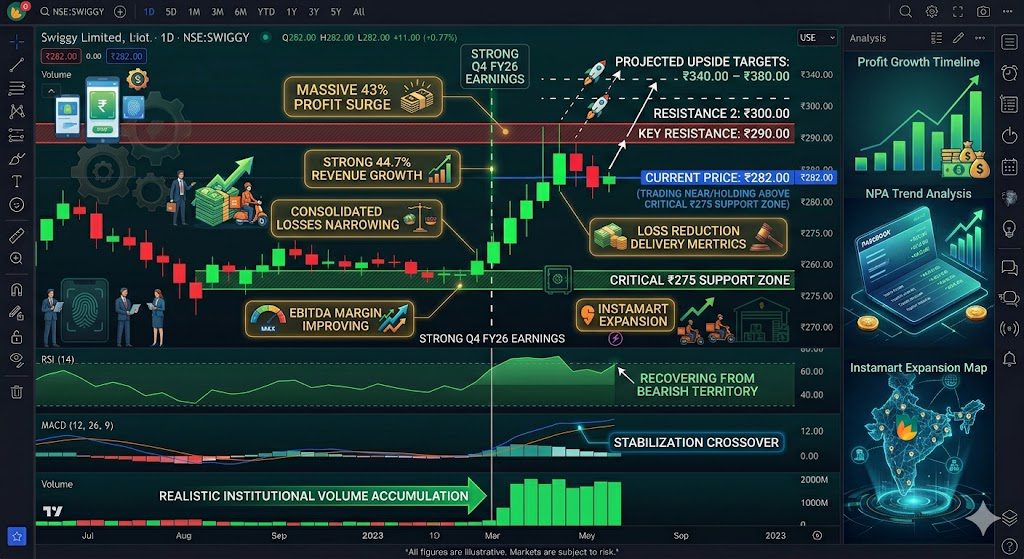
Stock Remains Under Pressure Despite Improving Fundamentals
From a technical analysis perspective, Swiggy remains under pressure despite improving operational performance.
The stock is currently trading nearly 40.6% below its 52-week high of ₹474, reflecting investor caution toward loss-making technology and quick-commerce companies.
High-growth internet stocks remain highly sensitive to concerns regarding:
- Profitability
- Cash burn
- Competitive intensity
- Interest rates
- Valuation sustainability
Even though Swiggy’s operational numbers are improving, the market still wants clearer visibility regarding long-term profitability before assigning higher valuations.
₹275 Is the Critical Support Zone
The most important support level currently lies near ₹275.50.
This level acted as the intraday low on results day and remains psychologically important for traders and investors. If the stock sustains above this support zone, short-term recovery momentum could gradually strengthen.
However, a decisive breakdown below ₹275 may trigger fresh selling pressure and further weakness.
Resistance Levels Continue Challenging Bulls
On the upside, immediate resistance currently exists between ₹284 and ₹290.
For a meaningful trend reversal to occur, the stock likely needs a sustained close above ₹300 supported by stronger institutional buying activity.
Technical traders are closely watching whether improving financial performance eventually attracts long-term institutional accumulation at lower price levels.
Long-Term Technical Structure Still Looks Weak
Although Swiggy’s operational numbers are improving, the broader chart structure still remains technically weak.
The stock continues trading below important long-term moving averages, while momentum indicators currently suggest a bearish-to-neutral setup.
However, if the company continues narrowing losses and improving margins over the next few quarters, the technical structure could gradually improve as investor confidence returns.
Brokerage Sentiment & Targets: The Long-Term View
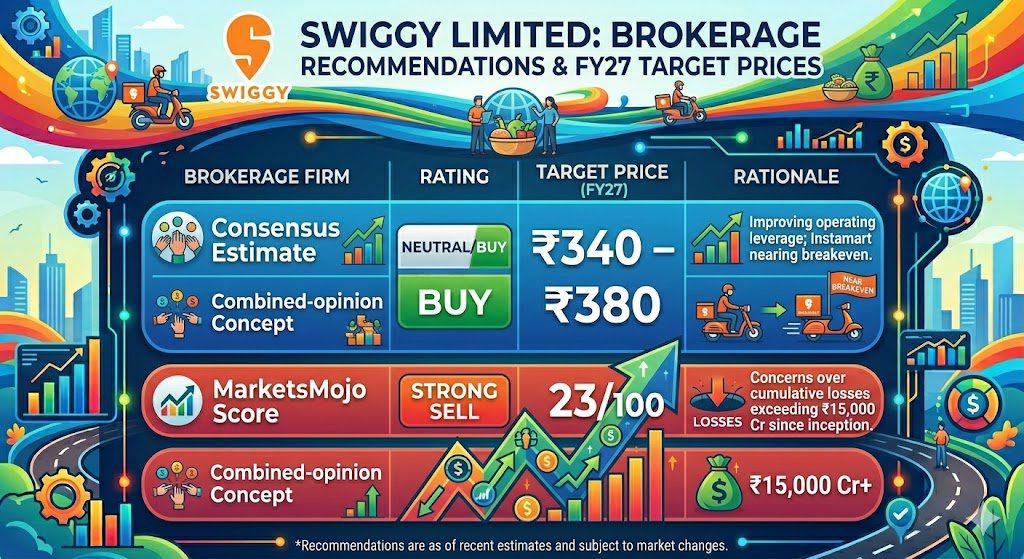
Institutional opinion regarding Swiggy remains divided because the company operates in a highly competitive and capital-intensive industry.
Some analysts believe improving operational leverage, stronger food delivery profitability, and rapid quick-commerce growth justify long-term optimism.
Others remain concerned about:
- Intense competition
- High cumulative losses
- Cash-burn sustainability
- Valuation risks
| Brokerage Firm | Rating | Target Price | Rationale |
|---|---|---|---|
| Consensus Estimate | NEUTRAL/BUY | ₹340 – ₹380 | Improving operational leverage |
| MarketsMojo Score | STRONG SELL | 23/100 | Concerns over cumulative losses |
Swiggy’s cumulative losses reportedly exceed ₹15,000 crore since inception, which remains a major concern for conservative investors. However, growth-focused investors continue betting on India’s expanding digital consumption economy and the long-term scalability of quick commerce.
Management Guidance: The Path Toward Breakeven
Operational Efficiency Remains the Main Focus
Management emphasized operational efficiency improvements as a key priority during the quarter.
The company continues focusing on:
- Reducing delivery costs
- Improving picking efficiency
- Optimizing dark-store operations
- Increasing delivery density
- Improving contribution margins
These improvements are critical because quick-commerce profitability depends heavily on operational scale and efficiency.
Dark Store Expansion Continues Aggressively
Swiggy added seven new dark stores during the quarter, taking the total network to approximately 1,143 stores across 129 cities.
Dark stores form the backbone of quick-commerce operations because they enable ultra-fast deliveries and improve customer convenience.
However, expanding this infrastructure also requires heavy capital investment and operational spending. The biggest challenge for Swiggy will be balancing aggressive expansion with improving profitability.
Competition Remains Extremely Intense
Management also acknowledged that competition within the quick-commerce industry remains extremely intense.
The sector continues witnessing aggressive investment from multiple players competing for market share through:
- Faster delivery
- Deep discounting
- Marketing campaigns
- Geographic expansion
Despite these pressures, Swiggy highlighted improving contribution margins, which improved to approximately negative 1.8% during Q4 FY26. This suggests the company is gradually moving closer toward operational breakeven.
The “30-Year” Analyst Verdict
For Long-Term Investors
For long-term investors, Swiggy remains a high-risk, high-reward growth story.
The company now possesses:
- Strong revenue growth
- Improving operational leverage
- A profitable food delivery business
- Rapid quick-commerce scaling
- Expanding digital consumer ecosystem
However, risks remain significant because the quick-commerce battle continues consuming large amounts of capital.
The path toward overall company profitability may remain difficult and highly competitive for several years.
Investors should therefore approach the stock with a long-term perspective and a higher risk tolerance.
For Active Traders
For active traders, Swiggy remains an extremely volatile stock that reacts sharply to quarterly revenue and margin performance.
The ₹275 support level remains critical for short-term trading setups.
If broader market sentiment stabilizes and the stock continues holding support, short-term recovery trades toward ₹310 may emerge.
However, traders should maintain disciplined stop-loss strategies because internet and startup stocks often remain highly volatile during uncertain market conditions.
Conclusion & Engagement (CTA)
Swiggy’s Q4 FY26 results clearly indicate that the company is gradually transitioning from aggressive cash-burn expansion toward more disciplined and sustainable growth.
Revenue surged nearly 45%, losses narrowed significantly, food delivery profitability improved further, and Instamart continued scaling rapidly.
The company still faces enormous competition within India’s quick-commerce ecosystem, but operational improvements suggest management is beginning to find the right balance between growth and profitability.
The biggest question now is whether Swiggy can eventually achieve full-company profitability while continuing to compete aggressively in one of India’s fastest-growing digital sectors.
Are you betting on Swiggy reaching profitability in FY27, or do you believe the quick-commerce war will continue burning cash for years to come?