Introduction: The Titan’s Temper Tantrum
Over the last three decades, India’s banking sector has gone through massive transformations. From the era of manual passbooks and endless paperwork to today’s digital-first financial ecosystem, very few institutions have adapted as successfully as SBIN. Once considered a slow-moving government banking giant, State Bank of India has evolved into a technology-driven financial powerhouse with one of the largest digital banking ecosystems in the world.
However, even the strongest companies sometimes face difficult reactions from the stock market.
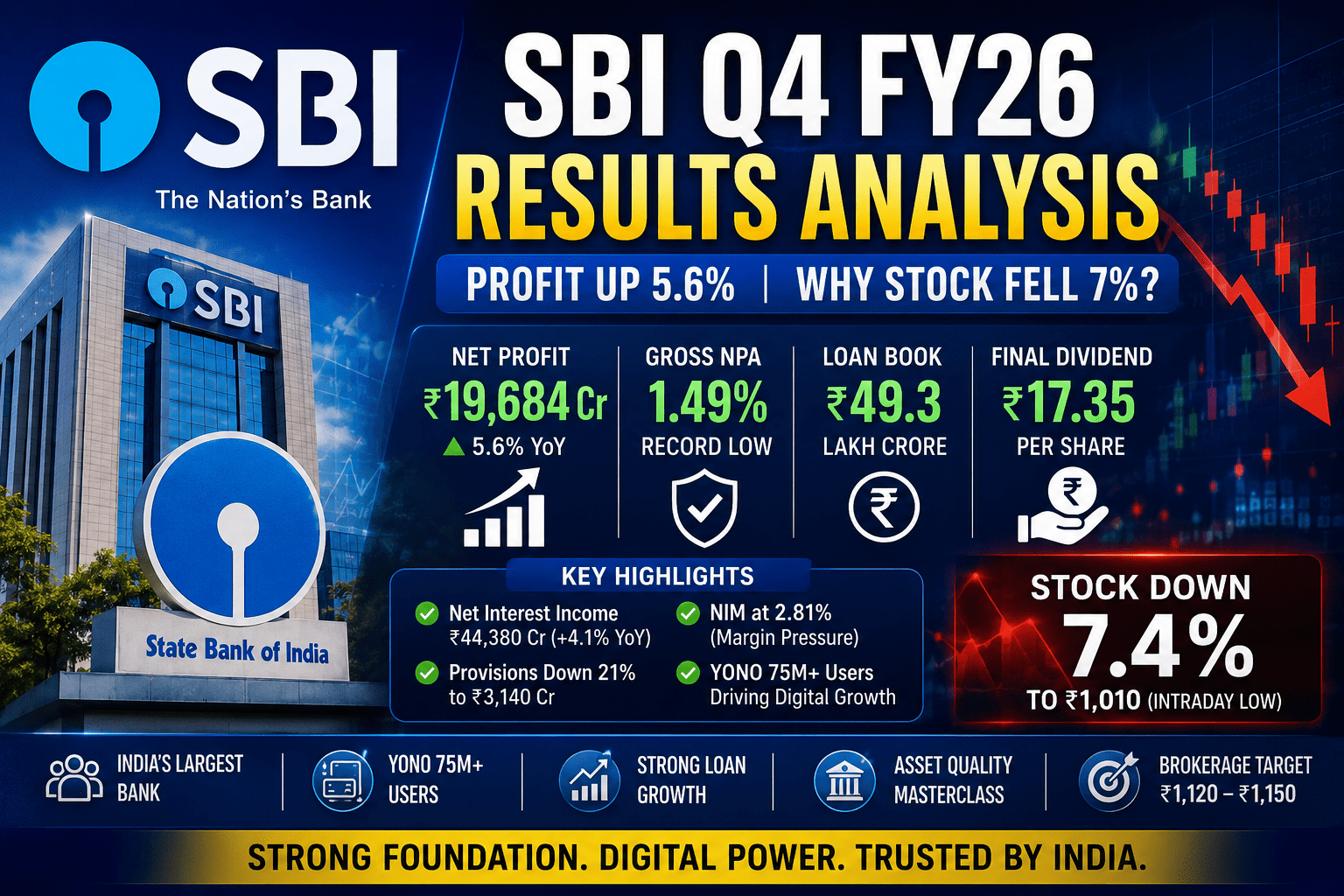
On Friday, May 8, 2026, SBI announced its Q4 FY26 results, and although the numbers appeared healthy on the surface, Dalal Street responded very differently. The stock witnessed intense selling pressure during intraday trading and dropped nearly 7.4%, touching levels close to ₹1,010.
This sharp correction surprised many retail investors because the bank still reported strong profitability, improving asset quality, and healthy loan growth. So why did the market react negatively?
The answer lies in one simple reality that experienced investors understand very well — markets trade on expectations, not just numbers.
Over the last few months, SBI had rallied strongly ahead of earnings, and expectations from investors had become extremely high. While the bank delivered stable profit growth and record-low bad loan levels, concerns over margin pressure and slower-than-expected earnings momentum triggered heavy profit booking.
Still, from a long-term perspective, SBI continues to remain one of India’s most important financial institutions with enormous scale, strong balance sheet quality, and improving digital capabilities.
For investors searching for fundamentally strong public sector bank stocks in India, SBI still remains one of the most attractive long-term opportunities in the banking sector.
Q4 FY26 Actual Scorecard: The Official NSE Data
State Bank of India delivered steady operational performance during the March 2026 quarter despite a challenging interest rate environment and rising deposit costs.
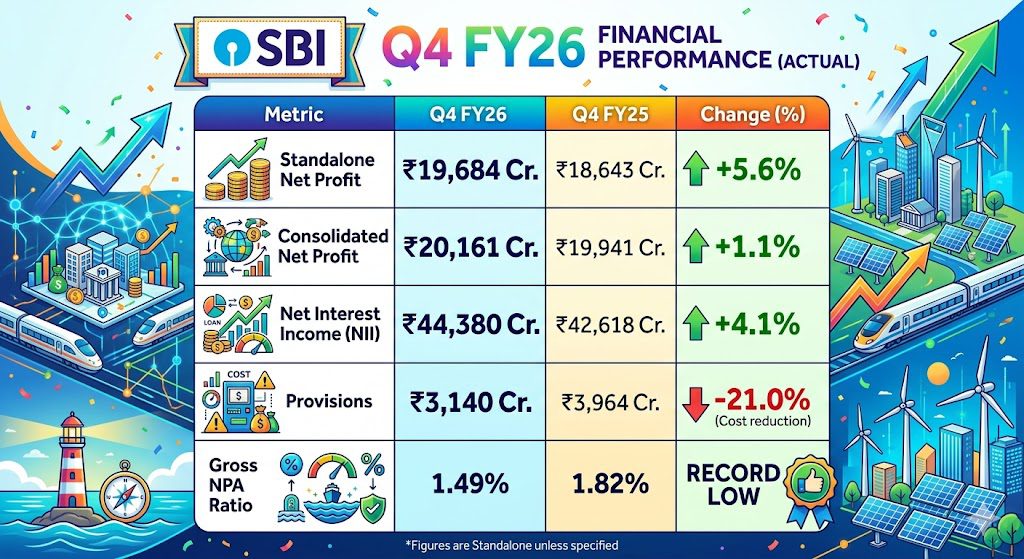
The bank reported standalone net profit of ₹19,684 crore for Q4 FY26 compared to ₹18,643 crore in the same quarter last year, representing growth of 5.6% year-on-year.
Consolidated net profit came in at ₹20,161 crore versus ₹19,941 crore in Q4 FY25, reflecting more modest growth of 1.1%.
Net Interest Income (NII), which remains one of the most critical profitability indicators for banks, increased to ₹44,380 crore from ₹42,618 crore, registering healthy growth of 4.1%.
One of the biggest positives in the quarter was the decline in provisioning costs. Provisions dropped sharply by 21% year-on-year to ₹3,140 crore compared to ₹3,964 crore in the year-ago period. Lower provisioning indicates improving loan book quality and reduced stress within the banking system.
The biggest highlight, however, was SBI’s asset quality performance. Gross NPA ratio improved significantly to 1.49%, compared to 1.82% a year ago. This marks one of the lowest bad loan ratios in the bank’s modern history.
| Metric | Q4 FY26 | Q4 FY25 | YoY Change |
|---|---|---|---|
| Standalone Net Profit | ₹19,684 Cr | ₹18,643 Cr | +5.6% |
| Consolidated Net Profit | ₹20,161 Cr | ₹19,941 Cr | +1.1% |
| Net Interest Income (NII) | ₹44,380 Cr | ₹42,618 Cr | +4.1% |
| Provisions | ₹3,140 Cr | ₹3,964 Cr | -21.0% |
| Gross NPA Ratio | 1.49% | 1.82% | Record Low |
These numbers clearly show that SBI remains fundamentally strong despite short-term market disappointment.
Fundamental Analysis: Quality Over Quantity
SBI’s Asset Quality Improvement Is Historic
The most important takeaway from SBI’s Q4 FY26 results is the dramatic improvement in asset quality.
For a bank of SBI’s enormous size to maintain a Gross NPA ratio of just 1.49% and Net NPA ratio of 0.39% is truly remarkable. Over the last decade, SBI has gone through one of the largest balance sheet cleanup cycles in Indian banking history.
Back in the previous credit cycle, public sector banks were heavily criticized for large corporate bad loans and weak underwriting standards. SBI itself had struggled with stressed infrastructure and corporate accounts for years.
However, the current numbers show that the cleanup process is now largely complete.
Improved underwriting discipline, aggressive recoveries, better digital monitoring systems, and stronger risk management have significantly strengthened the bank’s balance sheet.
This improvement is extremely important because lower NPAs directly reduce provisioning pressure and improve long-term profitability.
In today’s banking environment, SBI’s asset quality ratios now compare favorably even against many private sector banks.
Credit Growth Remains Strong
Another major positive from the quarter was the bank’s strong credit growth momentum.
Total advances grew by approximately 20.01% year-on-year, crossing the massive ₹49.3 lakh crore mark.
This growth reflects healthy demand across retail, corporate, SME, and agricultural lending segments. Retail loans, particularly home loans and personal banking products, continue to remain important growth drivers for SBI.
India’s broader economic recovery, government infrastructure spending, and rising consumption trends are supporting overall credit demand across the banking system.
SBI’s enormous branch network and digital reach allow it to capture growth opportunities across both urban and rural markets.
Strong loan growth is especially important because it supports future revenue expansion and improves long-term earnings visibility.
Margin Pressure Triggered Market Concerns
While asset quality and credit growth remained impressive, the biggest concern for investors was pressure on Net Interest Margins (NIMs).
SBI reported whole-bank NIM of 2.81% during Q4 FY26. Although still healthy for a public sector bank, margins showed signs of mild contraction due to rising deposit costs.
This appears to be the primary reason behind the sharp market reaction.
Indian banks are currently facing intense competition for deposits as liquidity conditions tighten across the financial system. Higher deposit rates increase funding costs and reduce profitability spreads.
The market was likely expecting stronger margin performance considering SBI’s scale advantage.
Although the margin decline was not severe, investor expectations had become very high after the stock’s strong rally over the last year.
This explains why the market reacted negatively despite stable profit growth and record-low bad loans.
Technical Analysis: The ₹1,000 Support Test
Earnings Pullback After Strong Rally
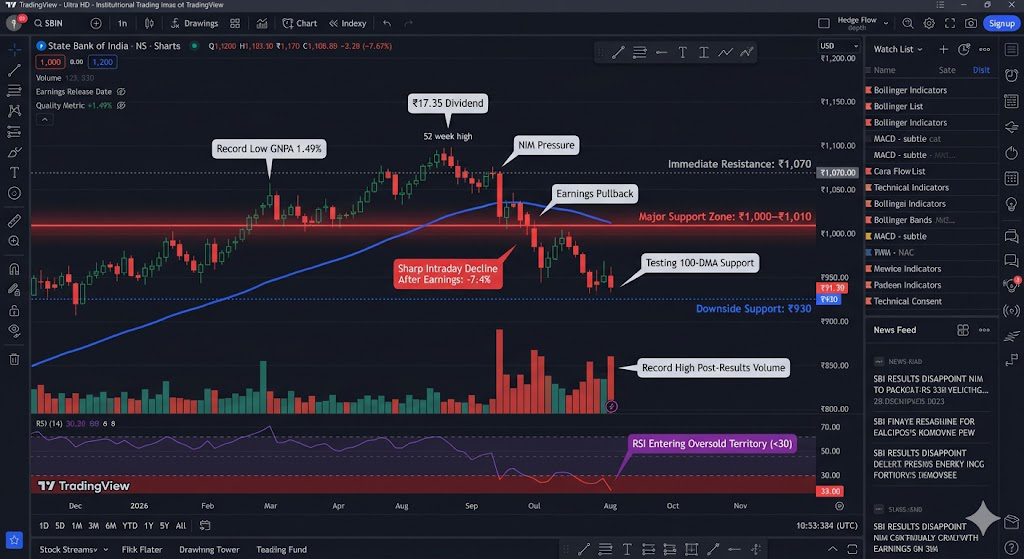
From a technical analysis perspective, SBI is currently experiencing a classic “earnings pullback” after a strong multi-month rally.
The stock had previously climbed close to its 52-week high near ₹1,100 before the Q4 FY26 results triggered heavy profit booking.
Sharp corrections after earnings are common when market expectations become excessively optimistic.
The current decline has now brought the stock near critical technical support levels that could determine the next phase of price action.
Major Support Zone Near ₹1,000
The ₹1,000–₹1,010 range has emerged as an extremely important psychological and technical support zone for the stock.
This level now acts as a key floor for the ongoing correction. If the stock manages to hold above this zone on a sustained basis, it could attract fresh institutional buying interest.
However, if the support breaks decisively, the stock could witness additional downside toward ₹930 levels.
Long-term investors are closely monitoring this support because corrections toward major support zones often create attractive accumulation opportunities in fundamentally strong companies.
Immediate Resistance Near ₹1,070
On the upside, SBI faces immediate resistance near ₹1,070.
The stock will need a decisive breakout above this level to restore strong bullish momentum and regain investor confidence after the sharp earnings-related selloff.
Until then, short-term volatility is likely to remain elevated.
Oversold Bounce Possibility
The 7.4% intraday correction has pushed SBI close to its 100-day moving average, making the stock appear technically oversold in the short term.
Historically, such sharp declines in fundamentally strong banking stocks often lead to technical rebound rallies once panic selling cools down.
Experienced traders may therefore view the current correction as a potential oversold bounce opportunity rather than the beginning of a long-term bearish trend.
Corporate Action: The Dividend Reward
SBI Declares ₹17.35 Final Dividend
State Bank of India has announced a final dividend of ₹17.35 per equity share for FY26.
The dividend declaration reflects the bank’s improving profitability, strong capital position, and confidence in long-term cash flow generation.
Dividend payouts are particularly important for public sector banks because they provide additional comfort to long-term institutional and retail investors.
Record Date and Payment Timeline
The bank has fixed May 16, 2026, as the record date for determining eligible shareholders.
The dividend payment is scheduled for June 4, 2026.
At current market prices near ₹1,028, the dividend yield also provides valuation support for long-term investors during periods of market volatility.
Brokerage Sentiment & Targets: The Post-Earnings View
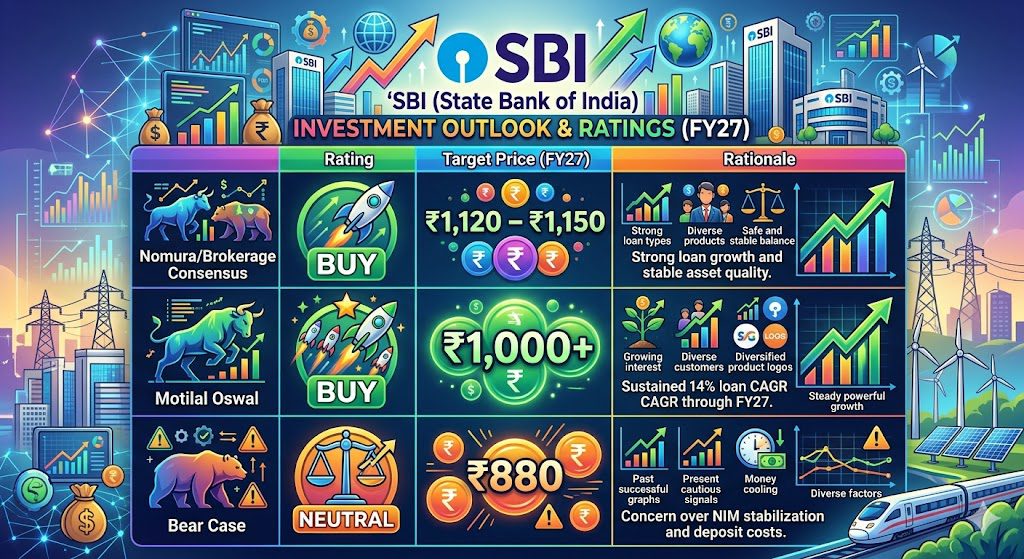
Several brokerages continue to remain positive on the long-term outlook for SBIN despite the sharp post-results correction.
Nomura and broader brokerage consensus estimates currently maintain BUY recommendations with target prices ranging between ₹1,120 and ₹1,150.
Analysts believe SBI’s strong loan growth, improving asset quality, and dominant market position continue to support long-term earnings visibility.
Motilal Oswal also remains constructive on the stock and expects SBI to maintain approximately 14% loan CAGR through FY27.
However, bearish analysts remain cautious about margin stability and deposit cost pressures. Some neutral estimates place downside support closer to ₹880 if NIM pressures intensify further.
Overall, market sentiment remains positive from a long-term perspective, although near-term volatility may continue.
Management Guidance: The Path to FY27
Credit Costs Expected to Remain Stable
SBI management has indicated that credit costs are expected to remain well-controlled in FY27.
According to management commentary, slippages within SME and agricultural portfolios remain under control, reducing the risk of significant future stress.
This guidance is important because stable credit costs support long-term earnings sustainability and improve investor confidence.
If asset quality continues improving further, SBI may benefit from lower provisioning requirements in future quarters.
YONO Continues Driving Digital Growth
One of SBI’s biggest long-term strengths today is its digital ecosystem.
The YONO platform, which now reportedly serves more than 75 million users, continues to remain the bank’s primary engine for low-cost customer acquisition and digital engagement.
India’s banking sector is rapidly shifting toward digital-first services, and SBI’s ability to scale YONO successfully has significantly improved operational efficiency and customer reach.
The platform allows SBI to compete more effectively against private sector banks and fintech companies while lowering customer acquisition costs.
Over the next few years, digital banking is expected to play a major role in improving profitability and operational scalability across the banking sector.
The “30-Year” Analyst Verdict
For Long-Term Investors
Despite the sharp market reaction, SBI remains one of the strongest large-cap banking opportunities in India.
The bank now combines record-low bad loans, strong credit growth, improving digital capabilities, stable profitability, and attractive valuations within a single investment story.
At current levels, SBI continues to trade at a significant valuation discount compared to many private sector banking peers despite showing major operational improvements.
For long-term investors seeking exposure to India’s banking growth story, SBI still appears highly attractive from a risk-reward perspective.
For Traders
For short-term traders, the stock has clearly entered a volatile phase following the earnings reaction.
The ₹1,000 support zone remains extremely important. If the stock stabilizes above this level, a short-term rebound rally toward ₹1,070 may become possible.
However, traders should remain cautious because broader market sentiment and banking sector volatility may continue affecting price action over the next few sessions.
Conclusion & Engagement (CTA)
SBI’s Q4 FY26 results delivered a fascinating reminder of how markets operate.
Even though the bank reported healthy profit growth, record-low bad loans, lower provisioning costs, and strong loan expansion, investors focused heavily on margin pressure and elevated expectations.
Still, from a long-term perspective, the transformation of SBIN over the last decade has been extraordinary. The bank is no longer simply a traditional PSU lender — it is increasingly becoming a modern digital banking powerhouse with improving operational efficiency and stronger financial health.
The biggest question now is whether the ₹1,000 support zone can hold and whether SBI can regain bullish momentum toward ₹1,150 and beyond in FY27.
Did you buy the SBI dip near ₹1,010, or are you waiting for lower levels around ₹950 before entering India’s banking giant?