Introduction: The Biscuit King’s Resilient Quarter
For more than three decades, the Indian FMCG sector has remained one of the strongest pillars of the country’s economy. From inflation shocks and commodity price cycles to changing consumer lifestyles, only a few brands have consistently maintained their dominance across generations. One such company is BRITANNIA. Britannia is no longer just a biscuit company. It has evolved into a complete packaged food powerhouse with strong presence across premium biscuits, dairy products, cakes, croissants, wafers, and healthy snacking categories.
Back in the 1990s, products like Good Day and Bourbon were considered occasional indulgences for middle-class families. In 2026, premium packaged foods have become part of daily household consumption across urban as well as rural India. Britannia has successfully adapted to this shift through premiumization, product innovation, and aggressive distribution expansion.
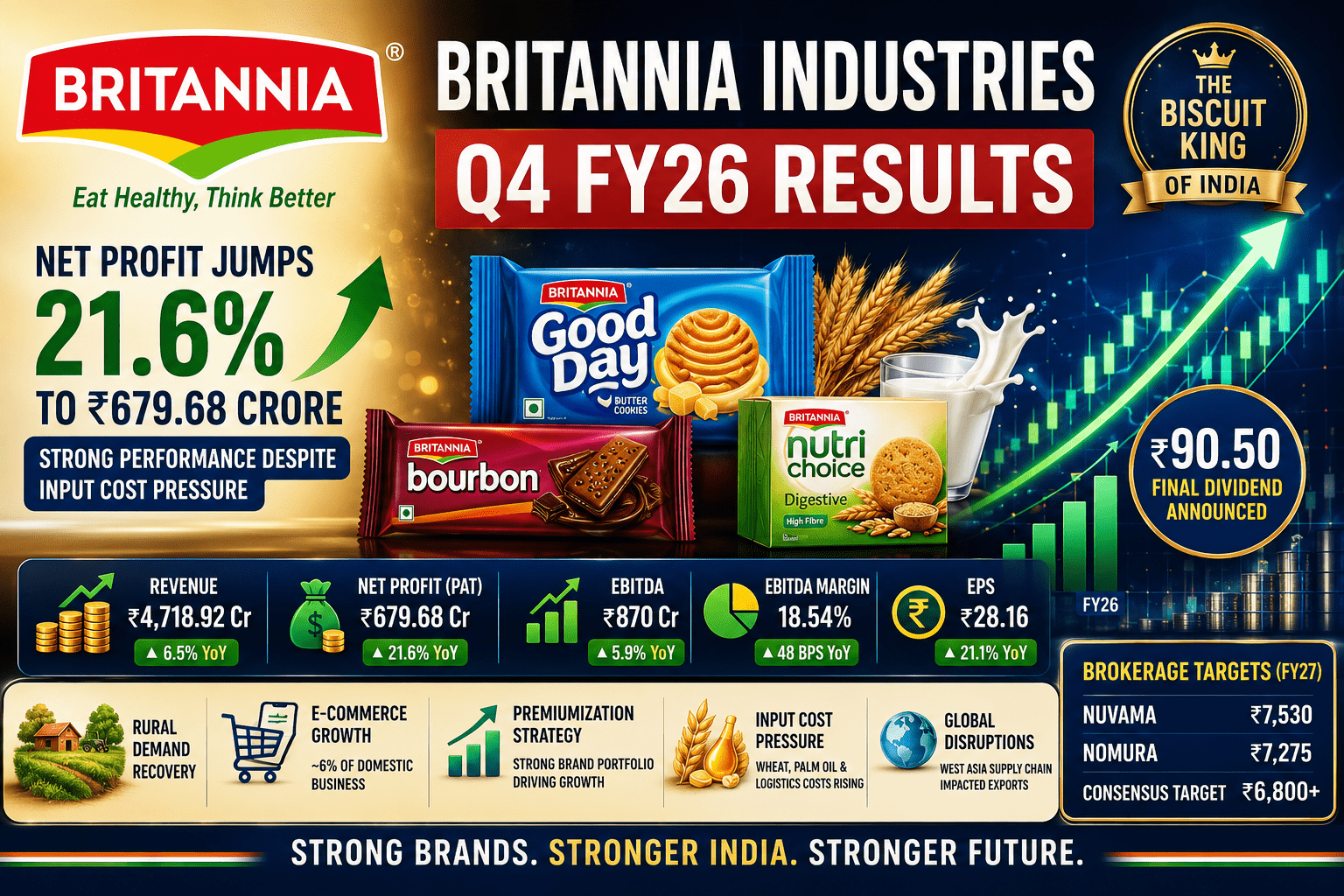
The Q4 FY26 results announced on May 8, 2026, once again prove why Britannia remains one of India’s most respected consumer companies. The company reported a strong 21.6% jump in consolidated net profit to ₹679.68 crore for the quarter ended March 31, 2026. While the headline profit numbers impressed investors initially, a closer look reveals that the company is currently navigating a delicate balance between rising raw material costs and sustaining premium product growth.
Despite reporting strong profit growth, the stock reacted negatively on the market. Britannia shares slipped nearly 5% during trading on May 8 and hovered near ₹5,524 on the NSE. Investors appeared concerned about flat EBITDA margins and increasing pressure from wheat flour, palm oil, and logistics costs. Geopolitical disruptions in West Asia also affected parts of the company’s international business.
Even with these short-term challenges, Britannia continues to remain one of the strongest long-term consumption stories in India due to its market leadership, pricing power, and strong cash generation ability.
Q4 FY26 Financial Scorecard: The Hard Numbers from NSE
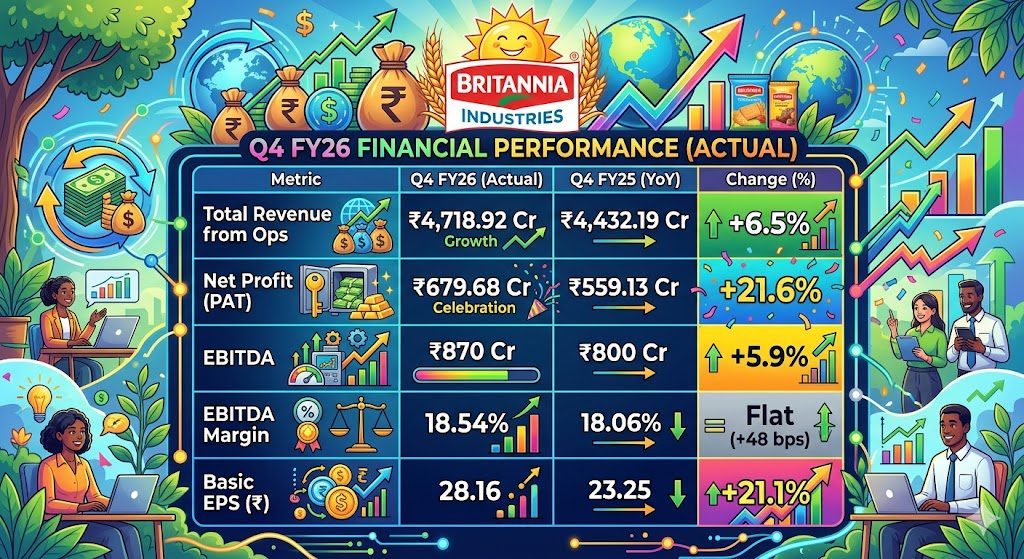
Britannia Industries delivered healthy growth across most key financial metrics during the March 2026 quarter. According to the company’s official consolidated filing with the exchanges, total revenue from operations rose to ₹4,718.92 crore compared to ₹4,432.19 crore in Q4 FY25. This reflects year-on-year growth of 6.5%, supported mainly by strong volume expansion and demand recovery in rural markets.
The biggest highlight of the quarter was the sharp rise in profitability. Consolidated net profit after tax surged to ₹679.68 crore from ₹559.13 crore in the same quarter last year, representing growth of 21.6%. This growth significantly outpaced revenue expansion and reflects a combination of operational improvements and tax-related gains.
EBITDA for the quarter increased to ₹870 crore compared to ₹800 crore a year earlier, reflecting growth of 5.9%. However, EBITDA margins remained largely stable at 18.54% versus 18.06% in Q4 FY25. The marginal improvement of 48 basis points indicates that rising input costs continue to pressure profitability despite higher sales.
Basic earnings per share also improved strongly from ₹23.25 to ₹28.16, showing better shareholder returns during the quarter.
| Metric | Q4 FY26 | Q4 FY25 | YoY Change |
|---|---|---|---|
| Total Revenue from Operations | ₹4,718.92 Cr | ₹4,432.19 Cr | +6.5% |
| Net Profit (PAT) | ₹679.68 Cr | ₹559.13 Cr | +21.6% |
| EBITDA | ₹870 Cr | ₹800 Cr | +5.9% |
| EBITDA Margin | 18.54% | 18.06% | +48 bps |
| Basic EPS | ₹28.16 | ₹23.25 | +21.1% |
These numbers clearly show that Britannia continues to maintain strong profitability and healthy consumer demand despite operating in a difficult inflationary environment.
Fundamental Analysis: The “Tax & Efficiency” Boost
Tax Reversal Played a Major Role in Profit Growth
One of the biggest reasons behind Britannia’s sharp profit growth during Q4 FY26 was a tax-related adjustment. The company benefited from a reversal of prior-period tax provisions amounting to approximately ₹95.39 crore. This boosted the bottom line significantly and helped net profit grow much faster than operational earnings.
This detail is extremely important for investors because the headline 21.6% profit growth may appear stronger than the actual operational performance. While Britannia’s core business remained healthy, the tax reversal played a key role in boosting quarterly profitability.
However, this should not completely overshadow the company’s operational strength. Britannia still delivered healthy revenue growth, stable margins, and strong volume expansion despite facing major commodity inflation pressures.
Volume-Led Growth Reflects Strong Consumer Demand
Britannia’s Q4 revenue growth was largely driven by volumes instead of aggressive price hikes. Industry estimates suggest volume growth remained in the range of 8–12%, supported by improving rural demand and stronger premium product consumption.
Products such as Good Day, NutriChoice, Milk Bikis, and Bourbon continued to perform well across markets. The company’s premiumization strategy is helping Britannia improve its product mix while strengthening brand loyalty among consumers.
This is a very positive signal for the FMCG sector because volume-led growth reflects genuine demand recovery rather than inflation-driven pricing alone. Rural recovery in India has improved gradually over the last few quarters due to better agricultural output and easing inflation trends.
Britannia’s ability to generate healthy volume growth during a period of rising costs highlights the strength of its brand portfolio and distribution network.
Rising Input Costs Continue to Pressure Margins
Although Britannia reported strong profit growth, rising raw material prices remain a major challenge for the company. During Q4 FY26, input and employee costs reportedly increased by nearly 17.5%, putting pressure on operating margins.
The prices of wheat flour, palm oil, sugar, milk products, packaging materials, and transportation services continue to remain elevated. These cost pressures explain why EBITDA margins remained largely flat despite healthy sales growth.
Commodity inflation has become one of the biggest concerns for FMCG companies globally. Britannia has managed the situation relatively well through selective price increases, premium product sales, and cost optimization measures. However, if commodity prices continue rising sharply, margin pressure could remain a concern over the next few quarters.
The company’s future profitability will largely depend on how effectively it balances pricing power with consumer affordability.
Technical Analysis: The Support Zone Test
 Stock Is Currently in a Consolidation Phase
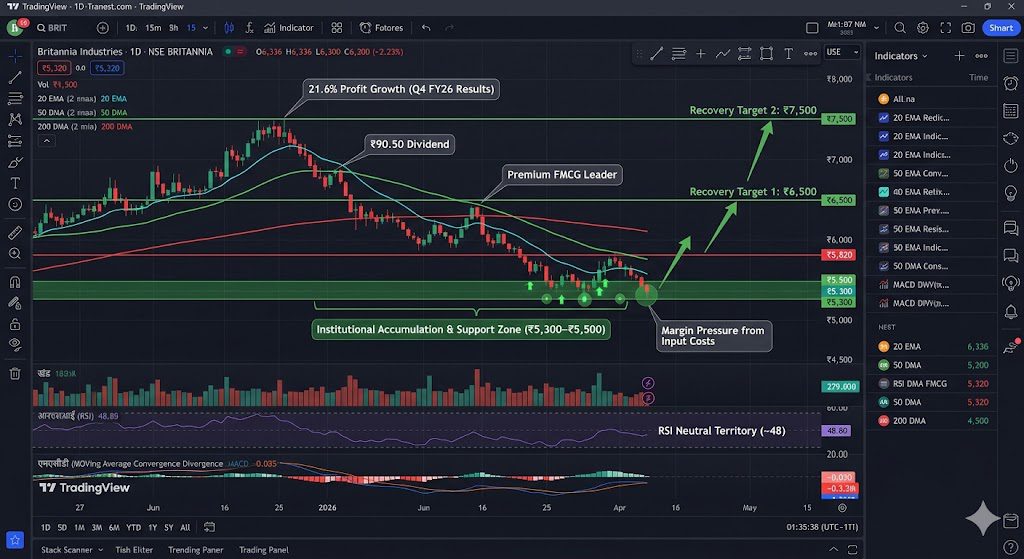
From a technical analysis perspective, Britannia Industries is currently going through a consolidation and stabilization phase after a strong multi-year rally. The stock had earlier touched a 52-week high near ₹6,336 before witnessing profit booking pressure in recent weeks.
Following the Q4 FY26 results, concerns over flat operating margins and supply chain disruptions triggered additional selling in the stock. Investors are now closely watching whether Britannia can hold its key support levels.
The current chart structure suggests that the stock is trying to build a stable base before making its next major move.
Major Support Zone at ₹5,300–₹5,500
The ₹5,300–₹5,500 zone has emerged as a very important support region for Britannia. Historically, institutional investors and long-term value buyers have shown strong interest near these levels because the company remains one of India’s highest-quality FMCG businesses.
As long as the stock sustains above this support range on a weekly basis, the broader long-term bullish structure remains intact. Any sharp correction toward this zone may attract fresh buying from long-term investors looking to accumulate quality consumer stocks.
This support area is therefore likely to play a crucial role in determining the stock’s medium-term direction.
Immediate Resistance Near ₹5,820
On the upside, Britannia faces immediate resistance near ₹5,820. A strong daily close above this level would be required for the stock to regain positive momentum and potentially move toward previous highs.
Until that breakout happens, the stock may continue moving sideways within a broad consolidation range.
Traders are closely watching this resistance zone because a breakout above it could trigger renewed institutional buying interest.
RSI and MACD Indicate Mixed Momentum
Technical indicators currently present mixed signals for Britannia Industries. The Relative Strength Index (RSI) remains in neutral territory, which means the stock is neither heavily overbought nor deeply oversold at current levels.
However, the MACD indicator suggests short-term weakness and slowing momentum after the recent correction.
Despite near-term technical pressure, Britannia continues to remain a strong long-term outperformer. Over 3-year, 5-year, and 10-year periods, the stock has consistently outperformed broader benchmark indices such as the Sensex.
Management Guidance: Future Strategy
West Asia Disruptions Impacted International Sales
Britannia management acknowledged that geopolitical disruptions in West Asia negatively affected international sales during March 2026. Managing Director and CEO Rakshit Hargave stated that supply chain disruptions and logistics challenges created pressure on export operations during the quarter.
This is an important issue because international markets are becoming increasingly important for Britannia’s long-term growth plans. Continued instability in West Asia could create additional operational challenges if geopolitical tensions persist.
However, Britannia’s strong domestic business continues to provide stability and offset temporary weakness in exports.
E-Commerce and Adjacency Categories Continue Growing
One of the strongest long-term growth drivers for Britannia is the rapid expansion of its e-commerce and adjacent product businesses.
The company reported that e-commerce now contributes nearly 6% of domestic sales. This highlights changing consumer behavior and increasing online food purchases across India.
At the same time, adjacent categories such as croissants, wafers, dairy products, cakes, and salty snacks continue to deliver strong double-digit growth. These categories are strategically important because they reduce Britannia’s dependence on traditional biscuit sales while expanding overall revenue opportunities.
As Indian consumers increasingly shift toward convenience foods and premium snacking products, Britannia appears well-positioned to capture future demand growth.
Brokerage Sentiment & Targets: The Path to ₹7,500
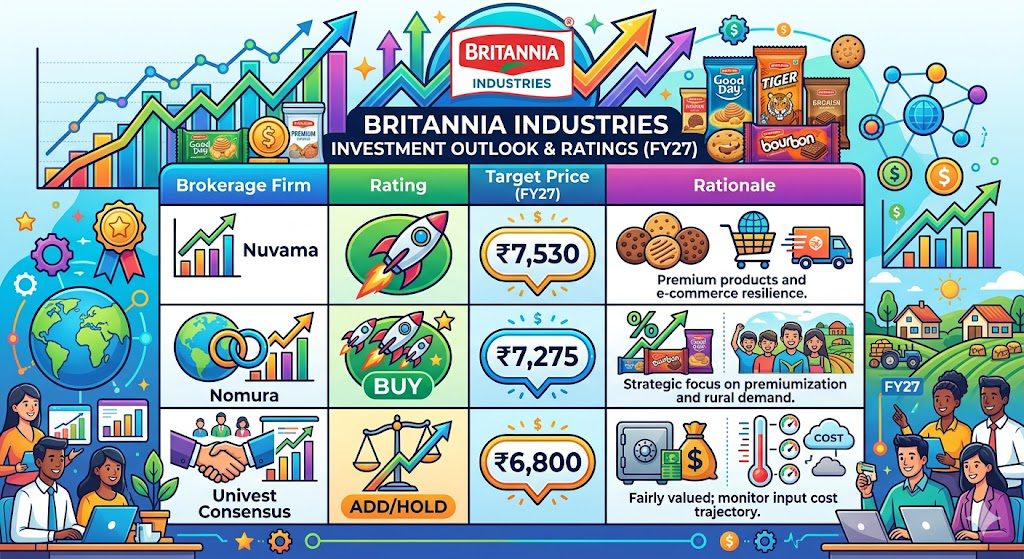
Several brokerage firms continue to maintain a positive long-term outlook on BRITANNIA despite near-term margin concerns.
Nuvama has maintained a BUY rating with a target price of ₹7,530, citing strong premiumization trends and resilience in e-commerce growth. Nomura has also assigned a BUY recommendation with a target near ₹7,275 due to improving rural demand and strategic product expansion.
Meanwhile, broader market consensus remains slightly more cautious. Several analysts currently maintain ADD or HOLD recommendations near ₹6,800 while monitoring the trajectory of raw material prices and operating margins.
Overall, brokerages believe Britannia remains fundamentally strong, but future upside may depend on how effectively the company manages rising commodity costs.
Final Dividend: Reward for Shareholders
Britannia Announces ₹90.50 Final Dividend
Britannia Industries has recommended a final dividend of ₹90.50 per equity share for FY26. This reflects the company’s strong cash flow generation and consistent shareholder-friendly capital allocation strategy.
Britannia has historically maintained one of the strongest dividend payout records in the FMCG sector, making it highly attractive for long-term income-focused investors.
The generous dividend announcement also reflects management confidence in the company’s long-term financial stability.
Record Date and AGM Timeline
Shareholders holding Britannia shares as of July 31, 2026, will be eligible to receive the final dividend, subject to approval during the Annual General Meeting scheduled for August 7, 2026.
For long-term investors, Britannia’s combination of stable earnings, dividend consistency, and strong brand leadership remains one of its biggest attractions.
The “30-Year” Analyst Verdict
For Long-Term Investors
Britannia Industries remains one of India’s strongest long-term FMCG compounders. Although the stock trades at a premium valuation of nearly 57x earnings, premium companies often deserve premium valuations due to their strong market leadership, stable cash flows, pricing power, and consistent execution.
The company’s dominant biscuit franchise, strong rural reach, expanding premium portfolio, and healthy dividend history continue supporting long-term investor confidence.
For patient investors seeking stable wealth creation within the consumer sector, Britannia still remains a high-quality “sleep-well” stock.
For Traders
For short-term traders, caution is advisable at current levels. The stock is currently trying to stabilize after a sharp correction from its highs, and momentum indicators remain mixed.
Aggressive buying should ideally be avoided until Britannia establishes strong support above ₹5,500 on a sustained weekly basis. Traders may prefer waiting for either a breakout above ₹5,820 or stronger price confirmation near support levels before entering fresh positions.
Short-term volatility may continue due to concerns over margins and commodity inflation.
Conclusion & Engagement (CTA)
Britannia Industries has delivered a classic “mixed box” quarter in Q4 FY26. The company reported impressive 21.6% profit growth, healthy volume expansion, strong premium category demand, and a generous ₹90.50 dividend payout.
At the same time, rising wheat flour prices, edible oil inflation, and supply chain disruptions continue to pressure margins and create uncertainty regarding future profitability.
Despite these challenges, Britannia remains one of India’s most powerful consumer brands with deep market penetration, strong pricing power, and excellent long-term growth visibility.
The key question now is whether the company can successfully protect operating margins while continuing its premiumization journey during FY27.
Are you holding BRITANNIA for the ₹90.50 dividend, or do rising commodity prices and West Asia disruptions make you cautious about the FMCG sector outlook?