Scope Outline
1. Introduction: The Hook
If you’ve been tracking the Indian insurance sector closely, you’ll know that SBI Life Insurance has always been one of the most consistent performers in the Nifty 50 universe. Backed by the massive distribution strength of the State Bank of India and a disciplined approach to growth, the company has built a reputation as a long-term wealth compounder.
The Big Picture
SBI Life is not just another insurance company—it is India’s largest private life insurer by market share, and a key proxy for the country’s financialization story. As more Indians move from traditional savings to financial products, life insurance companies like SBI Life are positioned at the center of this shift.
The Current Context
On April 22, 2026, the company announced its Q4 FY26 results at a time when markets are already under pressure due to global uncertainties, including the recent 26% US tariff-related developments that have shaken investor sentiment. In such a volatile environment, investors were keenly watching whether SBI Life could maintain its growth trajectory.
The “So What?”
The result can be summed up in one simple line: strong top-line growth, but mild pressure on profitability. And as we’ll see, that story is more positive than it appears at first glance.
2. Q4 FY26 Results: The Hard Data
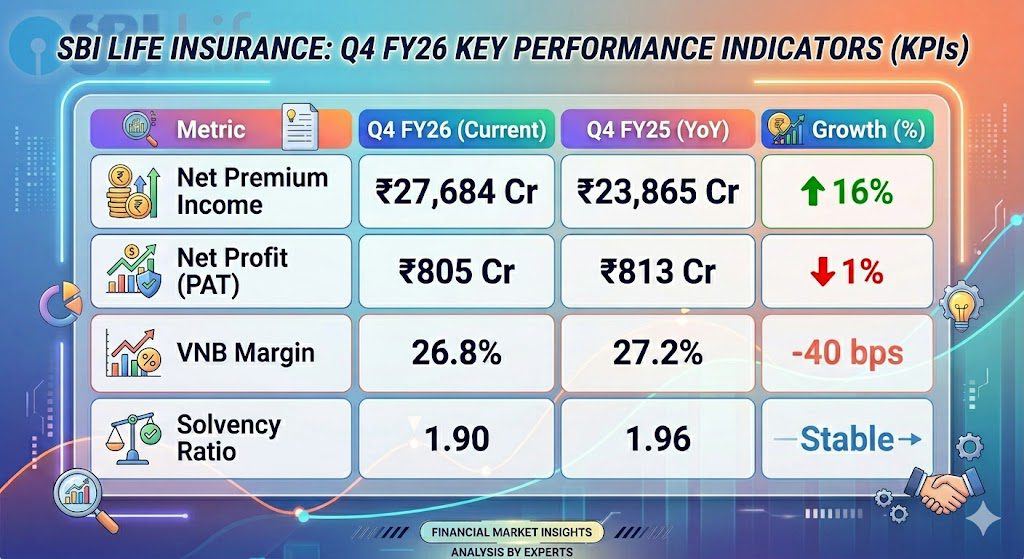
Let’s start with the numbers, because they tell the foundation of the story.
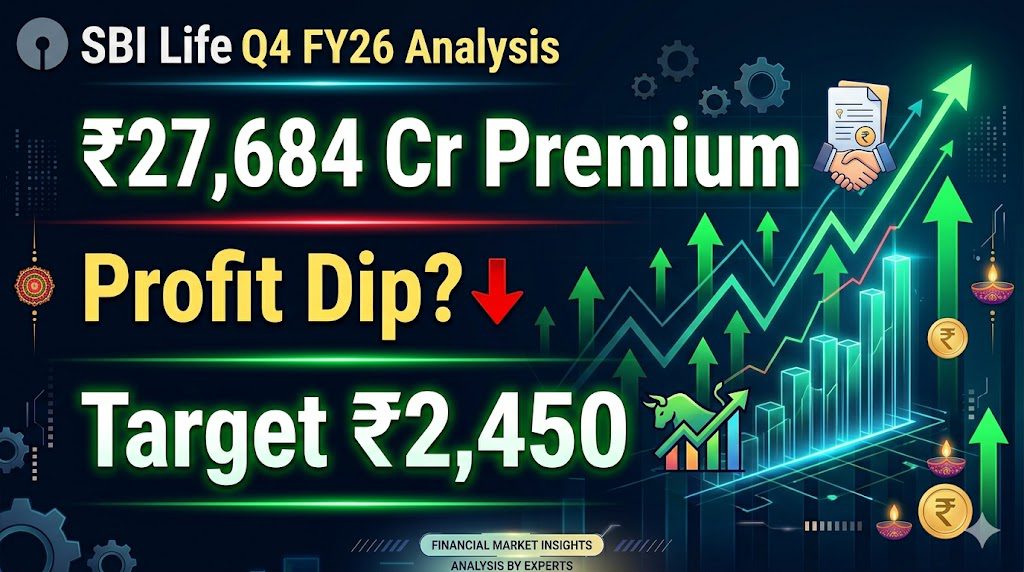
SBI Life reported a net premium income of ₹27,684 crore, marking a strong 16% year-on-year growth compared to ₹23,865 crore in Q4 FY25. This clearly shows that demand for insurance products remains strong, even in a challenging macro environment.
However, net profit came in at ₹805 crore, slightly lower than ₹813 crore last year, reflecting a 1% decline. While this might raise concerns at first, it is important to understand the underlying reasons, which we will explore in the next section.
The Value of New Business (VNB) margin stood at 26.8%, compared to 27.2% last year, indicating a 40 basis point decline. Meanwhile, the solvency ratio remained stable at 1.90, well above regulatory requirements, highlighting the company’s strong financial position.
Overall, the numbers indicate a company that is growing strongly but facing short-term margin pressures, which is quite common in the insurance sector.
3. Fundamental Analysis: Under the Hood
Distribution Dominance
One of SBI Life’s biggest strengths is its bancassurance model, powered by the vast network of the State Bank of India. With thousands of branches across the country, SBI provides unmatched access to customers, especially in semi-urban and rural areas.
This distribution advantage allows SBI Life to acquire customers at a lower cost compared to peers, improving profitability over the long term. It also ensures consistent growth in premium income, even when market conditions are challenging.
Persistency Ratios
Another critical metric in the insurance business is persistency, which measures how many customers continue paying their premiums over time. SBI Life’s 13th-month persistency ratio stands at around 87.1%, which is considered very strong.
High persistency means customers are staying invested in their policies, which translates into stable and high-quality earnings. In simple terms, it shows that SBI Life is not just selling policies—it is building long-term relationships.
Product Mix
A key strategic shift for SBI Life has been its move away from ULIPs (Unit Linked Insurance Plans) toward higher-margin products such as protection plans and non-participating savings products.
This shift improves profitability and reduces dependence on market-linked products, which can be volatile. Over time, this change in product mix is expected to support both margins and earnings stability.
The GST Impact
One of the reasons for the slight dip in margins is the recent GST rate rationalization, which had an impact of around 174 basis points. However, the management has managed to offset most of this impact through operational efficiencies and cost control.
If you’re holding this stock in your portfolio, this is important to understand—the margin pressure is largely temporary and manageable, not a structural problem.
4. Technical Analysis: The Trader’s Corner
Current Trend
From a technical perspective, SBI Life is currently trading around ₹1,897, after facing some pressure over the past year. The stock has delivered a negative return of around 16% over the last 12 months, indicating a phase of consolidation.
Support & Resistance
The stock has formed a strong support base around ₹1,800, which has acted as a floor multiple times. On the upside, the immediate resistance lies at ₹1,980, followed by a stronger resistance at ₹2,050.
A breakout above these levels could signal the start of a new upward trend.
Indicators
Technical indicators such as RSI and MACD suggest that the stock is currently in a consolidation phase. The RSI is neither overbought nor oversold, which indicates that the stock is preparing for its next move.
For traders, this is a classic setup—low risk near support, high potential on breakout.
5. Management Guidance & Future Outlook
Volume Growth
Looking ahead, management has guided for 13–15% growth in Annualized Premium Equivalent (APE) for FY27. This indicates continued confidence in demand and distribution strength.
Margins
The company has maintained its guidance of 26–28% VNB margins, suggesting that the recent dip is temporary and margins are expected to stabilize.
Digital Push
SBI Life is also investing in digital transformation, exploring AI-driven solutions similar to “VedBanao” style onboarding systems. These technologies aim to improve customer experience, reduce costs, and increase efficiency.
This digital push is critical for staying competitive in an increasingly tech-driven financial services landscape.
6. Brokerage Reports & Targets
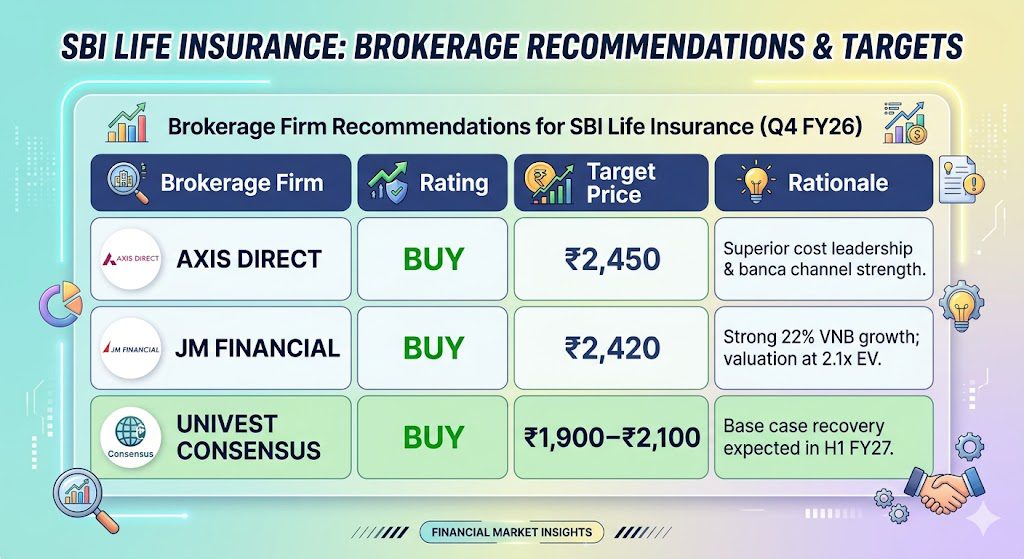
Brokerage firms remain largely bullish on SBI Life, despite the slight dip in profitability.
Motilal Oswal has given a “BUY” rating with a target price of ₹2,400, highlighting strong growth potential and improving product mix. Similarly, Axis Direct has also maintained a “BUY” rating with a target of ₹2,450.
The overall consensus view is “Overweight,” with an average upside of around 24%, indicating strong confidence among institutional investors.
7. Risks & Headwinds
Regulatory Changes
One of the key risks for the insurance sector is regulatory changes, particularly the new IRDAI surrender value norms, which could impact profitability in the short term.
Macro Risks
Global factors such as the ongoing tariff tensions and FII outflows can also impact stock valuations, including insurance companies. While these factors do not directly affect business fundamentals, they can influence market sentiment.
8. Conclusion & Final Verdict
The SBI Life Q4 Results FY26 present a classic case of short-term noise versus long-term strength. While profit growth has taken a slight hit, the underlying fundamentals remain strong.
For Investors
SBI Life continues to be a long-term compounding story, driven by strong distribution, improving product mix, and consistent growth in premiums. If your investment horizon is long, this remains a solid portfolio candidate.
For Traders
For short-term traders, the key level to watch is ₹1,920–₹1,980. A breakout above this range could trigger a quick upward move.
Final Word
SBI Life remains a “compounding machine” in the Indian financial ecosystem. Temporary margin pressures should not distract from its long-term growth potential.
9. FAQs (SEO Boost Section)
What was SBI Life’s dividend for FY26?
SBI Life has maintained a consistent dividend policy, though exact FY26 payout details should be checked in the official announcement.
Is SBI Life a good stock for the long term?
Yes, due to its strong fundamentals, high persistency ratios, and leadership in the insurance sector, SBI Life is considered a strong long-term investment.
What is VNB margin in insurance?
VNB (Value of New Business) margin represents the profitability of new policies sold. A higher VNB margin indicates better earnings quality and efficiency.
🔥 Final Thought (Engagement CTA)
So here’s the big question for you—
👉 Are you holding SBI Life for long-term compounding, or waiting for a breakout above ₹2,000 before entering?
💬 Drop your strategy and target price in the comments—let’s discuss!