Introduction: SAIL’s Massive Q4 FY26 Performance Signals a Structural Transformation
State-owned steel giant Steel Authority of India Limited has delivered one of the strongest quarterly performances in the Indian metals sector during Q4 FY26. The company announced its earnings on May 15, 2026, and the numbers immediately attracted strong attention across Dalal Street because profitability growth came far ahead of market expectations.
The latest results showed that SAIL is no longer operating like the slow-moving PSU company investors were once cautious about. Instead, the company is now benefiting directly from India’s large-scale infrastructure expansion, rising domestic steel demand, and improving operational efficiency. A massive 46.76% year-on-year jump in consolidated net profit, combined with record annual sales volumes and healthy margin expansion, has significantly improved investor confidence in the company’s long-term growth story.
The timing of these earnings was also important because the stock had already touched a fresh 15-year high of ₹202.35 earlier during the week. Institutional investors aggressively accumulated the counter ahead of results, expecting strong earnings momentum due to India’s booming infrastructure and construction activity.
For long-term investors, the quarter confirms that SAIL may now be entering a sustained structural growth phase supported by rising domestic steel consumption and improved balance-sheet quality. For traders, the stock has become one of the strongest momentum plays within the PSU and metals sectors heading into the new trading week.
Q4 FY26 Financial Scorecard: Strong Earnings Beat Strengthens Market Sentiment
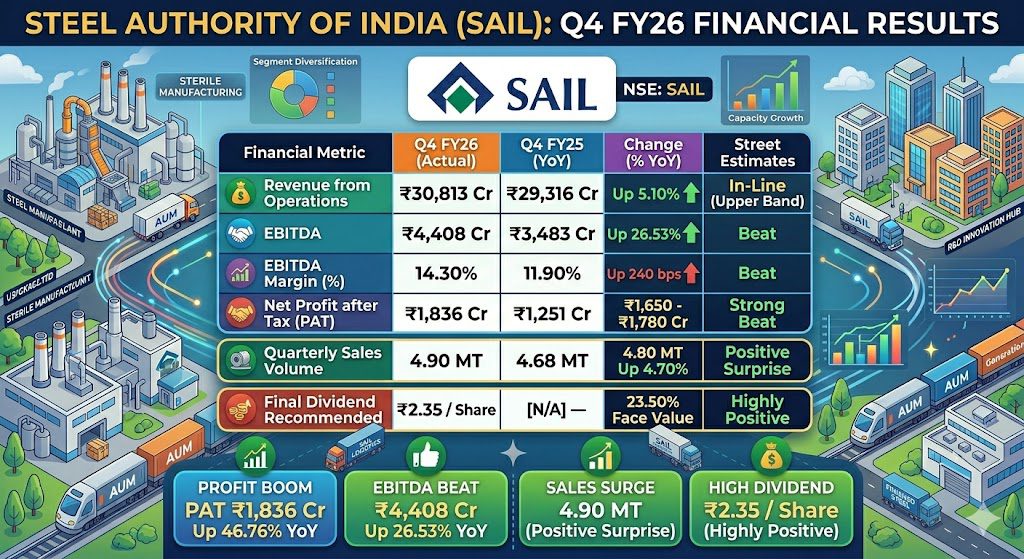
Steel Authority of India Limited reported consolidated revenue from operations of ₹30,813 crore during Q4 FY26 compared to ₹29,316 crore during the same quarter last year, registering year-on-year growth of 5.10%. The revenue figure broadly matched the upper band of Street estimates, which ranged between ₹30,100 crore and ₹30,900 crore.
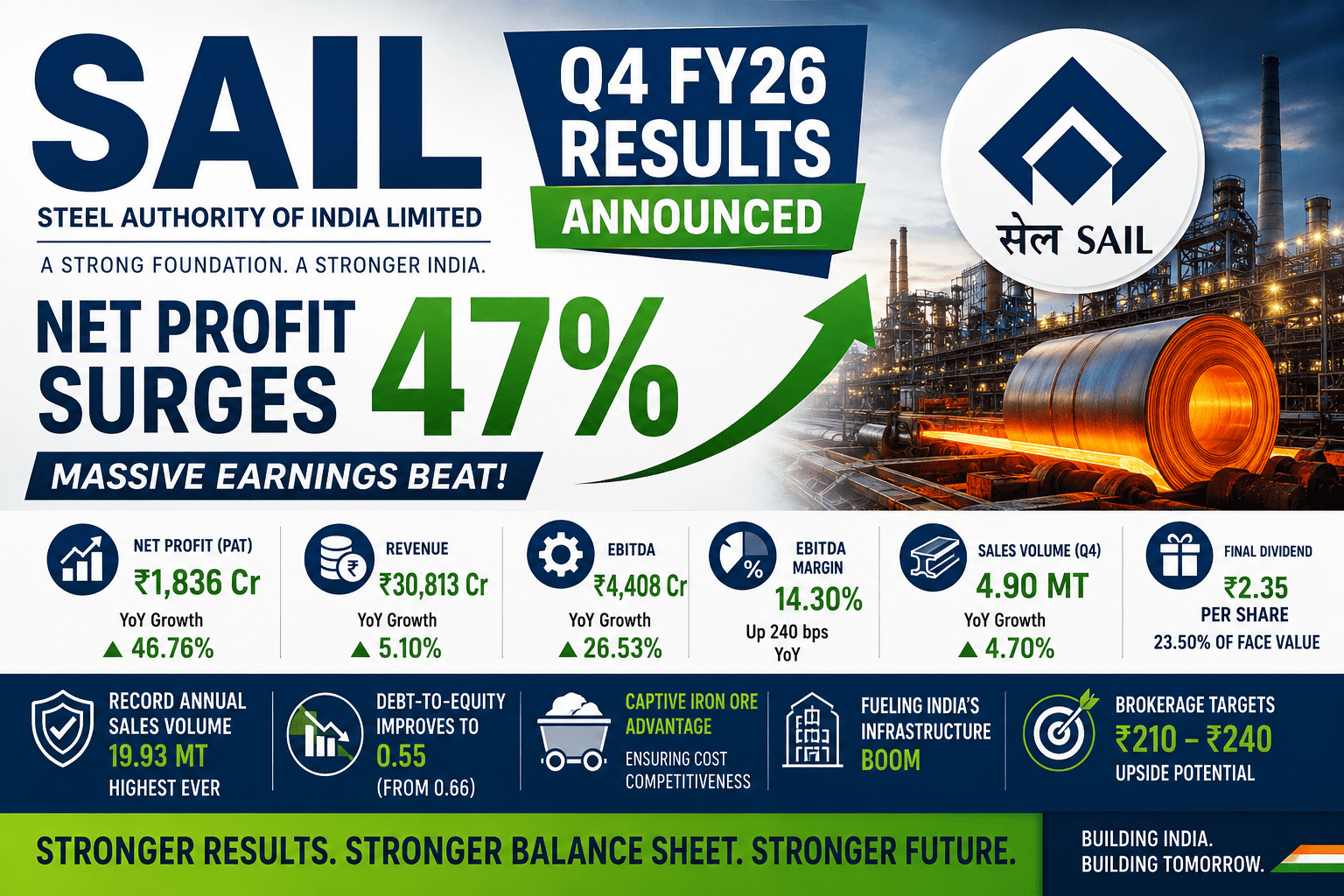
The real highlight of the quarter, however, was the sharp improvement in operating profitability. EBITDA surged to ₹4,408 crore compared to ₹3,483 crore during Q4 FY25, reflecting strong year-on-year growth of 26.53%. EBITDA margins also expanded significantly to 14.30% from 11.90%, representing a margin improvement of 240 basis points.
The biggest surprise came from consolidated net profit after tax. PAT jumped to ₹1,836 crore compared to ₹1,251 crore during Q4 FY25, reflecting an impressive year-on-year growth of 46.76%. This figure came substantially ahead of analyst expectations, which were positioned between ₹1,650 crore and ₹1,780 crore.
Operational momentum also remained healthy during the quarter. Sales volumes increased to 4.90 million tonnes compared to 4.68 million tonnes during the previous year period, representing growth of 4.70%.
Adding further strength to investor sentiment, the Board recommended a final dividend of ₹2.35 per equity share, representing 23.50% on the ₹10 face value.
Corporate Profile: India’s Largest State-Owned Steel Producer
Steel Authority of India Limited remains India’s largest government-owned steel manufacturing enterprise and one of the country’s most strategically important industrial organizations. The company operates five integrated steel plants located at Bhilai, Bokaro, Rourkela, Durgapur, and Burnpur, along with multiple specialized steel facilities.
SAIL plays a critical role in India’s infrastructure ecosystem. Its steel products are widely used across railways, highways, metro projects, public housing, bridges, defense infrastructure, and energy development projects.
One of the company’s biggest structural advantages is its captive iron ore mining operations. Unlike many private-sector steel companies that remain vulnerable to fluctuations in global raw material prices, SAIL enjoys stable access to domestic iron ore supplies through its own mines. This significantly improves cost stability and protects margins during periods of global commodity volatility.
The company has also been gradually increasing its focus on specialized steel products and value-added steel grades instead of depending purely on commodity steel production. This strategic transition is now helping improve both profitability and operational efficiency.
Earnings Breakdown: What Powered SAIL’s 47% Profit Growth?
Domestic Infrastructure Demand Continued Supporting Revenue Growth
One of the biggest reasons behind SAIL’s strong Q4 FY26 performance was the continued resilience of India’s domestic steel demand cycle. Even as global export markets remained sluggish, domestic infrastructure spending in India continued supporting strong steel consumption across multiple sectors.
Consolidated revenue from operations increased by 5.1% year-on-year to ₹30,813 crore during the March quarter. Sequentially, the growth was even stronger, with revenue jumping nearly 13% quarter-on-quarter compared to ₹27,371 crore during Q3 FY26.
This strong revenue trajectory clearly demonstrates that India’s infrastructure modernization programs, railway expansion projects, and public capital expenditure continue driving healthy steel demand despite weak international export conditions.
The broader infrastructure boom across India remains one of the most powerful long-term growth drivers for large integrated steel producers like SAIL.
Margin Expansion Became the Biggest Positive Surprise
While revenue growth remained healthy, the sharp expansion in operating margins became the biggest positive surprise in the earnings report. EBITDA increased by 26.53% while EBITDA margins improved by 240 basis points to 14.30%.
This margin expansion is particularly important because it indicates that SAIL is improving profitability not only through higher steel prices but also through internal operational efficiencies and better cost management.
Management achieved this through better inventory rationalization, increased focus on higher-value steel grades, and improved operational efficiency across manufacturing facilities. The company’s emphasis on specialized steel products also helped improve pricing power during the quarter.
For long-term investors, sustained margin expansion is one of the strongest indicators of structural improvement because companies with improving operating margins generally attract stronger institutional interest and higher valuation multiples.
Dividend Announcement Improved Shareholder Confidence
The Board recommended a final dividend of ₹2.35 per equity share for FY26, representing 23.50% on the ₹10 face value.
The dividend will be distributed to eligible shareholders within 30 days after approval at the company’s upcoming Annual General Meeting.
This dividend declaration is significant because it reflects management confidence regarding future cash-flow generation and financial stability. PSU companies generally become much more attractive to long-term investors when strong profitability combines with healthy shareholder payouts.
Fundamental Analysis: Record Volumes and Improving Financial Strength
Record Annual Sales Volumes Strengthened the Long-Term Growth Story
One of the strongest long-term positives for SAIL during FY26 was its record operational performance.
For the full financial year, crude steel production increased 1.4% to 19.43 million tonnes, while total sales volumes surged 11.4% to 19.93 million tonnes, representing the highest sales volume in the company’s history.
This record sales performance clearly confirms that India’s domestic steel demand cycle remains extremely strong and that SAIL continues benefiting directly from rising infrastructure and industrial activity.
Higher production utilization also improves operating leverage because fixed manufacturing costs are distributed across larger production volumes, which ultimately supports stronger profitability.
Debt Reduction Improved Balance Sheet Quality
Another major positive development was the improvement in SAIL’s balance-sheet quality.
Strong cash-flow generation from higher sales volumes and inventory liquidation allowed the company to reduce debt levels aggressively during FY26. The Debt-to-Equity ratio improved significantly from 0.66 to 0.55.
This is extremely important because historically one of the biggest concerns surrounding PSU steel companies was financial leverage and inefficient capital management.
The improving debt profile now indicates that SAIL is gradually transforming into a financially stronger industrial enterprise with healthier capital efficiency and lower financial risk.
Valuation Still Appears Attractive Relative to Peers
Following the sharp rally, SAIL closed Friday at ₹192.30, implying a trailing Price-to-Earnings ratio near 28.43x.
Although this valuation is above SAIL’s historical average P/E range of 15–20x, it still remains attractive relative to private steel majors.
For comparison:
- JSW Steel trades near approximately 39.6x earnings.
- Tata Steel trades near approximately 28–29x earnings.
This suggests that SAIL still possesses valuation rerating potential if operational momentum continues strengthening over the coming quarters.
Contingent Liabilities Remain an Important Risk Factor
Despite the strong operational performance, investors must continue monitoring one important risk factor — the company’s large contingent liabilities.
SAIL currently carries contingent liabilities totaling approximately ₹44,708 crore, primarily linked to disputed statutory levies and legacy mining royalty obligations.
While these liabilities may not immediately affect current cash flows, they remain an important long-term legal and financial risk factor that investors should not ignore completely.
Technical Analysis: Key Trading Levels for Monday
SAIL witnessed some profit booking on Friday after failing to decisively cross its lifetime high resistance zone. The stock declined 3.36% to close at ₹192.30.
However, despite Friday’s decline, the broader technical structure remains strongly bullish because the stock had already delivered an explosive 11% single-session rally earlier during the week — its strongest intraday rally in nearly 54 months.
Institutional buying activity remains clearly visible on price-volume charts, indicating that larger market participants continue maintaining bullish positions in the counter.
The most important pivot zone for Monday’s session now stands near ₹199.99. The stock must decisively close above this psychological resistance level to trigger the next aggressive rally toward ₹220 and beyond.
Immediate resistance levels remain positioned near ₹199.10, ₹200.25, and ₹209.70 near the 52-week high zone.
Meanwhile, major support levels remain positioned near ₹191.55, ₹184.90, and ₹175.00 as the primary structural support zone.
If the stock declines toward the ₹184.90–₹186 range during Monday’s session and successfully stabilizes, traders may view it as a high-probability entry zone for fresh long positions with stop-loss below ₹175.5.
Management Guidance and Future Strategic Roadmap
Management commentary highlighted several important strategic priorities for FY27 and beyond.
One of the company’s biggest focus areas remains protecting profitability from global steel oversupply, particularly from China. With Chinese crude steel production declining approximately 4.6% during early 2026, SAIL is strategically reallocating production toward specialized steel grades used in infrastructure and defense applications rather than low-margin commodity hot-rolled coils.
The company also remains committed to long-term capacity expansion plans as India targets 300 million tonnes of domestic steel production capacity by 2030.
India’s ongoing industrialization and infrastructure expansion cycle therefore continues creating a powerful structural growth opportunity for large integrated steel producers like SAIL.
Institutional Radar: Brokerage Ratings and Target Prices
Several institutional brokerages revised their outlooks after SAIL’s strong Q4 FY26 performance.
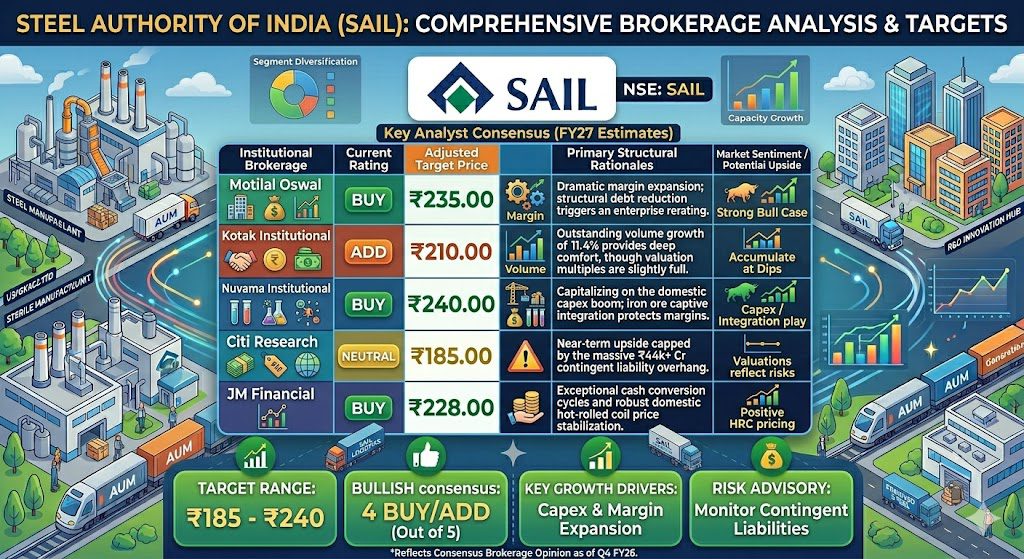
Motilal Oswal Financial Services maintained a BUY rating with a target price of ₹235, citing strong margin expansion and aggressive debt reduction.
Kotak Institutional Equities maintained an ADD rating with a target price of ₹210 while highlighting strong volume growth and improving operational visibility.
Nuvama Wealth maintained a BUY stance with a target price of ₹240, citing SAIL’s captive iron ore advantage and India’s infrastructure boom.
Citi maintained a NEUTRAL rating with a target price of ₹185 due to concerns surrounding contingent liabilities.
JM Financial maintained a BUY rating with a target price of ₹228 while highlighting strong cash conversion and improving domestic steel pricing.
The broader institutional consensus now points toward a median target price near ₹219.60, implying meaningful upside potential from current market levels.
The Veteran’s Verdict: Buy, Hold or Sell?
For long-term investors, SAIL is no longer the slow-moving PSU steel company of the past. The combination of 47% profit growth, improving operational efficiency, lower debt levels, record sales volumes, and healthy dividend payouts indicates that the company is undergoing a genuine structural transformation.
India’s infrastructure boom continues acting as a major long-term demand engine for domestic steel producers, and SAIL remains one of the biggest beneficiaries of this trend.
Long-term investors may therefore continue gradually accumulating the stock during temporary market corrections.
For short-term momentum traders, Friday’s decline appears more like healthy profit booking rather than a trend reversal. If the stock stabilizes above the ₹185 support zone and eventually reclaims the ₹200 pivot level, the probability of a fresh breakout rally toward ₹220 remains strong.