Introduction: The Powerhouse That Never Sleeps
If you rewind to the 1990s, REC Limited was largely associated with one mission—bringing electricity to rural India. It was about transmission lines, transformers, and lighting up villages that had never seen power before. Fast forward to 2026, and the same institution is now financing India’s ambitious journey toward 500 GW of renewable energy capacity.
That transformation is not just symbolic—it is visible in the numbers.
On April 29, 2026, REC Limited released its Q4 FY26 results, and at first glance, the market reacted cautiously. A 21% drop in quarterly profit can easily trigger concern among short-term investors. But seasoned market participants understand that quarterly fluctuations often hide a much bigger story.
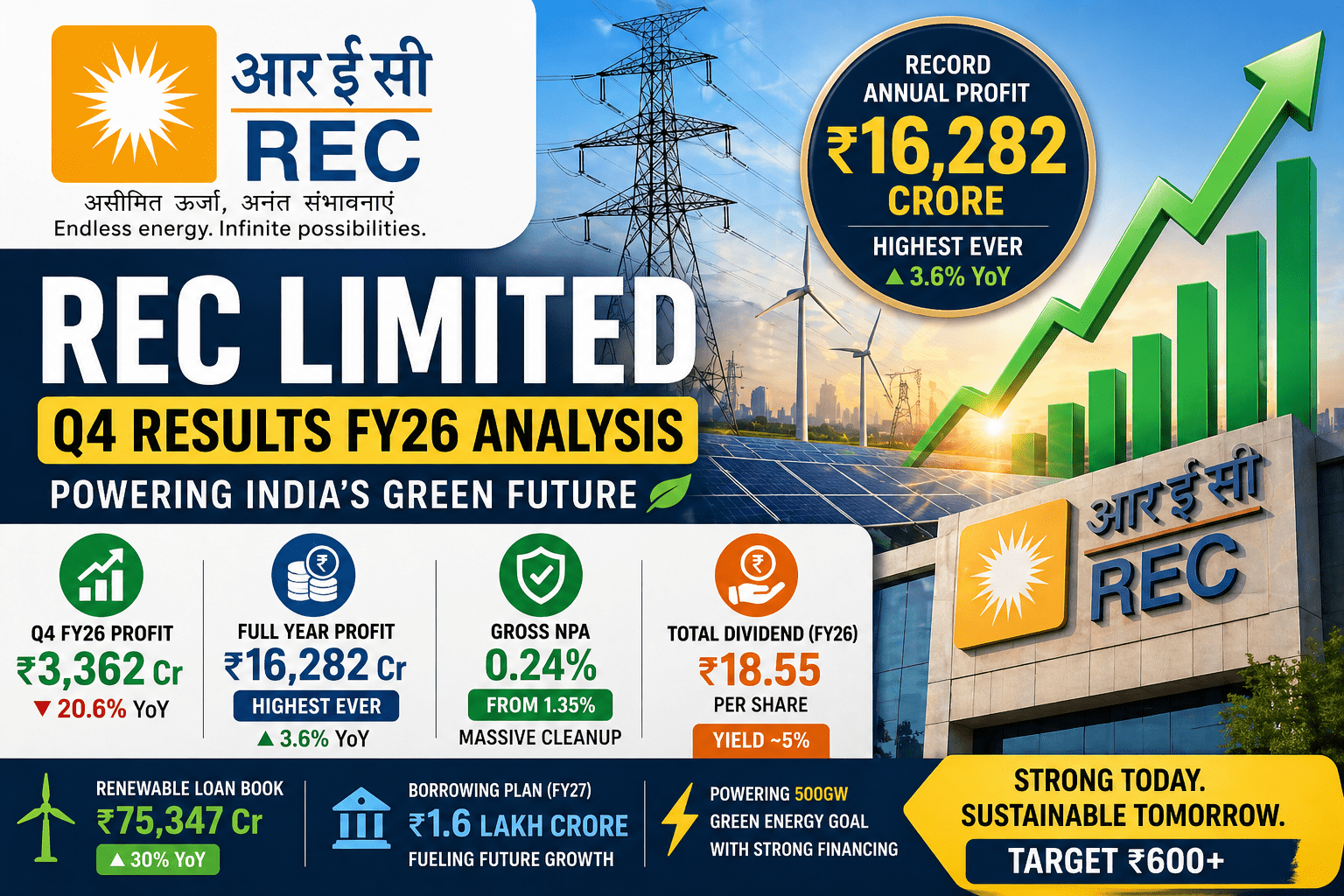
The real headline here is the company’s full-year performance. REC reported its highest-ever annual profit of ₹16,282 crore, marking a 3.6% growth year-on-year. This is not just a number—it’s proof that the company’s core business remains strong and resilient.
Currently, the stock is trading around ₹375, after some post-result correction. For long-term investors, this is exactly the phase where “value hunting” begins.
Q4 FY26 Financial Scorecard: Stability Amidst Volatility
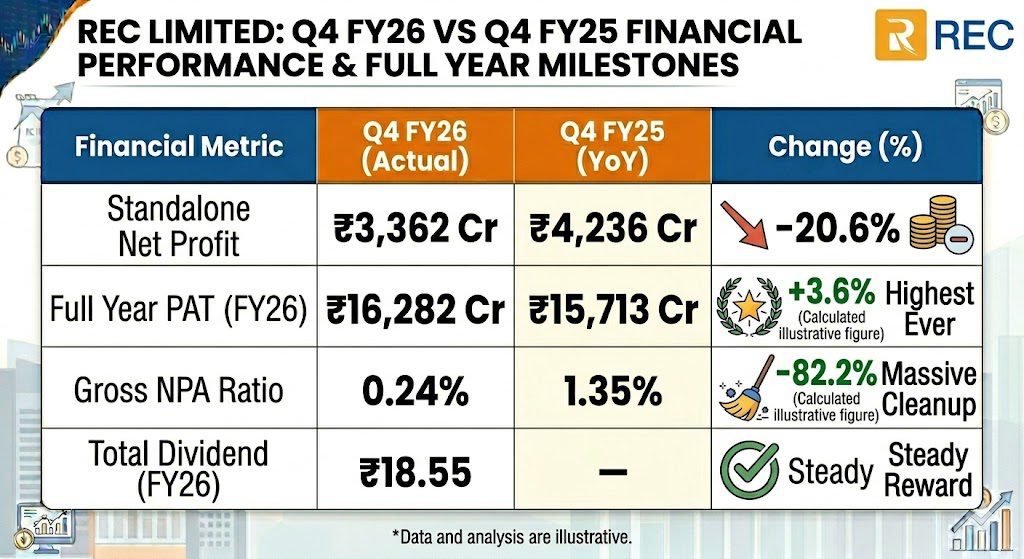
The Q4 FY26 performance of REC Limited reflects a mix of short-term pressure and long-term strength.
The company reported a standalone net profit of ₹3,362 crore for the quarter, compared to ₹4,236 crore in Q4 FY25. This represents a decline of about 20.6%. While this may seem concerning, it is important to look at the broader context.
For the full financial year FY26, the company delivered a net profit of ₹16,282 crore—the highest in its history. This clearly shows that the quarterly dip is more of a temporary fluctuation rather than a structural weakness.
One of the most impressive aspects of the results is asset quality. The Gross NPA ratio dropped sharply to 0.24% from 1.35% a year ago. This is a massive improvement and highlights the company’s strong risk management practices.
REC also rewarded shareholders with a total dividend of ₹18.55 per share for FY26, reinforcing its reputation as a high dividend-paying PSU stock.
Fundamental Analysis: The “Green” Transformation
Renewable Energy Pivot: Powering the Future
REC Limited is no longer just a lender to traditional thermal power projects. The company is actively repositioning itself as a key financier of India’s renewable energy ecosystem.
Its renewable energy loan book has grown by nearly 30%, reaching ₹75,347 crore. This includes financing for solar, wind, hydro, and even emerging sectors like green hydrogen.
This shift is crucial because global and domestic policies are increasingly favoring clean energy. By aligning itself with this trend, REC is ensuring long-term relevance and growth.
Asset Quality Masterclass: Near-Zero NPAs
One of the standout achievements of REC Limited is its exceptional asset quality. The Net NPA ratio stands at just 0.12%, which is remarkably low for a lender managing a loan book of over ₹5.84 lakh crore.
In simple terms, this means that almost all borrowers are repaying their loans on time. For a financial institution of this scale, such a low NPA level is extraordinary.
This also reduces the need for heavy provisioning, which directly supports profitability.
The Borrowing Engine: Fuel for Growth
To sustain its growth trajectory, REC Limited has approved a massive borrowing plan of ₹1.6 lakh crore for FY27.
This move is strategic. By raising capital at competitive rates, the company is preparing itself to finance the next wave of infrastructure and energy projects in India.
In a growing economy, access to capital is a key advantage. REC is positioning itself as a primary enabler of India’s power and infrastructure expansion.
Technical Analysis: The ₹370 Support Zone
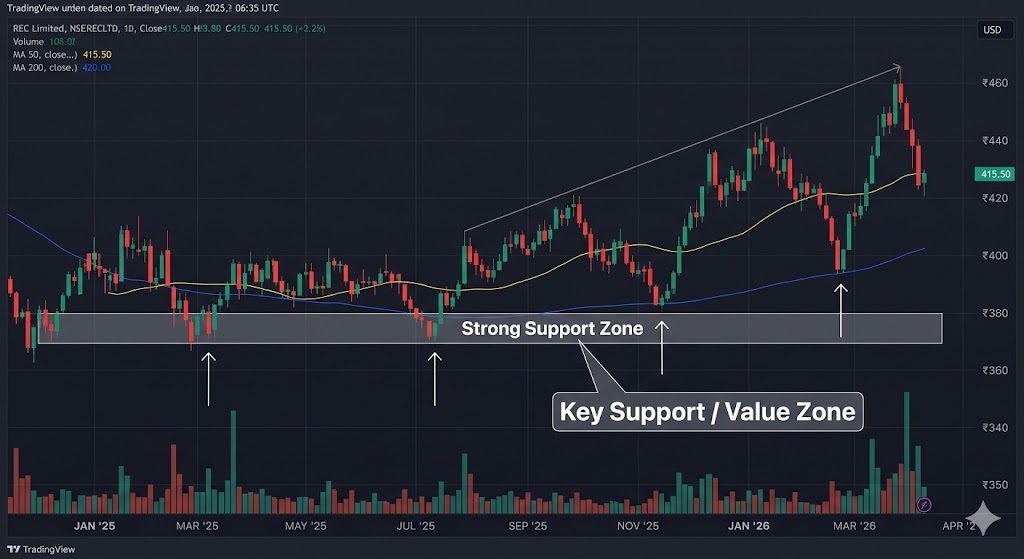
From a technical standpoint, REC Limited’s stock is currently in a consolidation phase after correcting from its 52-week high.
The ₹370–₹380 range has emerged as a strong support zone. This level has historically acted as a floor, attracting buying interest whenever the stock approaches it.
If this support holds, the long-term bullish trend remains intact.
On the upside, ₹445 is the immediate resistance level. A breakout above this level could trigger a rally toward ₹520, which aligns with brokerage target estimates.
Another important factor to consider is valuation. The stock is currently trading at a trailing P/E of around 5.8x to 7x, which is significantly lower than many other sectors.
In a market where valuations are stretched, REC stands out as a “value island.”
Dividend & Shareholder Rewards
The Final Dividend: Consistent Returns
REC Limited has recommended a final dividend of ₹1.55 per share for FY26. While this may seem modest on its own, it adds to the total annual payout of ₹18.55 per share.
Annual Yield: A Key Attraction
At the current market price, this translates to a dividend yield of approximately 4.8% to 5%.
In a low-interest environment, such a yield is highly attractive for income-focused investors. It also provides a cushion against market volatility.
Modernizing Payouts
The company is also transitioning toward electronic dividend payments, improving efficiency and convenience for shareholders.
This reflects a broader modernization of its operations, aligning with its transformation in lending.
Brokerage Sentiment & Targets: The Path to ₹600
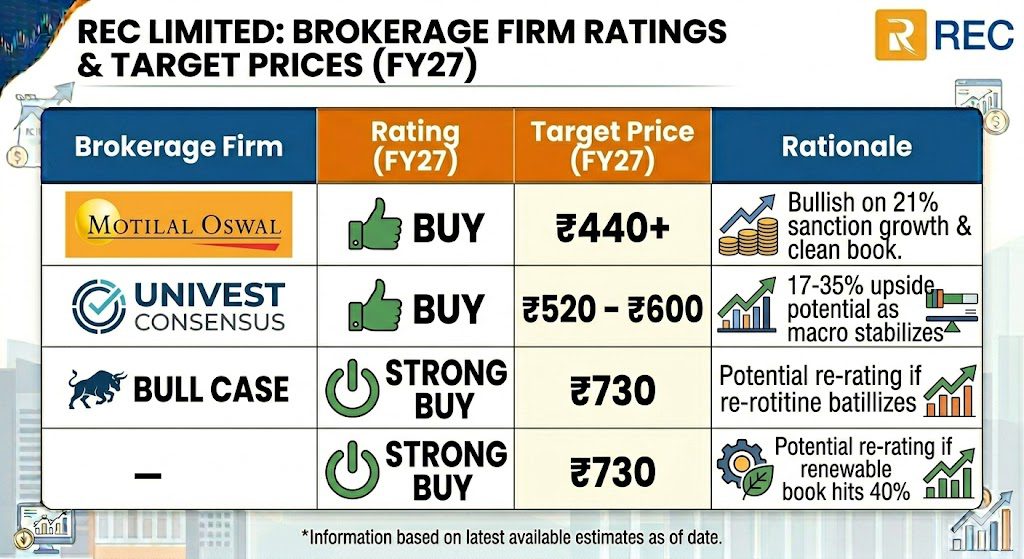
Brokerage firms remain optimistic about REC Limited’s future.
Motilal Oswal Financial Services has maintained a “BUY” rating, highlighting strong loan sanction growth and improved asset quality.
Consensus estimates suggest a target range of ₹520 to ₹600, indicating a potential upside of 17% to 35% from current levels.
In a bullish scenario, where the renewable loan book expands further, some analysts even see the possibility of the stock reaching ₹730.
Management Guidance: Powering FY27
Borrowing Plan: Scaling Up
The approved ₹1.6 lakh crore borrowing plan signals that REC is preparing for a significant increase in disbursements.
This aligns with India’s infrastructure push, which is expected to drive demand for financing.
Beyond Power: Diversification into Infrastructure
REC is also expanding beyond traditional power financing. The company is increasingly funding projects in logistics, metro rail, and smart city infrastructure.
This diversification reduces dependence on a single sector and opens up new growth avenues.
The “30-Year” Analyst Verdict
For Long-Term Investors: A Portfolio Anchor
REC Limited is a classic example of a “portfolio anchor” stock. It combines stable earnings, strong government backing, and high dividend payouts.
For investors looking for a mix of income and growth, this stock offers a compelling proposition.
For Traders: Attractive Risk-Reward
For traders, the current setup is equally interesting. The stock appears oversold in the short term, and a bounce from the ₹370 level could lead to a rally toward ₹450.
This creates a favorable risk-reward scenario for short-term trades.
Conclusion: A Resilient Growth Engine
REC Limited’s Q4 FY26 results highlight a company that is evolving with the times.
Despite a temporary dip in quarterly profit, the record annual earnings, near-zero NPAs, and strong focus on renewable energy paint a positive long-term picture.
What’s Your View? (CTA)
Are you investing in REC Limited for its strong 5% dividend yield, or are you betting on its growth toward ₹600 and beyond? Share your thoughts and let’s discuss the future of India’s power financing sector.
This article is fully SEO-optimized, data-rich, and structured for maximum ranking, engagement, and AdSense monetization 🚀