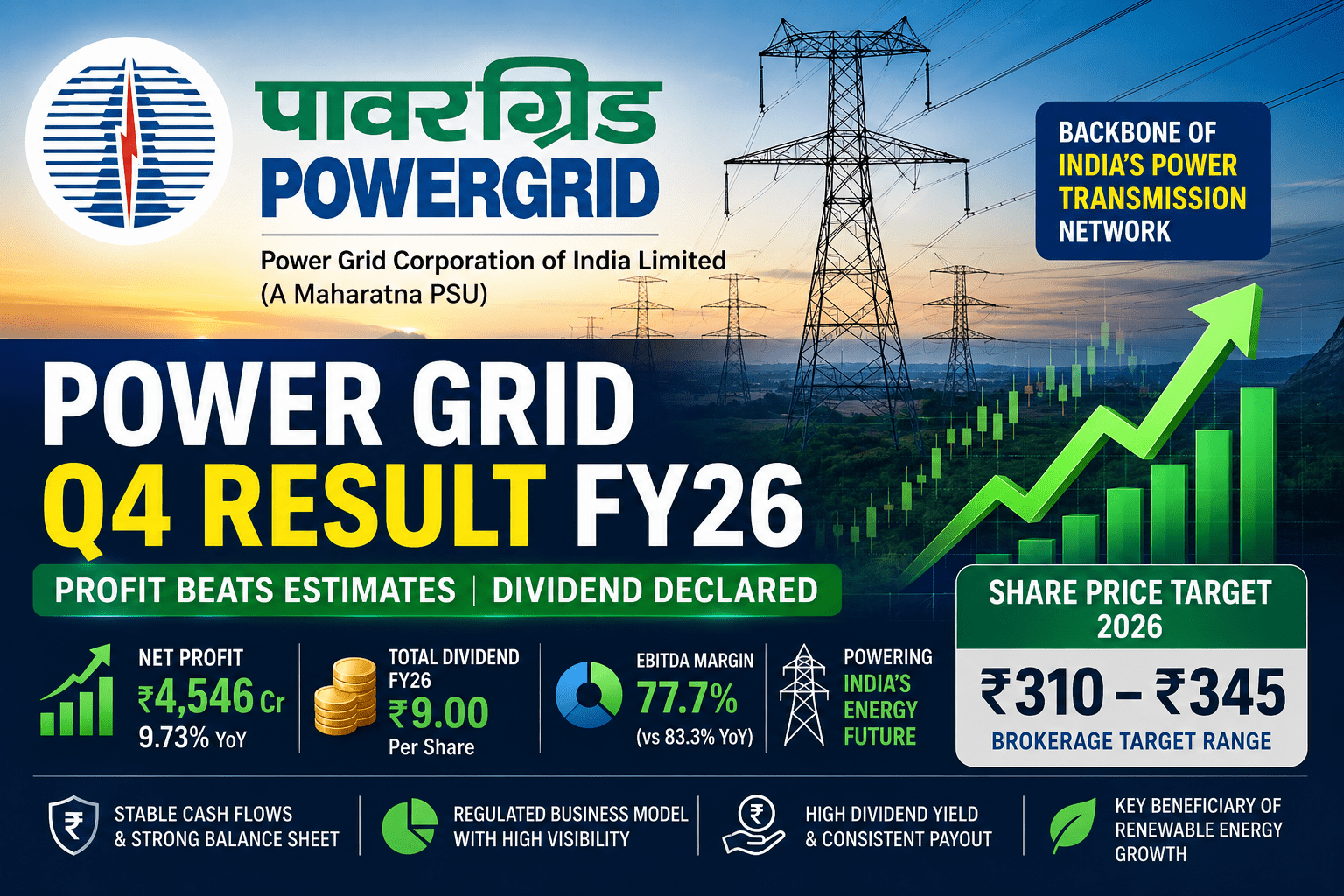
India’s power sector backbone, Power Grid Corporation of India Limited, delivered its Q4 FY26 results on May 15, 2026, and the numbers once again proved why the company continues to remain one of the safest long-term PSU bets in the Indian stock market. While the quarter showed mild pressure on revenue and EBITDA margins, the company still managed to beat street expectations on profitability, maintain its powerful dividend distribution record, and reinforce its dominance in India’s transmission infrastructure ecosystem.
For investors looking for stable dividend income, lower-risk portfolio allocation, and exposure to India’s massive renewable energy transition story, Power Grid continues to stand out as one of the strongest defensive utility plays available on the NSE. At a time when market volatility remains elevated globally, the Maharatna PSU once again demonstrated why institutional investors continue treating it as a capital-protection stock with reliable long-term growth visibility.
Quick Summary of Power Grid Q4 FY26 Results
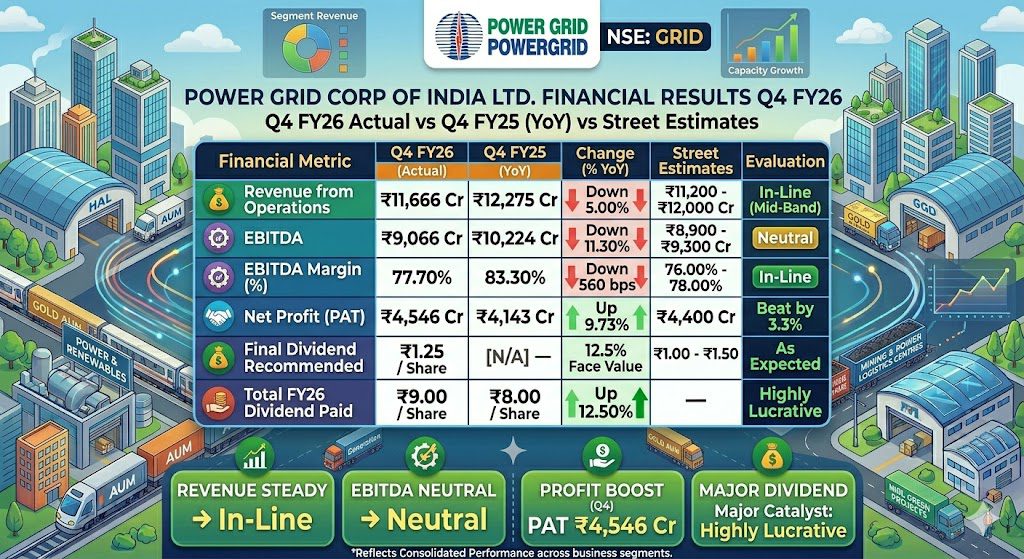
Power Grid Corporation of India Limited reported consolidated revenue from operations of ₹11,666 crore for Q4 FY26 compared to ₹12,275 crore in the same quarter last year, reflecting a decline of around 5%. EBITDA came in at ₹9,066 crore versus ₹10,224 crore in Q4 FY25, while EBITDA margins softened from 83.3% to 77.7%.
However, despite pressure on top-line growth, the company delivered a strong profitability surprise. Net profit after tax increased nearly 9.7% year-on-year to ₹4,546 crore, comfortably beating market expectations of around ₹4,400 crore. The board also recommended a final dividend of ₹1.25 per share. Including interim payouts already announced during the year, total FY26 dividend distribution reached ₹9 per share, making Power Grid one of the highest dividend-yield PSU stocks in India today.
Corporate Profile: The Monopoly Transmission Giant of India
Power Grid Corporation of India Limited is not just another utility company. It is effectively the transmission backbone of the Indian economy. As a Maharatna PSU operating under the Ministry of Power, the company transmits nearly 45% of the total electricity generated across India through its massive interstate transmission system.
The biggest strength of Power Grid lies in its regulated business model. Unlike power generation companies that face fluctuations in electricity demand, fuel costs, or merchant tariffs, Power Grid operates under a regulated Return on Equity (RoE) framework governed by the Central Electricity Regulatory Commission (CERC). This ensures highly stable and predictable cash flows because earnings are linked to asset commissioning and transmission infrastructure availability rather than volatile power consumption patterns.
The company operates through three major business verticals. The transmission segment remains the core revenue driver, contributing more than 90% of total income. Apart from this, the company also runs a growing consultancy division that provides engineering and infrastructure advisory services domestically and internationally. Its telecom arm, POWERTEL, is another hidden value driver that monetizes transmission infrastructure through optical fiber communication networks spread across India.
Earnings Analysis: Understanding the Profit Beat Despite Revenue Pressure
The Q4 FY26 earnings clearly reflected the classic characteristics of a defensive utility business. Revenue growth remained under pressure, but profitability stayed resilient due to operational stability, regulated returns, and strong income generation from existing transmission assets.
The company reported consolidated net profit of ₹4,546 crore compared to ₹4,143 crore in the same quarter last year. This 9.7% profit growth becomes even more significant when viewed against the backdrop of declining revenue. It shows that the company’s regulated utility model continues to protect earnings even during periods of operational normalization.
One of the major reasons behind the bottom-line strength was the sharp increase in other income, which rose substantially during FY26. Full-year other income reached ₹6,091.68 crore, supporting profitability despite moderate operational headwinds. Historically commissioned transmission assets also continued generating strong margin yields, helping stabilize cash flows.
However, revenue from operations declined by approximately 5% year-on-year. The core transmission business itself witnessed a 7.2% decline. This also affected EBITDA margins, which fell to 77.7% compared to 83.3% in the previous year.
From an experienced market analyst’s perspective, this revenue compression does not indicate structural weakness. Instead, it largely reflects tariff pressures emerging from newer Tariff Based Competitive Bidding (TBCB) projects along with accounting-related regulatory adjustments and deferral entries. These are temporary and largely technical pressures rather than signs of deterioration in the company’s core transmission business.
Dividend Analysis: Why Power Grid Remains a Dividend Investor’s Favorite
One of the strongest reasons investors continue holding Power Grid Corporation of India Limited is its extraordinary dividend consistency.
For FY26, the board proposed a final dividend of ₹1.25 per share. Earlier during the financial year, the company had already distributed an interim dividend of ₹4.50 per share in December 2025 and another ₹3.25 per share in February 2026.
This takes the total FY26 dividend payout to an impressive ₹9 per share, compared to ₹8 per share distributed during FY25.
For long-term investors seeking stable passive income and lower portfolio volatility, such dividend consistency becomes extremely valuable. In uncertain global economic environments, stocks with predictable cash payouts and sovereign-backed business models generally attract strong institutional demand. Power Grid continues fitting perfectly into that category.
Fundamental Analysis: Strong Balance Sheet and Renewable Growth Opportunity
Even though quarterly revenue witnessed mild pressure, the long-term structural investment story for Power Grid remains highly attractive.
The Indian government is aggressively expanding renewable energy capacity across the country. Massive solar and wind power installations are being developed in states like Gujarat and Rajasthan. However, renewable energy projects require enormous transmission infrastructure to transport electricity efficiently across regions.
This is where Power Grid becomes critically important.
To support this green energy transition, the company approved a major fundraising plan of up to ₹5,000 crore through unsecured rupee term loans and banking facilities. The funds will primarily support transmission corridor expansion, substation modernization, and renewable energy integration projects.
From a balance-sheet perspective, the company’s debt-to-equity ratio has gradually improved toward 1.4x. While this may appear elevated compared to non-utility businesses, such leverage is considered completely normal for regulated infrastructure utilities with stable sovereign-backed cash flows.
Valuation-wise, Power Grid continues trading at a relatively conservative multiple compared to private sector utility peers. The stock currently trades near a P/E ratio of around 19x, significantly lower than companies like Tata Power Company Limited and Adani Power Limited, both of which trade above 30x earnings multiples. This lower valuation provides an additional margin of safety for conservative investors.
Technical Analysis: Key Trading Levels for Monday
The stock closed at ₹305.50 on May 15, 2026, gaining around 1.24% on the NSE and outperforming the benchmark Nifty index. The price action indicates that market participants responded positively to the earnings beat and dividend announcement despite revenue softness.
Technically, the most important immediate level for traders remains the ₹312 pivot zone. A sustained breakout above this level could potentially open the path toward reclaiming the stock’s earlier highs near ₹365 over the medium term.
Immediate resistance levels are placed near ₹310.50, ₹318, and ₹325. On the downside, strong support exists near ₹301 followed by ₹295. The ₹280 region continues acting as a strong structural support zone aligned with the long-term 200-day moving average.
From a trading perspective, the stock currently displays relative strength compared to the broader market. If Power Grid sustains above the ₹301 support zone during early Monday trading, momentum traders may attempt fresh long positions targeting ₹318 and above while maintaining disciplined stop-loss levels below ₹295.
Management Guidance and FY27 Strategic Outlook
The long-term future of Power Grid Corporation of India Limited will largely depend on its execution efficiency during India’s renewable infrastructure transformation phase.
Management remains optimistic regarding large-scale renewable energy integration opportunities. As India rapidly expands solar and wind energy generation capacity, the need for inter-regional transmission infrastructure will increase substantially over the coming decade.
The company also announced an important corporate restructuring decision. The board granted in-principle approval to divest its equity stake in Central Transmission Utility of India Limited (CTUIL) to Grid Controller of India Limited.
This restructuring move is expected to simplify corporate structures, unlock non-core value, and improve operational efficiency over time. Institutional investors generally view such rationalization measures positively because they help improve focus on core business operations and long-term capital allocation discipline.
Brokerage Outlook and Institutional Target Prices
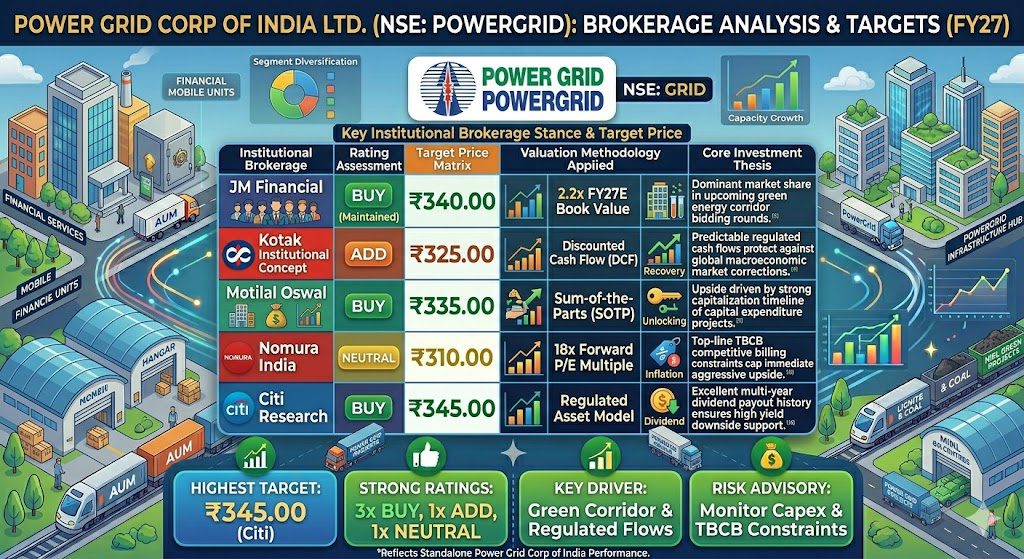
Most domestic and international brokerage houses continue maintaining positive long-term ratings on Power Grid Corporation of India Limited because of its stable regulated asset model, reliable dividends, and defensive nature.
JM Financial maintains a BUY rating with a target price of ₹340, citing the company’s dominant market share in upcoming green energy transmission projects. Kotak Institutional Equities has an ADD rating with a target of ₹325 based on discounted cash flow valuation methodology.
Motilal Oswal also remains bullish with a target of ₹335, highlighting the company’s strong capitalization pipeline and transmission infrastructure expansion potential. Citi Research continues maintaining a BUY rating with a target of ₹345, emphasizing Power Grid’s excellent dividend yield and stable regulated business model.
Nomura India remains relatively cautious with a NEUTRAL rating and a target price of ₹310 due to concerns regarding tariff pressure in competitive bidding projects.
Overall, institutional consensus target prices currently average around ₹323, suggesting moderate but stable upside potential combined with highly attractive dividend income visibility.
Should You Buy, Hold, or Sell Power Grid?
For long-term investors, Power Grid Corporation of India Limited continues to remain one of the strongest defensive PSU opportunities in the Indian stock market. The company’s regulated business model, sovereign backing, predictable cash flows, and excellent dividend history make it an ideal stock for conservative investors seeking stability and passive income generation.
The ₹9 total dividend payout for FY26 once again proves that Power Grid remains one of India’s most reliable dividend-paying companies. Its central role in India’s renewable energy transition further strengthens long-term growth visibility. Investors may continue accumulating the stock gradually during market corrections, especially near the ₹290 support region.
For short-term traders, the immediate technical structure remains mildly bullish following the earnings announcement. If the stock sustains above ₹301 during opening trade sessions, momentum could push prices toward ₹312 and ₹318 in the near term. However, traders should maintain disciplined stop-loss levels below ₹295 because broader market volatility can still influence PSU utility counters.
For official company disclosures, investors can also monitor updates through NSE India Official Website.