Introduction: The Phoenix of Fintech
Over the last three decades, India’s financial ecosystem has transformed completely. In the 1990s, banking transactions meant standing in long queues, maintaining passbooks, and handling physical cash almost everywhere. Today, India has become one of the world’s largest digital payment economies where QR codes, UPI, mobile wallets, and instant digital lending dominate daily transactions. Very few companies symbolize this digital transformation better than One 97 Communications, popularly known as Paytm.
For years, Paytm was viewed as one of India’s most aggressive fintech growth stories. However, after facing regulatory challenges, heavy losses, and investor skepticism following its stock market listing, the company entered a difficult period where survival became the biggest priority. Many market participants questioned whether the company could ever become sustainably profitable.
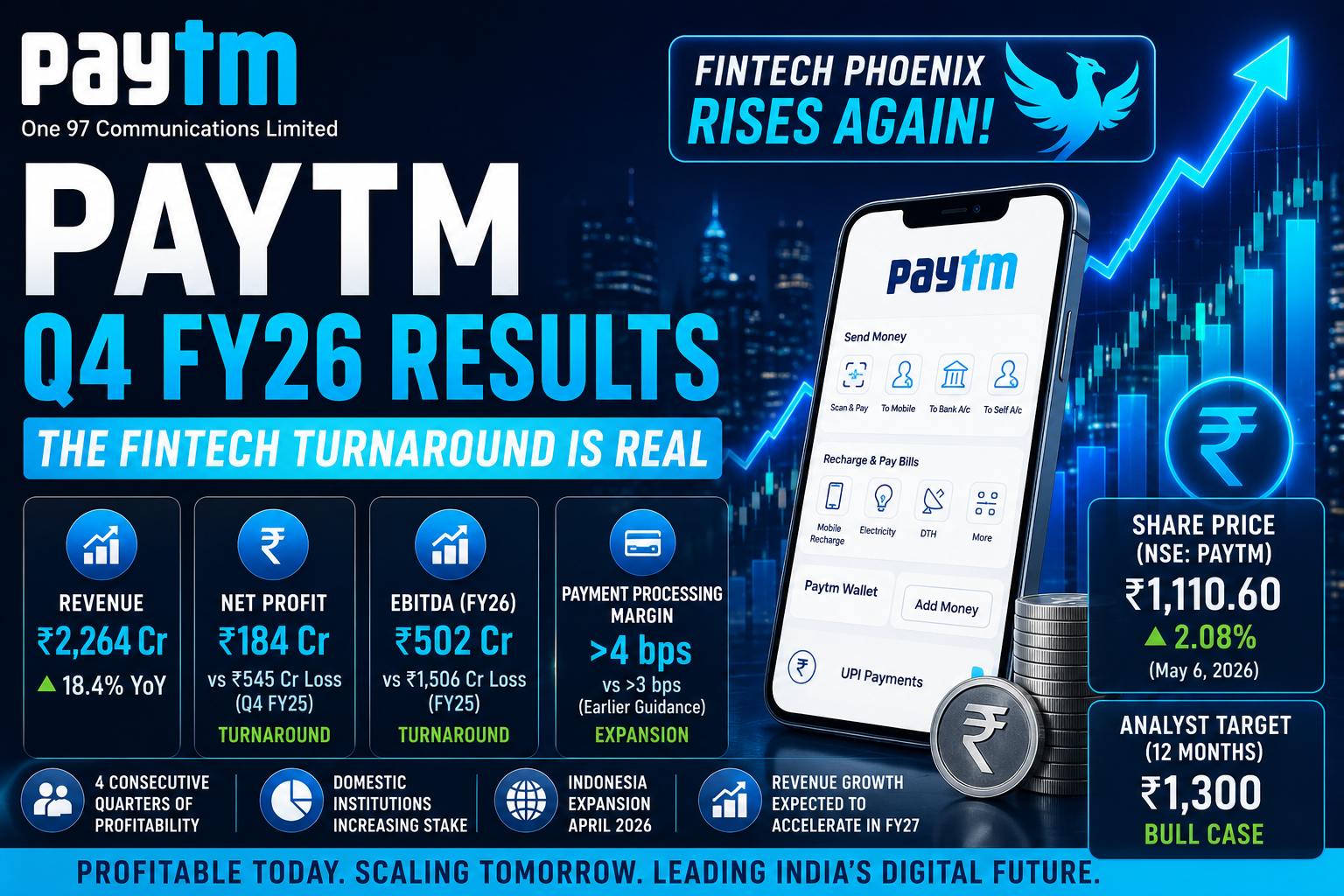
The Q4 FY26 results announced on May 6, 2026, may now mark one of the most important turning points in the company’s history. Paytm has officially transitioned from a “cash-burning fintech” into a profitable digital financial platform. The company reported a consolidated net profit of ₹184 crore for Q4 FY26 compared to a massive loss of ₹545 crore in the same quarter last year.
The market reacted positively to the turnaround. Paytm shares closed approximately 2.08% higher near ₹1,110.60 on the NSE, continuing a strong recovery from the stock’s 52-week lows. Investors are increasingly viewing the company not as a speculative fintech experiment but as a maturing digital financial ecosystem with improving profitability and operating leverage.
Today, Paytm’s story is no longer only about user growth and transaction volumes. It is increasingly becoming a story of disciplined execution, margin improvement, and sustainable earnings growth.
Q4 FY26 Financial Scorecard (Actual NSE Data)
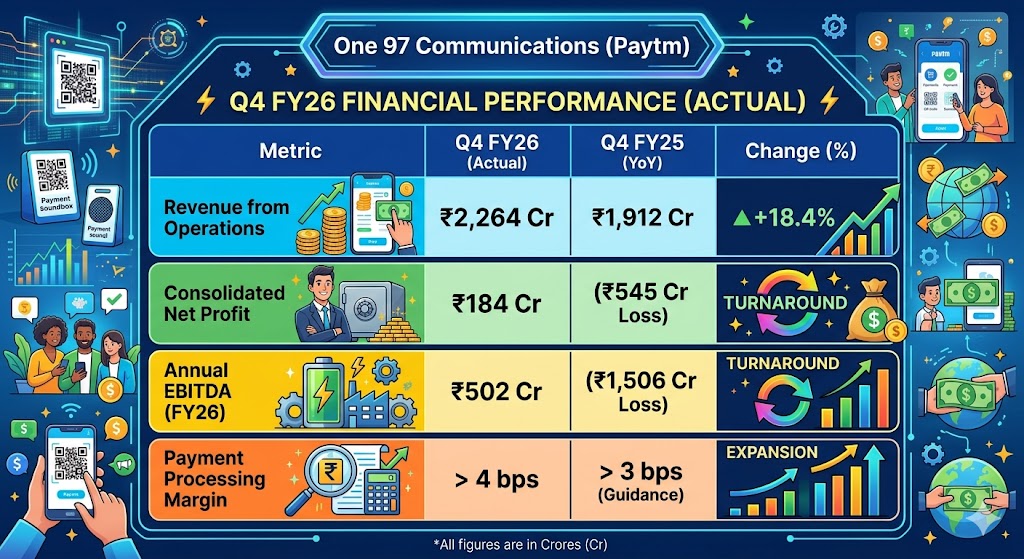
Paytm delivered one of its strongest quarterly performances since listing on the Indian stock exchanges. Revenue from operations rose to ₹2,264 crore compared to ₹1,912 crore in Q4 FY25, reflecting a healthy 18.4% year-on-year increase. This growth came despite regulatory disruptions and changing industry dynamics over the last year.
The biggest highlight was the dramatic turnaround in profitability. Consolidated net profit stood at ₹184 crore compared to a net loss of ₹545 crore during the same period last year. This marks one of the largest profitability improvements among Indian fintech companies in recent years.
Another major achievement was the sharp improvement in EBITDA performance. Annual EBITDA for FY26 turned positive at ₹502 crore compared to a loss of ₹1,506 crore in FY25. This indicates that Paytm’s core business model is now beginning to generate sustainable operating profits.
Payment processing margins also improved significantly, crossing 4 basis points compared to previous guidance of above 3 basis points. This expansion reflects better monetization of payment volumes and stronger operational efficiency across the platform.
The Q4 FY26 scorecard clearly demonstrates that Paytm’s profitability journey is no longer theoretical. The company is now delivering measurable financial results backed by disciplined cost management and operating leverage.
Fundamental Analysis: The Profitability Engine
Operating Leverage Begins to Work
One of the most important signs of a maturing technology company is operating leverage, where revenues grow faster than costs. Paytm’s Q4 FY26 results clearly show this shift happening.
Employee benefit expenses, which were historically one of the largest cost burdens for the company, remained stable at around 32.5% of total costs despite revenue growth. This indicates that Paytm is scaling its operations without proportionally increasing expenses.
This is extremely important because technology businesses become highly profitable once fixed costs stabilize while transaction volumes continue expanding. Paytm now appears to be entering that phase.
The PIDF Challenge and Revenue Strength
The discontinuation of the Payment Infrastructure Development Fund (PIDF) scheme created concerns about future revenue pressure for the company. However, management successfully offset nearly 30–40% of the negative impact through stronger growth in core revenue streams.
This demonstrates that Paytm’s underlying business ecosystem has become significantly stronger and less dependent on external incentives. Revenue diversification across payments, merchant services, financial products, and subscriptions is helping stabilize earnings growth.
Ownership Shift: Domestic Institutions Enter
Another major development has been the shift in ownership patterns. Foreign Institutional Investor (FII) holding reportedly declined from 72.1% to 49.4% as of March 2026, while Domestic Institutional Investors (DIIs) significantly increased their stake.
This shift is important because domestic institutions often focus more on long-term structural growth opportunities rather than short-term market sentiment. The rising interest from DIIs suggests growing confidence in Paytm’s profitability and long-term business sustainability.
Technical Analysis: The Bullish Recovery
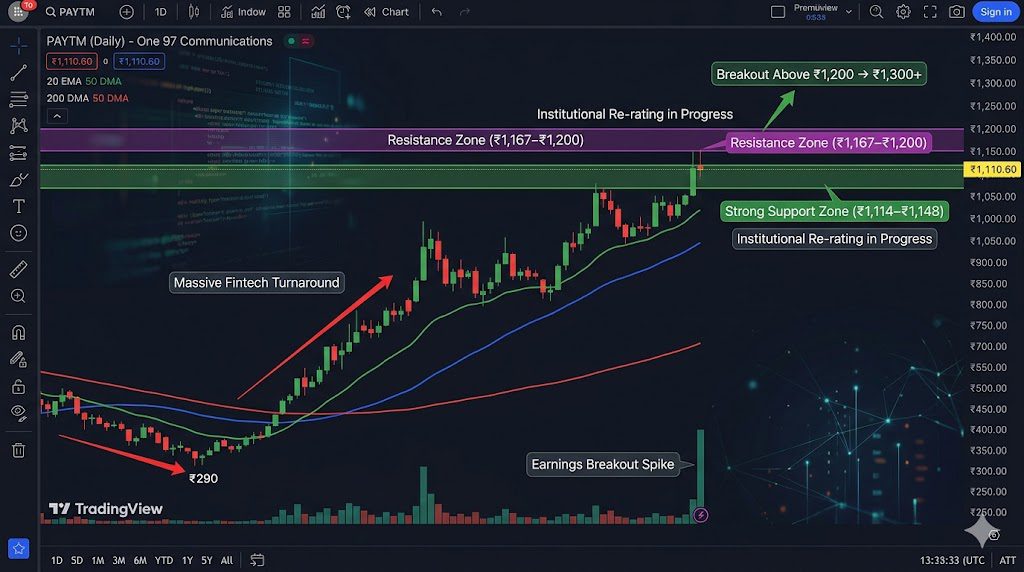
From a technical perspective, Paytm has staged one of the strongest recovery rallies in the Indian fintech sector. After collapsing to nearly ₹290 during its worst phase, the stock has now recovered strongly above ₹1,100.
The immediate support level currently stands near ₹1,148, while the 20-day EMA around ₹1,114 is acting as a strong dynamic support zone. This moving average has become an important short-term accumulation area for traders and institutional investors.
On the upside, the immediate resistance zone lies near ₹1,167. A decisive breakout above this level could trigger another rally toward the psychological ₹1,200 mark and potentially even higher levels.
Technical indicators continue to support the bullish structure. The MACD indicator is showing a positive bullish crossover, while the Relative Strength Index (RSI) near 53.15 indicates that the stock remains in a neutral-to-positive momentum zone with additional room for upside.
The broader chart structure suggests that Paytm is gradually transitioning from a recovery trade into a long-term bullish trend.
Management Guidance: Scaling FY27
Revenue Growth Outlook
Management remains optimistic about FY27 growth prospects. The company expects revenue growth during FY27 to exceed the 22% growth achieved in FY26.
This confidence reflects improving monetization across payments, merchant services, financial products, and subscription-based businesses. As India’s digital economy continues expanding rapidly, Paytm remains well-positioned to benefit from increasing transaction volumes and digital financial adoption.
International Expansion Strategy
One of the most interesting developments during FY26 was Paytm’s decision to expand internationally. The company incorporated a new subsidiary in Indonesia on April 10, 2026, as part of its broader global expansion strategy.
Indonesia represents one of Southeast Asia’s largest digital payment and fintech markets. If Paytm successfully executes its international strategy, it could eventually unlock significant long-term growth opportunities outside India.
Margin Expansion Roadmap
Management also indicated that indirect expenses are expected to grow significantly slower than revenue during FY27. This means operating leverage could continue improving, leading to further margin expansion and higher profitability.
This phase is particularly important because once fintech platforms achieve stable operating leverage, earnings growth can accelerate rapidly over multiple years.
Brokerage Sentiment & Targets: The Re-Rating View
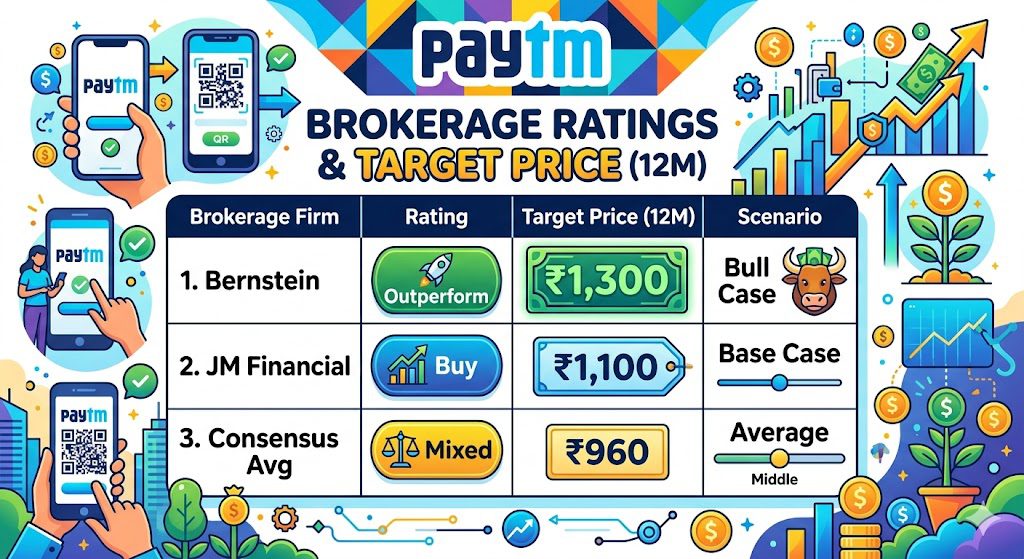
Brokerage firms are increasingly becoming optimistic about Paytm’s long-term prospects. Bernstein has maintained an “Outperform” rating with a bullish target price near ₹1,300, citing improving profitability and stronger execution.
JM Financial also maintains a positive “Buy” rating with a target near ₹1,100, reflecting confidence in the company’s turnaround story.
Consensus estimates remain somewhat mixed, with average targets near ₹960, mainly due to continued caution around regulatory risks and competitive pressures. However, sentiment has improved significantly compared to previous years when analysts remained deeply skeptical about Paytm’s business model.
The broader market is increasingly viewing Paytm as a mature fintech platform with improving earnings visibility rather than a speculative loss-making startup.
The “30-Year” Analyst Verdict
From a long-term investment perspective, Paytm’s turnaround story now appears far more credible than it did just two years ago. The company has demonstrated that it can scale revenue while controlling costs and generating operating profits.
The digital payments ecosystem in India continues to expand rapidly, supported by rising smartphone penetration, UPI adoption, online commerce, and digital lending growth. Paytm remains deeply embedded within this ecosystem.
The company’s improving operating leverage, stronger institutional ownership, and expanding financial product ecosystem now make it increasingly suitable as a long-term fintech investment rather than merely a momentum trade.
For traders, the stock continues to remain attractive on dips near key moving averages. The strong recovery from ₹290 to above ₹1,100 may only represent the early phase of a broader institutional re-rating cycle if profitability continues improving consistently.
Conclusion & Engagement Strategy
Paytm’s Q4 FY26 results mark one of the most important turning points in the company’s corporate journey. A fintech company once criticized for massive losses and uncertain monetization has now delivered four consecutive quarters of profitability while continuing to grow revenues and improve margins.
With a profit turnaround of ₹184 crore, expanding operating leverage, improving payment margins, and growing international ambitions, Paytm appears increasingly well-positioned to become one of India’s leading long-term digital financial platforms.
The biggest question for investors now is whether Paytm can sustain its profitability momentum while navigating competition, regulatory changes, and international expansion over the coming years.