Scope Outline
Introduction: The Profitable Pivot of a Fintech Giant
Over the last three decades, India’s financial services industry has undergone a massive transformation. In the 1990s, purchasing insurance meant filling out physical forms, meeting agents face-to-face, and storing policy papers inside lockers or files at home. In 2026, the entire process has become digital, fast, and accessible through smartphones. Consumers now compare policies online, buy insurance within minutes, renew policies digitally, and even access loans instantly. PB Fintech, the parent company of Policybazaar and Paisabazaar, has become one of the biggest symbols of this financial revolution in India.
The company’s Q4 FY26 results, announced on May 6, 2026, mark a major turning point in its journey. For years, investors viewed fintech companies mainly as aggressive growth stories that focused heavily on customer acquisition while sacrificing profitability. PB Fintech is now proving that digital platforms can scale profitably while building strong recurring revenue streams.
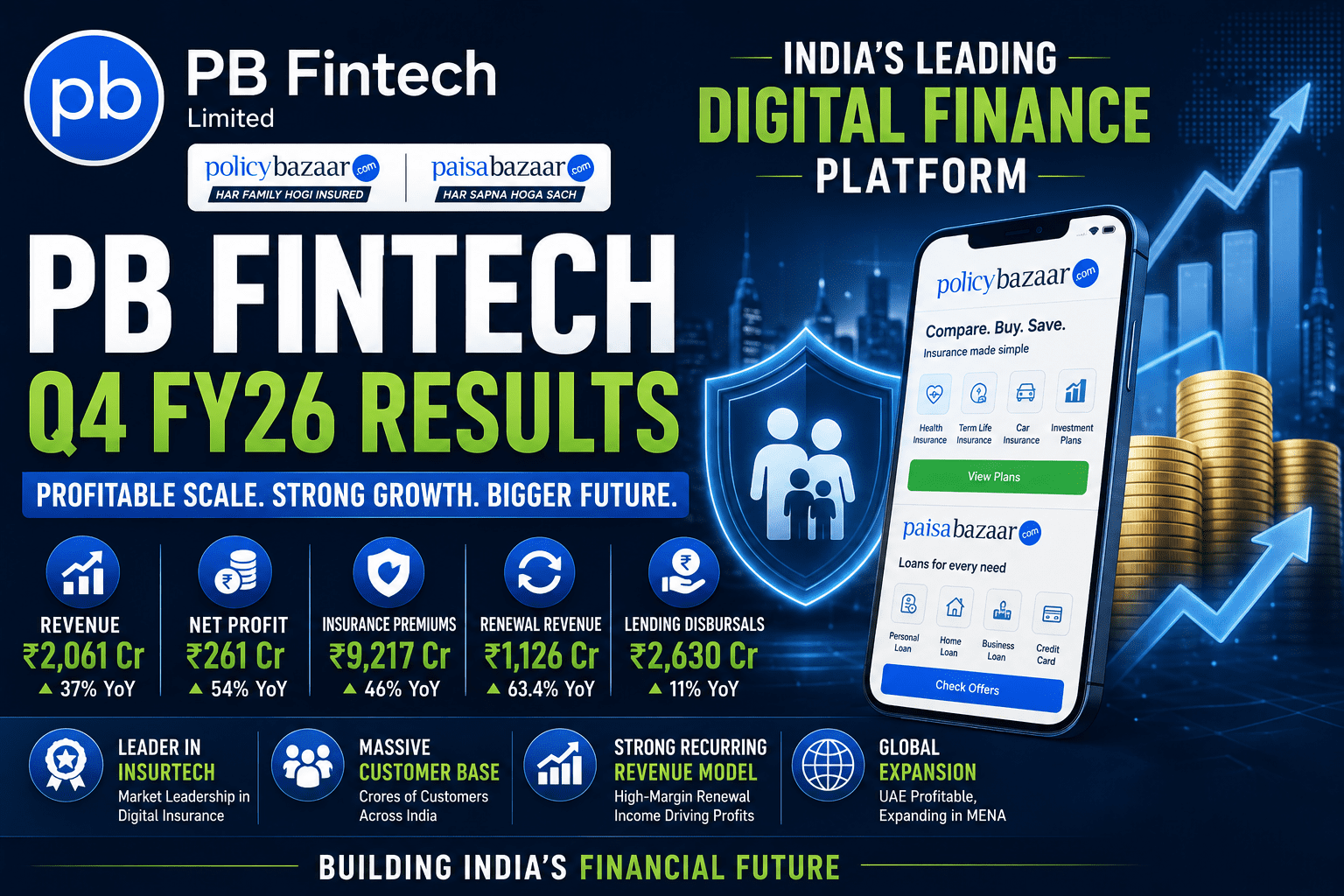
The company reported a sharp 54% year-on-year increase in net profit to ₹261 crore during Q4 FY26. Revenue grew 37% to ₹2,061 crore, while total insurance premiums sold through the platform crossed ₹9,217 crore for the quarter. Despite broader selling pressure in Indian markets, PB Fintech shares remained stable near ₹1,670 as investors rewarded the company’s improving profitability and long-term digital finance leadership.
Q4 FY26 Financial Scorecard (The Actual NSE Data)
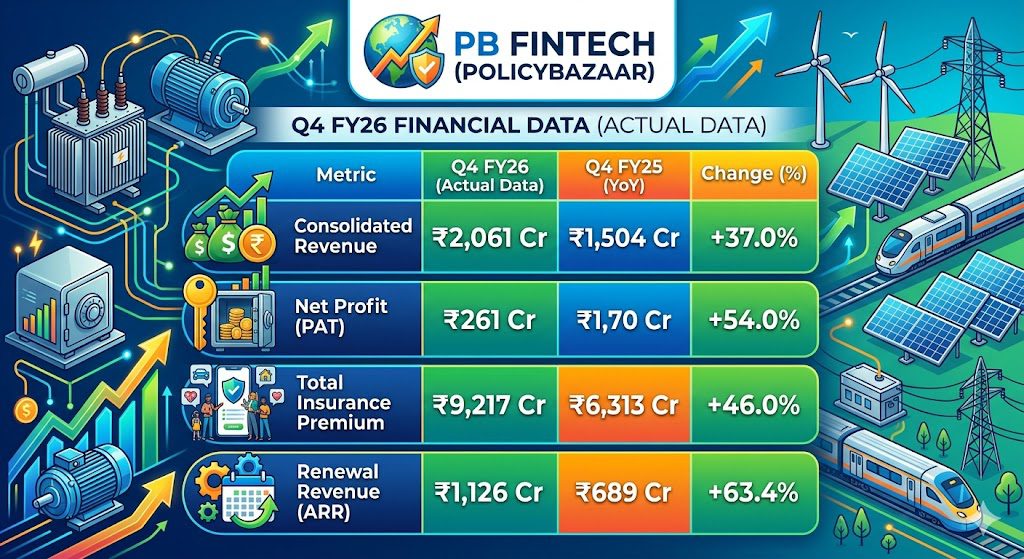
PB Fintech delivered one of its strongest quarterly performances since becoming a listed company. Consolidated revenue increased significantly to ₹2,061 crore compared to ₹1,504 crore in the same quarter last year, reflecting a strong 37% year-on-year growth. This growth was driven by higher insurance premium volumes, stronger renewal income, and steady expansion in the credit business.
The company’s profitability improved sharply as net profit rose to ₹261 crore from ₹170 crore in Q4 FY25, representing a massive 54% increase. The strong rise in profits clearly indicates that PB Fintech is now benefiting from operating leverage as its customer base continues to expand.
Total insurance premium collections surged to ₹9,217 crore compared to ₹6,313 crore last year, registering a strong 46% growth. Another important highlight was the sharp increase in renewal revenue, which rose to ₹1,126 crore from ₹689 crore, representing a 63.4% year-on-year increase. Renewal revenue is especially valuable because it creates recurring, high-margin income that strengthens the long-term stability of the business model.
Fundamental Analysis: The Engine of Growth
Renewal Income: The Hidden Profit Machine
One of the most important indicators for long-term fintech profitability is recurring income. In PB Fintech’s case, renewal and trail revenue has become one of the strongest growth drivers for the business. The company’s rolling 12-month renewal revenue surged nearly 40% to ₹935 crore.
This recurring income stream is extremely important because it carries significantly higher margins compared to fresh customer acquisition. As more customers renew their health and life insurance policies every year, the company continues generating stable cash flows without spending aggressively on marketing.
This creates a compounding business model where profitability improves steadily over time as the customer base grows. The renewal business is gradually becoming a strong financial “fortress” for PB Fintech’s earnings stability.
Rising Demand for Protection Products
Another major highlight from the quarter was the strong rise in protection-focused insurance products. Health insurance and term insurance premiums increased by nearly 67% year-on-year, indicating a major shift in Indian consumer behavior.
Earlier, many consumers purchased insurance mainly for tax-saving purposes. However, awareness regarding healthcare costs, financial planning, and long-term family protection has increased significantly after the pandemic years. Consumers are now increasingly buying larger protection-oriented insurance policies instead of short-term tax-saving products.
PB Fintech is benefiting directly from this shift because its digital platform makes policy comparison, product education, and online purchases much easier for customers across India.
Paisabazaar and Credit Stability
The company’s credit marketplace business under Paisabazaar also delivered stable growth during the quarter. Lending disbursals rose 11% year-on-year to ₹2,630 crore despite a relatively cautious credit environment and higher interest rates.
Unlike some fintech companies that pursued aggressive lending growth in the past, PB Fintech appears focused on maintaining balanced and sustainable expansion. This disciplined approach may help the company reduce long-term credit risks while improving the quality of its lending partnerships.
The stable growth in the credit business also provides additional diversification beyond insurance revenues.
Technical Analysis: Navigating the 52-Week Highs
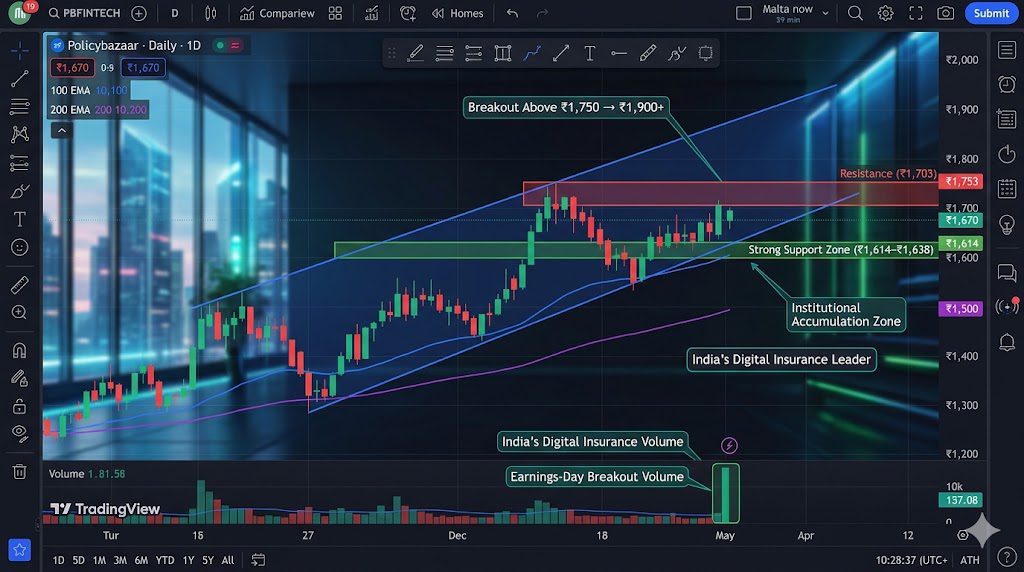
From a technical perspective, PB Fintech continues to trade in a strong bullish structure. The stock is currently moving within an ascending channel pattern while staying comfortably above key long-term moving averages.
The stock is trading above its 100-day EMA near ₹1,562 and 200-day EMA near ₹1,601, indicating that the long-term trend remains positive. Institutional buying activity has also been visible near support levels during recent market corrections.
The most important support zone currently lies between ₹1,638 and ₹1,614. This area is considered a strong accumulation zone where long-term investors and domestic institutional investors are actively building positions.
On the upside, the immediate resistance range stands between ₹1,708 and ₹1,753. A strong breakout above ₹1,750 with higher trading volumes could trigger another rally toward the next major psychological target of ₹1,900.
The Relative Strength Index (RSI) currently stands near 64.3, indicating bullish momentum while still leaving some room for additional upside before entering extremely overbought territory.
Management Guidance & Global Ambition
FY27 Growth Outlook
Management has guided for continued profitable growth during FY27. The company expects profit growth of nearly 15–20% over the next fiscal year while continuing to expand both insurance and credit businesses.
Unlike earlier years when customer acquisition was the primary focus, PB Fintech is now concentrating more on operational efficiency, renewal income growth, and improving profit margins. This strategic shift has strengthened investor confidence in the sustainability of the company’s business model.
The UAE Expansion Story
One of the most interesting developments during FY26 was the profitability achieved by PB Fintech’s UAE insurance business. The company’s international operations in the UAE reportedly grew 54% year-on-year and became profitable for the first time.
This milestone is important because it demonstrates that PB Fintech’s digital insurance platform can potentially succeed beyond India. The company is now expected to explore additional opportunities across the Middle East and North Africa (MENA) region where insurance penetration remains relatively low but digital adoption is rising rapidly.
International expansion could eventually become an important secondary growth engine for the company over the next decade.
Brokerage Sentiment & Targets: The Path to ₹1,900
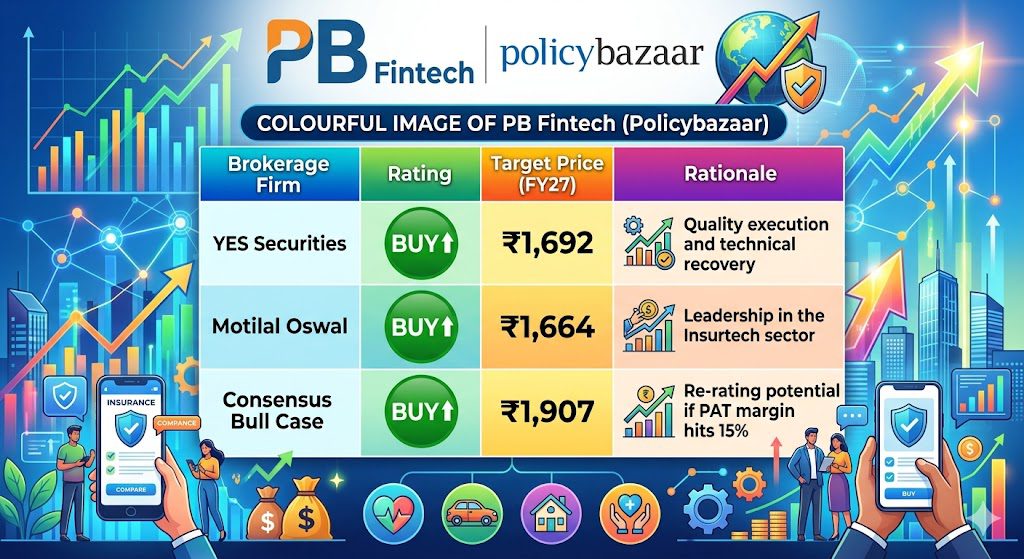
Brokerage firms remain broadly optimistic about PB Fintech’s long-term prospects. YES Securities has maintained a “Buy” rating with a target near ₹1,692, citing strong execution and improving technical momentum.
Motilal Oswal also remains positive on the company due to its dominant position in India’s rapidly growing insurtech sector. Some bullish consensus estimates suggest the possibility of the stock moving toward ₹1,900 if PB Fintech continues improving profit margins while sustaining high premium growth.
The market is increasingly viewing PB Fintech as a long-term digital financial platform business rather than just another speculative fintech stock.
The “30-Year” Analyst Verdict
From a long-term investment perspective, PB Fintech has successfully evolved from a pure growth-focused fintech company into a structurally profitable digital platform. The company now benefits from multiple long-term trends including rising insurance penetration, increasing digital adoption, higher financial awareness, and growing demand for protection products in India.
Its rapidly growing renewal income business acts like a recurring annuity stream that can continue compounding for years. This significantly improves earnings visibility and business quality.
For long-term investors, PB Fintech increasingly looks like a core digital finance holding rather than a speculative growth trade. For traders, the stock remains firmly in bullish momentum territory, and buying on dips near ₹1,640 may continue offering attractive risk-reward opportunities while the broader uptrend remains intact.
Conclusion & Engagement Strategy
PB Fintech’s Q4 FY26 results clearly show that the company has entered a new phase of profitable and sustainable growth. With strong premium growth, expanding renewal income, improving profitability, and successful international expansion, the company appears well-positioned to remain one of India’s leading digital financial platforms.
As India’s financial services ecosystem becomes increasingly digital, PB Fintech may emerge as one of the biggest long-term beneficiaries of the country’s fintech revolution. The key question for investors now is whether the company can continue scaling its high-margin renewal business while maintaining leadership in India’s highly competitive insurtech market.