Introduction: The Maharatna’s Decade-High Momentum
Across more than three decades of tracking energy cycles, one truth has remained remarkably consistent—upstream oil companies survive and thrive based on production strength. Commodity prices rise and fall, refining margins fluctuate, governments change policies, and energy transitions create uncertainty, but companies that consistently grow reserves and production tend to outperform across long cycles.
That is precisely why Oil India has suddenly returned to the center of investor attention after announcing its Q4 FY26 results on May 14, 2026.
The company’s latest quarterly performance is not just another earnings report. It reflects one of the strongest operational phases in Oil India’s recent history. From record drilling activity and rising crude realizations to expanding EBITDA margins and exceptional subsidiary performance from Numaligarh Refinery, the company appears to be firing on almost every operational cylinder simultaneously.
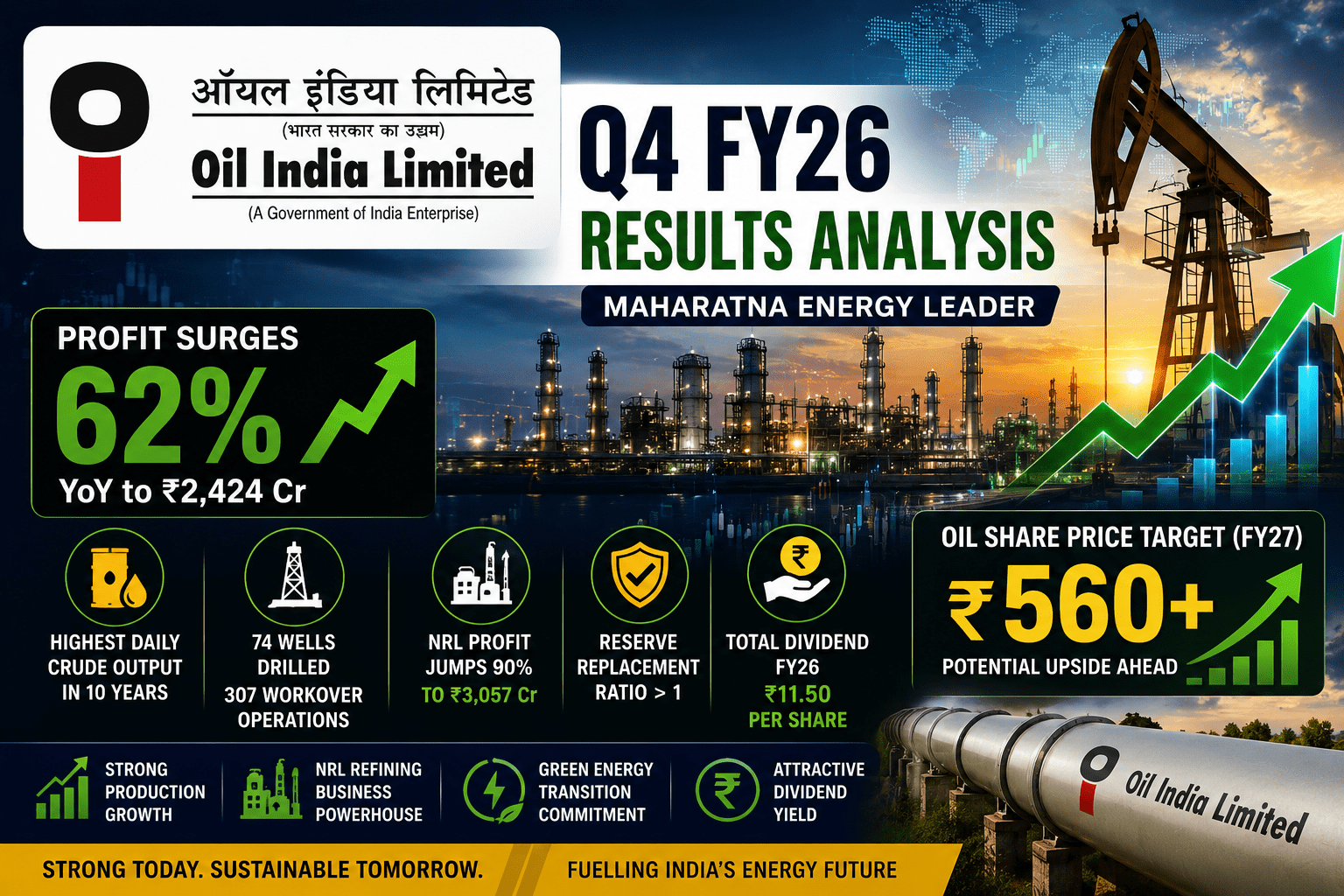
The headline number immediately grabbed market attention. Consolidated net profit surged 62% year-on-year to ₹2,424 crore, making it one of the strongest quarterly performances among Indian upstream energy companies this season.
More importantly, this profit growth was supported by real operational improvements rather than only temporary commodity price spikes. Oil India reported its highest daily crude oil production in nearly a decade while simultaneously improving reserve replacement metrics and maintaining strong financial discipline.
Following the earnings announcement, the stock continued showing resilience in the ₹450–₹470 zone, outperforming several broader energy-sector peers. Investors appear increasingly convinced that Oil India is no longer just a traditional PSU oil company—it is gradually evolving into a stronger integrated energy player with both value and growth characteristics.
At a time when global investors remain divided between fossil-fuel demand resilience and renewable-energy transition themes, Oil India is attempting to position itself intelligently between both worlds.
Q4 FY26 Performance: The Hard Numbers
Oil India’s audited results for the quarter ended March 31, 2026, delivered strong operational and financial performance across almost every key metric.
The biggest highlight was consolidated Profit After Tax (PAT), which jumped sharply to ₹2,424 crore compared to ₹1,497 crore in Q4 FY25. This represents a massive year-on-year increase of nearly 62%.
Standalone PAT also remained healthy at ₹1,790 crore compared to ₹1,591 crore last year, registering growth of approximately 12.5%. While the standalone profit growth appears more moderate compared to consolidated figures, it still reflects strong operational efficiency in a challenging global energy environment.
Standalone revenue for the quarter came in at ₹5,961 crore, showing sequential growth compared to the previous quarter’s ₹5,821 crore. This sequential improvement is particularly important because it demonstrates improving operational momentum entering FY27.
One of the strongest operational indicators from the report was EBITDA margin expansion. Oil India’s EBITDA margin improved significantly to 30.55% compared to 26.63% in Q3 FY26.
For an upstream energy company, crossing the 30% EBITDA margin level reflects very strong operational leverage, especially during periods of relatively stable commodity prices. Rising margins indicate improved production economics, stronger pricing realization, and disciplined cost management.
Overall, the Q4 FY26 numbers clearly demonstrate that Oil India is currently benefiting from a favorable combination of production growth, improved pricing, and strong downstream profitability support from Numaligarh Refinery.
Fundamental Analysis: The Production Engine
Crude Realization Strength
A major contributor to Oil India’s profit growth during the quarter was stronger crude oil price realization. The company achieved crude realization of approximately $77.89 per barrel compared to $74.46 per barrel during the same period last year.
Even relatively small improvements in crude realization can significantly impact profitability for upstream companies because operational leverage in the oil sector is extremely high. Higher crude prices directly improve earnings, cash flows, and dividend-paying capacity.
Although global oil prices remain volatile due to geopolitical tensions, OPEC production strategies, and global demand uncertainty, Oil India’s operational improvements helped the company maximize the benefit from favorable pricing conditions.
Record Drilling Activity
Perhaps the most important long-term development in the earnings report was Oil India’s record drilling performance.
The company completed its highest-ever operational activity in FY26 with 74 wells drilled and 307 workover operations completed during the year. This represents one of the most aggressive exploration and production expansion phases in the company’s recent history.
For upstream energy companies, drilling activity is the foundation of long-term production sustainability. Companies that fail to invest in reserve replacement eventually face declining output and weakening profitability. Oil India’s aggressive drilling strategy therefore sends a strong positive signal about management’s long-term production confidence.
This also demonstrates that the company is not merely benefiting from higher commodity prices—it is actively building future production capacity.
Numaligarh Refinery Becomes the Hidden Jewel
One of the most exciting parts of Oil India’s FY26 performance came from its subsidiary, Numaligarh Refinery Limited (NRL).
NRL reported an extraordinary 90% jump in annual profit to ₹3,057 crore during FY26. Gross Refining Margins (GRM) remained extremely healthy at $13.43 per barrel, which is considered highly attractive within the refining industry.
Refining profitability often acts as a balancing factor for integrated energy companies because refining margins can sometimes remain strong even when crude prices fluctuate.
For Oil India investors, NRL’s strong performance significantly improves the overall business quality of the group. It provides diversification away from pure upstream dependence while strengthening cash flow stability.
As refinery expansion projects continue progressing, NRL may increasingly become one of the company’s most important long-term value drivers.
Reserve Replacement Ratio Signals Sustainability
Another highly important but often overlooked metric in upstream energy analysis is the Reserve Replacement Ratio (RRR).
Oil India achieved an RRR greater than 1 during FY26. In simple terms, this means the company replaced more reserves than it produced during the year.
This is extremely important because reserve depletion remains one of the biggest long-term risks for oil exploration companies. An RRR above 1 suggests that Oil India is maintaining long-term resource sustainability rather than exhausting existing reserves without replenishment.
Experienced energy investors usually consider reserve replacement one of the strongest indicators of operational quality and future production stability.
Technical Analysis: Navigating the Support Zones
Current Technical Setup
From a technical analysis perspective, Oil India stock currently remains in a constructive long-term bullish structure.
The stock is comfortably trading above its 200-day Exponential Moving Average (EMA) near ₹447, which is generally considered a strong long-term bullish signal. Stocks trading above their 200-day EMA often attract institutional interest because they indicate sustained medium-term trend strength.
The recent earnings announcement further improved sentiment as investors reacted positively to both operational growth and shareholder payouts.
Major Support Levels
The key support zone currently lies between ₹450 and ₹453. This range has repeatedly acted as a strong accumulation area where buying interest has emerged consistently.
As long as the stock remains above this support band, the broader bullish structure remains intact.
However, if broader market weakness or crude price pressure pushes the stock below this zone decisively, the next major downside support could emerge closer to the 52-week low region near ₹360.
For long-term investors, such support zones often become strategic accumulation opportunities in fundamentally strong commodity businesses.
Resistance Levels
On the upside, immediate resistance remains visible between ₹460 and ₹463.
A strong daily close above ₹466 could potentially trigger a fresh momentum rally toward higher medium-term targets. Technical traders are especially watching this breakout zone closely because clearing it with strong volume may open the path toward the previous 52-week high near ₹680 over time.
RSI Momentum Signal
The Relative Strength Index (RSI) currently stands near 62.66.
This is an encouraging technical signal because it indicates bullish momentum is strengthening without yet entering extreme overbought territory. Stocks with RSI between 60 and 70 often indicate healthy upward momentum while still allowing room for further appreciation.
Shareholder Rewards: The Dividend Story
Final Dividend Announcement
Oil India’s board recommended a final dividend of ₹1 per share for FY26.
While the final payout itself may appear modest, the bigger story lies in the company’s total dividend distribution for the year.
Total FY26 Dividend Payout
Including the two interim dividends already announced earlier during FY26—₹3.50 and ₹7 per share—the total dividend payout for the financial year now stands at ₹11.50 per share.
For dividend-focused investors, this remains an attractive yield proposition, especially considering the company’s relatively reasonable valuation compared to several private-sector energy peers.
PSU energy companies historically attract strong investor interest during periods of high cash generation because they often distribute a significant portion of profits through dividends. Oil India continues maintaining that reputation.
Dividend Timeline
The final dividend payout is expected within 30 days following approval during the company’s Annual General Meeting (AGM).
Stable and growing dividends remain especially important for long-term investors seeking passive income from energy-sector exposure.
Management Guidance & Brokerage Sentiment
Brokerage Outlook Remains Positive
Market analysts generally remain optimistic regarding Oil India’s medium-term outlook.
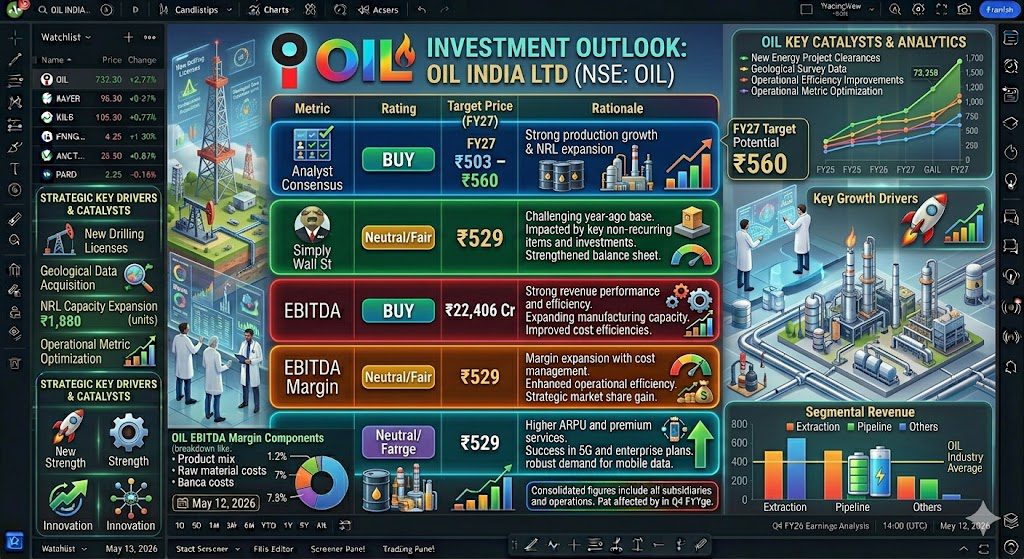
Consensus brokerage estimates currently maintain “Buy” ratings with target ranges between ₹503 and ₹560 over FY27. Analysts continue highlighting strong production growth, reserve replacement stability, and NRL expansion as major growth drivers.
Some analysts maintain more neutral positions due to long-term uncertainty surrounding global energy transition policies and fossil fuel demand moderation. However, even conservative estimates continue acknowledging the company’s strong operational base.
Green Energy Pivot Begins
One of the most strategically important developments from management commentary is the growing focus on renewable energy expansion through OIL Green Energy Limited.
The company has already signed multiple Memorandums of Understanding (MoUs) for group captive renewable-energy projects aligned with its Net Zero 2040 roadmap.
This transition is particularly important because global energy companies are increasingly being evaluated not only on current profitability but also on their long-term transition readiness toward cleaner energy ecosystems.
Oil India appears to be taking a balanced approach—continuing to maximize upstream profitability while gradually building renewable-energy capabilities for the future.
The 30-Year Analyst Verdict
For Long-Term Investors
Oil India currently offers a relatively rare combination in the Indian market—a genuine “value stock” supported by operational growth momentum.
The company trades at comparatively attractive valuations while simultaneously delivering strong production growth, reserve sustainability, dividend payouts, and refining expansion benefits.
Numaligarh Refinery’s strong profitability significantly strengthens the broader investment case because it diversifies earnings streams and improves cash flow quality.
For investors seeking long-term exposure to India’s energy sector with relatively strong dividend support, Oil India remains one of the stronger PSU opportunities available today.
For Active Traders
For traders, the stock currently appears technically attractive as long as the ₹450 support zone remains intact.
Momentum traders are closely watching the ₹465 breakout level. A sustained move above this zone with strong volume could potentially trigger the next upward leg toward ₹500 and beyond.
Given the improving operational momentum and bullish energy-sector sentiment, “buy on strength” currently appears to be the preferred trading strategy rather than aggressively waiting for deep corrections.
Conclusion & Engagement (CTA)
Oil India’s Q4 FY26 results clearly demonstrate why the company’s Maharatna status remains fully justified.
A 62% jump in consolidated profit, record drilling activity, strong reserve replacement metrics, improving refining profitability, expanding EBITDA margins, and stable shareholder payouts together paint the picture of an energy company operating with renewed confidence and operational discipline.
Perhaps most importantly, Oil India is proving that traditional upstream companies can still generate attractive shareholder value while simultaneously preparing for the renewable-energy transition.
For long-term investors, the stock now represents a unique combination of value, dividends, operational growth, and strategic transition potential.
Are you buying Oil India for the ₹11.50 total dividend yield or betting on the ₹560 long-term target? Share your energy-sector investment strategy in the comments below.