NTPC Green Energy Limited released its Q4 FY26 earnings on May 22, 2026, and the market reaction has been mixed. The company reported a massive jump in revenue driven by aggressive renewable energy capacity additions and rising electricity demand across India. However, despite this impressive top-line growth, consolidated net profit declined because of rising operational expenses, depreciation costs, and financing pressure linked to ongoing expansion projects.
For investors, though, this quarter represents a much deeper story than simply looking at falling profits. Renewable energy companies often experience temporary margin pressure during aggressive expansion phases because newly commissioned projects initially generate high depreciation and interest costs before reaching full operating efficiency. This appears to be the exact phase NTPC Green is currently navigating.
India’s renewable energy transformation remains one of the strongest long-term structural themes in the market, and NTPC Green continues positioning itself as a major player in that journey. Whether you are a long-term investor, short-term trader, or someone tracking India’s green energy ambitions, understanding the company’s latest financial performance becomes extremely important for evaluating future opportunities.
NTPC Green Energy Q4 FY26 Financial Snapshot

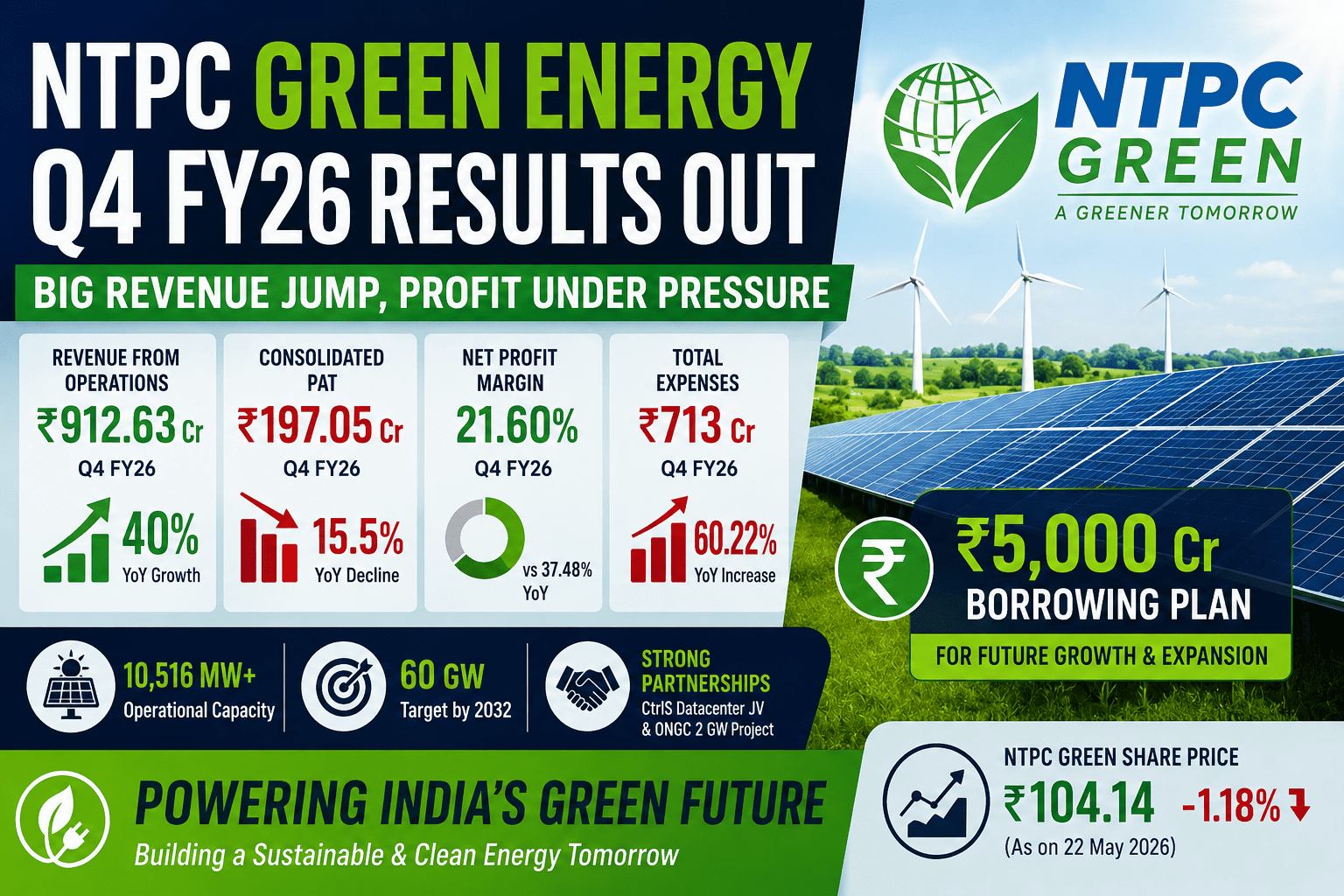
NTPC Green Energy reported consolidated revenue from operations of ₹912.63 crore during Q4 FY26 compared to ₹653.29 crore in the same quarter last year, representing a strong year-on-year growth of nearly 40%. This sharp increase was driven by the commissioning of new solar generation assets and improved renewable energy output across multiple projects. However, total expenses also surged significantly to ₹713 crore from ₹445 crore, creating substantial pressure on profitability.
As a result, consolidated net profit declined by 15.5% to ₹197.05 crore, while standalone net profit dropped sharply by 54% because of higher parent-level financing and capital costs. Net profit margins also compressed heavily from 37.48% to 21.60%, indicating the temporary pressure created by aggressive infrastructure expansion and debt-funded project execution. Despite these concerns, the stock remained relatively stable near ₹104.14 after the earnings announcement, suggesting that investors may already be pricing in short-term profitability pressure.
1. Corporate Introduction: Understanding the NTPC Green Moat
NTPC Green Energy Plays a Central Role in India’s Renewable Transition
NTPC Green Energy Limited operates as the renewable energy arm of NTPC Limited, India’s largest power generation company. The business is entirely focused on developing, building, and operating large-scale renewable energy assets including solar and wind power plants. Unlike smaller renewable startups, NTPC Green benefits from the financial strength, execution capabilities, and sovereign-backed credibility of its parent organization.
The company’s business model is highly stable because most projects operate under long-term Power Purchase Agreements (PPAs) signed with state and central utilities. These agreements typically span around 25 years, creating predictable revenue streams and reducing long-term business uncertainty.
Low-Cost Capital Access Creates a Major Competitive Advantage
One of the company’s biggest strengths is its ability to access low-cost financing. Renewable energy projects require enormous upfront investment, and companies capable of raising cheaper debt gain a massive long-term advantage. NTPC Green’s strong parentage allows it to secure financing at relatively attractive borrowing rates compared to many private renewable companies.
The company recently crossed a renewable operational capacity milestone of 10,516 MW after commissioning multiple solar projects across Rajasthan and other key states. Management is aggressively targeting 60 GW of renewable energy capacity by 2032, making NTPC Green one of India’s most strategically important renewable utility companies.
2. Earnings Analysis: Understanding the Revenue Growth and Profit Decline
Revenue Growth Remained Extremely Strong
The biggest positive from NTPC Green’s Q4 FY26 earnings was the sharp increase in operational revenue. Revenue from operations rose nearly 40% year-on-year to ₹912.63 crore, mainly because of fresh renewable capacity additions and rising electricity demand across India.
Several factors supported this growth:
- Commissioning of new solar projects
- Higher renewable generation output
- Improved solar Plant Load Factors (PLFs)
- Strong industrial electricity demand
- Rising pre-summer power consumption
India experienced severe heatwave conditions during the quarter, which significantly boosted electricity demand and improved renewable energy utilization across several states.
This strong top-line performance clearly indicates that NTPC Green’s project execution pipeline remains active and operational growth continues steadily.
Why Consolidated Net Profit Declined by 15.5%
Despite strong revenue growth, consolidated net profit fell to ₹197.05 crore compared to ₹233.22 crore in the previous year’s quarter. At first glance, this may appear concerning for retail investors. However, this pattern is very common in capital-intensive renewable utility businesses during expansion cycles.
The major pressure came from rising costs. Total expenses surged by more than 60% to ₹713 crore because of:
- Higher depreciation charges
- Rising interest expenses
- Increased employee costs
- New project commissioning expenses
- Financing pressure from large infrastructure investments
When renewable energy projects become operational, companies begin recording significant depreciation and amortization costs linked to the massive capital expenditure involved in building those assets. Simultaneously, financing expenses rise because renewable infrastructure expansion is heavily debt-funded during the growth phase.
Net Profit Margin Compression Reflects Expansion Pressure
One of the weakest areas in the earnings report was the sharp decline in consolidated net profit margins. Net profit margin dropped from 37.48% to 21.60%.
Although this decline appears severe, long-term investors often focus more on operational revenue growth during expansion phases rather than temporary quarterly margin pressure. As newly commissioned projects mature and utilization stabilizes, profitability typically improves over time.
3. Fundamental Analysis: Long-Term Structural Story Remains Intact
Full-Year FY26 Performance Still Shows Strong Growth
Despite quarterly pressure on profitability, NTPC Green’s full-year FY26 financial performance remained healthy overall. Consolidated revenue increased by 29.36% to ₹2,858.42 crore, while full-year consolidated net profit rose nearly 10% to ₹522.60 crore.
These numbers indicate that the broader business trajectory remains positive despite short-term margin compression caused by expansion activities.
Balance Sheet Strength Continues Improving
One of the encouraging signals for investors is the company’s improving operational efficiency and balance sheet quality. Standalone net worth currently stands near ₹16,892 crore, reflecting substantial financial strength.
Another major positive is the improvement in debtor days, which declined from 98.3 days to 78.5 days. Faster receivable collections are especially important in India’s power sector because delayed payments from state electricity distribution companies have historically created cash flow risks for utility businesses.
Improving cash realization strengthens NTPC Green’s operational stability and supports future expansion funding.
The ₹5,000 Crore Borrowing Plan Explained
The company’s board has approved plans to raise up to ₹5,000 crore during FY27 through:
- Non-convertible debentures (NCDs)
- Commercial bonds
- Secured debt instruments
- Unsecured borrowing mechanisms
This funding will primarily support future renewable energy expansion projects.
For renewable utility businesses, debt-funded growth is normal because large infrastructure assets require significant upfront investment before generating long-term cash flows. The key factor investors should monitor is whether future project returns remain comfortably above financing costs.
4. Technical Analysis: Important Trading Levels for Next Week
NTPC Green Shares Remain in Consolidation Mode
NTPC Green shares closed the week near ₹104.14, remaining relatively stable after the earnings announcement. The stock currently trades roughly 13% below its recent 52-week high near ₹120 but continues holding above important support levels.
This suggests that institutional investors are not aggressively exiting positions despite the temporary profit decline.
Key Pivot Level Traders Must Watch
The most important technical pivot for NTPC Green currently stands near ₹108.50.
y=108.5y=108.5
If the stock successfully breaks and sustains above this level, short-term bullish momentum could accelerate toward higher resistance zones.
Major Resistance Levels Ahead
Immediate resistance remains visible near ₹106.80. If the stock crosses this level with strong trading volume, the next major upside targets could emerge near ₹109.50 and ₹112 respectively.
These levels are important because they represent areas where institutional traders may either initiate fresh buying or book short-term profits.
Strong Support Zones for Traders
On the downside, immediate support is located near ₹102.10, while stronger structural support exists near ₹99.50. In an extreme bearish scenario, the stock’s long-term structural support remains close to ₹84.
Swing traders should monitor these levels carefully because institutional buying activity near support zones often determines short-term price direction.
Trading Strategy for Swing Traders
Short-term traders should avoid chasing aggressive breakout entries near resistance zones. Instead, better risk-reward opportunities may emerge closer to the ₹101–₹102 support region if price stabilization occurs with healthy trading volumes.
At the same time, maintaining disciplined stop losses below ₹99 remains important because a breakdown below this level could trigger deeper correction pressure.
5. Management Guidance & Strategic Growth Catalysts
The CtrlS Datacenter Partnership Could Become a Major Revenue Driver
One of the most strategically important developments announced by management was the approval for a joint venture with CtrlS Datacenters Limited.
The objective of this partnership is to build dedicated green energy infrastructure for energy-intensive data centers. This move is strategically significant because India’s data center industry is expanding rapidly due to rising digital infrastructure demand, cloud computing growth, and artificial intelligence adoption.
Dedicated commercial green power contracts could help NTPC Green generate more stable and potentially higher-margin revenue streams over the long term.
ONGC Renewable Project Pipeline Remains on Track
Management also confirmed that execution timelines for the company’s 2 GW renewable energy partnership with Oil and Natural Gas Corporation remain on schedule.
This large project pipeline is expected to contribute meaningfully to future operational capacity additions across FY27 and beyond.
6. Institutional Radar: Brokerage Ratings & Target Prices
Analysts Continue Viewing NTPC Green Positively
Despite temporary quarterly margin pressure, several institutional brokerages continue maintaining constructive long-term views on NTPC Green Energy.
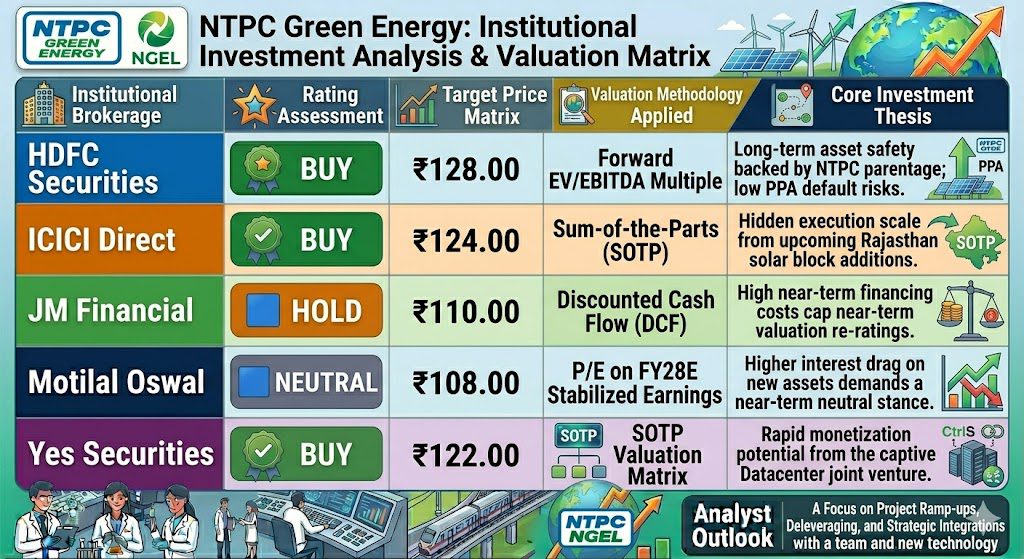
HDFC Securities maintained a BUY rating with a target price of ₹128, while ICICI Direct projected a target of ₹124. Yes Securities also remained bullish because of the company’s future renewable expansion opportunities and data center partnership potential.
Some brokerages remain cautious in the near term because of rising financing costs and margin pressure, but the broader institutional consensus continues supporting the long-term renewable energy growth story.
The median institutional target price currently stands near ₹118.40, indicating healthy upside potential from current market levels.
7. Analyst Verdict: Should Investors Buy, Hold, or Sell?
Long-Term Investors Should Focus on the Bigger Renewable Story
Long-term investors should avoid overreacting to temporary quarterly profit pressure. Renewable utility businesses often experience profitability compression during aggressive expansion phases because depreciation and financing costs rise sharply before projects achieve full operational efficiency.
The bigger structural story remains highly attractive:
- Massive renewable energy demand growth
- Long-term government support
- Stable power purchase agreements
- Strong parent backing
- Expanding renewable capacity
At current levels near ₹104, many long-term investors may continue viewing NTPC Green as an important clean energy compounder for India’s future energy transition.
Swing Traders Should Accumulate Near Support Zones
For short-term traders, the stock is likely to remain range-bound between ₹99 and ₹108 over the near term. Instead of chasing momentum near higher resistance zones, traders may find better opportunities by accumulating near strong support areas around ₹101–₹102 with disciplined stop losses below ₹99.
Final Conclusion
NTPC Green Energy Limited delivered a quarter that reflects both the opportunities and challenges of India’s aggressive renewable energy expansion cycle. Revenue growth remained extremely strong because of new project commissioning and rising electricity demand, but profitability temporarily weakened under the burden of higher depreciation and financing costs.
However, the company’s long-term growth trajectory remains firmly intact. With a ₹5,000 crore expansion funding plan, rapidly growing renewable capacity, strategic data center partnerships, and strong sovereign-backed execution capabilities, NTPC Green continues positioning itself as one of India’s most important renewable energy companies for the coming decade.