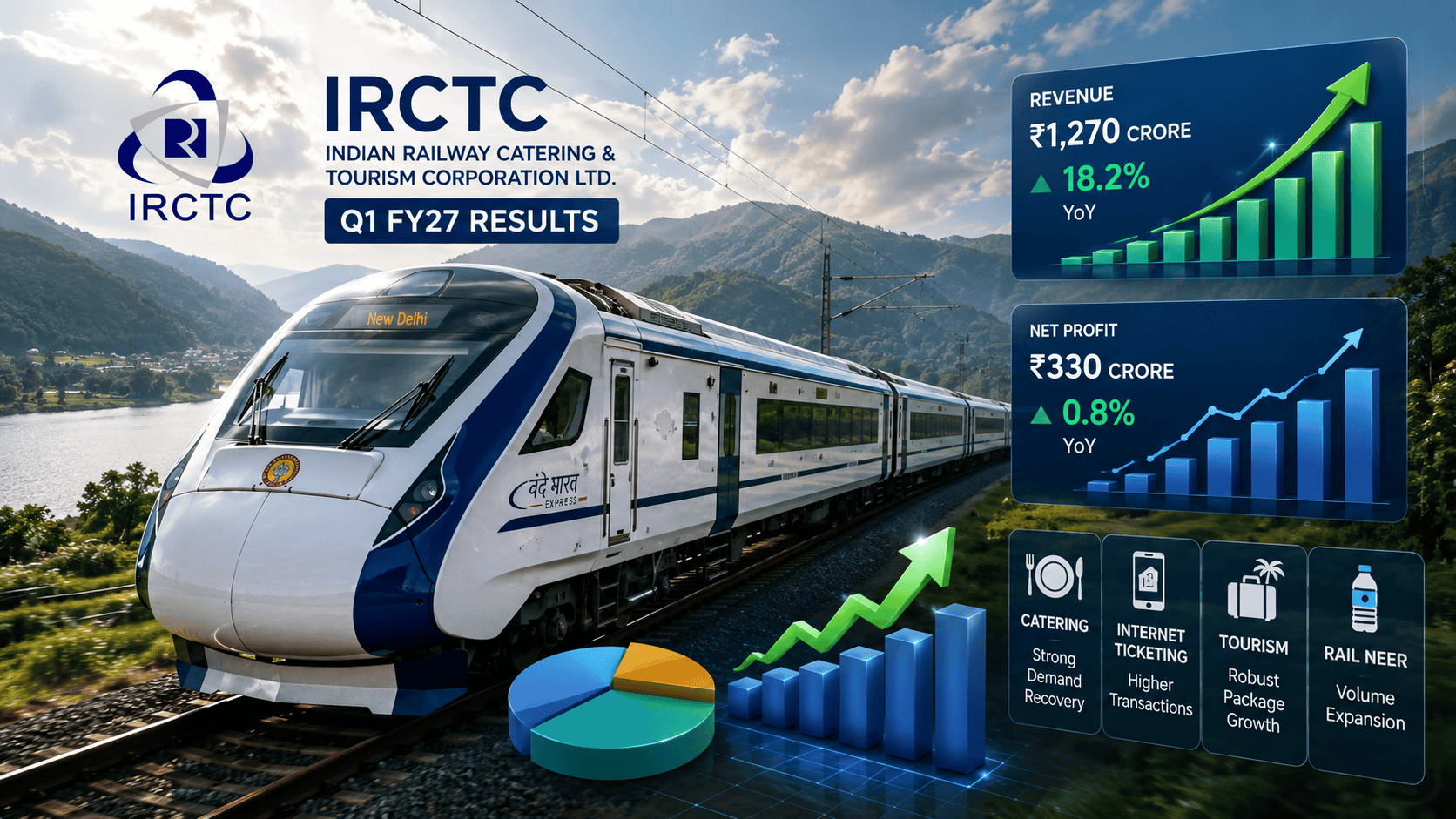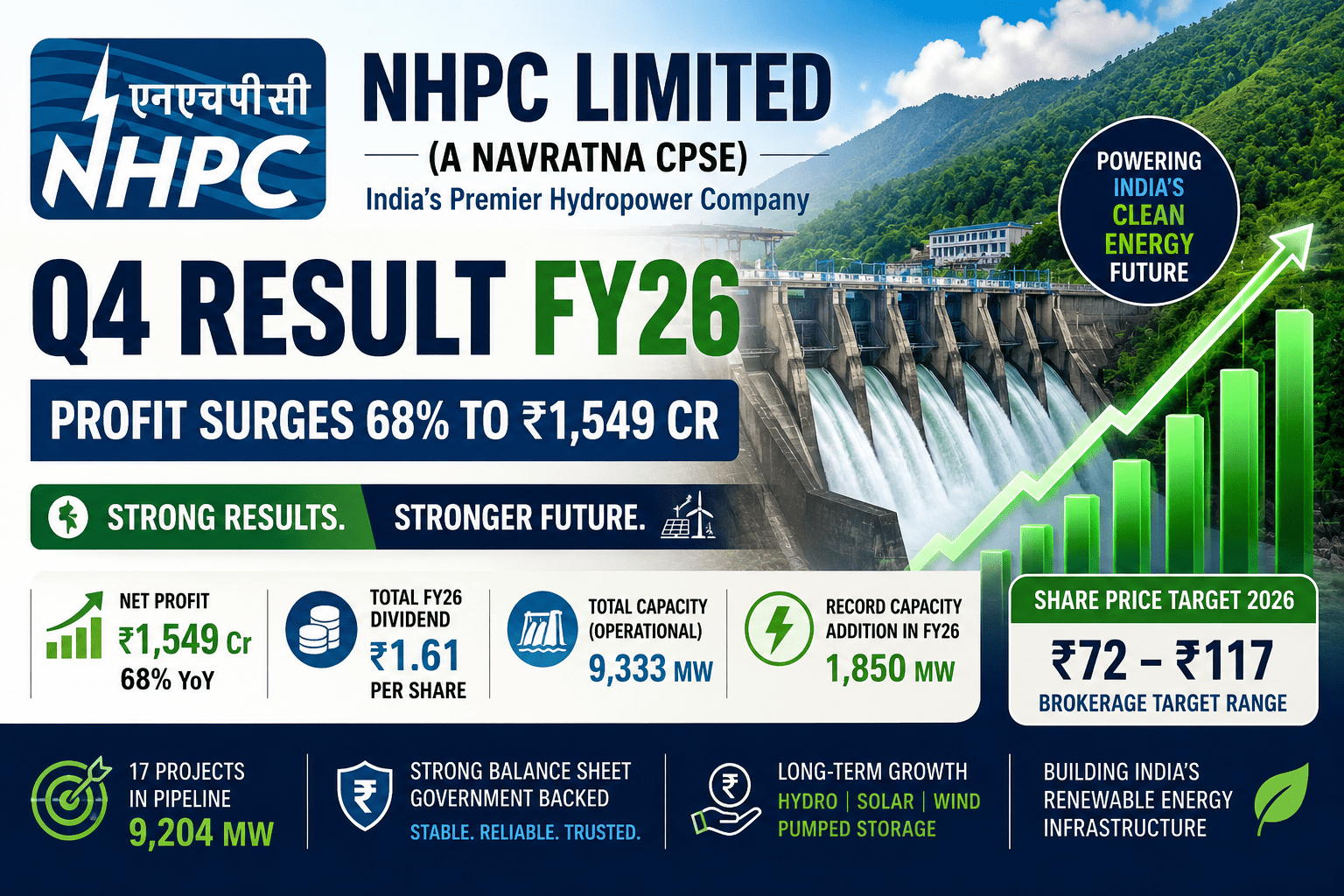
India’s hydropower giant, NHPC Limited, announced its Q4 FY26 earnings on May 15, 2026, and the headline numbers immediately grabbed the attention of PSU investors across the country. The company reported a massive 68% jump in consolidated net profit, making it one of the most discussed government-owned energy companies after the results announcement.
However, experienced market participants understand that headline profit numbers do not always tell the full story. A deeper analysis of NHPC’s quarterly books reveals a far more complex picture. While the company achieved the highest annual capacity addition in its corporate history and strengthened its long-term renewable energy positioning, core operational profitability actually remained under pressure during the quarter.
This creates an interesting situation for investors. On one side, NHPC is emerging as one of India’s most important green energy infrastructure players with aggressive future expansion plans. On the other side, rising finance costs and margin pressure continue creating near-term operational concerns. For long-term investors, dividend seekers, and short-term traders, understanding this balance becomes extremely important before taking investment decisions.
Quick Summary of NHPC Q4 FY26 Results
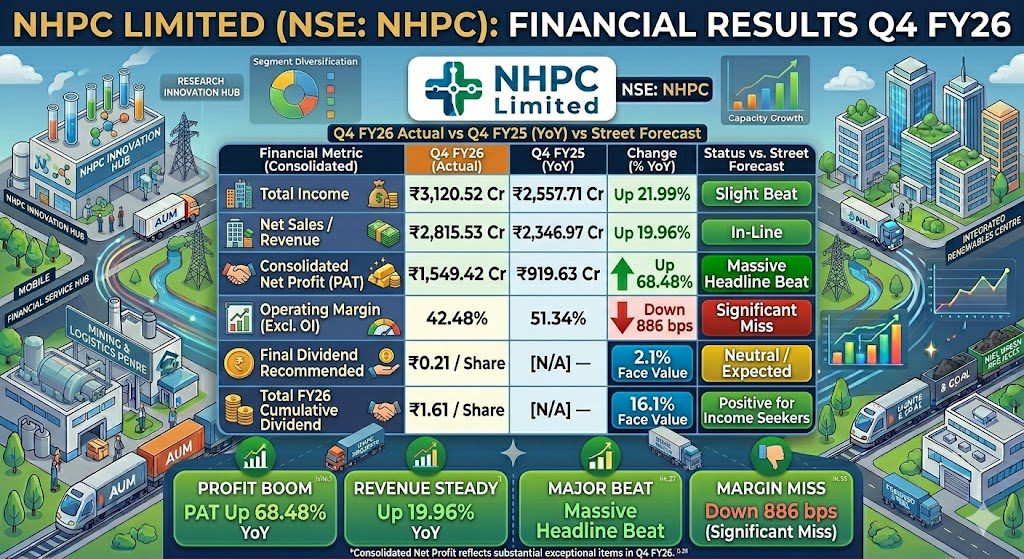
NHPC Limited reported consolidated total income of ₹3,120.52 crore in Q4 FY26 compared to ₹2,557.71 crore in the same quarter last year, reflecting nearly 22% year-on-year growth. Net sales increased around 20% to ₹2,815.53 crore.
The biggest surprise came from the bottom line. Consolidated net profit surged to ₹1,549.42 crore compared to ₹919.63 crore in Q4 FY25, representing a massive 68.48% growth. However, despite the profit jump, operating margins declined sharply from 51.34% to 42.48%.
The board also recommended a final dividend of ₹0.21 per share. Including interim dividends already distributed during FY26, total dividend payout for the year reached ₹1.61 per share, offering decent returns for income-focused investors.
Corporate Profile: India’s Hydropower Backbone
NHPC Limited remains one of India’s most strategically important renewable energy companies. As a Navratna CPSE operating under the Ministry of Power, the company has built a dominant presence in hydropower generation while gradually expanding into solar and wind energy projects.
As of May 2026, NHPC operates 31 power stations across India through its standalone operations, subsidiaries, and joint ventures. The company’s total installed capacity currently stands at 9,333 MW, making it one of the country’s largest renewable energy producers.
What gives NHPC a powerful structural advantage is its long-term Power Purchase Agreement (PPA) framework. Most of its electricity generation contracts are signed with state distribution companies for periods extending between 35 and 40 years. This provides stable and predictable regulated returns over long durations.
Hydropower also plays a uniquely important role in India’s energy ecosystem. Unlike solar and wind power, hydroelectric projects provide critical grid-balancing capabilities during peak demand periods. This gives NHPC strategic national importance as India aggressively transitions toward renewable energy infrastructure.
Earnings Analysis: The Massive Profit Jump and the Hidden Tax Story
At first glance, NHPC’s Q4 FY26 profit numbers appear extraordinarily strong. A 68% jump in consolidated profit usually signals massive operational improvement. However, a forensic examination of the financial statements tells a more nuanced story.
Revenue Growth Was Supported by Historic Capacity Expansion
The company’s revenue growth was largely driven by aggressive capacity additions during FY26. NHPC added a record 1,850 MW of clean energy capacity during the financial year — the highest annual expansion achieved since the company’s establishment.
Several major projects contributed to this milestone.
The Subansiri Lower Hydro Project continued progressing rapidly, with another 250 MW unit synchronized on May 8, 2026, increasing operational project capacity to 1,000 MW. The company also benefited from full seasonal generation recognition from the 800 MW Parbati-II hydro project, which had been commissioned earlier.
Additionally, the 300 MW Karnisar Solar Project began contributing commercial generation during the fiscal year, strengthening NHPC’s renewable diversification strategy.
The Operating Margin Warning Signal
Despite strong revenue growth, core operational profitability actually weakened significantly during the quarter.
Operating margins declined sharply from 51.34% in Q4 FY25 to 42.48% in Q4 FY26. This represents a major contraction in operational efficiency.
The primary reasons behind this pressure were rising finance costs and increasing depreciation expenses linked to newly commissioned projects. Interest expenses alone surged to ₹574.28 crore, marking the highest level seen in the last seven quarters.
More importantly, on a standalone basis, NHPC’s core operational profit before tax actually turned negative by ₹19.55 crore during the quarter.
This is the key reason experienced investors are treating the earnings report carefully despite the massive headline profit jump.
The Deferred Tax Adjustment Changed Everything
The biggest reason behind the dramatic profit surge was not operational improvement but a one-time deferred tax adjustment.
Following changes under the Finance Act, NHPC shifted toward the concessional tax regime under Section 115BAA starting next fiscal year. This allowed the company to reverse historical deferred tax liabilities worth ₹1,156.60 crore.
In simple terms, accounting adjustments related to future tax obligations significantly boosted reported net profit.
This does not mean the profit growth is fake, but it does mean investors should separate operational earnings performance from accounting-driven tax benefits while evaluating the company’s long-term profitability trends.
Dividend Analysis: Stable Returns for Income Investors
NHPC once again maintained its reputation as a stable dividend-paying PSU company.
The board recommended a final dividend of ₹0.21 per equity share with a face value of ₹10. Earlier during FY26, the company had already distributed an interim dividend of ₹1.40 per share in February 2026.
This takes the total dividend payout for FY26 to ₹1.61 per share.
For long-term investors focused on stable cash returns rather than aggressive capital appreciation, NHPC continues offering reasonable dividend visibility backed by sovereign ownership and regulated power assets.
The official AGM schedule and record date announcement are still pending, but market expectations suggest that the ex-dividend timeline may likely fall during mid-to-late August 2026.
Fundamental Analysis: Strong Renewable Energy Expansion Pipeline
Despite operational margin pressure in the current quarter, NHPC’s long-term balance sheet structure remains fundamentally stable.
The company currently has 17 large-scale projects under active development with a combined future capacity addition of 9,204 MW. If executed successfully, this pipeline could nearly double NHPC’s operational generation capacity over the next five to seven years.
This makes NHPC one of the biggest long-term beneficiaries of India’s renewable energy transition strategy.
To maintain liquidity and support future project execution, the company also approved the issuance of ₹2,000 crore worth of listed unsecured taxable bonds through private placement routes.
At current market levels near ₹76.81, NHPC’s valuation continues appearing relatively attractive considering its long-term regulated infrastructure asset base. The company’s market capitalization stands around ₹77,156 crore while the Government of India continues holding approximately 70.95% stake with zero pledged shares.
From a balance-sheet perspective, sovereign ownership and regulated revenue visibility continue offering stability even during operational volatility phases.
Technical Analysis: Key Trading Levels for Monday
The stock closed around ₹76.81 on Friday, falling more than 2% after investors analyzed the tax-driven composition of the earnings beat.
Technically, NHPC remains trapped inside a medium-term corrective structure and currently trades nearly 33% below its previous cycle highs.
The most important technical level for traders remains the ₹81.40 pivot zone. A strong daily closing above this level would be required for the stock to break out of its immediate descending wedge pattern.
Immediate resistance levels are placed near ₹78.50, ₹81.40, and ₹84.10.
On the downside, immediate support exists around ₹75.20 while the stronger historical demand zone remains between ₹72 and ₹75. Below this, the next major structural support level stands near ₹68.
The Relative Strength Index (RSI) currently hovers near 38, suggesting the stock is approaching near-oversold territory.
From a swing trading perspective, any panic-driven decline toward the ₹72–₹75 support zone may potentially create low-risk entry opportunities for a rebound toward the ₹81 resistance region.
Management Guidance and Future Strategy
Management commentary during the earnings announcement clearly indicated that NHPC is now transitioning from heavy project construction phases toward active revenue generation phases.
Large delayed projects such as Subansiri and Parbati are gradually becoming operational, which means future cash flows should increasingly shift from capital expenditure consumption toward electricity generation income.
At the same time, the company is aggressively diversifying beyond traditional hydropower generation.
Management has outlined a long-term strategy targeting a 70:30 asset mix between hydropower and pumped storage/solar energy assets by 2030. This diversification is important because it reduces long-term environmental risks associated with monsoon dependency, river flow variability, and siltation challenges.
India’s growing renewable energy demand and energy storage requirements may create major long-term opportunities for pumped storage hydro projects, where NHPC is actively strengthening its future positioning.
Brokerage Outlook and Institutional Target Prices
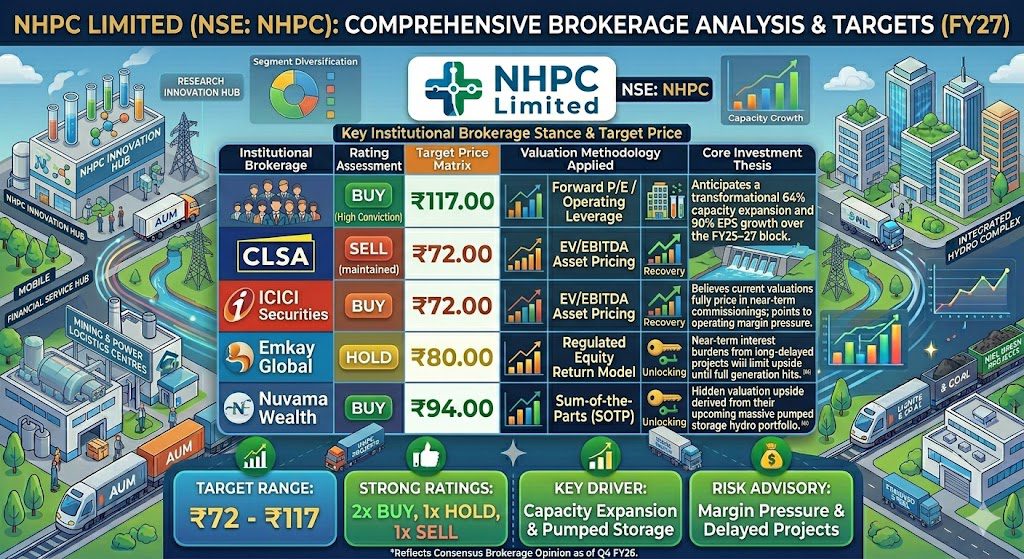
Institutional opinions on NHPC Limited currently remain sharply divided.
CLSA maintains a high-conviction BUY rating with a target price of ₹117, expecting strong operating leverage and nearly 64% capacity expansion between FY25 and FY27. The brokerage also anticipates substantial EPS growth as major projects become fully operational.
On the opposite side, ICICI Securities maintains a SELL rating with a target of ₹72, arguing that current valuations already fully reflect upcoming project commissionings while operational margin pressure remains concerning.
Emkay Global currently has a HOLD recommendation with a target price of ₹80, citing elevated interest burdens and delayed earnings normalization risks. Meanwhile, Nuvama Wealth remains bullish with a ₹94 target price based on the company’s upcoming pumped storage hydro portfolio opportunities.
Overall, consensus median target price currently stands around ₹89.57, implying nearly 16–17% upside potential from current levels if execution momentum continues improving.
Should You Buy, Hold, or Sell NHPC?
For long-term investors, the current weakness in NHPC may actually represent a strategic accumulation opportunity rather than a reason for panic.
The tax-related accounting benefit is clearly a one-time event and should not be mistaken for recurring operational growth. However, the addition of 1,850 MW of new capacity during FY26 is a real and permanent expansion of NHPC’s future income-generating asset base.
India’s renewable energy transition remains a multi-decade structural trend, and NHPC continues holding a powerful position within that ecosystem. Investors with long-term investment horizons may consider gradual accumulation in the ₹72–₹75 range.
For short-term traders, caution remains necessary. Operational weakness and margin pressure could keep the stock range-bound in the near term. Aggressive buying during sharp opening rallies may remain risky unless the stock convincingly breaks above the ₹78.50 resistance zone with strong volume support.
A disciplined approach remains essential because utility and PSU counters often witness extended consolidation phases despite positive long-term fundamentals.
For official corporate disclosures and exchange filings, investors can monitor updates through NSE India Official Website.