Introduction: NCC Faces Margin Pressure Amid India’s Massive Infrastructure Boom
India’s infrastructure sector is currently experiencing one of the largest government-led capital expenditure cycles in modern history. Massive investments in roads, urban infrastructure, railways, irrigation, water supply systems, electrical distribution, and public housing projects are creating enormous opportunities for Engineering, Procurement, and Construction (EPC) companies. Among the leading players benefiting from this long-term structural growth theme is NCC Limited, one of India’s largest diversified infrastructure companies with a strong presence across multiple critical sectors.
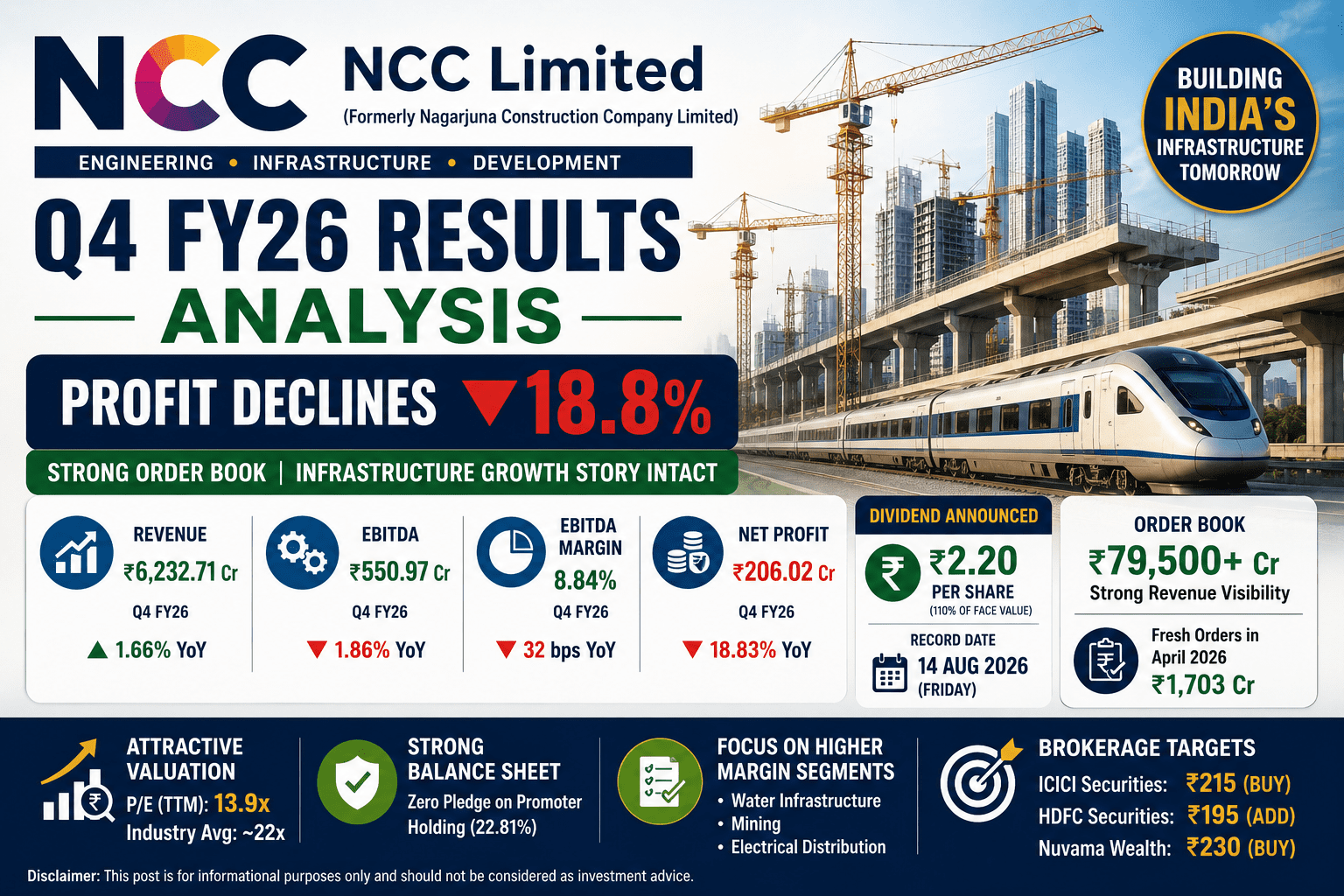
On May 15, 2026, NCC Limited announced its Q4 FY26 financial results, and the numbers presented a mixed operational picture for investors. While revenue execution remained relatively stable and project activity continued at a healthy pace, profitability came under pressure due to rising input costs and operational margin compression. The market reaction was cautious, with the stock closing at ₹160.00, down 3.72% after investors assessed the weaker profit numbers and tighter operating margins.
Despite the near-term pressure on earnings, the broader long-term investment story around NCC remains very much alive. The company continues to hold one of the largest order books in the sector, enjoys strong exposure to government infrastructure spending, and is strategically shifting toward higher-margin businesses such as water infrastructure, mining, and electrical distribution projects. Investors are therefore closely evaluating whether the recent correction in the stock price is creating a long-term buying opportunity or whether profitability challenges may continue impacting the company during FY27.
Q4 FY26 Financial Scorecard: Stable Revenue Growth but Weak Profitability
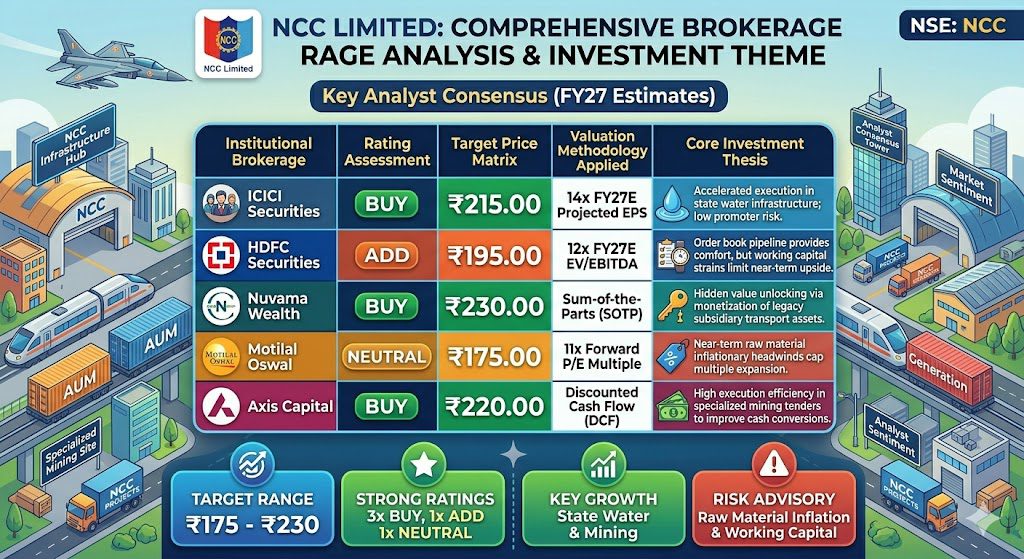
NCC Limited reported revenue from operations of ₹6,232.71 crore during the March 2026 quarter compared to ₹6,130.88 crore in Q4 FY25, reflecting modest year-on-year growth of 1.66%. Although the growth rate was not very aggressive, the revenue figure still landed near the upper range of market expectations, which were between ₹5,800 crore and ₹6,300 crore. This indicated that project execution activity remained relatively stable despite broader macroeconomic challenges affecting the construction sector.
Operating profitability, however, came under visible pressure. EBITDA declined slightly to ₹550.97 crore from ₹561.40 crore during the same period last year. More importantly, EBITDA margins slipped from 9.16% to 8.84%, highlighting the impact of rising raw material costs and lower operating leverage during the quarter. The 32 basis point decline in operating margins became one of the biggest concerns for investors and analysts after the earnings release.
Net profit after tax also declined sharply. Consolidated PAT fell by 18.83% to ₹206.02 crore compared to ₹253.82 crore in Q4 FY25. Earnings per share dropped to ₹3.38 from ₹4.15 during the same period last year. While the PAT number remained broadly within the lower end of street expectations, the decline in profitability clearly reflected operational pressure within the business.
One positive factor for shareholders was the dividend announcement. The Board recommended a final dividend of ₹2.20 per equity share for FY26, which was viewed positively because it demonstrated management confidence despite short-term profitability weakness.
Corporate Profile: NCC’s Diversified Infrastructure Business Model
NCC Limited operates as one of India’s largest diversified EPC conglomerates with a presence across multiple infrastructure sectors. The company’s business operations span buildings and housing, roads, railways, irrigation, mining, electrical transmission and distribution, water infrastructure, and urban modernization projects.
One of NCC’s biggest strengths is the diversification of its order book and operational footprint. Unlike companies that remain heavily dependent on a single infrastructure vertical, NCC has built a broad-based project portfolio that helps reduce both sector-specific and regional risks. This diversified structure provides operational stability even during periods when certain infrastructure segments face slower growth.
Over the last few years, management has strategically increased focus on water supply and environmental infrastructure projects. These segments generally offer better execution visibility and relatively healthier margins compared to highly competitive highway projects. The company has also aggressively targeted state-level modernization programs and public infrastructure contracts, helping it maintain strong order inflows despite intense competition within the EPC industry.
This diversified infrastructure model remains one of the key reasons long-term investors continue viewing NCC as a structurally strong infrastructure growth story despite temporary quarterly fluctuations.
Earnings Post-Mortem: Understanding the Revenue Stability and Margin Pressure
Revenue Growth Remained Supported by Strong Project Execution
Despite a difficult cost environment, NCC managed to maintain stable revenue growth due to healthy execution activity across several large infrastructure projects. Traditionally, the final quarter of every financial year remains one of the strongest execution periods for EPC companies because government departments and public agencies attempt to utilize budget allocations before the fiscal year closes.
The company benefited from strong billing activity across multiple projects during the quarter, including the ₹2,062.7 crore Gauhati Medical College contract and several large water grid projects. These projects helped maintain execution momentum even as some legacy infrastructure contracts faced slower progress.
The revenue performance therefore indicated that NCC’s project pipeline remains active and that the company continues maintaining strong execution capabilities despite broader challenges within the construction and infrastructure sector.
Why Profitability Declined Sharply During the Quarter
Although revenue growth remained stable, profitability came under heavy pressure because operating margins deteriorated during the quarter. EBITDA margins declined to 8.84%, which directly impacted the company’s net profit performance.
The primary reason behind this margin compression was rising input cost inflation. Elevated commercial steel prices, higher transportation expenses, and increasing logistics costs significantly affected profitability. Since infrastructure companies generally operate on relatively thin operating margins, even moderate inflation in raw material costs can create meaningful pressure on earnings.
Another important factor was the project mix executed during the quarter. Several lower-margin legacy contracts contributed significantly to revenue during Q4 FY26. These projects were originally secured during highly competitive bidding periods and therefore carried lower profitability compared to newer specialized contracts in sectors such as mining and water infrastructure.
The market largely interpreted the weaker profitability numbers as a temporary operational challenge rather than a structural breakdown in the company’s business model.
Shareholders’ Reward: NCC Dividend Details for FY26
Despite the pressure on earnings, NCC continued rewarding shareholders through dividend payouts. The company’s Board recommended a final dividend of ₹2.20 per equity share, representing 110% of the ₹2 face value.
The official record date for determining shareholder eligibility has been fixed as Friday, August 14, 2026. Investors holding NCC shares before the record date will qualify for the dividend payout.
The dividend announcement is particularly important because it reflects management’s confidence in the company’s long-term cash flow generation capability despite temporary operational headwinds. Dividend-paying infrastructure companies generally attract long-term investors seeking stable income generation along with capital appreciation potential.
Fundamental Analysis: Strong Order Book and Attractive Valuation Support Long-Term Story
Massive Order Book Creates Strong Revenue Visibility
One of the strongest aspects of NCC’s investment thesis remains its enormous order book visibility. The company currently holds an order backlog exceeding ₹79,500 crore, which provides revenue visibility equivalent to nearly 3.2 times its trailing annual revenue.
Such a large order book significantly reduces business uncertainty because a major portion of future revenue growth is already secured through existing contracts. Infrastructure companies with strong order pipelines typically enjoy higher investor confidence because revenue visibility becomes more predictable.
The momentum in new order inflows also remains healthy. NCC secured fresh domestic orders worth ₹1,703 crore during April 2026 alone, demonstrating that demand for infrastructure execution services continues to remain strong.
As India continues increasing spending across infrastructure sectors such as water supply, public healthcare, railways, power distribution, and urban modernization, NCC remains strategically positioned to benefit from long-term government capex expansion.
Valuation Appears Attractive After the Recent Correction
Following a correction of nearly 34% from its 52-week high of ₹242.15, NCC’s market capitalization currently stands near ₹10,002 crore.
At current levels, the stock trades at a trailing Price-to-Earnings multiple of approximately 13.9x, which appears relatively attractive compared to the broader capital goods sector average of nearly 22x.
This valuation discount creates a meaningful margin of safety for long-term investors. If operating margins gradually recover and execution momentum remains strong during FY27, the stock could witness valuation re-rating over the medium term.
Balance Sheet Quality Remains Stable
Another positive factor for investors is the stability of the company’s balance sheet. Promoters have maintained zero pledge on their 22.81% shareholding throughout FY26, which strengthens investor confidence regarding financial discipline and governance quality.
Debt levels also remain relatively manageable, although working capital cycles have stretched marginally due to delayed payments associated with public-sector infrastructure projects. However, such working capital pressure remains relatively common across the EPC industry.
Technical Analysis: Key Trading Levels for the Upcoming Week
From a technical perspective, NCC currently remains under short-term pressure following the earnings announcement. The stock closed at ₹160.00 after declining 3.72%, reflecting cautious market sentiment due to weaker profitability numbers.
The most important pivot level for the stock currently stands near ₹170.13. The stock needs to decisively cross and sustain above this level to invalidate the present short-term bearish bias.
Immediate resistance levels remain positioned near ₹165.80, ₹171.50, and ₹174.30, while important support zones remain near ₹159.25, ₹155.00, and the major structural support near ₹130.00.
If the stock breaks below ₹159.25 during the next few trading sessions, it could potentially test the ₹155 support zone quickly. However, strong institutional buying near these levels may also trigger a technical rebound toward the ₹165 range.
For short-term traders, waiting for confirmation of price stabilization may remain the safer strategy before initiating aggressive long positions.
Management Guidance and FY27 Outlook
Although Q4 FY26 reflected operational pressure, management’s long-term growth outlook remains constructive. NCC continues targeting annual revenue growth of approximately 10% to 11% over the next two financial years, supported primarily by execution of newly secured infrastructure contracts.
Management is increasingly prioritizing sectors such as water infrastructure, medical infrastructure, mining, and electrical distribution projects. These segments generally offer better operating margins and lower competitive intensity compared to traditional road construction projects.
The company also indicated that it is gradually reducing aggressive participation in low-margin highway bidding. Instead, management is focusing on specialized infrastructure businesses where profitability remains structurally stronger.
This strategic realignment could gradually support margin recovery during FY27 and beyond.
Institutional Radar: Brokerage Targets and Analyst Sentiment
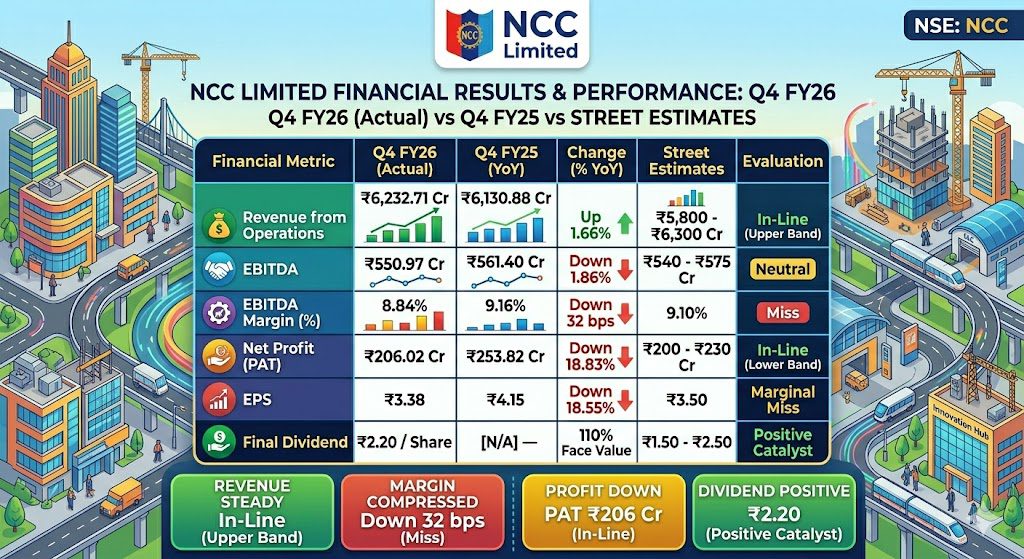
Most institutional research houses continue maintaining a positive long-term view on NCC despite the weak quarterly profitability numbers.
ICICI Securities currently maintains a BUY rating with a target price of ₹215, citing strong execution in water infrastructure and relatively low promoter risk.
HDFC Securities maintains an ADD rating with a target price of ₹195 while acknowledging that working capital stress may limit near-term upside.
Nuvama Wealth remains bullish with a target price of ₹230, highlighting potential value unlocking from legacy subsidiary asset monetization.
The broader institutional consensus currently tracks a median target price near ₹199.91, implying potential upside of nearly 25% from current market levels.
The Veteran’s Verdict: Buy, Hold, or Sell?
From a long-term investment perspective, the structural growth story surrounding NCC Limited remains largely intact. Temporary margin compression caused by inflationary pressures does not fundamentally alter the company’s strong order book visibility, diversified business model, or long-term infrastructure growth opportunities.
For long-term value investors, the current correction toward the ₹150–₹160 zone may therefore represent an attractive accumulation opportunity with a 12–18 month investment horizon.
For short-term swing traders, however, caution remains important. The weaker earnings report has created temporary bearish sentiment, and aggressive buying before technical stabilization may remain risky. Traders should ideally wait for confirmation of support formation before entering fresh bullish positions.
Conclusion: NCC’s Long-Term Infrastructure Opportunity Remains Strong
NCC Limited’s Q4 FY26 earnings reflected a classic infrastructure sector challenge — stable execution growth combined with temporary profitability pressure caused by rising input costs and operational margin compression.
While net profit declined nearly 19%, the company’s massive order book, diversified project portfolio, stable revenue performance, and attractive valuations continue supporting the broader long-term investment thesis.
India’s infrastructure capex cycle remains one of the strongest long-term economic themes in the country, and NCC continues to remain deeply positioned within this structural growth opportunity.
The biggest question for investors now is simple — does the current correction create a long-term buying opportunity, or will operating margin pressure continue weighing on the stock during FY27?