Scope Outline
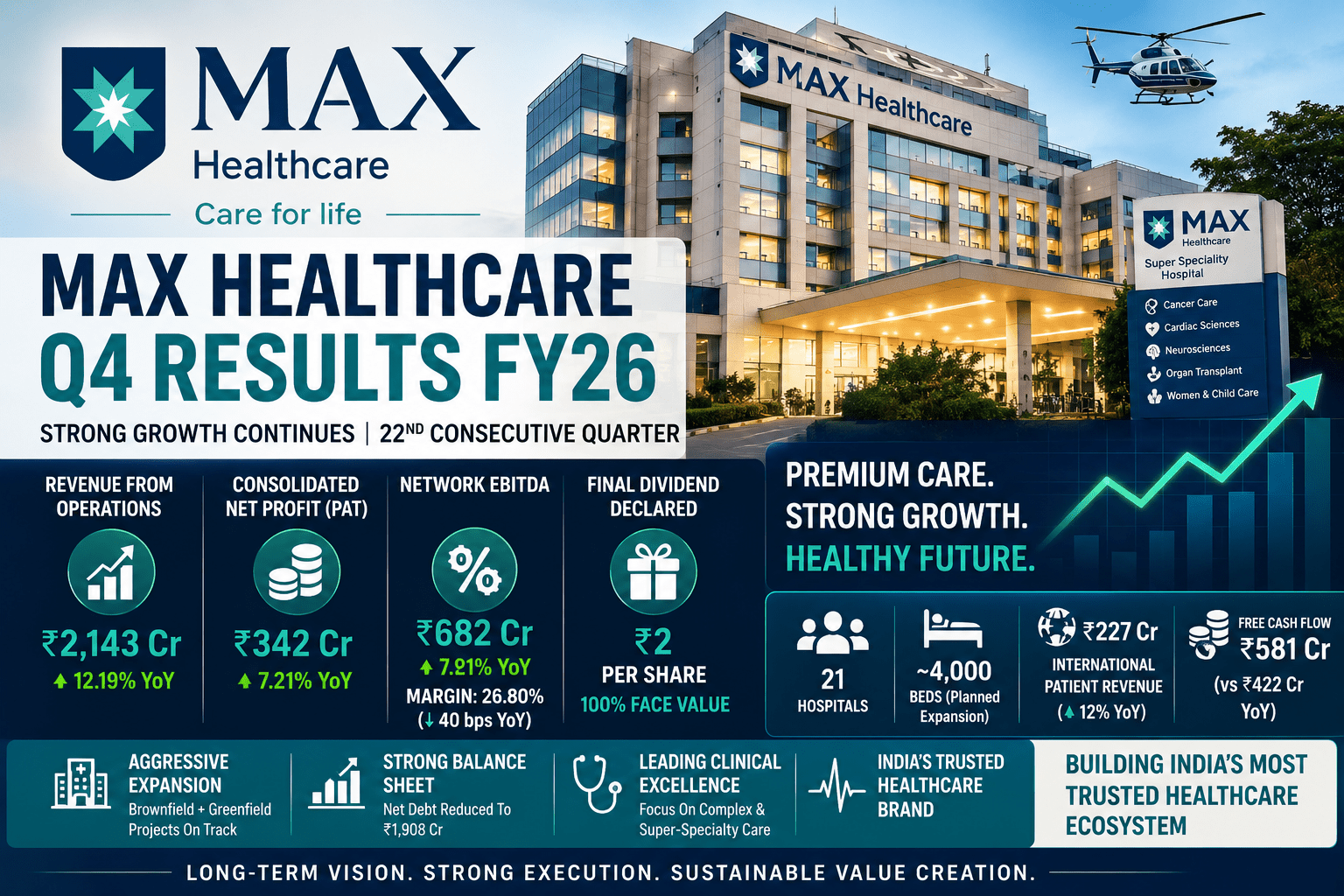
Max Healthcare Institute Limited announced its Q4 FY26 financial results on May 21, 2026, and once again demonstrated why India’s premium healthcare sector continues attracting strong institutional confidence even during volatile market conditions. The company delivered its 22nd consecutive quarter of year-on-year growth, supported by rising medical tourism demand, strong Occupied Bed Day growth, and resilient premium healthcare pricing across key metro markets.
Although the headline earnings remained healthy, the market reaction was initially mixed because of slight EBITDA margin compression caused by aggressive hiring of top clinical talent ahead of the company’s massive hospital-expansion pipeline. However, long-term investors largely interpreted this margin pressure as a strategic investment into future growth capacity rather than a structural operational weakness.
The company reported double-digit revenue growth, maintained industry-leading Average Revenue Per Occupied Bed metrics, strengthened free-cash-flow generation, and surprised shareholders positively with a ₹2 final dividend announcement. For long-term investors, the latest quarter reinforced Max Healthcare’s position as one of India’s strongest structural healthcare compounders. For short-term traders, the stock now appears to be approaching an important technical breakout zone after months of healthy consolidation.
Max Healthcare Q4 FY26 Financial Performance Snapshot
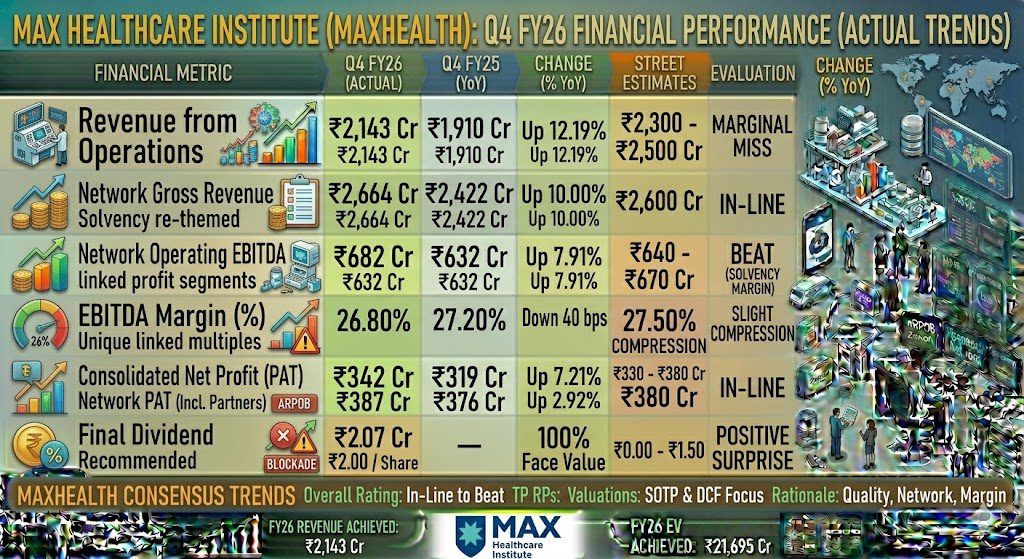
Max Healthcare Institute Limited reported revenue from operations of ₹2,143 crore during Q4 FY26 compared to ₹1,910 crore during the same quarter last year, reflecting strong year-on-year growth of approximately 12.19%. Although the revenue growth remained healthy, the number marginally missed aggressive Street estimates ranging between ₹2,300 crore and ₹2,500 crore.
Network Gross Revenue increased to ₹2,664 crore compared to ₹2,422 crore during Q4 FY25, reflecting growth of nearly 10%. Meanwhile, Network Operating EBITDA increased to ₹682 crore compared to ₹632 crore during the previous year, representing healthy operational growth of approximately 7.91%.
However, EBITDA margins compressed slightly to 26.8% from 27.2% during Q4 FY25. This modest margin decline became one of the most discussed aspects of the earnings report because investors closely monitor profitability trends within premium hospital operators.
Consolidated net profit after tax increased to ₹342 crore compared to ₹319 crore during the previous year, reflecting growth of approximately 7.21%. Network PAT including partner hospitals also improved to ₹387 crore compared to ₹376 crore during the previous year.
The Board additionally recommended a final dividend of ₹2 per equity share, which came as a positive surprise because several analysts were expecting either a lower payout or no dividend announcement at all.
Despite temporary margin compression, the broader earnings report strongly reinforced the company’s healthy operational momentum and premium healthcare positioning.
Understanding Max Healthcare’s Structural Competitive Advantage
Max Healthcare Institute Limited has gradually evolved into one of India’s most dominant premium tertiary and quaternary healthcare providers. The company currently operates 21 advanced healthcare facilities strategically concentrated across high-income healthcare micro-markets such as Delhi-NCR and Mumbai while steadily expanding into important Tier-1 cities including Mohali, Nagpur, Lucknow, and Bhubaneswar.
Unlike many hospital operators that compete mainly through patient volume, Max Healthcare focuses heavily on high-complexity super-specialty healthcare segments including oncology, organ transplantation, advanced cardiac sciences, and neurosciences. This strategy allows the company to command exceptionally strong pricing power and maintain industry-leading Average Revenue Per Occupied Bed metrics.
During Q4 FY26, ARPOB remained stable near ₹77,900, which continues ranking among the highest within India’s listed hospital sector. This premium positioning creates a major structural advantage because high-end healthcare demand generally remains less sensitive to broader economic slowdowns.
Another major long-term growth driver for the company is international medical tourism. International patient revenue increased approximately 12% year-on-year to ₹227 crore during Q4 FY26 and now contributes nearly 9% of total network hospital billing.
India’s premium healthcare industry continues benefiting from rising inflows of international patients seeking advanced treatment at costs significantly lower than Western healthcare systems. Max Healthcare remains strategically positioned to benefit from this trend because of its strong reputation in complex medical procedures and premium patient care standards.
Earnings Analysis: Why Margins Compressed Despite Strong Revenue Growth
The biggest concern inside Max Healthcare’s Q4 FY26 earnings report was the slight compression in EBITDA margins. Network operating margins declined from 27.2% to 26.8%.
However, the underlying reason behind the decline appears strategic rather than operationally negative.
Management aggressively increased hiring across key clinical specialties to support future hospital expansions and upcoming capacity additions. Clinician costs reportedly increased by approximately 230 basis points year-on-year and 120 basis points sequentially.
Instead of viewing this as a weakness, most institutional analysts interpreted the increase as a long-term investment into future operating leverage. As newer hospitals stabilize and occupancy improves over the next several quarters, these upfront staffing costs could eventually translate into stronger profitability.
Another important operational indicator remained highly encouraging. The company reported approximately 8% growth in Occupied Bed Days during the quarter.
This metric remains critically important because healthy bed occupancy growth directly reflects rising patient inflow, stronger utilization efficiency, and improving operational scalability.
Combined with stable ARPOB levels, the strong Occupied Bed Day growth clearly reinforced Max Healthcare’s dominance within India’s premium hospital ecosystem.
Dividend Announcement Strengthened Investor Confidence
One of the biggest positive surprises from the board meeting was the recommendation of a ₹2 final dividend for FY26.
The payout represented 100% of face value and exceeded most Street expectations.
The official dividend record date is expected to be finalized during the company’s upcoming Annual General Meeting.
For long-term investors, the dividend announcement reinforced management confidence regarding free-cash-flow generation, liquidity strength, and long-term balance-sheet stability.
The ability to maintain shareholder payouts while simultaneously funding aggressive hospital-expansion projects significantly strengthens investor confidence in the company’s capital-allocation discipline.
Fundamental Analysis: Why Max Healthcare Remains a Strong Long-Term Compounder
One of the strongest long-term growth drivers for Max Healthcare Institute Limited remains its aggressive but highly efficient expansion strategy.
The company continues executing a brownfield-heavy hospital-expansion pipeline across Mohali, Mumbai, and Delhi. This phased rollout is expected to add nearly 20% fresh capacity over the coming years.
Additionally, the upcoming Gurgaon greenfield facility is expected to contribute another 10% expansion by the end of calendar year 2026.
This expansion strategy remains extremely important because India continues facing a severe shortage of premium tertiary-care healthcare infrastructure relative to rising long-term healthcare demand.
Another major positive inside the earnings report was the sharp improvement in free-cash-flow generation.
Free cash flow increased to ₹581 crore compared to ₹422 crore during the previous fiscal year’s corresponding quarter.
This strong liquidity generation helped reduce consolidated net debt to ₹1,908 crore compared to ₹2,166 crore sequentially.
The improving debt profile significantly strengthens the company’s long-term financial flexibility and expansion capacity.
At current market prices near ₹1,091.55, Max Healthcare trades at a trailing Price-to-Earnings multiple near 88x–90x.
While this valuation initially appears expensive, institutional investors continue justifying the premium because of the company’s industry-leading EBITDA-per-bed metrics, premium healthcare positioning, strong return ratios, and long-term growth visibility.
Additionally, the company’s digital healthcare ecosystem continues scaling rapidly. Max Lab reportedly grew approximately 14% year-on-year to ₹52 crore while Max@Home expanded nearly 30% year-on-year to ₹73 crore.
These adjacent healthcare businesses could gradually emerge as important long-term growth engines.
Technical Analysis: Key Trading Levels Investors Must Watch
Following the earnings announcement, Max Healthcare shares closed near ₹1,091.55, gaining approximately 1.42% intraday.
Technically, the stock now appears to be consolidating after correcting from its 52-week high near ₹1,314.30.
The broader chart structure resembles a tightly coiled consolidation pattern that could potentially trigger a strong directional breakout over the coming weeks.
The most important technical pivot currently remains near ₹1,099.
A decisive daily close above this level could invalidate short-term bearish structures and potentially trigger fresh momentum buying activity.
On the upside, important resistance levels remain near ₹1,122, ₹1,144, and eventually the broader breakout zone near ₹1,180.
On the downside, critical support levels remain near ₹1,037, ₹985, and the major long-term accumulation zone near ₹903.
For swing traders, sustained movement above ₹1,099 supported by strong institutional volume could create attractive momentum opportunities toward the ₹1,144 region.
Management Guidance & Long-Term Expansion Outlook
Management maintained a highly constructive long-term outlook during the post-results earnings interaction.
Chairman and Managing Director Abhay Soi confirmed that the company remains on track to add nearly 4,000 additional beds over the coming fiscal years.
This aggressive expansion strategy clearly reflects management confidence regarding long-term healthcare demand growth within India.
The company also continues scaling its asset-light diagnostics ecosystem aggressively.
Management expects Max Lab to maintain annual growth rates exceeding 20% as the company expands deeper into non-captive retail diagnostics markets.
This strategy remains strategically important because diagnostics businesses generally generate high-margin recurring revenue without requiring capital-intensive hospital infrastructure investments.
Institutional View: Brokerage Ratings & Target Prices
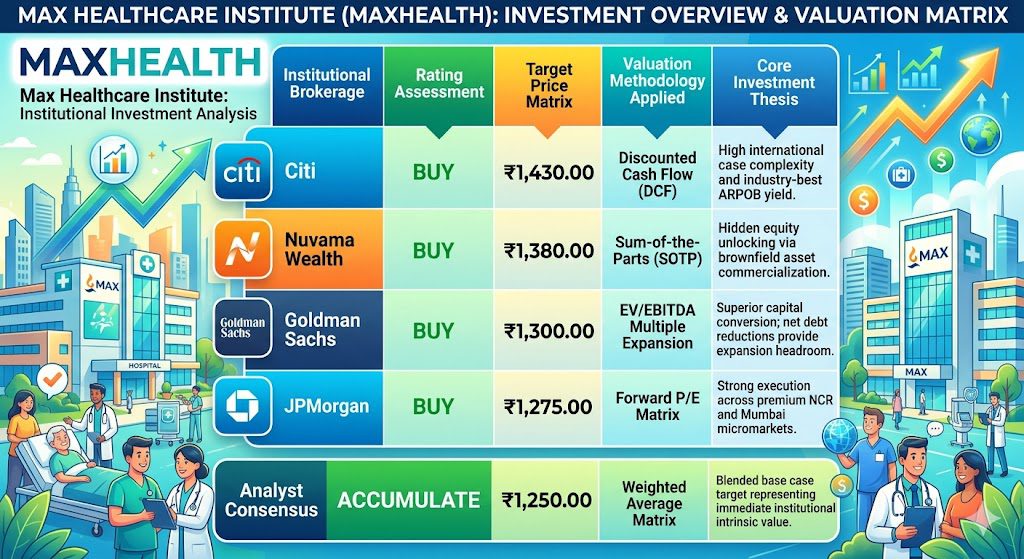
Institutional research firms remained strongly bullish following Max Healthcare’s earnings announcement.
Citigroup Inc. maintained a BUY recommendation with a target price of ₹1,430, highlighting strong international patient growth and industry-leading ARPOB metrics.
Nuvama Wealth Management retained a BUY recommendation with a target price of ₹1,380 because of hidden value creation through brownfield expansion monetization.
Goldman Sachs maintained a BUY recommendation with a target price of ₹1,300 due to improving capital conversion and falling debt levels.
JPMorgan Chase & Co. retained a BUY recommendation with a target price of ₹1,275, citing strong execution across premium NCR and Mumbai healthcare markets.
The broader institutional consensus target currently stands near ₹1,250, implying potential upside of approximately 15% from current market prices.
Final Verdict: Buy, Hold, or Sell?
For long-term investors, Max Healthcare Institute Limited continues looking like one of India’s strongest structural healthcare compounders.
The slight EBITDA margin compression should not be interpreted negatively because it primarily reflects strategic investment into clinical talent and future expansion capacity.
The broader long-term investment thesis remains supported by rising premium healthcare demand, strong medical-tourism growth, stable ARPOB pricing power, falling debt levels, and a massive capacity-expansion pipeline.
For short-term traders, the stock currently remains inside an important consolidation structure.
Aggressive trading positions may become more attractive only after a decisive breakout above ₹1,099 supported by strong institutional volume participation.
Overall, Max Healthcare’s Q4 FY26 results once again reinforced the company’s reputation as one of India’s highest-quality premium healthcare franchises with strong long-term growth visibility and improving shareholder value creation.