Scope Outline
Introduction: The “New-Age” FMCG Giant
If you step back and look at how India’s FMCG sector has evolved over the past three decades, you’ll notice that very few companies have successfully transitioned from being commodity-driven to becoming premium, growth-oriented businesses. Marico is now clearly moving in that direction. What started as a brand synonymous with Parachute coconut oil has transformed into a diversified consumer company with strong presence in foods, premium personal care, and digital-first brands. The Q4 FY26 results highlight this transition in a very visible way. With revenue growing at its fastest pace in 14 years and the stock reacting positively around ₹807 levels, Marico is no longer just a defensive FMCG play—it is becoming a growth-driven story backed by evolving consumer trends in both urban and rural India.
Q4 FY26 Financial Scorecard: The Actual Numbers
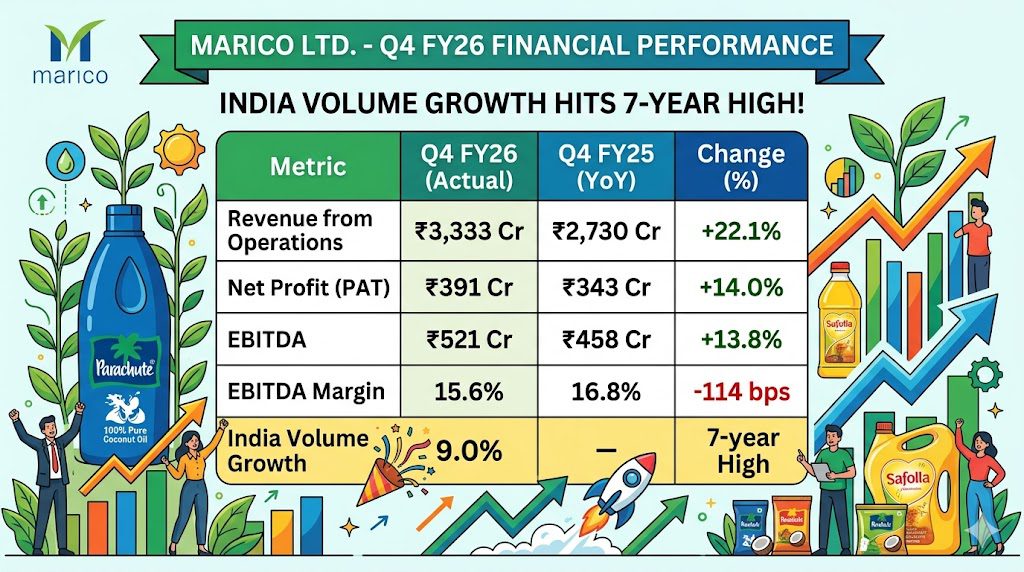
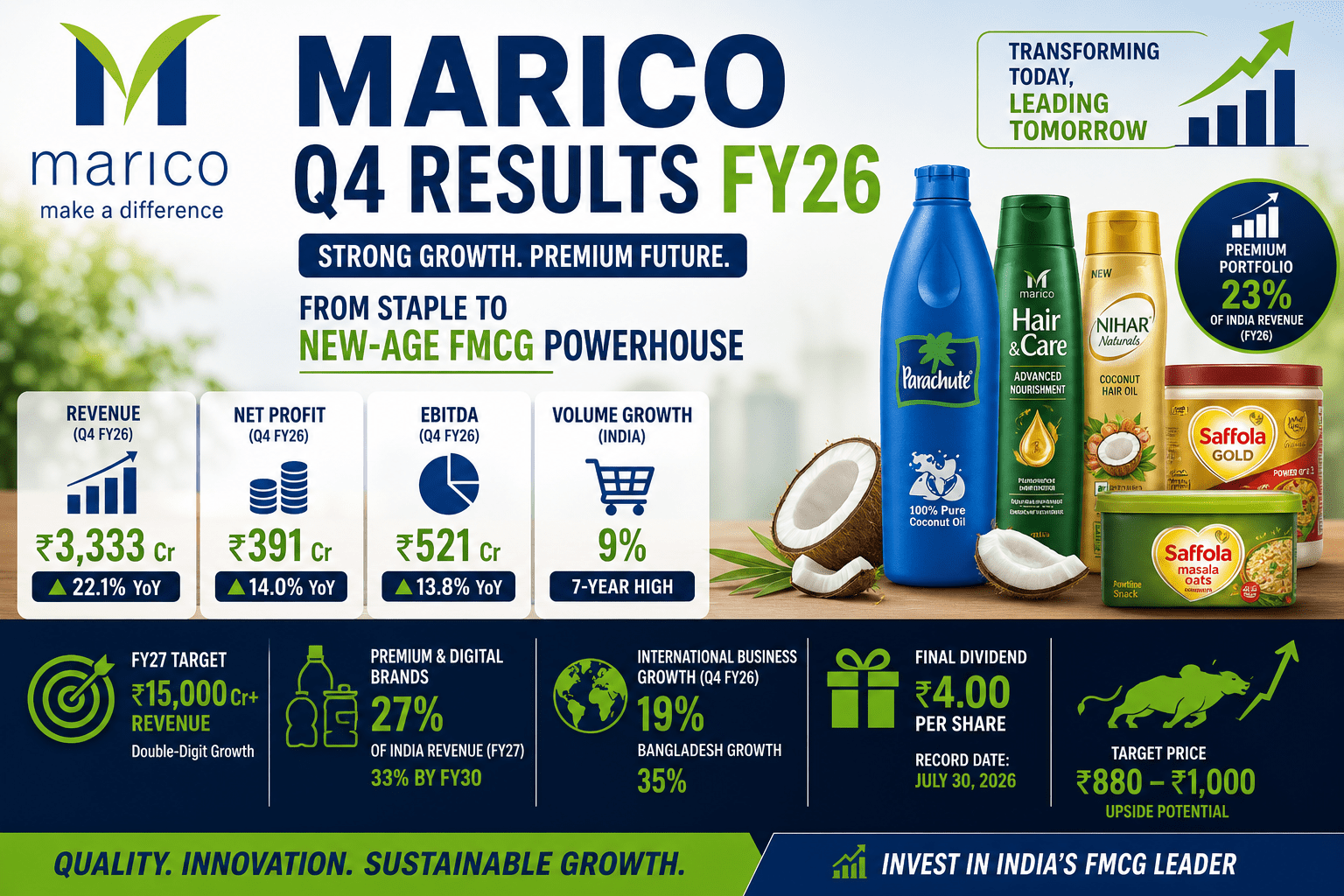
Marico’s Q4 FY26 performance reflects a company that is delivering strong growth despite operating in a challenging cost environment. Revenue from operations stood at ₹3,333 crore, showing a 22.1% increase over ₹2,730 crore in the same quarter last year. This kind of growth is significant for an FMCG company, where double-digit expansion is often considered strong. Net profit came in at ₹391 crore, up 14% from ₹343 crore, indicating steady earnings growth. EBITDA rose to ₹521 crore from ₹458 crore, registering a 13.8% increase. However, EBITDA margins declined slightly to 15.6% from 16.8%, reflecting higher raw material costs and continued investments in new categories. The standout metric remains India volume growth of 9%, which is the highest in seven years and a clear signal of strong demand recovery across markets.
Fundamental Analysis: Diversification Beyond Coconut Oil
Volume Supremacy
The 9% volume growth achieved by Marico in Q4 FY26 is a critical indicator of demand strength. In the FMCG sector, volume growth is more important than price-led growth because it reflects actual consumption trends. This strong performance suggests that both rural and urban demand are improving, supported by better distribution, product innovation, and brand strength. It also indicates that Marico is gaining market share in key categories, reinforcing its competitive position.
Segment Performance
Marico’s core brand Parachute delivered an impressive 29% revenue growth, demonstrating that even legacy products can continue to perform strongly with the right pricing and distribution strategies. The international business also stood out, growing 19% in constant currency terms, with Bangladesh leading the way at 35% growth. This highlights the strength of Marico’s global operations and its ability to tap into emerging markets. The Foods segment has crossed the ₹1,000 crore revenue mark in FY26, marking a major milestone and establishing it as a key growth driver. Additionally, premium personal care and digital-first brands now contribute 23% of India’s revenue, reflecting a successful shift toward higher-margin categories.
Margin Analysis
While revenue growth has been strong, margins have seen some pressure due to rising input costs, particularly in key raw materials like copra. EBITDA margins declined to 15.6% from 16.8%, which is a short-term concern but not a structural issue. The company is also investing heavily in premium and digital segments, which impacts margins in the near term but is expected to drive higher profitability in the long run. As input costs stabilize and premium products gain a larger share, margins are likely to improve.
Technical Analysis: The Breakout Above Support
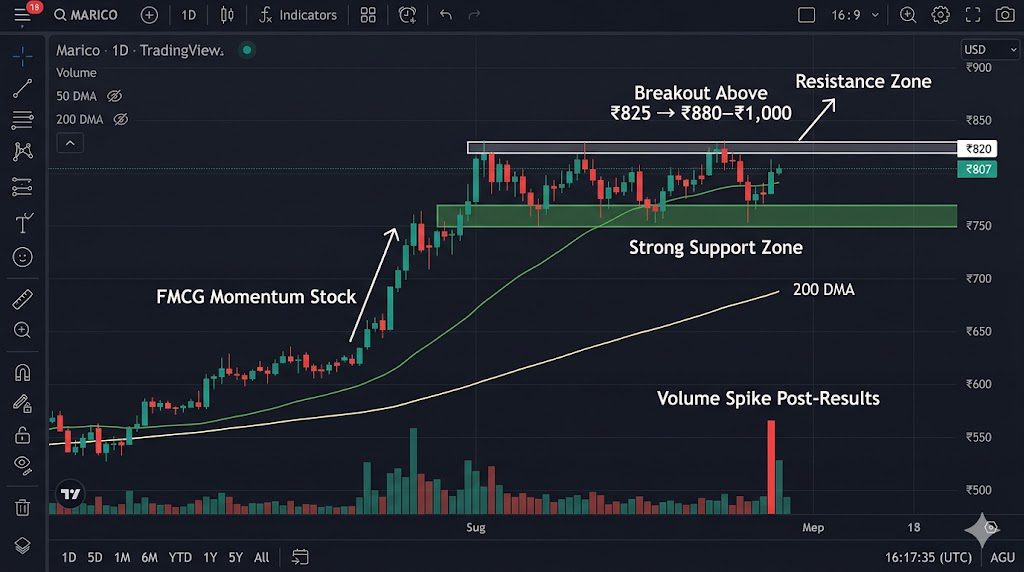
From a technical perspective, Marico’s stock has shown strong bullish momentum following its Q4 results. The stock has rallied sharply from around ₹580 in early April to ₹807, indicating strong investor interest. The ₹760 level, which was previously a resistance zone, now acts as a strong support and is expected to hold during any short-term corrections. On the upside, ₹825 is the immediate resistance level, and a breakout above this could lead to further gains. The overall trend remains positive, supported by strong fundamentals and improving sentiment. However, after such a sharp rally, some consolidation is likely before the next upward move.
Management Guidance: The Vision for FY27
The ₹15,000 Crore Target
Marico’s management has set a clear goal of crossing ₹15,000 crore in revenue in FY27, supported by double-digit growth. This target reflects confidence in sustained demand across categories and geographies. The company’s focus on innovation, distribution expansion, and premiumization is expected to drive this growth.
Diversification Goal
The company aims to increase the contribution of premium and digital-first brands from 23% in FY26 to 27% in FY27 and eventually to 33% by FY30. This shift is crucial for improving margins and reducing dependence on commodity-based products. By focusing on higher-value categories, Marico is positioning itself for long-term profitability and growth.
Profitability Outlook
Marico expects high-teen EBITDA growth in FY27, supported by a significant correction in copra prices, which have fallen by around 35% from their peak levels. Lower input costs combined with a higher share of premium products are likely to drive margin expansion, improving overall profitability in the coming quarters.
Brokerage Sentiment & Targets (The Path to ₹1,000)
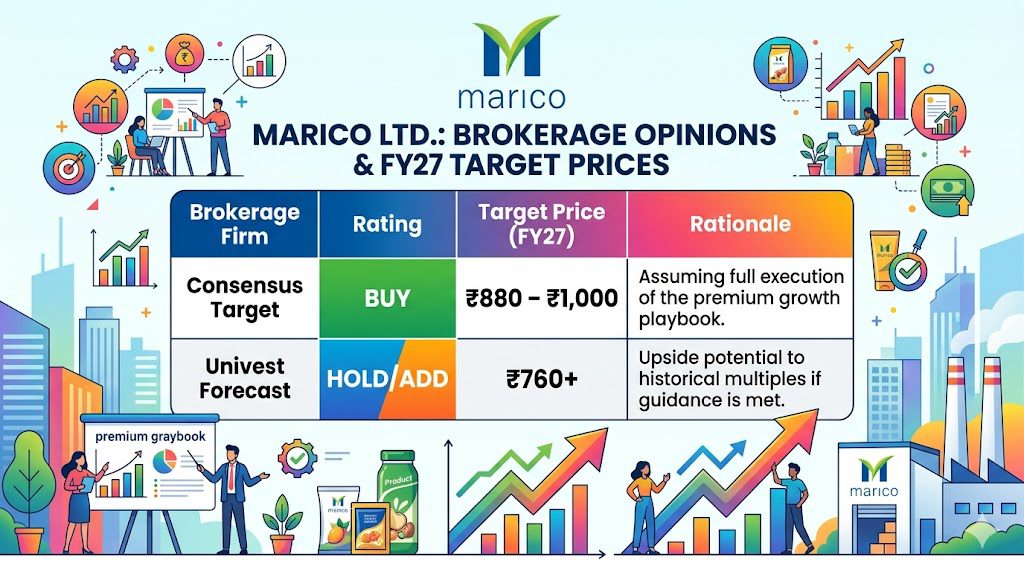
Brokerage sentiment around Marico remains positive, with most analysts maintaining a “Buy” rating. Target prices range between ₹880 and ₹1,000, reflecting confidence in the company’s growth strategy and execution. These targets are based on expectations of continued volume growth, margin improvement, and successful expansion of premium categories. While some concerns remain around valuation and execution risks, the overall outlook suggests strong upside potential.
Dividend & Shareholder Value
Marico continues to reward its shareholders through consistent dividend payouts. The company has announced a final dividend of ₹4 per share for FY26, reflecting strong cash flow generation. The record date is July 30, 2026, with the payout expected by September 5, 2026. This steady dividend policy makes Marico an attractive option for investors seeking both income and growth.
The “30-Year” Analyst Verdict
From a long-term perspective, Marico is undergoing a structural transformation. It is moving away from being a commodity-driven business to becoming a premium, diversified FMCG company. This shift is essential for sustaining growth in a competitive market. For investors, Marico offers a balanced opportunity combining steady earnings, improving margins, and long-term growth potential. For traders, the stock’s current momentum and clear technical levels provide opportunities for short-term gains.
Conclusion & Engagement (CTA)
Marico’s Q4 FY26 results highlight a company that is evolving with changing consumer preferences. With strong revenue growth, robust volume expansion, and a clear focus on premiumization, the company is well-positioned for the future. The transition toward higher-margin categories and digital brands is likely to drive long-term value creation. The key question for investors now is whether to view Marico as a growth story or a stable FMCG investment. Your perspective on this shift could shape your investment strategy in the coming years.