India’s fast-growing omnichannel eyewear giant Lenskart Solutions Limited delivered one of the most closely watched earnings reports of the quarter after announcing its Q4 FY26 and full-year results on May 20, 2026. The company reported explosive revenue growth, strong margin expansion, and continued operational scaling, although headline net profit numbers initially created confusion among investors. At first glance, the quarterly results appeared mixed because revenue surged sharply while reported profit declined slightly. However, deeper analysis clearly shows that the operational strength of the business remains exceptionally powerful and that the decline in reported profit was largely caused by accounting adjustments linked to last year’s exceptional gains.
The earnings report reinforced the broader market belief that Lenskart is rapidly transforming into one of India’s strongest consumer-retail technology companies. The company is no longer viewed merely as an eyewear retailer. Instead, investors increasingly see it as a scalable omnichannel platform combining technology, manufacturing, digital commerce, healthcare services, premium retailing, and international expansion into one integrated ecosystem. Strong same-store-sales growth, rising premium-product contribution, expanding operating margins, and improving capital efficiency collectively strengthened institutional confidence around the long-term growth story.
For long-term investors, the latest quarterly results confirmed that the company’s structural growth momentum remains intact. For traders, the stock continues attracting significant interest because of its high-growth profile, strong listing momentum, and aggressive expansion strategy.
Lenskart Q4 FY26 Financial Performance Snapshot
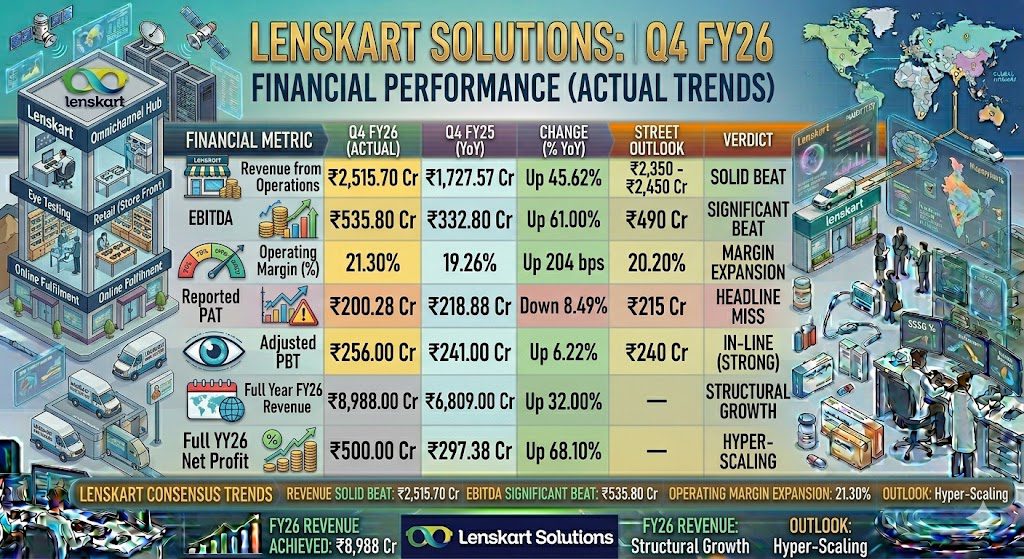
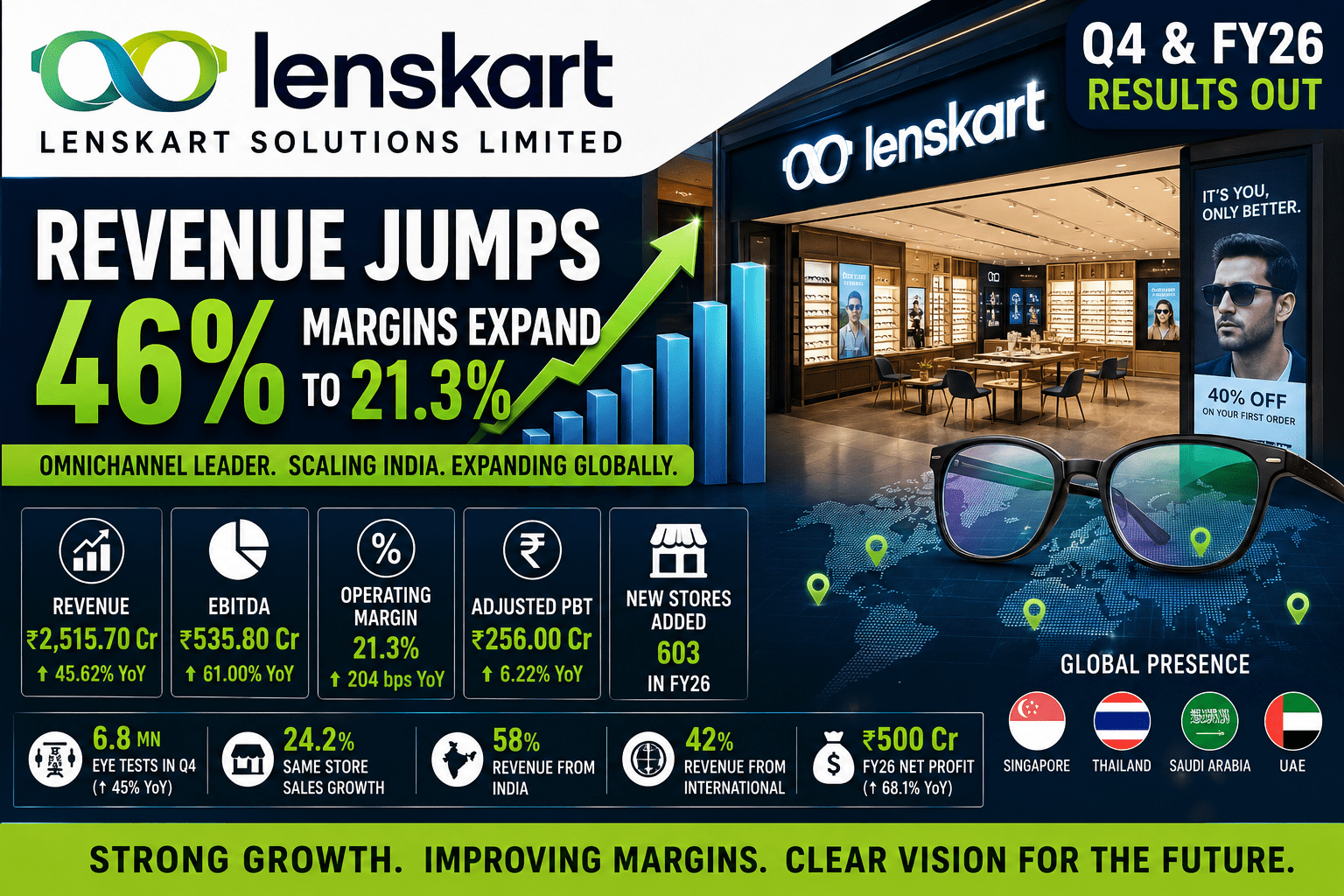
Lenskart Solutions Limited reported revenue from operations of ₹2,515.70 crore during Q4 FY26 compared to ₹1,727.57 crore in the corresponding quarter last year, registering massive year-on-year growth of 45.62%. The revenue performance comfortably exceeded most analyst expectations and became one of the strongest retail-consumption earnings beats of the season. The company’s ability to maintain such strong growth despite rising competitive intensity clearly demonstrates the strength of its brand positioning and omnichannel business model.
EBITDA increased sharply to ₹535.80 crore compared to ₹332.80 crore during Q4 FY25, reflecting exceptional growth of 61%. Operating EBITDA margins also improved significantly to 21.3% from 19.26% last year, representing an expansion of 204 basis points. The margin improvement became one of the biggest highlights of the quarter because it clearly showed that the company is benefiting from better operational leverage, lower customer acquisition costs, and stronger premium-product contribution.
Reported net profit after tax stood at ₹200.28 crore compared to ₹218.88 crore during Q4 FY25, reflecting a decline of 8.49%. However, this headline decline does not accurately represent the company’s true operational performance because the previous year’s quarter included a one-time exceptional goodwill-related gain worth ₹167 crore. Adjusted Profit Before Tax actually increased to ₹256 crore compared to ₹241 crore last year, indicating that the underlying business remains fundamentally strong.
On a full-year basis, FY26 revenue increased sharply to ₹8,988 crore compared to ₹6,809 crore during FY25, registering annual growth of 32%. Even more importantly, full-year net profit surged to ₹500 crore compared to ₹297.38 crore last year, reflecting explosive growth of 68.1%. These numbers strongly reinforce the view that Lenskart is now entering a hyper-scaling phase within India’s organized retail ecosystem.
Corporate Profile: The Vertically Integrated Retail Disruptor
Lenskart Is Far More Than a Traditional Eyewear Retailer
Lenskart Solutions Limited operates a highly integrated direct-to-consumer ecosystem that combines manufacturing, logistics, digital commerce, technology, eye-care services, and retail distribution into one scalable business model. Unlike traditional optical retailers that rely heavily on fragmented third-party supply chains, Lenskart controls a major portion of its production infrastructure through its advanced manufacturing facilities, including its mega-factory in Bhiwadi, Rajasthan.
This vertically integrated structure allows the company to maintain tighter quality control, faster product development cycles, superior inventory optimization, and stronger pricing flexibility. It also significantly improves operating efficiency and long-term profitability.
The company’s omnichannel ecosystem integrates online ordering, AI-driven eyewear recommendations, home eye-checkup services, app-based shopping, and physical retail stores into one unified customer experience. This integrated structure has become one of the company’s strongest competitive advantages because it improves both customer acquisition and repeat purchase behavior.
International Expansion Is Becoming a Powerful Growth Engine
Although India remains the company’s largest revenue contributor, international operations are rapidly becoming an increasingly important growth driver. Currently, approximately 58% of total revenue comes from India, while the remaining 42% originates from overseas markets such as Singapore, Thailand, Saudi Arabia, and the UAE.
The company’s aggressive international expansion strategy is strategically important because several global markets still remain underpenetrated in organized eyewear retailing. This creates substantial long-term growth opportunities while also helping diversify the company’s revenue base beyond India.
Earnings Post-Mortem: Why Did Reported PAT Decline?
The Headline Profit Decline Was Largely Accounting Driven
The biggest confusion surrounding the Q4 FY26 results came from the reported decline in quarterly net profit. At first glance, net profit fell 8.49% year-on-year to ₹200.28 crore compared to ₹218.88 crore during Q4 FY25. Naturally, many short-term market participants initially interpreted this as a sign of weakening profitability.
However, the comparison was distorted because last year’s Q4 included a one-time exceptional goodwill-related accounting gain worth ₹167 crore. This artificially inflated the previous year’s profit base and made direct comparison misleading.
Once this exceptional item is excluded, the company’s underlying profitability actually improved significantly.
The Underlying Operational Performance Remained Extremely Strong
After adjusting for the exceptional gain, the company’s core operational performance remained exceptionally strong. Management indicated that adjusted profitability expanded sharply because of strong cost efficiencies, better inventory management, lower customer acquisition expenses, rising premium-product sales, and higher operating leverage.
Adjusted PAT growth reportedly expanded nearly 165% after excluding the exceptional accounting adjustment. This clearly indicates that the business fundamentals remain very healthy despite the misleading headline PAT decline.
The strong EBITDA margin expansion further confirms that operational efficiency continues improving rapidly across the business.
Fundamental Analysis: Why Lenskart’s Growth Story Still Looks Powerful
Eye-Test Volumes Are Becoming a Structural Demand Driver
One of the most important operational metrics reported by Lenskart Solutions Limited was the sharp increase in eye-test volumes. During Q4 FY26 alone, the company conducted approximately 6.8 million eye tests, reflecting growth of nearly 45% year-on-year. For the full fiscal year, eye-test volumes reached approximately 23.8 million.
This metric is strategically important because eye examinations function as the company’s primary customer acquisition funnel. Every eye test effectively becomes a lead-generation mechanism for spectacles, contact lenses, premium eyewear, subscriptions, and future repeat purchases.
The ability to scale eye-care infrastructure at this pace creates a long-term structural competitive moat that is extremely difficult for smaller competitors to replicate.
Same-Store-Sales Growth Remains Exceptionally Strong
The India business continued delivering outstanding same-store-sales growth during the quarter. India SSSG stood at an impressive 24.2% during Q4 FY26, indicating that older stores continue generating strong organic growth even while the company aggressively expands its retail footprint.
More importantly, same-pincode growth outpaced SSSG by nearly 690 basis points. This is highly significant because it indicates that opening additional stores within existing regions is expanding total market demand rather than cannibalizing existing store sales.
This phenomenon demonstrates the strength of the company’s omnichannel ecosystem and growing brand dominance across India’s organized eyewear market.
Premiumization Trends Are Supporting Margin Expansion
Another major long-term positive emerging from the earnings report was the strong premiumization trend within the business. Orders with ticket sizes above ₹10,000 now contribute nearly 20.5% of Indian revenues.
This gradual shift toward premium eyewear products significantly improves gross margins, profitability consistency, and customer lifetime value. It also reflects changing consumer behavior where eyewear is increasingly being viewed as both a healthcare necessity and a lifestyle-fashion product.
The premiumization trend is likely to remain a major long-term profitability driver for the company.
Valuation Analysis: Is Lenskart Overvalued?
Premium Valuation Reflects Exceptional Growth Expectations
At current market prices near ₹484, Lenskart Solutions Limited commands a market capitalization of nearly ₹84,175 crore. The stock currently trades at a trailing Price-to-Earnings multiple near 162x, which appears extremely expensive compared to traditional retail businesses.
However, institutional investors continue supporting this premium valuation because the company is delivering exceptionally strong growth across multiple operational metrics simultaneously.
The business currently combines:
- 32% annual revenue growth
- 68% full-year profit growth
- Expanding EBITDA margins
- Strong same-store-sales growth
- Improving capital efficiency
- International expansion
- Self-funded scaling capability
As a result, the market increasingly values Lenskart as a technology-enabled consumer platform rather than a conventional optical retailer.
ROCE Expansion Signals Improving Business Quality
One of the strongest indicators of improving business quality is the sharp improvement in Return on Capital Employed (ROCE). Excluding IPO cash balances, ROCE expanded to 23% during FY26 compared to just 13.8% during FY25.
This indicates that management is generating significantly higher profitability from deployed capital while simultaneously expanding the retail network aggressively. Improving ROCE becomes particularly important for long-term investors evaluating scalability and management execution quality.
Technical Analysis: Key Trading Levels for Lenskart Share Price
Stock Is Building a Constructive Post-Listing Base
Following strong institutional accumulation ahead of the earnings announcement, Lenskart shares closed near ₹484 after rallying approximately 10.3% over recent trading sessions.
Technically, the stock now appears to be consolidating within a constructive post-listing base formation. Such structures often indicate healthy institutional accumulation before the next directional breakout phase.
₹492.65 Remains the Most Important Pivot Level
The key technical pivot currently stands near ₹492.65, which also aligns closely with the stock’s 50-day exponential moving average.
A decisive breakout and sustained closing above this level could trigger fresh momentum buying and potentially accelerate bullish price action toward higher resistance zones.
Important Resistance and Support Levels
On the upside, important resistance zones remain near ₹520, ₹545, and the lifetime high region near ₹557.65.
On the downside, major support zones remain near ₹465 and ₹448 respectively. As long as the stock sustains above ₹465, the broader bullish structure remains intact.
Management Guidance & Capital Allocation Strategy
The Business Is Becoming Self-Sustaining
One of the most important long-term positives highlighted by management was the company’s improving self-sufficiency. Operating cash flows fully funded the launch of 603 net new stores, manufacturing expansion, and broader operational growth investments during FY26.
This is strategically important because it indicates that the business is no longer heavily dependent on external equity dilution to sustain rapid expansion.
The company is gradually evolving into a self-funded growth machine capable of financing its own scaling ambitions.
Aggressive Store Expansion Will Continue
Management indicated that retail-network expansion remains a major strategic priority for FY27. The company continues targeting premium urban clusters, underpenetrated Tier-2 cities, and high-growth international locations.
The scalability of the omnichannel ecosystem allows Lenskart to aggressively expand while still maintaining healthy operating leverage and margin discipline.
Institutional Radar: Brokerage Ratings & Target Prices
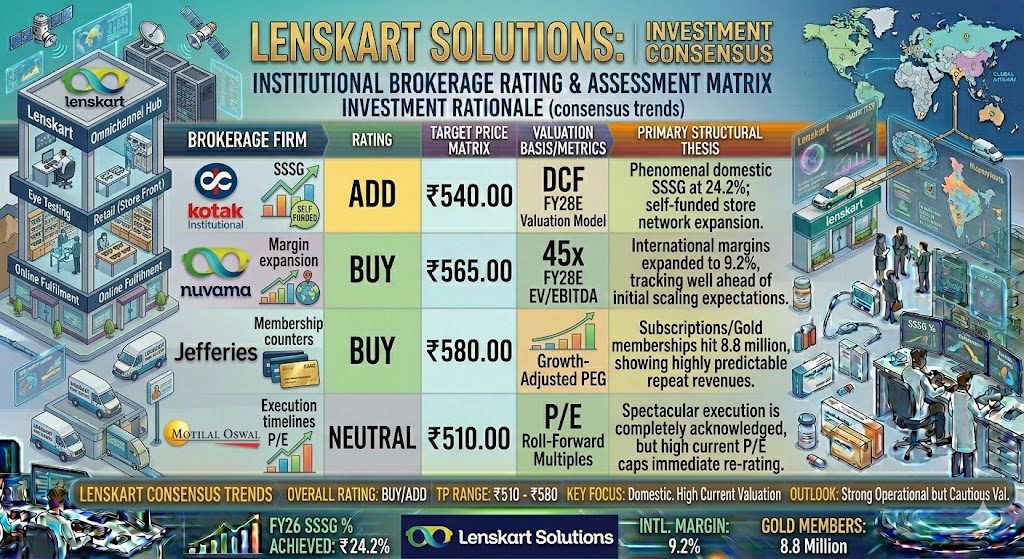
Institutional brokerages responded positively to the company’s strong operating leverage and full-year execution quality.
Kotak Institutional Equities maintained an ADD recommendation with a target price of ₹540, highlighting strong same-store-sales growth and self-funded expansion capability.
Nuvama Wealth Management maintained a BUY recommendation with a target price of ₹565, citing strong international-margin expansion and premiumization trends.
Jefferies India retained a BUY rating with a target price of ₹580 because of improving subscription revenues and strong customer retention metrics.
Motilal Oswal Financial Services maintained a NEUTRAL stance with a target price of ₹510 while cautioning that elevated valuation multiples could temporarily limit further re-rating potential.
The broader analyst consensus target currently stands near ₹551, implying potential upside of roughly 14% from current market levels.
Final Verdict: Should Investors Buy Lenskart Shares?
Long-Term Investors Can Continue Accumulating
For long-term investors, Lenskart Solutions Limited continues to remain one of India’s strongest consumer-retail execution stories. The company combines exceptional revenue growth, strong operating leverage, rapid omnichannel expansion, premiumization momentum, international diversification, self-funded growth capability, and improving ROCE metrics.
Businesses capable of growing revenues above 30% while simultaneously expanding margins and return ratios remain extremely rare within India’s retail sector.
Any post-earnings correction toward the ₹465–₹475 accumulation zone may continue attracting long-term institutional buying interest.
Swing Traders Should Watch the ₹492.65 Pivot Carefully
For short-term traders, the technical structure remains constructive following recent pre-results accumulation. If the stock decisively sustains above the ₹492.65 pivot during upcoming trading sessions, momentum traders may potentially target ₹520 and eventually ₹545.
However, disciplined stop-loss positioning below ₹465 remains extremely important because the stock continues exhibiting high-beta trading characteristics.
Final Conclusion
Lenskart delivered a strategically powerful Q4 FY26 performance despite the misleading headline PAT decline. Massive revenue growth, strong EBITDA expansion, rising operational efficiency, improving capital productivity, premiumization momentum, and self-funded scaling capabilities collectively reinforced the company’s long-term structural growth narrative.
Although the stock remains expensive based on traditional valuation metrics, institutions continue rewarding the company for its rare combination of hyper-growth, operational discipline, and omnichannel execution dominance.
If management successfully sustains the current growth trajectory while maintaining margin discipline, Lenskart Solutions Limited could emerge as one of India’s defining long-duration consumer technology compounders over the coming decade.