Scope Outline
Introduction: The High-Voltage Growth Engine
If you zoom out and observe how India’s infrastructure ecosystem has evolved over the last three decades, one theme stands out clearly—what was once a low-margin, fragmented cable industry has now transformed into a high-value, technology-driven sector. Cables today are not just connectors; they are the backbone of power transmission, renewable energy, data centers, and industrial expansion. KEI Industries has positioned itself right at the center of this transformation. The Q4 FY26 results released on May 5, 2026, highlight a company that is scaling efficiently while maintaining strong profitability. With net profit rising 25.5% year-on-year and the stock trading near ₹5,058 after a post-results rally, KEI has clearly demonstrated that it is not just growing—it is doing so with quality and consistency even in a volatile macro environment.
Q4 FY26 Financial Scorecard: The Actual NSE Numbers
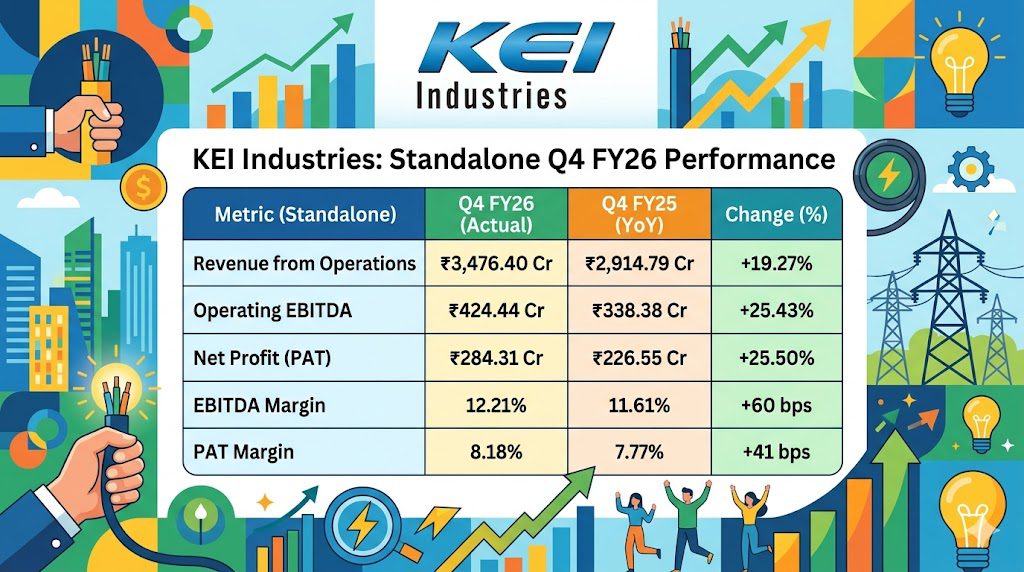
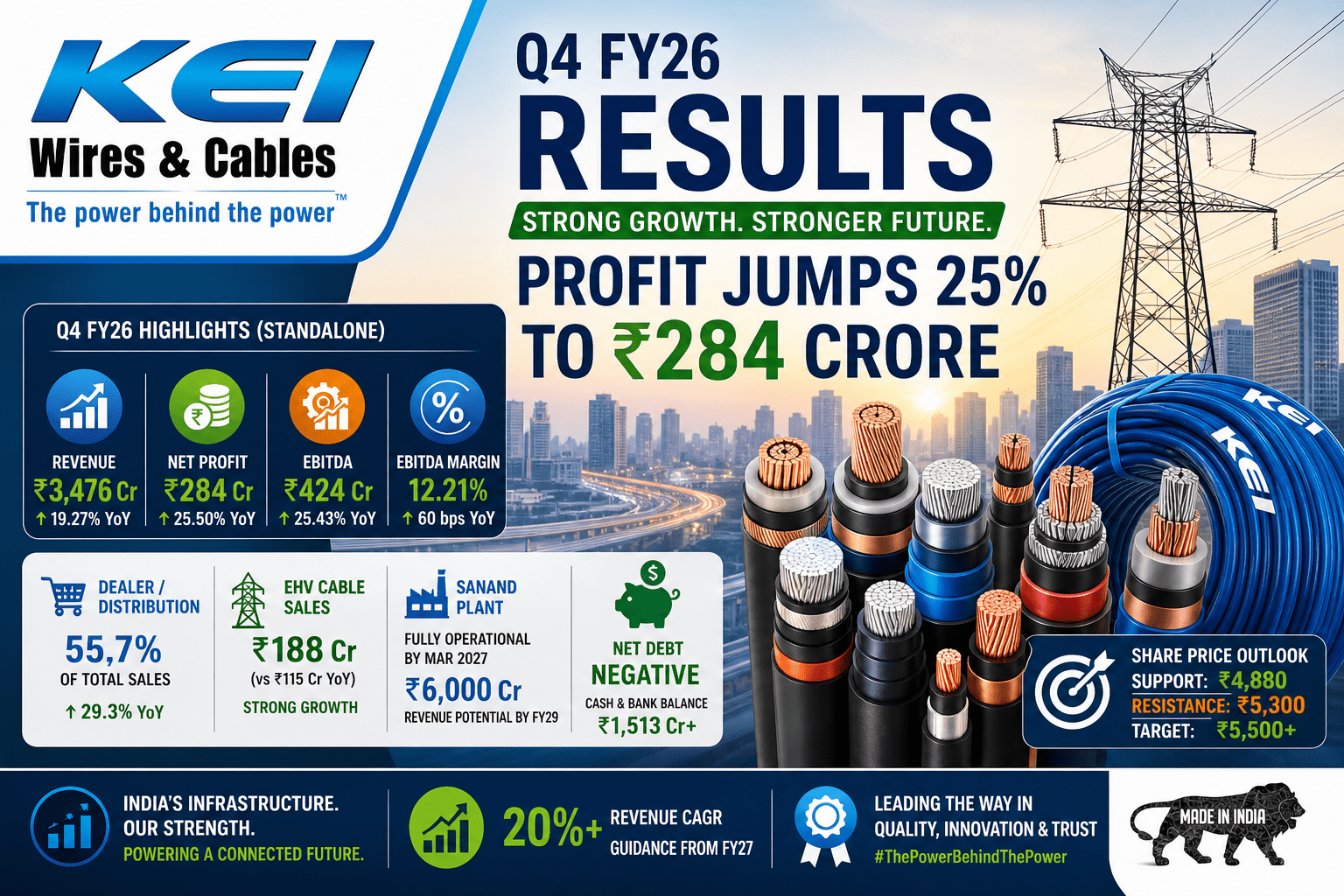
The financial performance of KEI Industries in Q4 FY26 reflects a well-balanced mix of growth and operational efficiency. Revenue from operations stood at ₹3,476.40 crore, registering a strong 19.27% increase compared to ₹2,914.79 crore in the same quarter last year. Operating EBITDA grew even faster at 25.43%, reaching ₹424.44 crore, which indicates that the company is benefiting from operating leverage as volumes increase. Net profit came in at ₹284.31 crore, marking a 25.50% growth, showing that profitability is scaling alongside revenue. Margins also improved, with EBITDA margin rising to 12.21% from 11.61% and PAT margin increasing to 8.18% from 7.77%. These improvements, though seemingly small, are significant in a high-volume business and highlight strong cost control and pricing power.
Fundamental Analysis: Decoding the Segment Mix
The Dealer Dominance
One of the most important drivers of KEI’s recent performance is the growing contribution from its dealer and distribution network. This segment now accounts for 55.7% of total sales and has grown by an impressive 29.3% year-on-year. This shift is crucial because retail and dealer-led sales typically offer higher margins compared to large institutional orders. By strengthening its distribution network, KEI is not only improving profitability but also creating a more stable and diversified revenue base, reducing dependence on cyclical infrastructure projects.
EHV Cables (The Moat)
KEI’s strongest competitive advantage lies in its Extra High Voltage (EHV) cable segment. In Q4 FY26, domestic institutional EHV cable sales increased to ₹188 crore from ₹115 crore in the previous year. This segment represents a high-entry-barrier business where only a few players have the capability to deliver complex solutions. KEI’s presence in this niche gives it a near-monopolistic advantage in certain infrastructure projects, particularly in power transmission and renewable energy. As India continues to invest heavily in these sectors, demand for EHV cables is expected to remain strong, reinforcing KEI’s long-term growth prospects.
Debt-Free Status
Another key strength of KEI Industries is its robust balance sheet. The company has effectively turned net debt negative, meaning it operates with a cash surplus rather than debt. Cash and bank balances have reached ₹1,513 crore, including unutilized QIP proceeds. This financial strength provides flexibility for expansion, reduces interest costs, and enhances overall stability. It also positions KEI to capitalize on growth opportunities without relying heavily on external funding.
Technical Analysis: The Multi-Year Breakout
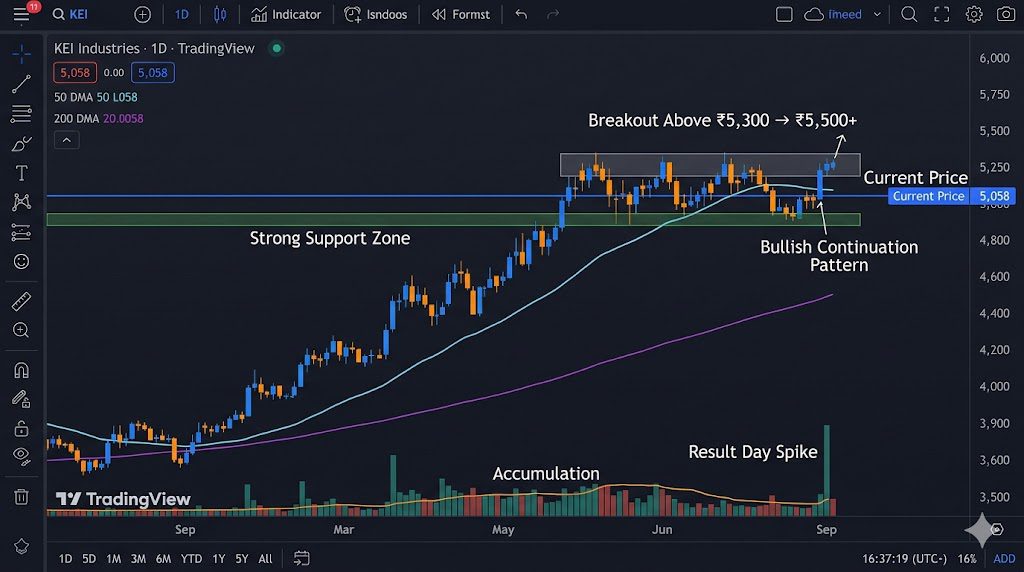
From a technical standpoint, KEI Industries is showing strong bullish momentum. The formation of a White Marubozu candle indicates intense buying interest following the Q4 results, suggesting strong market confidence. The immediate support level is around ₹4,884, which acts as a key pivot zone. As long as the stock remains above this level, the upward trend is likely to continue. On the upside, the resistance range between ₹5,150 and ₹5,300 is critical. A decisive breakout above ₹5,300 could trigger a sharp rally toward ₹5,500. Momentum indicators such as RSI are trending upward, and the stock is trading above key moving averages, reinforcing the bullish outlook.
Management Guidance: The Sanand Catalyst
Capacity Expansion
The Sanand plant is expected to play a transformative role in KEI’s growth story. The facility is on track to be fully operational by March 2027 and is projected to significantly enhance production capacity. Once fully ramped up, the plant is expected to contribute up to ₹6,000 crore in additional revenue by FY29. This expansion will allow KEI to meet rising demand across both domestic and export markets while maintaining efficiency.
Revenue Targets
Management has reiterated its confidence in achieving a revenue growth rate of over 20% CAGR from FY27 onwards. This growth will be driven by a combination of strong demand in the EHV segment, expansion of the dealer network, and increasing infrastructure investments across India. Such consistent growth at scale highlights the company’s strong execution capabilities and market positioning.
Margin Outlook
Looking ahead, KEI expects further improvement in margins, with an anticipated expansion of around 100 basis points once the Sanand plant becomes fully operational. This improvement will be driven by better operating leverage and a higher contribution from the retail segment. Sustained margins in the range of 11–12% will significantly enhance profitability over the long term.
Brokerage Sentiment & Targets (The High-Value View)
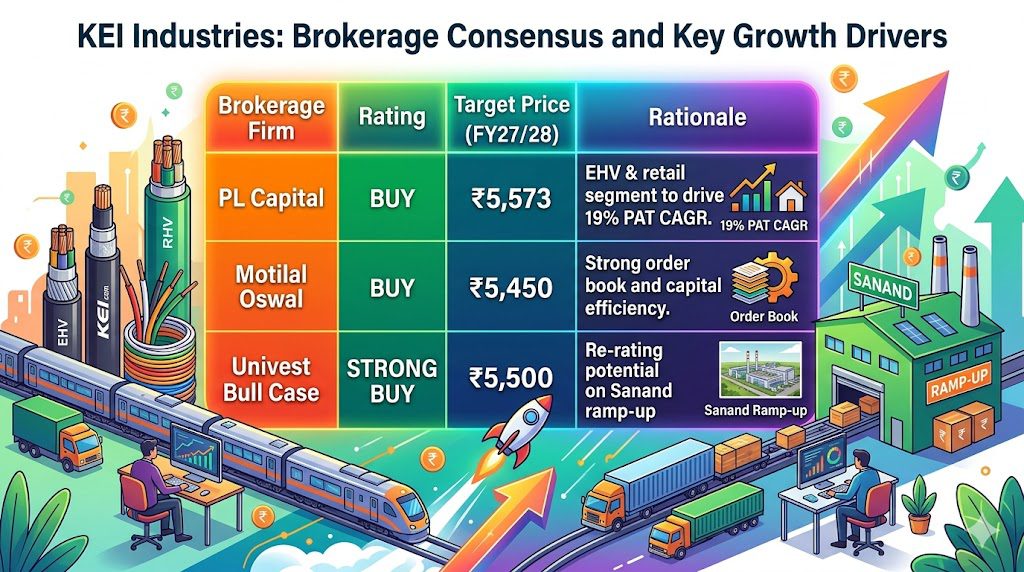
Brokerages remain highly optimistic about KEI Industries, reflecting strong confidence in its growth trajectory. Analysts highlight the company’s strong order book, efficient capital allocation, and leadership in the EHV segment as key positives. Target prices from leading brokerages range between ₹5,450 and ₹5,573, with some bullish estimates going up to ₹5,500 and beyond. These targets suggest that the market sees continued upside potential, particularly if the company executes its expansion plans successfully.
The “30-Year” Analyst Verdict
From a long-term perspective, KEI Industries has evolved into more than just a cable manufacturer; it has become a proxy for India’s infrastructure growth. Its ability to generate strong cash flows while expanding capacity sets it apart from many peers. For investors, the company offers a combination of steady growth, strong financial health, and long-term visibility. For traders, the stock presents an attractive opportunity, with clear support and resistance levels guiding short-term strategies. The current setup, supported by strong fundamentals and technical momentum, makes KEI a compelling candidate for both investment and trading.
Conclusion & Engagement (CTA)
KEI Industries’ Q4 FY26 performance reflects a company operating at the peak of its capabilities. With a 25.5% increase in profit, improved margins, and a debt-free balance sheet, it has delivered a high-quality growth quarter. The upcoming Sanand expansion, combined with strong demand in the EHV segment and a growing retail network, positions the company for sustained long-term growth. The key question for investors now is whether to focus on its near-term valuation or its long-term potential. Are you holding KEI for its ₹5,500+ growth trajectory, or are you cautious about external risks like global tariffs? Your perspective on this evolving “wire and cable” story could shape your investment strategy going forward.