Introduction: The Efficiency King of Mid-Cap Banking
For decades, regional private sector banks in India were often viewed as conservative institutions with limited growth potential. Investors considered them safe but slow-moving banks that lacked the scale and operational efficiency of larger private sector giants. However, the Indian banking industry has changed significantly over the last thirty years, and one of the strongest examples of this transformation is KARURVYSYA. Karur Vysya Bank has steadily evolved from a traditional South India-focused lender into one of the most efficient and profitable mid-cap banks in the country. Its Q4 FY26 earnings prove that disciplined banking, strong management execution, and digital transformation can create exceptional long-term shareholder value.
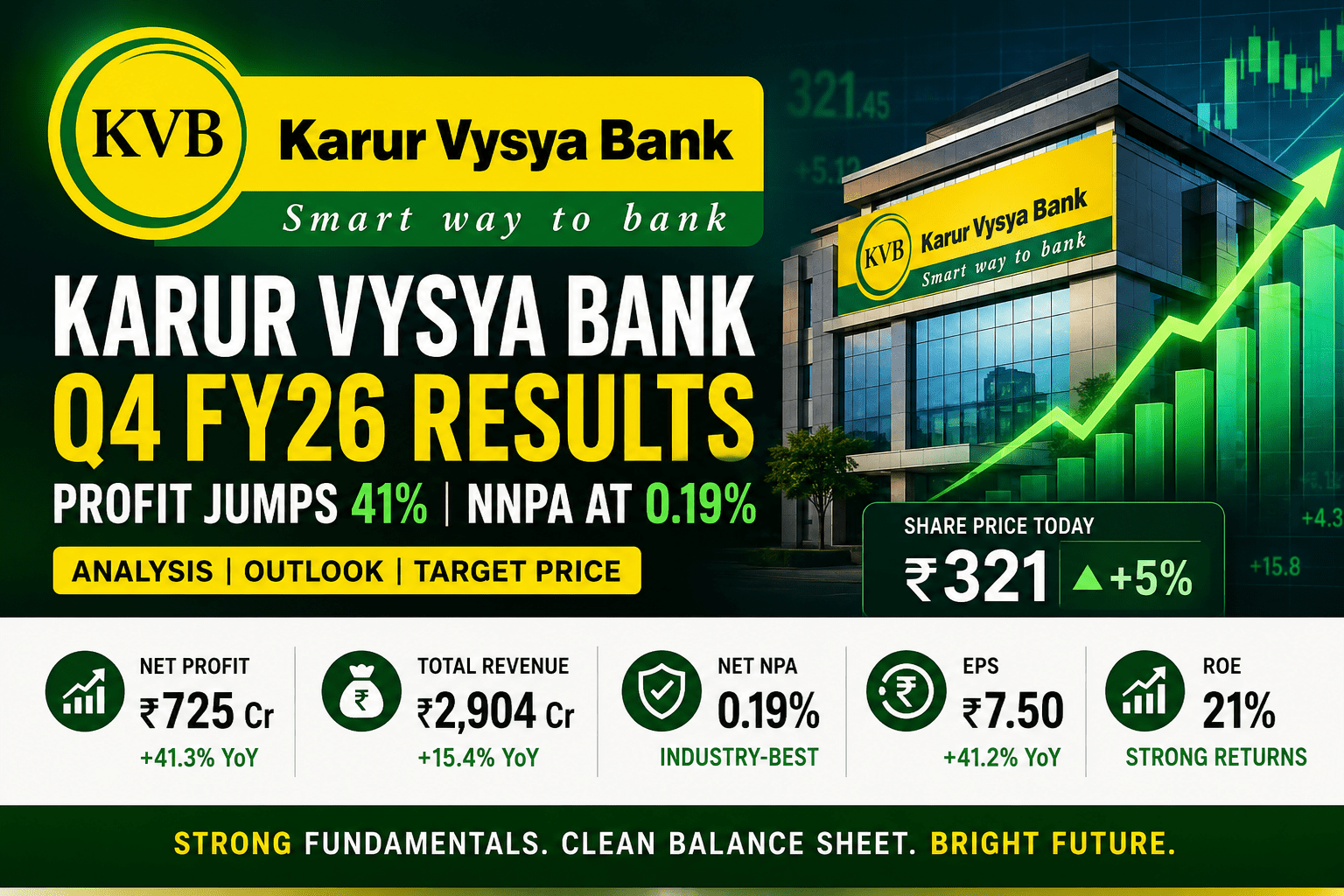
The latest quarterly results announced on May 7, 2026, have surprised the market in a positive way. The bank reported a net profit of ₹725 crore for Q4 FY26 compared to ₹513 crore in the same quarter last year, representing a remarkable 41.3% year-on-year growth. This performance becomes even more impressive when combined with the bank’s exceptionally clean balance sheet and stable margins. Investors reacted immediately to the results, pushing the stock above ₹321 during intraday trading with gains of more than 5%. At a time when many banking stocks are facing pressure from rising competition and global uncertainty, Karur Vysya Bank has emerged as one of the strongest performers in the mid-cap banking space.
Q4 FY26 Financial Scorecard (Actual NSE Data)
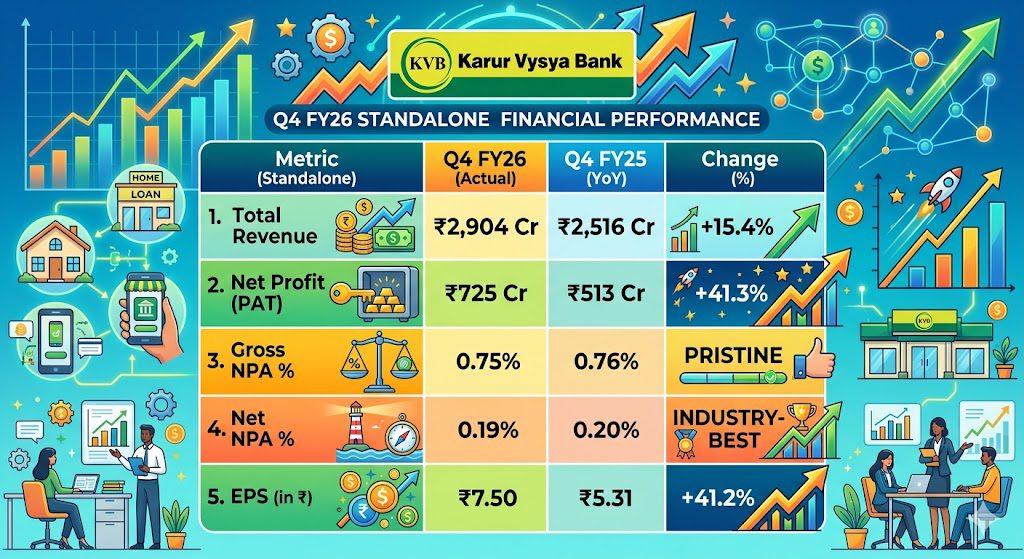
Karur Vysya Bank delivered a strong financial performance across all major metrics during the March 2026 quarter. The bank’s total revenue increased to ₹2,904 crore from ₹2,516 crore in Q4 FY25, reflecting healthy growth of 15.4% year-on-year. The sharp rise in profitability was even more impressive, with net profit rising to ₹725 crore from ₹513 crore a year ago. This massive improvement shows that the bank is benefiting from strong loan growth, better operational efficiency, and lower credit costs.
The earnings per share (EPS) also improved significantly from ₹5.31 to ₹7.50, indicating that shareholder profitability continues to strengthen. One of the biggest highlights of the quarter was the bank’s asset quality performance. Gross NPA remained stable at 0.75%, while Net NPA improved further to just 0.19%, making it one of the cleanest loan books in the Indian banking sector. Such low bad loan levels are extremely rare among Indian banks and clearly demonstrate the strength of the bank’s risk management system.
Fundamental Analysis: The “0.19%” Moat
Pristine Asset Quality
The most important strength of Karur Vysya Bank today is undoubtedly its asset quality. A Net NPA ratio of just 0.19% is extraordinary for any Indian bank, especially in the mid-cap category. Over the years, many banks have struggled with rising bad loans and stressed corporate accounts, but KVB has consistently maintained strict lending standards and conservative underwriting practices. This disciplined approach has helped the bank keep its balance sheet extremely clean even during difficult economic cycles.
Low NPAs are not just accounting numbers; they directly improve profitability because the bank needs to set aside less money for bad loan provisions. This creates higher earnings stability and improves investor confidence. In today’s banking environment, where credit quality remains one of the biggest concerns for investors, Karur Vysya Bank’s ability to maintain Net NPA below 0.20% gives it a major competitive advantage over many peers.
Operating Leverage and Digital Transformation
Karur Vysya Bank is also benefiting from years of investment in technology and digital banking infrastructure. The bank’s financing profit reportedly increased from ₹164 crore to ₹373 crore year-on-year, showing how operational efficiency is improving rapidly. Over the past few years, KVB has modernized its digital systems, expanded mobile banking services, and improved internal automation processes. These initiatives are now helping the bank reduce costs while serving a larger customer base more efficiently.
Digital transformation has become a critical factor for banks in India because customers increasingly prefer online and mobile banking services. Banks that successfully adapt to this trend can scale faster without proportionately increasing operational expenses. Karur Vysya Bank appears to be executing this transition very effectively, which is contributing to its rising profitability and stronger return ratios.
Strong Return Ratios
Another major positive for the bank is its impressive return profile. Karur Vysya Bank is currently generating a Return on Equity (ROE) of nearly 21%, placing it among the top-performing private sector banks in India. Such high ROE levels are typically associated with large private banking leaders, making KVB’s achievement especially notable for a mid-cap bank.
A strong ROE indicates that the bank is efficiently utilizing shareholder capital to generate profits. Investors usually reward companies with consistently high ROE because it reflects strong management quality and sustainable business performance. If KVB can maintain these return ratios over the next few years while continuing to grow its loan book, the stock may witness further valuation re-rating in the market.
Technical Analysis: The Blue-Sky Breakout
Strong Breakout Above Consolidation Zone
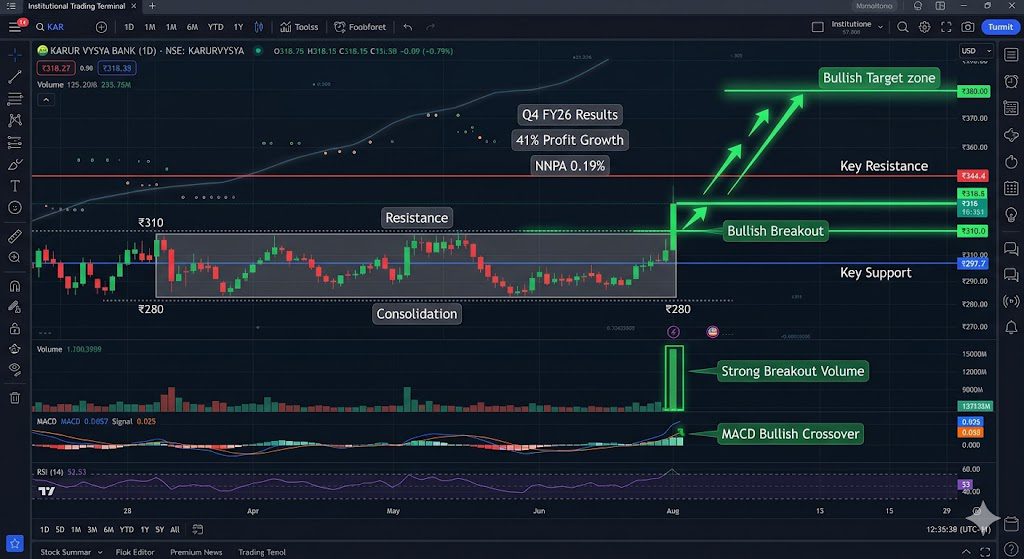
From a technical chart perspective, Karur Vysya Bank has entered a bullish phase after breaking out of a multi-month consolidation range between ₹280 and ₹310. The stock had been moving sideways for several months as investors waited for a major trigger. The strong Q4 FY26 earnings acted as that trigger and pushed the stock above important resistance levels.
Such breakouts are significant because they often indicate fresh institutional buying and renewed investor confidence. When a stock successfully moves out of a long consolidation pattern, it usually signals the beginning of a stronger upward trend. The recent price action in KVB suggests that bullish momentum is building steadily.
Major Support Level at ₹297
The ₹297 level is currently one of the most important support zones for the stock. This area also aligns closely with the 200-day Exponential Moving Average (EMA), making it a technically strong base for the ongoing rally. As long as the stock remains above this support level, the broader bullish trend is expected to remain intact.
For medium-term investors and swing traders, any correction toward the ₹300 zone could potentially provide a buying opportunity. Strong support levels often attract fresh demand from investors looking to enter quality stocks at lower prices.
Resistance Zone Near ₹344
On the upside, the next major resistance for the stock is around ₹344, which is close to its recent 52-week high zone. A decisive breakout above this level could open the path for a rally toward ₹380 in the coming months. Market participants are closely watching this resistance because stocks often witness strong momentum once they move above previous highs.
If earnings growth remains strong and broader banking sentiment stays positive, KVB could attract additional institutional interest and higher trading volumes.
Technical Indicators Remain Positive
Most technical indicators are currently supporting the bullish outlook for the stock. The MACD indicator has generated a positive crossover, which generally signals strengthening upward momentum. Meanwhile, the Relative Strength Index (RSI) is around 53, suggesting that the stock is neither overbought nor overheated at current levels.
An RSI above 70 is typically considered overbought territory, but KVB still has significant room before reaching such levels. This indicates that the rally may continue further if positive momentum remains intact.
Management Guidance & The FY27 Outlook
Healthy Loan Growth Expectations
The management of Karur Vysya Bank remains optimistic about growth prospects for FY27. The bank is guiding for loan growth of 14% to 17% year-on-year, supported by strong demand from SME and agricultural sectors. These segments continue to play an important role in India’s economic expansion, particularly in semi-urban and rural regions.
KVB has historically maintained strong relationships within these sectors, giving it a competitive edge in lending. If India’s domestic growth remains stable, the bank is likely to continue benefiting from rising credit demand while maintaining healthy asset quality.
Stable Net Interest Margins
Despite increasing competition in the banking industry and pressure on deposit costs, the bank expects to maintain Net Interest Margins (NIMs) in the range of 4.0% to 4.2%. This is considered a strong margin profile for a private sector bank and reflects efficient liability management.
Stable NIMs are important because they help banks protect profitability even during changing interest rate cycles. If interest rates decline later in FY27, KVB could potentially benefit further through lower funding costs and treasury gains.
Brokerage Sentiment & Targets (The Path to ₹338+)
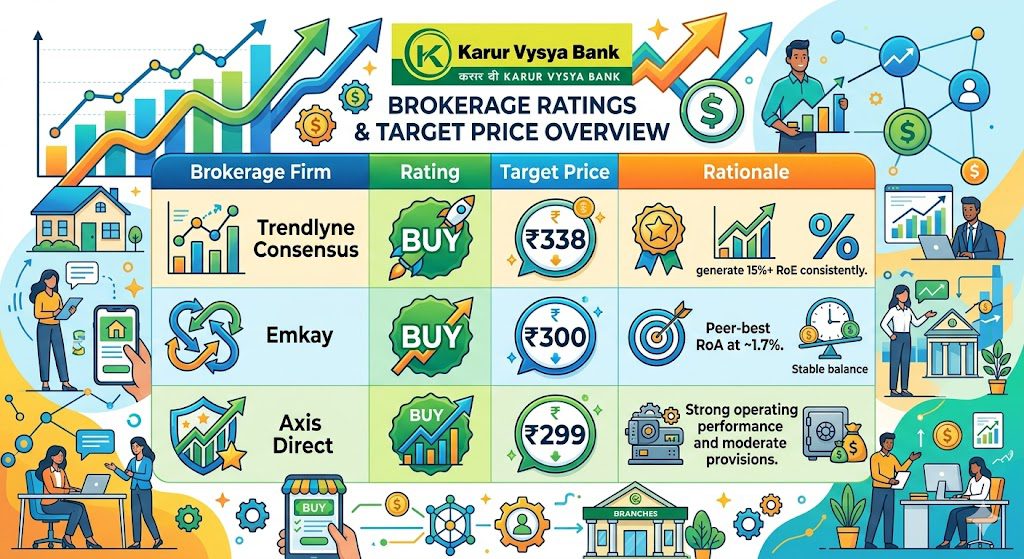
Market analysts and brokerage firms remain positive on Karur Vysya Bank following its impressive Q4 FY26 performance. According to Trendlyne consensus estimates, the stock carries a BUY recommendation with an average target price of around ₹338. Analysts believe the bank can continue generating sustainable Return on Equity above 15%, which supports further upside potential.
Emkay has also maintained a positive outlook on the stock due to its peer-leading Return on Assets (RoA) of nearly 1.7%. Similarly, Axis Direct has highlighted the bank’s strong operating performance and controlled provisioning levels as key strengths. The overall market sentiment suggests that KVB remains attractively valued compared to its improving earnings profile and strong fundamentals.
The “30-Year” Analyst Verdict
For Long-Term Investors
Karur Vysya Bank has clearly moved beyond its old image of being just another regional lender. The bank is now demonstrating strong earnings growth, industry-leading asset quality, high return ratios, and improving digital capabilities. These factors make it one of the most attractive mid-cap banking opportunities in India today.
For long-term investors, the stock offers a compelling combination of growth potential, dividend stability, and improving operational efficiency. If management continues executing its strategy successfully, KVB could emerge as one of the strongest compounders in the private banking sector over the coming years.
For Short-Term Traders
For traders, the technical structure of the stock remains firmly bullish. The breakout above the ₹310 zone indicates strong momentum and institutional participation. Any correction toward the ₹300–₹305 range could provide fresh entry opportunities for momentum traders.
Importantly, this rally is supported by genuine earnings growth rather than speculative sentiment alone. Strong financial performance, low NPAs, and improving profitability provide a solid foundation for the ongoing uptrend.
Conclusion & Engagement (CTA)
Karur Vysya Bank has delivered an exceptional Q4 FY26 performance with a 41% jump in net profit and one of the cleanest balance sheets in the Indian banking industry. The combination of strong earnings growth, 0.19% Net NPA, stable margins, and healthy loan growth guidance has strengthened investor confidence significantly. The bank is no longer seen as a slow-moving regional player but as a high-quality mid-cap banking growth story with strong long-term potential.
With improving fundamentals and positive technical momentum, the stock remains firmly on the radar of both investors and traders. The coming quarters will now determine whether KVB can sustain its growth trajectory and move toward the ₹338+ target zone projected by analysts.
Are you bullish on KARURVYSYA for the long term, or do you think global economic risks and banking sector competition could limit upside potential? Share your views and join the discussion on the future of India’s mid-cap banking sector.