
India’s mid-sized private banking sector witnessed one of the strongest turnaround performances of the quarter as Karnataka Bank Limited delivered a blockbuster Q4 FY26 earnings report that comfortably exceeded Street expectations. The Mangaluru-based lender reported a massive 62% jump in net profit along with one of the cleanest asset-quality profiles seen in recent years. The results reinforced investor confidence in the bank’s ongoing transformation story and strengthened the view that Karnataka Bank is gradually evolving into a stronger, more efficient, and digitally focused banking franchise.
What makes this quarter especially important is the unusual nature of the earnings growth. While the bank’s total revenue remained completely flat year-on-year, profitability surged sharply because of better operational efficiency, strong cost management, improving lending quality, and a major reduction in bad-loan pressure. This signals that Karnataka Bank is no longer dependent only on loan-book expansion to improve earnings growth. Instead, the bank is now generating stronger profitability through balance-sheet improvement and smarter operational execution.
The market responded positively to the earnings announcement because investors increasingly see Karnataka Bank as a potential structural re-rating candidate among India’s mid-cap private banking stocks. Strong profitability growth, falling NPAs, healthy capital adequacy, stable margins, and attractive valuations together have significantly improved the long-term investment case for the stock.
Karnataka Bank Q4 FY26 Financial Performance Snapshot
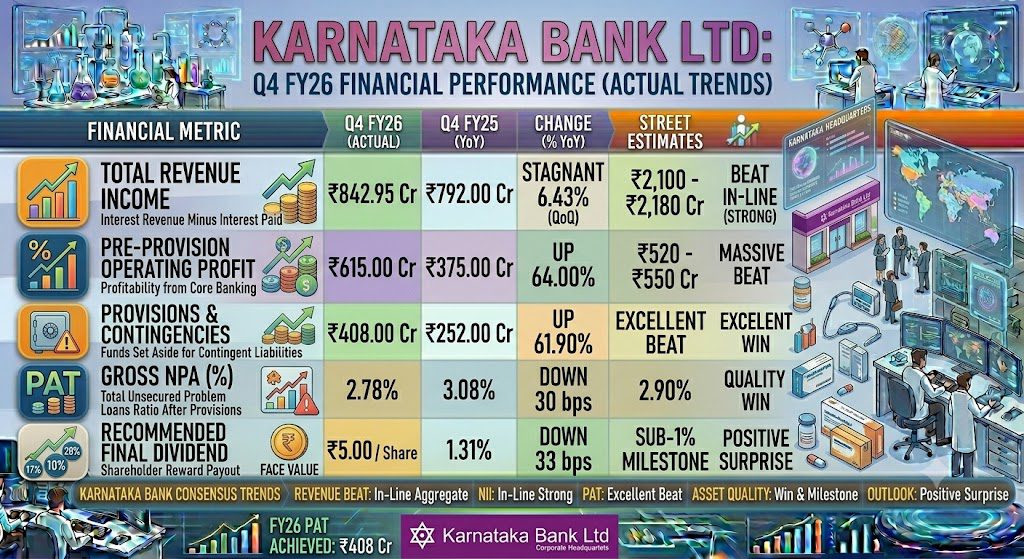
Karnataka Bank Limited reported total revenue of ₹2,260 crore during Q4 FY26, which remained largely unchanged compared to the same quarter last year. Although the flat revenue initially appeared disappointing, the underlying operational performance turned out to be significantly stronger than expected.
Net Interest Income (NII) increased to ₹842.95 crore compared to ₹792 crore in the previous comparable period, reflecting healthy growth of 6.43%. This steady improvement in NII highlighted the bank’s ability to maintain stable lending spreads and improve yield management despite tight liquidity conditions across the banking system.
The biggest operational surprise came from Pre-Provision Operating Profit (PPOP), which surged sharply to ₹615 crore compared to ₹375 crore last year, registering exceptional growth of 64%. This strong operational improvement comfortably exceeded analyst expectations and highlighted Karnataka Bank’s improving cost structure and operational discipline.
Net profit after tax jumped to ₹408 crore compared to ₹252 crore during Q4 FY25, reflecting phenomenal growth of 61.9%. The earnings performance beat most Street estimates, which were positioned between ₹375 crore and ₹405 crore. Asset quality also improved significantly during the quarter. Gross NPA declined to 2.78% from 3.08%, while Net NPA fell below the psychologically important 1% mark to 0.98% compared to 1.31% last year.
The board also recommended a final dividend of ₹5 per equity share, representing 50% of face value, which further strengthened investor sentiment around the stock.
Corporate Profile: Karnataka Bank’s Digital Transformation Journey
Karnataka Bank Is Reinventing Itself as a Digital-First Private Lender
Karnataka Bank Limited is one of India’s oldest private-sector banks with deep historical roots across southern India. Traditionally, the bank was known as a conservative regional lender focused on semi-urban and rural banking operations. However, over the past few years, Karnataka Bank has aggressively modernized its business model and operational framework in an effort to reposition itself as a digital-first and analytics-driven banking institution.
The bank has implemented more than 11 advanced analytics dashboards and over 40 predictive risk-management models aimed at improving underwriting quality, operational efficiency, customer targeting, and risk monitoring. This digital transformation strategy has already helped the bank attract nearly one million digitally active customers, significantly strengthening its future retail banking potential.
The management’s focus on digital banking expansion is gradually helping Karnataka Bank move away from its old image as a slow-moving regional lender and reposition itself as a more agile and technology-focused banking franchise.
Strategic Focus Shift Toward Retail & MSME Banking
Historically, several mid-sized private banks struggled because of excessive dependence on risky corporate loans and stressed infrastructure exposures. Karnataka Bank is now actively reducing dependence on such volatile lending segments.
Instead, the bank is increasingly focusing on retail lending, MSME financing, agricultural loans, merchant ecosystem partnerships, and digital banking products. This strategic shift is helping improve earnings quality, reduce future credit-risk pressure, and stabilize long-term profitability.
The transition also aligns with broader trends within the Indian banking industry where granular retail and MSME lending continue outperforming large corporate-heavy loan books.
Earnings Analysis: How Karnataka Bank Delivered 62% Profit Growth on Flat Revenue
The Operational Paradox Explained
The most interesting aspect of Karnataka Bank’s Q4 FY26 results was the massive rise in profitability despite stagnant revenue growth. Normally, banks require strong loan growth and rising revenue to generate sharp profit expansion. However, Karnataka Bank managed to achieve nearly 62% profit growth even while total revenue remained flat at ₹2,260 crore.
The primary reason behind this operational paradox lies in the bank’s improving efficiency, lower credit costs, better asset quality, and disciplined expense management. This form of earnings growth is often considered healthier and more sustainable because it reflects structural business improvement rather than temporary top-line acceleration.
Cost Control Became a Major Profit Driver
One of the biggest contributors to Karnataka Bank’s strong earnings growth was disciplined cost management. Sequential operating expenses declined by approximately 2.46%, helping the bank significantly improve operational leverage.
At the same time, the bank maintained healthy Net Interest Income growth through better loan pricing and improved yield optimization across its advances portfolio. The combination of stable lending spreads and tighter cost controls substantially improved core profitability during the quarter.
This operational discipline played a major role in boosting Pre-Provision Operating Profit to ₹615 crore.
Asset Quality Restoration Became the Biggest Catalyst
The single most important reason behind Karnataka Bank’s profit explosion was the dramatic improvement in asset quality. Over the past few years, legacy bad loans had heavily impacted the bank’s profitability and valuation multiples. However, the latest quarterly results clearly indicate that much of this historical stress is now gradually disappearing from the balance sheet.
Gross NPA declined to 2.78%, while Net NPA dropped below the critical 1% threshold to just 0.98%. Crossing below 1% Net NPA is considered a major milestone for banks because it signals strong balance-sheet stabilization and significantly lower future credit-risk concerns.
The bank’s Provision Coverage Ratio (PCR) also improved to 65.39%, further strengthening investor confidence in the quality of the balance sheet.
Dividend Announcement Strengthened Investor Confidence
Karnataka Bank Rewarded Shareholders Aggressively
To reward shareholders for the strong FY26 performance, the board of Karnataka Bank Limited recommended a final dividend of ₹5 per equity share on face value of ₹10. This represented a healthy 50% payout ratio and came as a positive surprise because most analysts were expecting dividend announcements between ₹3.50 and ₹4.50 per share.
The generous dividend declaration reinforced management’s confidence regarding the bank’s capital position, future earnings visibility, and long-term financial stability. The official record date is expected to be finalized during the upcoming Annual General Meeting.
For dividend-focused investors searching for stable mid-sized banking opportunities, Karnataka Bank is now becoming increasingly attractive.
Fundamental Analysis: Why Karnataka Bank Looks Attractive at Current Valuations
Asset Quality Has Improved Dramatically
One of the strongest positives for Karnataka Bank Limited is the sharp improvement in asset quality. For years, stressed assets and elevated bad loans had weighed heavily on the bank’s valuation and investor confidence. However, the latest Q4 FY26 results clearly indicate that much of this legacy pressure is now disappearing.
Gross NPA declining to 2.78% and Net NPA falling below 1% significantly lowers long-term credit-risk concerns. Improved asset quality generally helps banks achieve higher valuation multiples, lower provisioning expenses, better profitability, stronger investor confidence, and healthier return ratios.
This balance-sheet clean-up now appears to be one of the biggest long-term catalysts for Karnataka Bank’s structural turnaround story.
Capital Adequacy Remains Exceptionally Strong
Following its recently completed Qualified Institutional Placement (QIP), Karnataka Bank’s Basel III Capital Adequacy Ratio (CAR) now stands at an impressive 20.07%.
This gives the bank a strong capital cushion to aggressively expand lending activities without requiring near-term dilution or additional capital raising. Strong capital adequacy becomes particularly important during periods when banking-sector credit demand remains high but regulatory standards continue tightening.
The bank’s strong capital base now provides management substantial flexibility to accelerate retail and MSME loan growth during FY27.
Valuation Still Looks Deeply Undervalued
Despite the strong earnings performance and improving fundamentals, Karnataka Bank continues trading at relatively inexpensive valuation levels. At current market prices near ₹242–₹245, the stock trades at a trailing Price-to-Earnings multiple of approximately 11.6x.
For a bank delivering nearly 62% profit growth, Net NPA below 1%, strong capital adequacy, improving operational efficiency, and expanding digital banking penetration, this valuation appears significantly cheaper compared to several mid-cap private banking peers trading at 15x–18x earnings multiples.
This creates a strong margin-of-safety opportunity for long-term value investors looking for underappreciated banking stocks.
Technical Analysis: Key Trading Levels for Karnataka Bank Share Price
Stock Has Entered a Strong Momentum Zone
Technically, Karnataka Bank now appears to be entering a highly attractive post-results momentum phase. The stock recently broke above its earlier 52-week resistance zone near ₹225 and rallied toward ₹245 following the earnings announcement.
This breakout structure indicates improving bullish momentum supported by strong institutional buying interest and improving investor sentiment.
₹240 Remains the Most Important Pivot Level
The key technical pivot for Karnataka Bank currently stands near ₹240. As long as the stock continues sustaining above this level, bulls are expected to maintain short-term control over the price action.
Any temporary pullback toward the ₹236–₹240 zone could potentially attract fresh swing-buying interest from momentum traders.
Important Resistance Levels Traders Must Watch
Key upside resistance zones currently include ₹248.50, ₹255, and ₹262 respectively. A decisive breakout above ₹248.50 could trigger another wave of momentum buying and potentially accelerate the stock toward higher resistance levels.
Strong Support Levels Continue Holding
On the downside, important support levels remain near ₹236, ₹230, and ₹215 respectively. As long as Karnataka Bank remains above ₹236, the broader bullish structure continues remaining intact.
Short-term traders should continue maintaining disciplined stop-loss positioning below major support zones.
Management Guidance & FY27 Growth Strategy
Loan Growth Expansion Becomes the Next Major Focus
During the post-results investor interaction, management highlighted that accelerating credit growth is now becoming the bank’s next major strategic objective.
Backed by strong capital adequacy above 20%, Karnataka Bank is aggressively expanding outbound sales teams to improve retail and MSME loan-book growth. Gross advances currently stand near ₹83,340 crore, and management expects stronger lending momentum during FY27.
This growth strategy could significantly improve future revenue visibility over the coming quarters.
CASA Growth Continues Improving
The bank also reported healthy 11% sequential growth in CASA deposits. Management plans to further strengthen low-cost deposit mobilization through merchant ecosystem partnerships and digital banking integrations.
The recently launched partnership with Pine Labs PoS systems is expected to help Karnataka Bank capture additional transactional deposits while improving fee-income generation opportunities.
Net Interest Margins Expected to Remain Stable
Management expects Net Interest Margins (NIMs) to remain stable within the 3.2%–3.5% range during FY27 even if broader banking-system liquidity conditions remain tight.
Stable NIM guidance significantly improves future profitability visibility for investors and analysts.
Institutional Brokerage Ratings & Target Prices
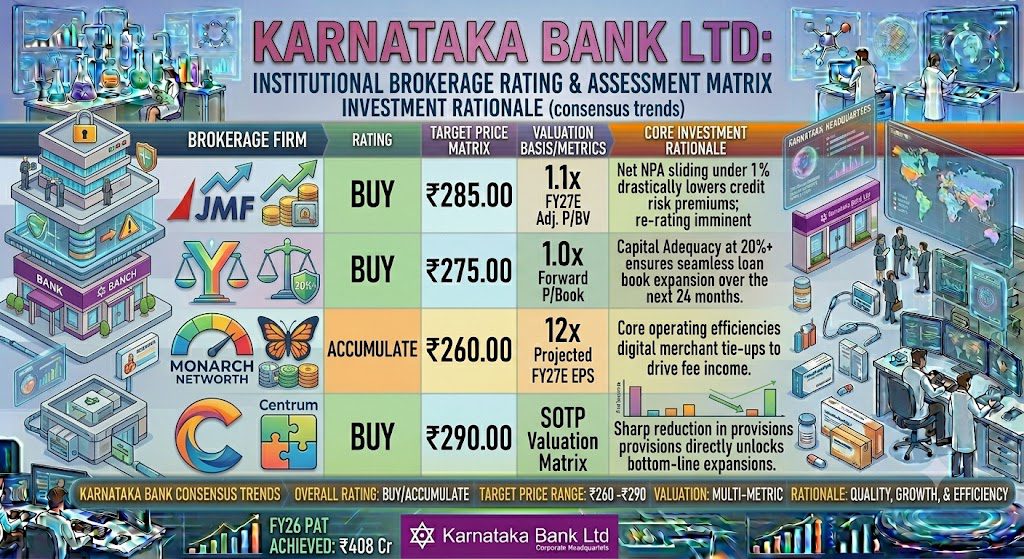
Institutional research firms responded positively to Karnataka Bank’s strong balance-sheet improvement and operational turnaround.
JM Financial maintained a BUY recommendation with a target price of ₹285 based on FY27 adjusted price-to-book valuation methodology. The brokerage highlighted that Net NPA below 1% substantially reduces future credit-risk premiums.
YES Securities retained a BUY rating with a target price of ₹275, citing strong capital adequacy and future loan-growth visibility.
Monarch Networth Capital maintained an ACCUMULATE stance with a target price of ₹260 based on projected FY27 earnings growth and digital merchant ecosystem expansion.
Centrum Research assigned a BUY recommendation with a target price of ₹290 using Sum-of-the-Parts valuation methodology.
The broader analyst consensus target currently stands near ₹277.50, indicating healthy upside potential from current market levels.
Final Verdict: Should Investors Buy Karnataka Bank Shares?
Long-Term Investors Can Continue Accumulating
For long-term investors, Karnataka Bank Limited now appears to be one of the most interesting structural turnaround stories among India’s mid-sized private banks.
The bank has successfully addressed many of its historical weaknesses including elevated bad loans, weak operational efficiency, slow digital transformation, and inconsistent profitability. Today, the institution combines Net NPA below 1%, strong capital adequacy, rapid profit growth, attractive valuations, improving digital banking infrastructure, and stable retail banking expansion.
Long-term investors may continue gradually accumulating the stock during short-term market volatility.
Swing Traders Can Use Pullbacks Strategically
For short-term traders, the technical structure remains favorable following the earnings breakout. As long as Karnataka Bank sustains above the ₹236–₹240 zone, momentum traders may continue targeting ₹255 and eventually ₹262 over the near term.
However, disciplined stop-loss management below ₹230 remains important given broader banking-sector volatility.
Final Conclusion
Karnataka Bank delivered one of the strongest mid-cap private banking earnings performances of Q4 FY26. Massive profit growth, falling bad loans, strong capital adequacy, improving operational efficiency, and inexpensive valuations collectively strengthened the bank’s structural re-rating narrative.
The turnaround story now appears increasingly credible, and if management successfully accelerates retail and MSME credit growth during FY27, Karnataka Bank could emerge as one of the most closely watched banking turnaround stories in India over the coming years.