Scope Outline
JK Lakshmi Cement Limited announced its Q4 FY26 earnings on May 20, 2026, and the numbers reflected the reality of India’s highly competitive cement industry. While the company delivered strong cement volume growth during the quarter, aggressive price competition and weak cement realizations across northern and western India created pressure on margins and profitability. At first glance, the quarterly earnings looked soft, but once investors examine the full-year FY26 performance and the company’s aggressive expansion roadmap, the broader long-term story still appears structurally strong.
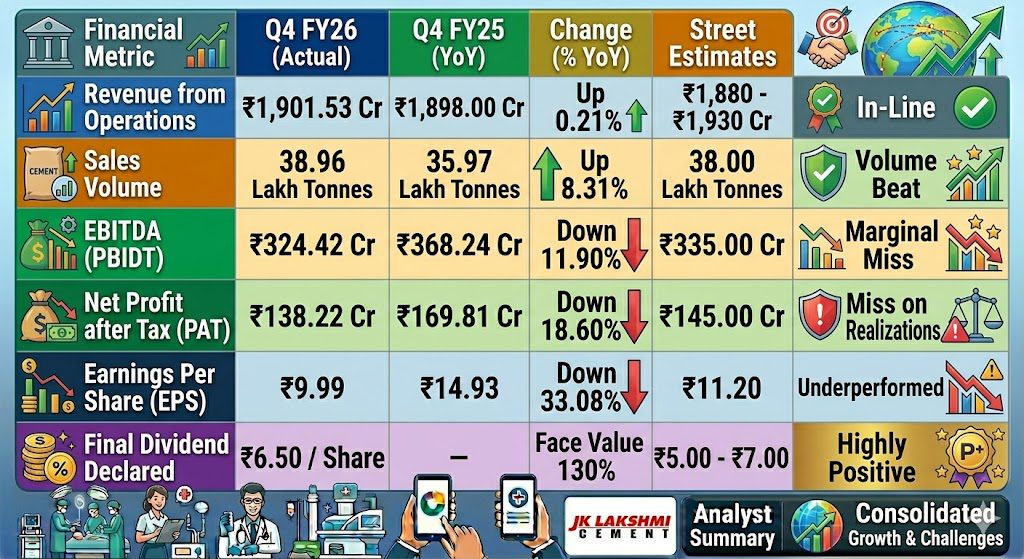
The company reported revenue from operations of ₹1,901.53 crore during Q4 FY26 compared to ₹1,898 crore in the same quarter last year, reflecting marginal year-on-year growth of just 0.21%. Although revenue growth remained almost flat, the operational performance was much stronger than the headline numbers suggested. Cement dispatch volumes increased by 8.31% year-on-year to 38.96 lakh tonnes compared to 35.97 lakh tonnes during Q4 FY25. This strong volume growth clearly indicates healthy underlying demand from infrastructure activity, housing construction, and regional real estate development across the company’s core operating markets.
However, despite selling more cement during the quarter, the company failed to convert higher volumes into stronger profitability because of lower cement prices. Cement prices across India witnessed significant pressure during the January–March quarter because of intense regional competition and weak pricing power. In simple terms, JK Lakshmi Cement sold more bags of cement but at lower average prices per bag. This sharply impacted operating margins and profitability across the business.
As a result, EBITDA declined by 11.90% year-on-year to ₹324.42 crore compared to ₹368.24 crore during the same quarter last year. Net profit after tax also dropped 18.60% to ₹138.22 crore compared to ₹169.81 crore during Q4 FY25. Earnings per share (EPS) fell sharply to ₹9.99 compared to ₹14.93 last year, reflecting the impact of lower realizations and compressed operating margins. Although the quarterly earnings missed Street expectations slightly, investors largely understood that the weakness was driven by broader industry-wide pricing pressure rather than any structural operational failure inside the company.
Another important factor affecting profitability during the quarter was the company’s decision to officially cancel its mining development agreement in Assam. As part of this balance sheet clean-up process, JK Lakshmi Cement Limited derecognized investments worth nearly ₹325 crore related to the project while simultaneously recognizing claims worth approximately ₹130 crore and initiating legal proceedings for the remaining recovery. While this adjustment temporarily affected profitability sentiment, many investors viewed the move positively because it demonstrated disciplined capital allocation and management’s willingness to clean up non-performing investments proactively.
Despite the weaker quarterly profitability, the board recommended a final dividend of ₹6.50 per equity share, representing 130% on the face value of ₹5. The dividend announcement reinforced management confidence regarding the company’s long-term financial stability and future cash flow generation. Investors generally interpret stable dividend payouts during weak industry cycles as a sign of strong balance sheet confidence.
From a broader business perspective, JK Lakshmi Cement Limited continues operating as one of India’s strongest regional cement players with a dominant presence across northern, western, and central India. Apart from cement manufacturing, the company also operates businesses in Ready Mix Concrete (RMC) and Autoclaved Aerated Concrete (AAC) blocks, helping diversify its construction materials portfolio. Its key manufacturing facilities located in Sirohi, Rajasthan and Durg, Chhattisgarh provide important logistical and freight advantages within its operating territories. Unlike large pan-India cement giants, JK Lakshmi Cement focuses heavily on regional operational efficiency, which helps improve market penetration and cost management.
One of the most important reasons long-term investors remain optimistic about the company is its strong full-year FY26 performance despite temporary quarterly weakness. For the entire financial year ending March 31, 2026, standalone net profit actually surged 44.6% to ₹444.65 crore while annual revenue increased 9.2% to ₹6,762.63 crore. These numbers clearly indicate that the business still possesses strong structural earnings power despite short-term pricing challenges during Q4.
The biggest long-term growth trigger for the company remains its aggressive ₹3,000 crore capital expenditure expansion program. Management has approved a major infrastructure expansion plan that includes setting up an additional clinker line in Chhattisgarh and expanding grinding capacities across strategic locations. The project is expected to be completed by March 2028 and could significantly improve the company’s production scale, operating leverage, and market share across central India. This expansion plan is particularly important because India’s long-term cement demand outlook remains highly favorable due to ongoing infrastructure development, urbanization, housing demand, highway construction, and industrial growth.
At the current market price near ₹626, the stock trades at a market capitalization of approximately ₹7,591 crore and a trailing P/E ratio of around 16.6x. Compared to larger peers such as UltraTech Cement and JK Cement, JK Lakshmi Cement continues trading at a noticeable valuation discount despite its expansion roadmap and improving full-year earnings growth. This valuation gap is one of the biggest reasons value-oriented investors continue monitoring the stock closely.
Management also highlighted that the company is aggressively investing in green energy initiatives to improve long-term operational efficiency. The Sirohi manufacturing facility is currently undergoing a major transition toward waste heat recovery systems and increased solar power integration. Since energy costs form a large portion of cement manufacturing expenses, improving renewable energy utilization could significantly strengthen margins during future years, especially if coal prices remain volatile.
From a technical analysis perspective, the stock currently remains under short-term pressure after the earnings release. JK Lakshmi Cement shares closed near ₹626 after slipping around 1.57%. The Relative Strength Index (RSI) currently stands near 24.46, which places the stock in a deeply oversold zone.
y=644.60y=644.60y=644.60
The most important short-term trend pivot currently remains near ₹644.60. If the stock manages to reclaim this level with strong volume participation, short-term momentum could improve significantly. Immediate resistance levels remain near ₹638, ₹644.60, and ₹655 respectively, while major support levels are visible near ₹619, ₹600, and ₹550. The ₹600 zone now represents a major institutional accumulation region because it combines both psychological and technical support.
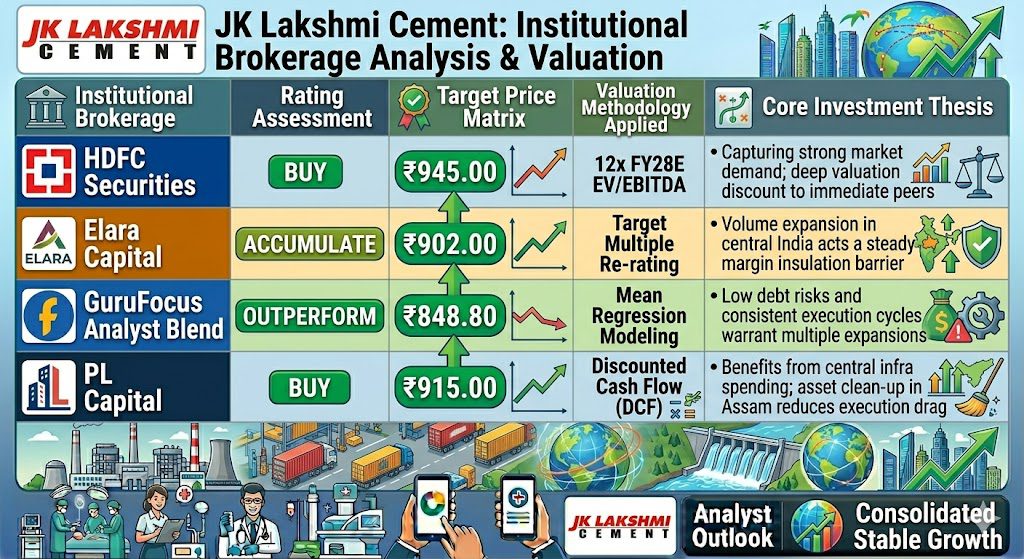
Institutional brokerages largely continue maintaining positive long-term views on the stock despite short-term earnings weakness. HDFC Securities maintained a BUY rating with a target price of ₹945, while Elara Capital assigned an ACCUMULATE rating with a target near ₹902. PL Capital and GuruFocus analysts also remained constructive because of the company’s future capacity expansion, low valuation multiples, strong infrastructure demand outlook, and improving operational scale. The broader consensus target currently stands near ₹848.88, implying potential upside of nearly 35% from current levels.
Overall, the Q4 FY26 earnings report reflects the classic cyclical nature of the cement industry where temporary pricing weakness impacted short-term profitability despite strong operational volumes. However, the broader structural story for JK Lakshmi Cement Limited remains attractive because of strong full-year earnings growth, aggressive expansion plans, green energy initiatives, improving operational efficiencies, and relatively undervalued market pricing compared to larger industry peers. For long-term investors willing to tolerate short-term commodity cycle volatility, the company continues offering an interesting infrastructure-linked growth opportunity within India’s expanding cement sector.