When investors first saw the Q4 FY26 earnings headline from ITC Limited on May 21, 2026, the reaction across financial media looked dramatic. Headlines screamed that ITC’s net profit had collapsed nearly 74% year-on-year. For inexperienced market participants, the number appeared deeply alarming and created the impression that one of India’s largest blue-chip companies had suddenly entered operational trouble.
However, seasoned investors understood almost immediately that the headline figure was highly misleading.
The reported decline in profit was not caused by a collapse in the core business. Instead, it was largely the result of a massive accounting base effect linked to the one-time exceptional gain recorded during Q4 FY25 following the hotels business demerger. Once this distortion is removed, the underlying business actually delivered a stable and operationally healthy quarter that comfortably exceeded Street expectations.
In reality, ITC’s continuing operations reported nearly 5% growth in profit after tax despite facing a major cigarette tax hike, temporary margin pressure, and broader global supply-chain disruptions. This explains why the stock price remained relatively stable after the earnings announcement instead of witnessing panic selling.
The latest quarterly performance once again reinforced why ITC Limited continues occupying a unique position within India’s corporate landscape. The company combines extraordinary cash-flow generation, dominant market leadership, premium consumer brands, one of the strongest balance sheets in the Nifty 50 universe, and a dividend profile that remains extremely attractive for long-term investors.
ITC Limited Q4 FY26 Financial Performance Snapshot
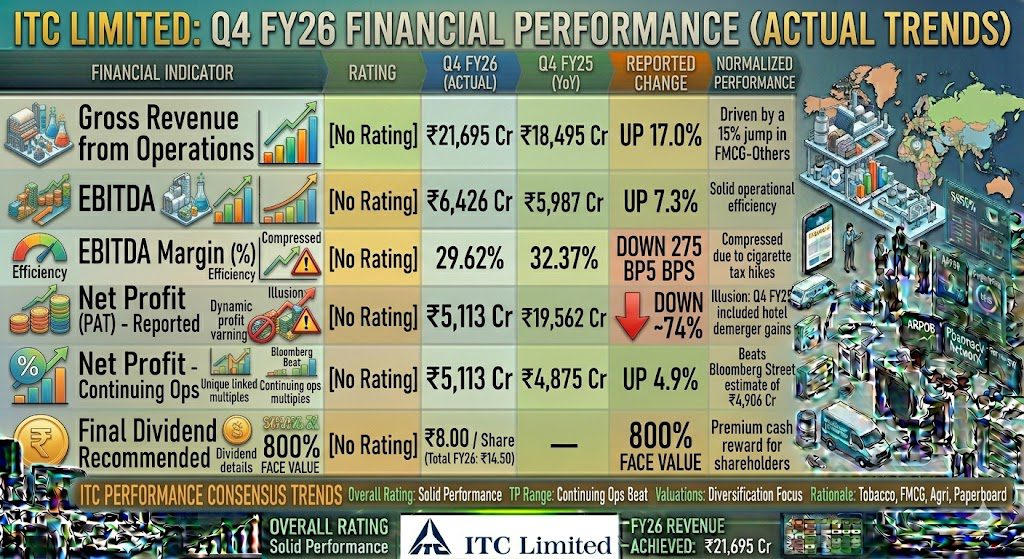
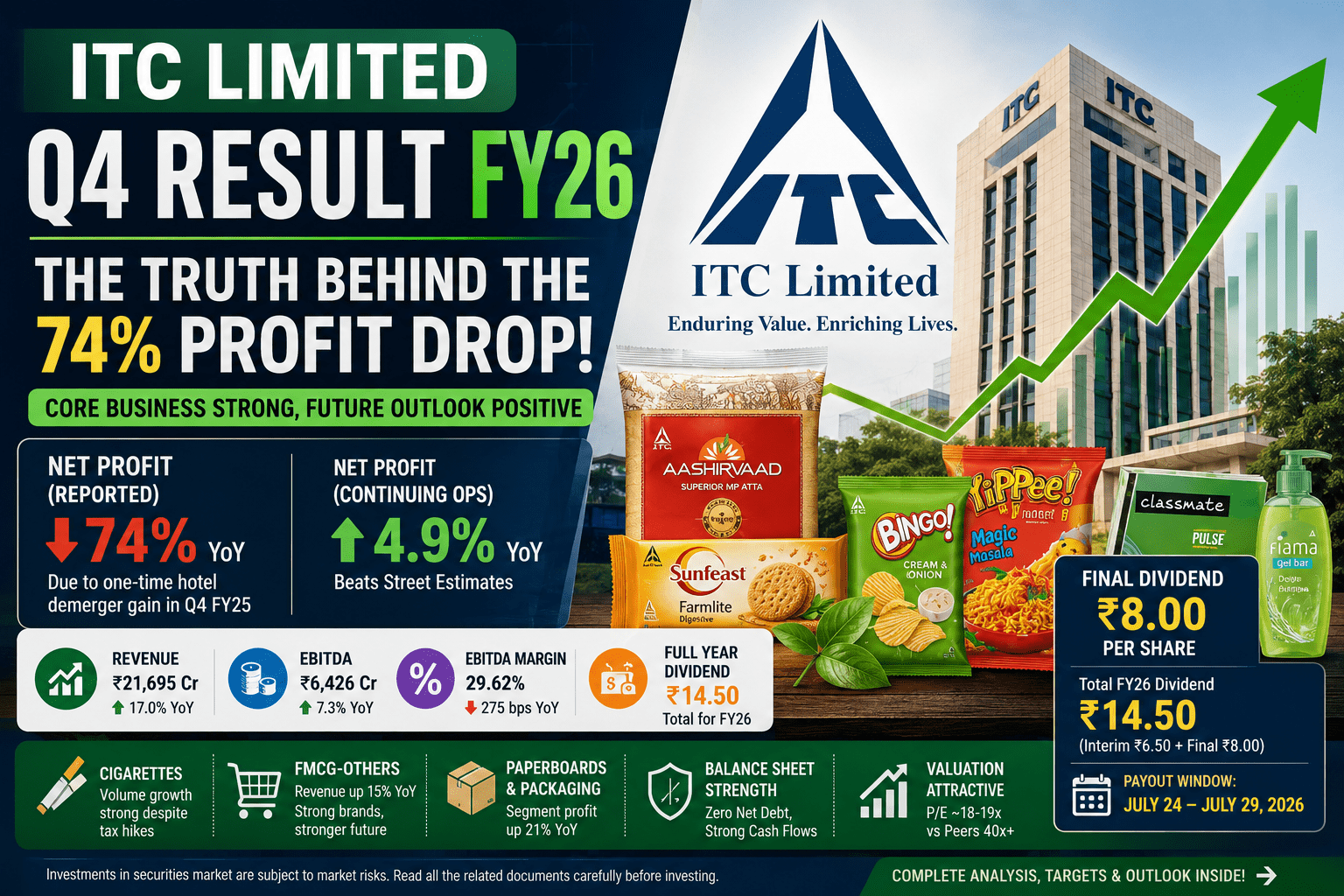
ITC Limited reported gross revenue from operations of ₹21,695 crore during Q4 FY26 compared to ₹18,495 crore during the same quarter last year, reflecting strong year-on-year growth of approximately 17%.
The top-line performance was supported primarily by the company’s fast-growing FMCG-Others segment, which registered robust growth of nearly 15%. This performance further strengthened investor confidence that ITC’s long-term diversification strategy beyond cigarettes is now delivering meaningful results.
EBITDA increased to ₹6,426 crore compared to ₹5,987 crore during Q4 FY25, reflecting healthy operational growth of 7.3%. However, EBITDA margins declined to 29.62% from 32.37% during the previous year. The margin compression was primarily caused by the unprecedented cigarette tax increase implemented during the Union Budget on February 1, 2026.
The most misunderstood number inside the earnings report was the headline profit after tax figure. Reported PAT stood at ₹5,113 crore compared to ₹19,562 crore during Q4 FY25, creating the appearance of a 74% collapse in profitability.
However, Q4 FY25 included a one-time exceptional gain of ₹15,179 crore linked to the hotels business demerger.
Once this exceptional item is excluded, profit from continuing operations actually increased from ₹4,875 crore to ₹5,113 crore, reflecting genuine operational growth of approximately 4.9%.
Importantly, this normalized profit figure also exceeded Bloomberg consensus estimates of ₹4,906 crore, reinforcing the strength of ITC’s underlying business engine.
The Board additionally recommended a final dividend of ₹8 per equity share. Combined with the interim dividend of ₹6.50 already paid earlier during FY26, total shareholder payout for the fiscal year now stands at ₹14.50 per share.
The Evolutionary Transformation of ITC Limited
ITC Is No Longer Defined Only by Cigarettes
For decades, ITC Limited was viewed primarily as India’s dominant tobacco company. That perception, however, has gradually changed over the last several years as the company aggressively expanded its presence across India’s broader consumption economy.
Today, ITC operates across cigarettes, packaged foods, personal care, dairy products, frozen foods, agri-business, paperboards, notebooks, incense sticks, digital commerce, hotels, and premium lifestyle products.
This transformation is strategically important because it steadily reduces long-term dependence on tobacco revenues while increasing exposure to high-growth consumer sectors linked to India’s expanding middle class.
Even so, the cigarette business continues functioning as the company’s primary cash-flow engine.
The segment benefits from unmatched distribution strength, powerful pricing authority, deep brand loyalty, and structural barriers that make large-scale competition extremely difficult.
The enormous profitability generated by cigarettes continues funding ITC’s expansion into FMCG and consumer-facing businesses.
FMCG-Others Business Is Becoming Increasingly Important
The FMCG-Others segment has now evolved into one of the company’s most important long-term growth engines.
ITC owns several major consumer brands including Aashirvaad, Sunfeast, YiPPee!, Bingo!, Savlon, Fiama, Mangaldeep, Master Chef, and Yoga Bar.
Over the last decade, the company has systematically expanded its distribution network across both urban and rural India while simultaneously increasing premium product offerings.
This integrated consumer ecosystem now provides ITC with significant competitive advantages in distribution, sourcing, packaging, and retail penetration.
Hotels Demerger Fundamentally Improved Capital Efficiency
One of the most important structural changes inside ITC came through the demerger of its hotel business.
Historically, the hotels segment remained highly capital intensive and generated lower returns compared to the company’s FMCG and tobacco businesses.
Following the demerger, ITC effectively transformed into a leaner and more capital-efficient enterprise with stronger Return on Capital Employed metrics and improved balance-sheet flexibility.
This restructuring is one of the biggest reasons institutional investors have gradually become more positive regarding the company’s long-term valuation potential.
Earnings Analysis: The Operational Reality Behind the Headlines
Cigarette Tax Hike Temporarily Pressured Margins
The single biggest operational challenge during Q4 FY26 emerged from the cigarette tax hike announced in the Union Budget.
The tax increase forced management to implement staggered pricing adjustments across multiple cigarette categories.
Instead of aggressively raising prices immediately, ITC adopted a calibrated pricing strategy designed to protect market share and prevent consumers from shifting toward illicit tobacco products and unorganized cigarette channels.
This approach proved operationally effective because the cigarette segment still reportedly delivered approximately 26% growth during the quarter.
However, the transition temporarily compressed EBITDA margins to 29.62%.
Most analysts currently believe this pressure remains temporary and could gradually normalize once the pricing structure stabilizes over the coming quarters.
FMCG Business Continued Delivering Structural Growth
The FMCG-Others segment once again emerged as one of the strongest-performing businesses within the Indian consumer sector.
Revenue increased approximately 15% year-on-year, supported by strong demand across packaged foods, snacks, frozen foods, dairy products, personal care, and premium health-focused categories.
Importantly, ITC’s FMCG strategy is increasingly focused on premiumization and margin-accretive product expansion.
The acquisition and integration of brands such as Yoga Bar are strategically important because they improve portfolio quality while strengthening exposure to India’s rapidly growing health-conscious consumer segment.
The broader transformation strongly suggests that FMCG could eventually emerge as the company’s largest long-term value driver outside tobacco.
Paperboards & Packaging Segment Delivered Strong Recovery
ITC’s paperboards and packaging division also delivered an impressive operational recovery during the quarter.
Segment profits reportedly increased approximately 21% year-on-year after the Indian government imposed a Minimum Import Price on cheap foreign paperboard imports.
This policy intervention improved domestic pricing stability and provided meaningful relief to Indian paper manufacturers facing aggressive international competition.
The paperboards business also remains strategically important because it supports ITC’s broader FMCG ecosystem through vertically integrated packaging capabilities.
Dividend Strength Continues Reinforcing Investor Confidence
ITC Remains One of India’s Strongest Dividend Companies
The Board of ITC Limited recommended a final dividend of ₹8 per equity share for FY26.
When combined with the interim dividend of ₹6.50 already distributed earlier during the year, total shareholder payout now stands at ₹14.50 per share.
This continues positioning ITC among the strongest dividend-yielding blue-chip companies within the Indian equity market.
Subject to shareholder approval during the Annual General Meeting, dividend payments are expected to reach investor bank accounts between July 24 and July 29, 2026.
For income-focused investors seeking stability, ITC continues functioning as one of India’s most dependable cash-generating businesses.
Fundamental Analysis: Why ITC Still Looks Deeply Undervalued
Full-Year FY26 Performance Remained Impressive
For the complete FY26 fiscal year, ITC Limited reported gross revenue exceeding ₹80,867 crore, reflecting growth of approximately 10.1%.
This performance remained highly respectable despite supply-chain disruptions linked to the ongoing West Asia shipping crisis and regulatory taxation pressure within cigarettes.
The broader numbers clearly demonstrate the resilience of ITC’s diversified operating model.
ITC’s Valuation Gap Remains Extremely Attractive
At current market prices near ₹308 per share, ITC trades at a trailing Price-to-Earnings multiple of roughly 18x–19x.
This valuation appears remarkably inexpensive when compared to India’s other major FMCG companies.
For comparison, companies such as Hindustan Unilever Limited and Nestlé India Limited continue trading well above 40x earnings multiples.
This valuation discount becomes even more compelling considering ITC maintains superior dividend yields and one of the strongest balance sheets in the Indian corporate sector.
Balance-Sheet Strength Remains Exceptional
Another major strength for ITC remains its virtually debt-free financial structure.
The company continues maintaining one of the strongest balance sheets within the Nifty 50 index.
This provides enormous flexibility for future acquisitions, dividend payouts, buybacks, and strategic investments.
Technical Analysis: Critical Trading Levels for the Upcoming Sessions
Following the earnings announcement, ITC shares closed relatively flat near ₹308, indicating that most institutional investors had already anticipated the regulatory headwinds linked to the cigarette tax increase.
Technically, the stock continues consolidating inside a long-term value accumulation structure.
The most important breakout pivot currently remains near ₹312.40. If the stock decisively crosses this level with strong volume participation, traders may witness aggressive short-covering and momentum buying.
On the upside, important resistance levels remain near ₹315, ₹322.80, and eventually the broader structural resistance zone near ₹330.
On the downside, critical support zones remain near ₹304.50, ₹298, and the major historical congestion floor near ₹285.
If panic-driven selling temporarily pushes the stock toward the ₹298–₹304 zone, experienced swing traders may closely monitor reversal candlestick structures for tactical long-entry opportunities targeting a rebound toward ₹315.
Management Guidance & Future Growth Outlook
Management confirmed during the earnings interaction that ITC is actively re-architecting portions of its premium tobacco portfolio to better manage localized tax spikes and protect long-term market share.
The company is also aggressively expanding digital integration, premium packaged foods, frozen foods, health-focused products, and margin-accretive FMCG categories.
Brands like Yoga Bar are expected to play an increasingly important role in improving the profitability profile of the FMCG segment over the next two years.
Most analysts now believe the FMCG business could gradually move toward double-digit EBIT margins over the medium term.
Institutional View: Brokerage Ratings & Target Prices
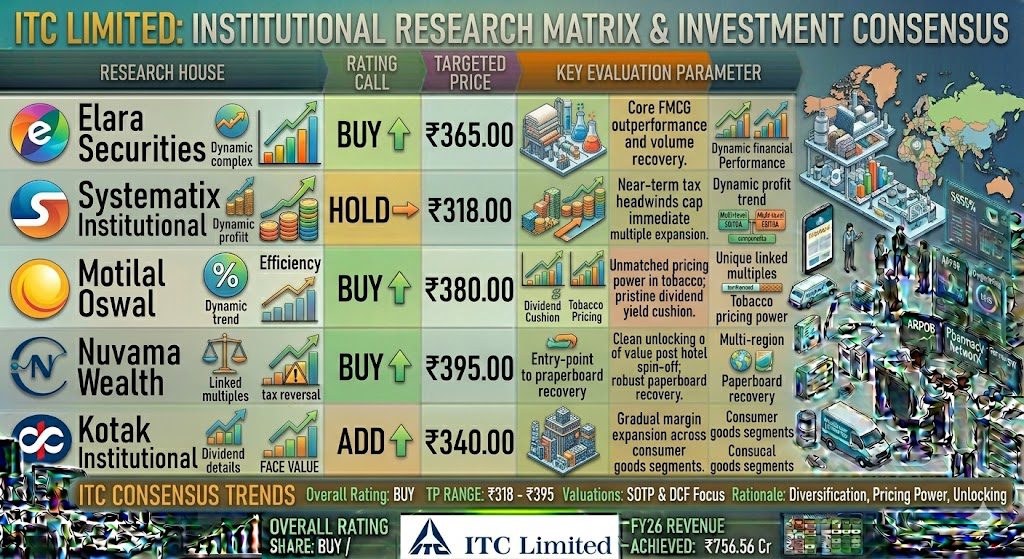
Institutional research firms delivered broadly positive reactions following ITC’s quarterly results.
Elara Securities maintained a BUY recommendation with a target price of ₹365, highlighting strong FMCG execution and cigarette volume resilience.
Systematix Institutional Equities maintained a HOLD recommendation with a target price of ₹318 because near-term tax pressures could temporarily limit valuation expansion.
Motilal Oswal Financial Services retained a BUY recommendation with a target price of ₹380 citing unmatched pricing power and strong dividend yield support.
Nuvama Wealth Management maintained a BUY recommendation with a target price of ₹395 due to improved capital efficiency following the hotels demerger.
Kotak Institutional Equities retained an ADD recommendation with a target price of ₹340 while highlighting gradual FMCG margin improvement.
The broader analyst consensus target currently stands near ₹359.60, implying upside potential of approximately 16.5% from current market levels.
Final Verdict: Buy, Hold, or Sell?
For long-term investors, the dramatic 74% profit-crash headline should largely be ignored because it reflects accounting distortion rather than operational weakness.
The real business of ITC Limited continues generating powerful cash flows, stable earnings, growing FMCG scale, and dependable dividend payouts.
At current valuations, the stock still offers a significant margin of safety compared to most large-cap FMCG peers.
For tactical traders, the ₹304.50 support zone remains critically important. If the stock successfully sustains above this region, short-term momentum could gradually push prices back toward ₹315 and ₹322.80 over the coming sessions.
Overall, ITC delivered one of the most misunderstood earnings reports of Q4 FY26. Beneath the sensational headlines, the company’s core operating engine remains fundamentally strong, diversified, cash-rich, and structurally positioned for long-term compounding.