Introduction: The Energy Engine of Bharat
If you’ve tracked India’s energy sector over the past three decades, you would know that cycles are everything. Refining margins go up and down, crude oil prices fluctuate sharply, and government policies often reshape profitability overnight. Through all of this, Indian Oil Corporation (IOC) has remained one of the most important pillars of India’s energy ecosystem.
In the early 2000s, IOC was primarily seen as a refining and fuel marketing company. Today, in 2026, it has evolved into a diversified energy giant with interests spanning refining, petrochemicals, natural gas, and even green energy initiatives. This transformation has not been linear—it has been shaped by cycles of volatility and recovery.
The Q4 FY26 results, released on April 30, 2026, mark a significant turning point. IOC has delivered a blockbuster quarter, with net profit jumping sharply, indicating that operational strengths are once again coming to the forefront.
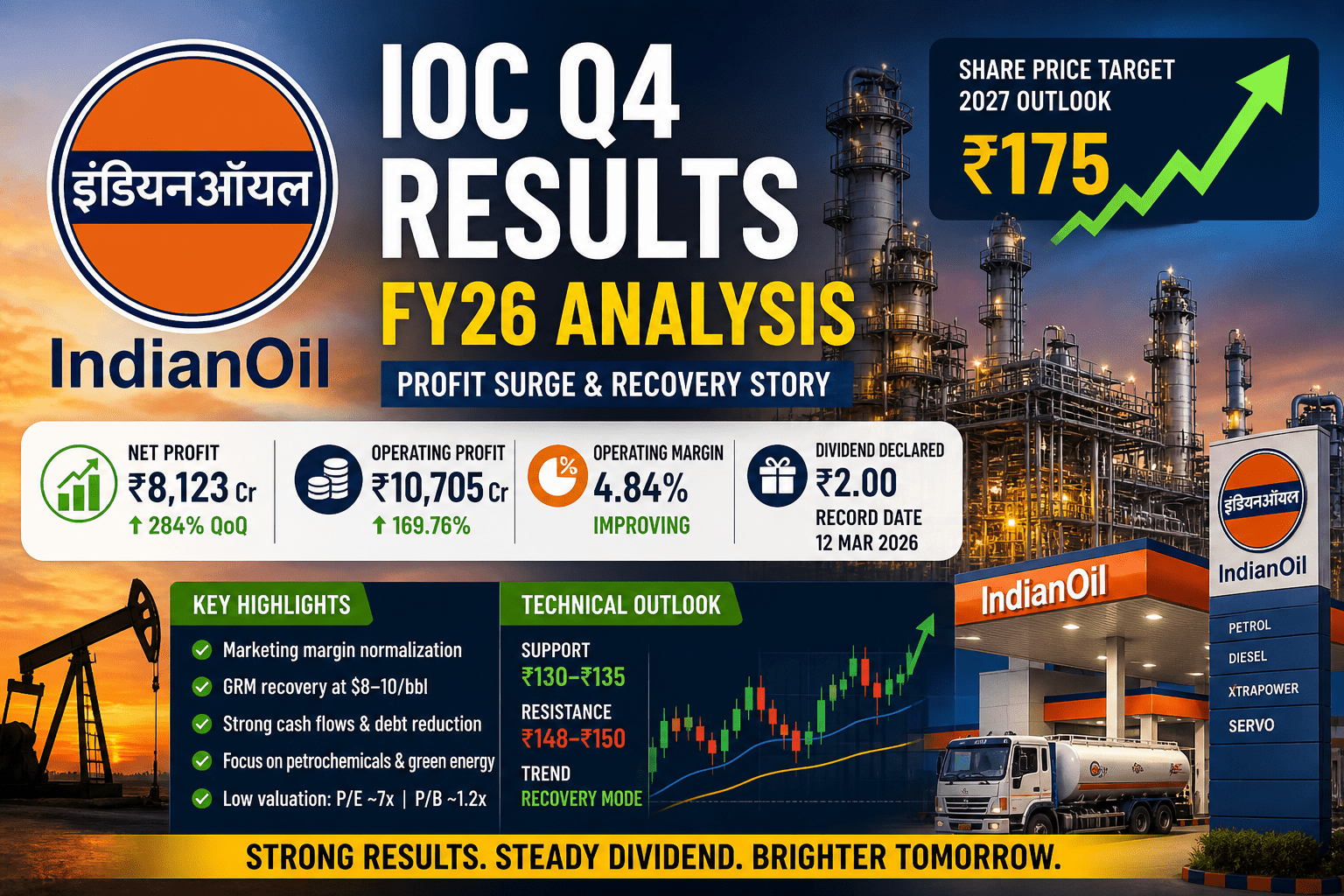
The headline number is hard to ignore. IOC reported a net profit of ₹8,123.64 crore, representing a massive 284% quarter-on-quarter increase. This surge reflects the normalization of marketing margins and improved refining performance.
From a market perspective, the stock is currently trading around ₹141, recovering from its 52-week low of ₹130. While the past year has been challenging for IOC shareholders, the latest numbers suggest that the company may be entering a new phase of value unlocking and re-rating.
Q4 FY26 Financial Scorecard: The Actual NSE Numbers
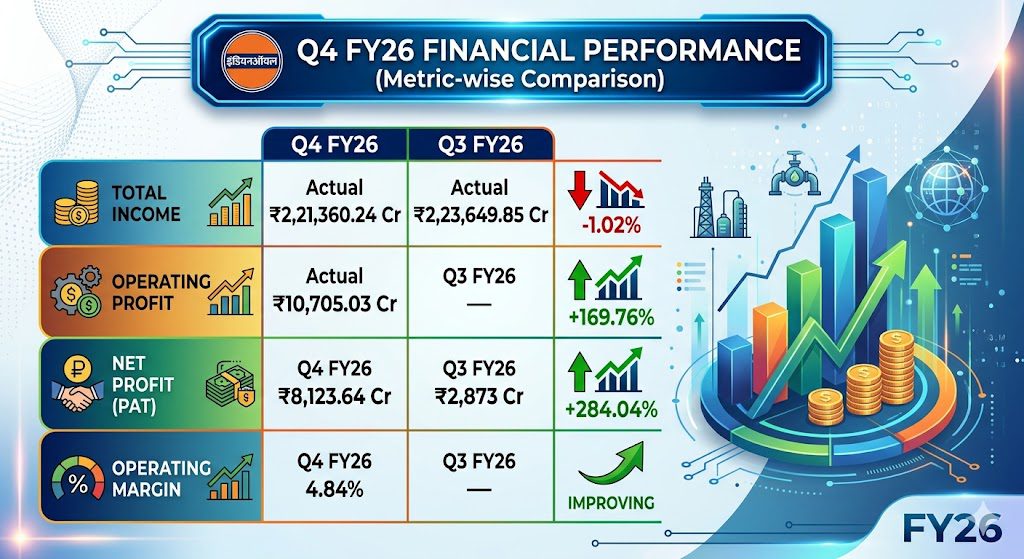
The Q4 FY26 financial performance highlights a strong operational recovery across key metrics. Total income for the quarter stood at ₹2,21,360.24 crore, slightly lower than ₹2,23,649.85 crore in Q3, reflecting a marginal 1.02% decline. However, this minor dip in revenue is not a concern, as the real story lies in profitability.
Operating profit surged to ₹10,705.03 crore, marking a significant 169.76% increase. This sharp jump indicates improved efficiency and better cost management.
The standout figure is net profit (PAT), which rose dramatically to ₹8,123.64 crore from ₹2,873 crore in the previous quarter. This represents a 284% increase, driven primarily by improved marketing margins and stable crude prices.
Operating margins also improved to 4.84%, signaling that the company is regaining its pricing power and operational efficiency.
Overall, the numbers reflect a classic recovery phase—where profitability improves faster than revenue, driven by margin expansion.
Fundamental Analysis: Decoding the Recovery
Marketing Margin Normalization
One of the biggest challenges for oil marketing companies in India has been fluctuating marketing margins. Over the past year, margins were under pressure due to volatile crude prices and government intervention in fuel pricing.
In Q4 FY26, this situation has improved significantly. Retail fuel prices remained relatively stable, while crude oil costs moderated. This led to a normalization of marketing margins, which became the primary driver of the profit surge.
GRM Trajectory (Gross Refining Margin)
Another critical factor is the recovery in Gross Refining Margins (GRMs). Analysts had estimated GRMs in the range of $8–10 per barrel for the quarter, and the actual performance appears to align with these expectations.
Higher GRMs directly translate into better profitability for refining companies like IOC. This operational leverage is one of the key reasons behind the sharp increase in net profit.
Debt Reduction and Balance Sheet Strength
With improved cash flows from operations, IOC is now focusing on reducing its debt levels. This is an important step, as a stronger balance sheet provides flexibility for future investments, particularly in petrochemicals and green energy projects.
Lower debt also means reduced interest costs, which further supports profitability in the long term.
Technical Analysis: The Support Floor
From a technical perspective, IOC is currently in a short-term consolidation phase, but with strong support levels in place.
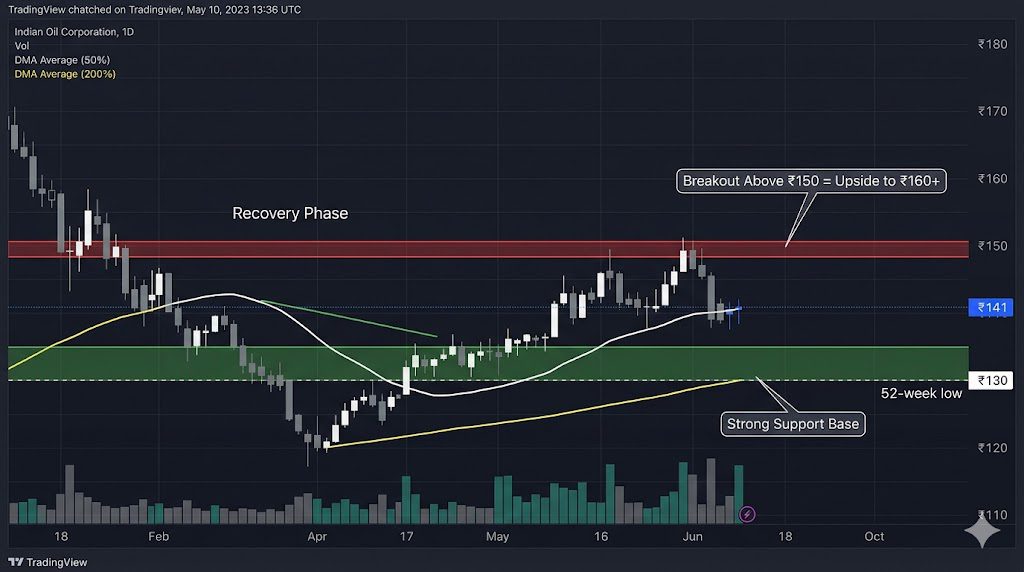
The stock has found a solid base near the ₹130–₹135 zone, which corresponds to its 52-week low. This level has acted as a strong support, indicating that downside risk may be limited.
The major support level is ₹130.30, which has held firm despite market volatility. As long as this level remains intact, the long-term structure remains stable.
On the upside, the immediate resistance is ₹148.34. A breakout above this level could trigger a move toward the ₹160+ zone, opening the door for further upside.
From a valuation perspective, IOC is currently trading at a trailing P/E of around 7x, which is significantly lower than many peers. This makes it an attractive value buy for long-term investors.
Dividend & Shareholder Value
IOC has always been known for its strong dividend payouts, and FY26 is no exception. The company declared a dividend of ₹2.00 per share, with a record date of March 12, 2026.
When combined with previous payouts of ₹5.00 and ₹3.00, the total dividend for the year reflects a strong commitment to shareholder returns.
For long-term investors, this dividend yield provides a margin of safety, ensuring steady income even during periods of price volatility.
Brokerage Sentiment & Targets: The Path to ₹175
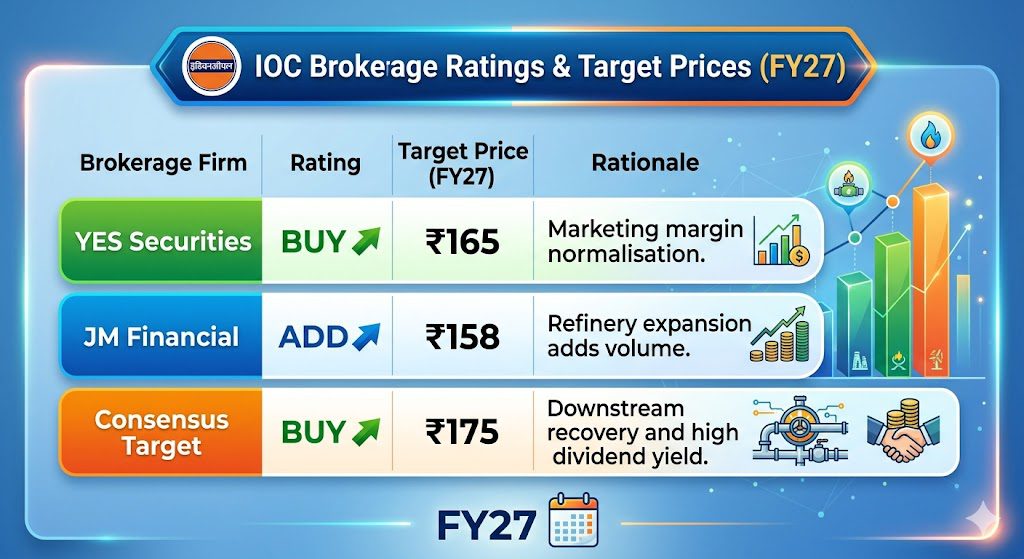
Brokerages have turned increasingly optimistic about IOC’s prospects following the Q4 results.
- YES Securities has a “Buy” rating with a target price of ₹165, driven by the normalization of marketing margins.
- JM Financial has an “Add” rating with a target of ₹158, highlighting the benefits of refinery expansion.
- The consensus target stands at ₹175, reflecting expectations of continued recovery in downstream operations and strong dividend yield.
These targets indicate that the market expects IOC to benefit from both operational recovery and valuation re-rating.
Management Guidance: The FY27 Outlook
Petrochemical Expansion
IOC is focusing on expanding its petrochemical business to reduce dependence on traditional fuel marketing. Petrochemicals offer higher margins and more stable demand, making them a key growth driver for the future.
Green Energy Transition
The company is also investing in electric vehicle (EV) charging infrastructure and City Gas Distribution (CGD) networks. These initiatives align with India’s broader push toward cleaner energy and sustainability.
Over time, these investments could transform IOC into a more diversified energy company, reducing its exposure to crude oil price volatility.
The “30-Year” Analyst Verdict
From a long-term perspective, IOC is what I would call a “quality-at-a-discount” stock. With a price-to-book ratio of around 1.2x, it is trading below its historical averages, making it attractive for value investors.
The recent profit surge indicates that the worst may be behind the company, and a recovery cycle is underway.
For investors, this is a stock that offers both income (via dividends) and capital appreciation potential. For traders, the strategy is to accumulate on dips near ₹140 and target a move toward ₹160+ in the medium term.
Conclusion & Engagement (CTA)
IOC’s Q4 FY26 performance marks a strong comeback. A 284% jump in profit, combined with stable dividends and improving margins, signals that the company is regaining its operational strength.
The era of prolonged marketing losses appears to be behind us, and the focus is now shifting toward value creation and diversification.
The key question for investors is simple—are you buying IOC for its attractive dividend yield, or are you positioning for the potential upside toward ₹175?
Let’s discuss your strategy in the comments—because in the world of oil and gas, timing and patience often make all the difference.