

Introduction: The World’s Factory System Is Changing
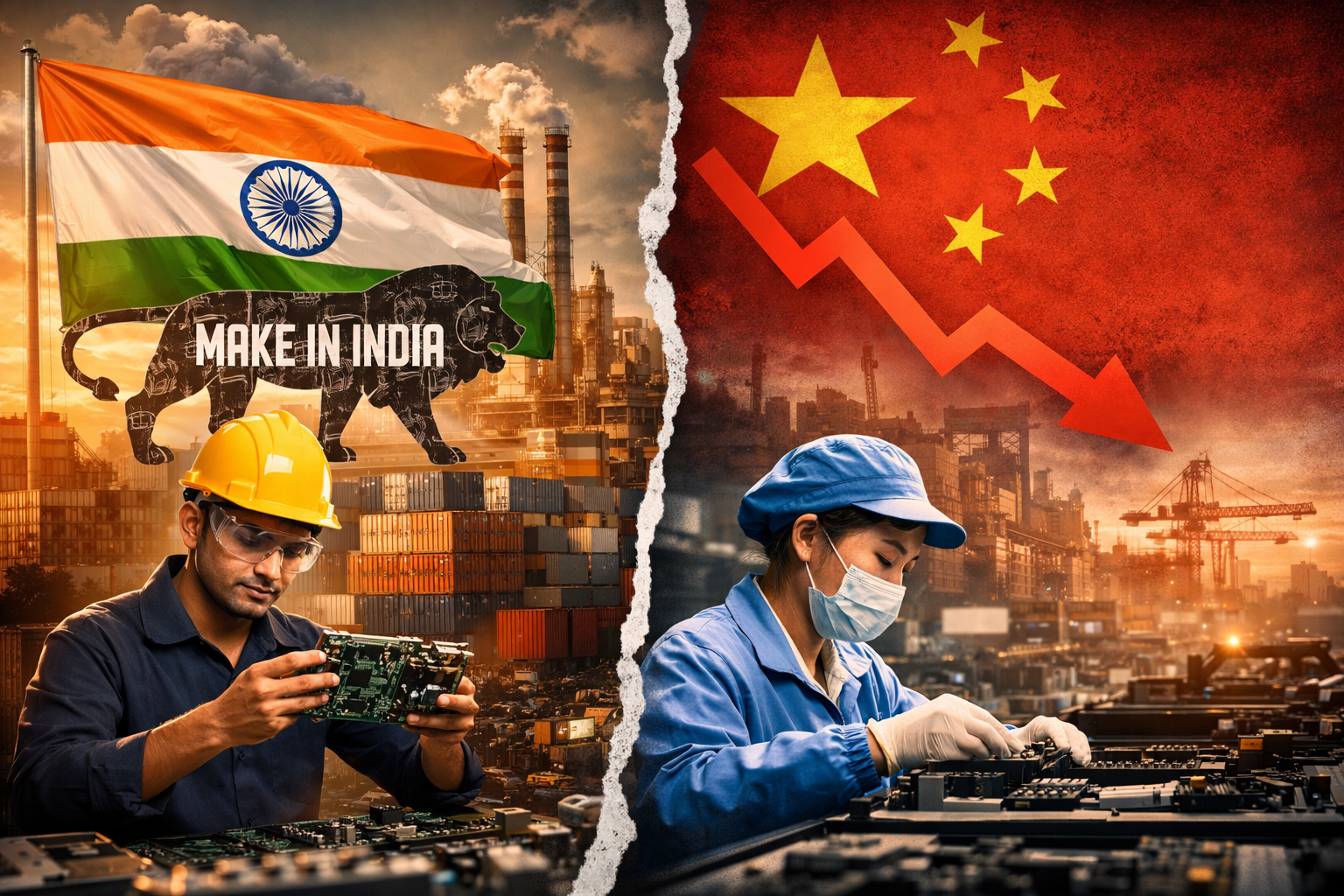
For nearly three decades, the world depended heavily on one country for making everything—from toys and textiles to smartphones and solar panels. That country was China. Low costs, fast execution, and massive scale turned it into the “factory of the world.” But the global economy never stands still. Over the last five years, cracks have started to appear in this model. Rising costs, geopolitical tensions, trade wars, and supply chain shocks have forced companies and governments to rethink where and how goods are produced.
At the same time, India has been quietly preparing for a bigger role in global manufacturing. With policy support, infrastructure spending, and a large workforce, India is being seen as a serious alternative. This has led to a surge in searches like “Make in India winners”—people want to know who benefits, how real the boom is, and whether India can truly gain from China’s slowdown.
This article explains the shift in simple language. It looks at real-world data trends, lessons from history, and on-ground realities. The goal is not hype, but clarity—so readers can understand what is actually happening and why it matters.
Why China’s Manufacturing Growth Is Slowing
China is not collapsing, but it is slowing—and that difference matters. For many years, China grew at breakneck speed because it combined cheap labour, export-friendly policies, and heavy investment in factories and ports. Over time, this success created new problems. Wages rose sharply, land became expensive, and environmental rules became stricter. What was once cheap is no longer so.
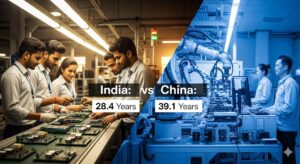
Another major factor is demographics. China’s working-age population is shrinking. Fewer young workers mean higher labour costs and lower flexibility for factories that depend on large manpower. This is a structural issue, not a temporary one. Countries like Japan faced a similar challenge in the 1990s when their population aged and manufacturing growth slowed.
The Comparison: India vs China in 2025
| Feature | India (2025) | China (2025) |
|---|---|---|
| Median Worker Age | 28.4 years | 39.1 years |
| Manufacturing Focus | Electronics, EVs, Pharma, Textiles | High-end Robotics, AI, Aerospace |
| Advantage | Labor cost & Young workforce | Infrastructure & Supply chain maturity |
| Challenge | Last-mile logistics efficiency | Geopolitical trade barriers (US/EU) |
Geopolitics has also played a big role. Trade tensions with the United States led to tariffs, technology restrictions, and tighter controls on Chinese firms. This increased uncertainty for global companies. Even firms that wanted to stay in China started asking a simple question: What if things get worse? That question alone was enough to push them to look for backup locations.
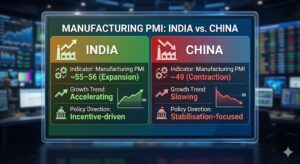
Finally, China’s domestic problems—especially in real estate—have reduced internal demand. When construction slows, many linked industries also suffer. Together, these factors explain why China’s manufacturing engine is no longer running at full speed.
The Rise of the “China+1” Strategy
Global companies are not abandoning China overnight. Instead, they are following what is called the “China+1” strategy. This means keeping some production in China but adding at least one more country to reduce risk. The goal is stability, not politics.
The COVID-19 pandemic showed how risky it is to depend on a single country. Factory shutdowns, shipping delays, and shortages of basic goods shocked the global system. Later, disruptions in shipping routes, such as those in the Red Sea, added another layer of uncertainty. These events taught companies that resilience matters as much as cost.
As a result, countries like India, Vietnam, Mexico, and Indonesia entered the picture. Among them, India stands out because of its market size, workforce, and government support. This is where the idea of a manufacturing boom begins—not because China failed, but because the world is spreading its bets.
India’s Manufacturing Push: Understanding the Policy Shift

India’s manufacturing story did not begin yesterday. For years, policymakers talked about increasing the share of manufacturing in GDP, but progress was slow. The turning point came when the government started linking incentives directly to production outcomes. This approach rewarded companies not for promises, but for actual output.
The Production Linked Incentive (PLI) schemes are a good example. Under these schemes, firms receive financial incentives only if they meet specific production targets. This changed behaviour. Companies that were unsure earlier began to commit capital because the rules were clearer and returns were tied to performance.
Alongside this, India invested heavily in roads, ports, railways, and digital infrastructure. Logistics costs, which were once a major weakness, began to fall. Corporate tax rates for new manufacturing units were reduced, making India more competitive compared to many peers.
However, reforms are uneven. Some states move faster than others. Land acquisition and legal delays still exist. But compared to the past, the direction is clear and consistent—and that consistency is crucial for long-term manufacturing investment.
Electronics and Smartphones: The Most Visible Winner
The clearest success story of “Make in India” is electronics manufacturing, especially smartphones. A few years ago, India mainly imported finished phones. Today, it assembles and exports millions of units each year. Large global brands now use India as an export base, not just a domestic market.
This shift created jobs, improved skills, and brought India into global value chains. Critics rightly point out that much of the work is still assembly-level, with limited value addition. That criticism is valid. But every manufacturing powerhouse started somewhere. China itself began with assembly before moving up the value chain.
What matters is trajectory. Local sourcing of components is increasing, and supporting industries are slowly developing. Electronics shows how policy, scale, and global demand can come together when conditions are right.
Automobiles and EV Components: A Parallel Track
India’s automobile sector has long been strong in conventional vehicles. Now, the focus is expanding to electric vehicles (EVs) and related components. Instead of betting everything on one technology, India is running two tracks—improving traditional auto exports while building capacity in EV batteries, motors, and power electronics.
This balanced approach reduces risk. Global demand for cleaner transport is rising, and companies want diversified supply chains. India’s large domestic market also helps manufacturers test and scale new products before exporting them.
While China remains ahead in battery technology, India is catching up in assembly and integration. Over time, this could turn into a competitive advantage, especially as global firms look to reduce China-centric exposure.
Pharmaceuticals and Chemicals: Strategic Manufacturing
Pharmaceuticals and specialty chemicals are less visible but strategically more important. During global crises, access to medicines becomes a national security issue. India has long been a major supplier of finished drugs, but it depended heavily on China for raw materials.
That dependence created concern. Over the last few years, efforts have increased to build domestic capacity for key inputs. While progress is gradual, the direction is important. Reducing import dependence improves resilience and bargaining power.
In chemicals, environmental restrictions in China pushed many firms to look for alternative locations. India benefited from this shift, especially in niche chemical segments where technical skills matter more than scale alone.
Defence Manufacturing: From Importer to Exporter
Defence manufacturing deserves special mention because it combines economics with geopolitics. Traditionally, India imported most of its defence equipment. This created long-term dependence and drained foreign exchange.
Policy changes encouraged domestic production and joint ventures. Today, India exports defence equipment to several countries, even if volumes are still modest. More importantly, local manufacturing improves strategic autonomy. In a world of uncertain alliances, this autonomy is a form of power.
Defence manufacturing also has spillover benefits. Technologies developed for defence often find civilian use, improving overall industrial capability.
Are Jobs Being Created Where They Are Needed Most?
Manufacturing is often seen as a solution to job creation. The reality is more complex. Modern factories are more automated than before. They create fewer jobs per unit of output compared to older models.
Still, manufacturing jobs are generally more stable and better paid than informal work. They also support indirect employment in logistics, services, and local supply chains. The real challenge is skills. Without proper training, workers cannot move into higher-value roles.
Small and medium enterprises play a key role here. When large firms source locally, MSMEs gain exposure to global standards. This is where long-term employment potential lies—not just in big factories, but in the ecosystem around them.
What India Still Lacks Compared to China
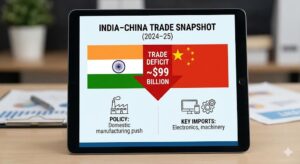
Despite progress, India is not China—and may never be. China’s strength lies in scale, speed, and deep supply chains. A factory there can source almost every component within a short distance. India is still building that depth.
Power costs, contract enforcement, and bureaucratic delays remain challenges. Logistics have improved, but consistency across regions varies. A realistic assessment must accept these gaps.
However, history shows that no country replaces another entirely. Instead, global manufacturing spreads across regions. India does not need to become “the next China” to succeed. It only needs to be reliable, competitive, and improving.
Manufacturing and Geopolitics: Why This Shift Matters
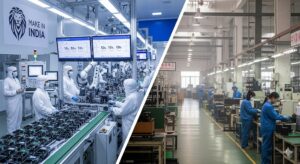
Manufacturing is not just about economics; it is about influence. Countries that control supply chains gain leverage in diplomacy. This is why manufacturing policy now sits at the centre of geopolitics.
India’s growing role strengthens its position in global forums and partnerships. It allows India to engage with multiple powers without over-dependence on any one country. At the same time, India avoids direct confrontation by focusing on economic opportunity rather than political alignment.
China’s slowdown, therefore, is not just an economic story. It is part of a broader rebalancing of global power.
The Road Ahead: Can India Sustain the Momentum?
The next decade will decide whether India’s manufacturing push becomes a lasting transformation or a short-term surge. Success depends on execution—stable policies, faster reforms, and skill development.
If India improves value addition, strengthens MSMEs, and maintains policy consistency, it can become one of the world’s top manufacturing hubs. Not by replacing China, but by complementing a more diversified global system.
The risk lies in complacency. Manufacturing growth is hard work. It requires patience, discipline, and coordination between states, industry, and workers.
Conclusion: Understanding the Real ‘Make in India’ Winners
India’s manufacturing boom is real, but it is selective. Electronics, autos, pharmaceuticals, chemicals, and defence show clear gains. China’s slowdown created an opening, but India’s response created the opportunity.
The real winners are not just companies or sectors. They are the systems that improve productivity, resilience, and skills. For readers, the key takeaway is simple: global manufacturing is changing, and India is part of that change—not as a replacement, but as a rising pillar in a more balanced world economy.
Understanding this shift helps investors, students, and policymakers see beyond headlines and grasp the deeper forces shaping the future.
To visit official website of Ministry of Commerce {China} click here
❓ Frequently Asked Questions (FAQ)
1. Why is China’s manufacturing growth slowing in 2024–2025?
China’s manufacturing is slowing mainly because of rising labour costs, weak global demand, an ageing workforce, and geopolitical pressures like trade restrictions. Many global companies are also reducing over-dependence on China, which has affected new factory investments.
2. Is India really benefiting from China’s manufacturing slowdown?
Yes, but selectively. India is gaining in sectors like electronics, automobiles, pharmaceuticals, chemicals, and defence manufacturing. India is not replacing China entirely, but it is becoming a strong alternative in specific industries.
3. What does “Make in India winners” actually mean?
“Make in India winners” refers to industries, companies, and regions that benefit most from India’s manufacturing push. These include smartphone manufacturing, auto components, EV parts, pharma APIs, and defence equipment producers.
4. What is the China+1 strategy and why does it matter for India?
China+1 is a strategy where global companies keep operations in China but add another country—like India—to reduce risk. This matters for India because it brings foreign investment, jobs, technology, and export opportunities.
5. Which sectors are growing fastest under Make in India in 2025?
The fastest-growing sectors include:
Electronics and smartphone manufacturing
Automobiles and EV components
Pharmaceuticals and specialty chemicals
Defence manufacturing
Renewable energy equipment
6. How important is the PLI scheme for India’s manufacturing boom?
The Production Linked Incentive (PLI) scheme is critical. It rewards companies for actual production, not promises. By 2025, it has attracted large investments, boosted exports, and created millions of jobs, especially in electronics and solar manufacturing.
7. Can India replace China as the world’s factory?
No country can fully replace China in the short term. China still has unmatched scale and supply-chain depth. However, India can become one of the world’s top manufacturing hubs by focusing on selected sectors and improving execution.
8. What challenges does India still face in manufacturing?
India still struggles with:
Smaller manufacturing scale compared to China
Supply-chain depth and component availability
Higher logistics and power costs in some regions
Skill gaps in advanced manufacturing
These challenges need long-term reform.
9. How does manufacturing growth help India geopolitically?
Manufacturing strength improves strategic autonomy. It reduces import dependence, strengthens export power, creates jobs, and gives India more influence in global trade and diplomacy.
10. Is India’s manufacturing growth sustainable after 2025?
India’s growth can be sustainable if policies remain stable, infrastructure investment continues, skill development improves, and MSMEs are integrated into global supply chains. Execution will decide long-term success.
To visi Ministry of Trade & Commerce click here
🔍 People Also Ask (PAA)
Is India replacing China as the world’s manufacturing hub?
No. India is not replacing China entirely. China remains the largest manufacturing country in the world. However, India is becoming a strong alternative in selected sectors as companies diversify their supply chains.
Why are global companies moving manufacturing out of China?
Companies are moving part of their manufacturing out of China due to rising labour costs, geopolitical risks, trade restrictions, and supply chain disruptions experienced during COVID-19 and global shipping crises.
Which country benefits most from China’s manufacturing slowdown?
Several countries benefit, including India, Vietnam, Mexico, and Indonesia. Among them, India benefits due to its large workforce, government incentives, and growing domestic market.
What is the China+1 strategy in manufacturing?
China+1 is a business strategy where companies keep production in China but add another country, such as India, to reduce dependence on a single manufacturing base.
How successful is Make in India in 2025?
Make in India has seen mixed but improving success. It has performed strongly in electronics, smartphones, defence, and automobiles, while challenges remain in scale, supply-chain depth, and skill development.
Which sectors are the biggest Make in India winners?
The biggest winners include electronics manufacturing, automobile and EV components, pharmaceuticals, specialty chemicals, defence equipment, and renewable energy manufacturing.
Does India have lower manufacturing costs than China?
India generally has lower labour costs than China, but overall manufacturing costs depend on factors like logistics, power supply, productivity, and supply-chain efficiency.
How does manufacturing growth impact India’s economy?
Manufacturing growth helps increase exports, create stable jobs, reduce import dependence, improve trade balance, and strengthen India’s long-term economic resilience.
What are the biggest challenges for India’s manufacturing sector?
Key challenges include land acquisition delays, uneven infrastructure quality across states, skill gaps, higher logistics costs in some regions, and slower contract enforcement.
Can Make in India generate large-scale employment?
Manufacturing can generate employment, especially through MSMEs and supply chains. However, modern manufacturing is more automated, so job creation depends on skill development and supporting industries.
Why is manufacturing important for geopolitics?
Manufacturing gives countries economic power, supply-chain control, and strategic autonomy. Strong manufacturing reduces dependence on imports and increases global influence.
Will India’s manufacturing boom continue after 2025?
India’s manufacturing boom can continue if policy stability, infrastructure investment, skill training, and export competitiveness are maintained over the next decade.

2 thoughts on “India Manufacturing Boom vs China Slowdown: Who Are the Real ‘Make in India’ Winners in 2025?”