Dalal Street Ends Slightly Lower as Markets Struggle With Global Cues and Profit Booking
1️⃣ Why Today’s Market Action Matters
Was today’s market a trap, a breakout, or a warning signal for traders and investors? On 17 December 2025, Indian equity benchmarks opened with modest gains but quickly lost steam as the trading session progressed. After a choppy ride marked by short-lived optimism and cautious flows, both the Nifty and Sensex closed in the red for the third consecutive session — a rare pattern that traders don’t take lightly.
At the close, the Nifty 50 settled at 25,818.55, down about 0.16%, while the BSE Sensex finished at 84,559.65, lower by approximately 0.14%. Even the Bank Nifty dipped, ending the day at around 58,926.75, reflecting weakness in key banking counters. The subdued finish — despite early gains — suggests that market participants are weighing global uncertainties, foreign selling pressure, and domestic profit-taking more heavily than near-term bullish sentiment.
This market action matters because it signals a shift from speculative optimism to cautious consolidation, especially as investors grapple with mixed global cues, foreign fund outflows and softer domestic triggers. Today’s session is an important pulse check for both traders and long-term investors as they position ahead of quarterly results and year-end flows.
2️⃣ Index Performance: Nifty, Sensex & Bank Nifty Explained
The headline indices painted a picture of range-bound indecision throughout the session. After opening marginally higher, the market struggled to hold gains and veered into negative territory due to persistent selling pressure in heavyweight stocks.
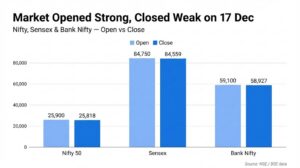
Nifty 50: Closed at 25,818.55, down 41.55 points (~0.16%). The index briefly traded above 25,900 in the early session before reversing.
Sensex: Ended lower at 84,559.65, shedding around 120 points by the closing bell.
Bank Nifty: Closed at 58,926.75, down roughly 0.18%, underperforming the broader index.
Market participants noted that the session resembled a trend-negative day, albeit without extreme volatility. Indices spent much of the day oscillating in a tight range — a sign of consolidation rather than a breakout. Technical analysts point out that indices remain below major resistance levels (e.g., Nifty’s 26,000–26,100 band), suggesting that bulls have yet to regain control.
For traders, this behaviour signals a mix of profit booking and caution. Range-bound markets often offer short-term trading opportunities between support and resistance, but they also indicate that consensus directional conviction is weak. Meanwhile, longer-term investors are watching critical levels above the 26,000 zone for signs of renewed strength.
3️⃣ Sector Watch: Which Sectors Drove Today’s Market?
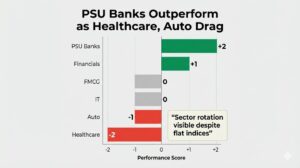
Today’s market action was a tale of selective sectoral strength and broad weakness.
Gaining Sectors
PSU Bank Index: Demonstrated resilience and rose modestly, supported by solid fundamentals and recent earnings strength in state-owned banks. This sector has been a standout performer throughout 2025, with the PSU Bank Index gaining significantly more than the benchmark.
Select Financials: Stocks like Shriram Finance and State Bank of India (SBI) featured among the session’s gainers, offering some support to the broader market.
Underperforming Sectors
Healthcare & Auto: These sectors were among the weakest, with names like Max Healthcare and Apollo Hospitals dragging on market sentiment.
Consumer Durables & Media: Also lagged, reflecting risk-off positioning and profit booking in discretionary segments.
The rotation into banks and financials — and away from defensives like healthcare — suggests that some investors are still hunting yield and valuation plays even as broader sentiment remains cautious. Sector rotation often tells a deeper story than headline index moves, as it reveals where money is actually flowing. A sustained tilt toward financials and PSU banks could signal that value seekers are looking past headline volatility.
4️⃣ Top Gainers & Losers: Stocks That Defined Today
Here’s a snapshot of the stocks that left their mark on 17 December 2025:
Top Gainers
Shriram Finance: Led the gainers with a roughly 2.07% rise, buoyed by strength in financial counters.
State Bank of India (SBI): Clawed back some ground with around 1.58% gains.
Hindalco Industries: Added about 1.3% amid selective buying.
Eicher Motors: Recorded modest gains (~1.15%).
Tata Consumer Products: Closed up near 0.86%, contributing to defensive support.
Top Losers
Max Healthcare: The biggest laggard, down around 3.7%, hit by profit booking and weak sentiment.
Apollo Hospitals: Declined nearly 2%.
Trent: Fell about 1.7%.
Bajaj Auto: Down about 1.5%.
HDFC Life: Slipped around 1.5%.
This mix of gainers and losers highlights the divergent nature of market participation — financials and cyclical names found buying interest, while defensive and discretionary names encountered selling pressure. The disparity suggests that profit booking in some expensive names was a key driver for the declines, even as value-oriented stocks attracted selective buying.
5️⃣ Institutional Activity: What FIIs & DIIs Did Today
Institutional activity is always a key barometer of market sentiment, and today was no different.
Foreign Institutional Investors (FIIs):
The market saw continued pressure from foreign portfolio investor outflows, a trend investors have tracked closely throughout the recent market pullback. Persistent FII selling tends to sap momentum in large-cap stocks and dampens overall market sentiment, especially when global cues are uncertain or risk appetite wanes.
Domestic Institutional Investors (DIIs):
On the other hand, DIIs maintained selective buying, particularly in value and financial segments. This helped cushion some of the broader declines and kept losses from deepening further. DIIs often act as a counterbalance to FII flows and can help stabilize markets during bouts of foreign selling.
These divergent flows — FIIs selling while DIIs buy selectively — reflect a common pattern in current market conditions. Simply put: FII selling doesn’t always equate to market crash; it often signals profit taking or repositioning in response to global cues, while DIIs focus on long-term valuation and domestic story fundamentals.
To visit Moneycontrol website click here
6️⃣ Global Cues & News Impacting Today’s Market
Global signals played a significant role in today’s session.
Mixed U.S. Data:
Shares in India opened modestly higher in tune with global markets, which were reacting to mixed U.S. jobs data, leaving investors uncertain about the Federal Reserve’s next interest rate move.
Rupee Volatility & RBI Action:
The Indian rupee had been under pressure recently, prompting intervention by the Reserve Bank of India (RBI) to stabilize it — an action that had ripple effects on sentiment.
Combined, these factors kept traders on edge, with none powerful enough to generate sustained buying. Instead, the market traded cautiously, oscillating between mild optimism and defensive profit booking.
7️⃣ Market Breadth & Volatility: What the Numbers Say
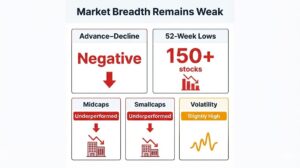
The breadth of the market — a measure of how many stocks advance versus decline — was skewed negatively.
According to broader market data, a large majority of stocks declined on 17 December, with many hitting new lows. Reports indicated that over 150 stocks touched 52-week lows and that both midcap and smallcap indices lagged behind the benchmark.
This kind of breadth — where declines outnumber advances significantly — is often interpreted as weak market health, even if headline indices like the Nifty or Sensex don’t plunge sharply. It signals that selling pressure is broad-based rather than isolated to a few names.
Contrary to volatility spikes seen in strong trend moves, today’s session looked like a measured pause with moderate intraday swings and a lack of decisive directional momentum.
To visit official website of NSE CLICK HERE
8️⃣ What Today’s Market Means for Traders & Investors
So what does this mean for different market players?
For Short-Term Traders:
Today’s range-bound session with mild declines offered intraday opportunities between support and resistance.
Traders who trade volatility might have found setups within tight bands, but the absence of strong trends for indices makes breakout trades riskier.
For Long-Term Investors:
A 0.16–0.14% decline is unlikely to warrant major portfolio changes.
However, sector shifts — such as strength in PSU banks and weakness in healthcare — may guide selective rebalancing of equity holdings.
Overall, the market exhibited hints of distribution and consolidation rather than aggressive selling or accumulation. This suggests that participants are watching macro cues and earnings prospects closely before committing fresh capital.
9️⃣ Tomorrow’s Market Outlook: What to Watch Next
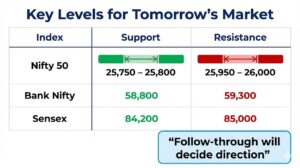
Looking ahead, there are a few key levels and events that traders and investors should monitor:
Nifty near support at ~25,800: A decisive break below this could attract further selling, whereas holding above it might set up a rebound.
Resistance near 25,950–26,000: A sustained rally above this band could signal renewed bullishness.
Bank Nifty support zone: 58,800–59,000 remains crucial for banking stocks.
Global macro data: Any fresh U.S. inflation or policy signals could swing sentiment overnight.
In short, tomorrow’s market will be decided not by headlines, but by follow-through — whether buyers step in at key supports or sellers dominate technical breakdowns.
Gold Rate Today (17 Dec 2025): Prices Surge Again — Is Now the Right Time to Buy? Read Now
❓ Frequently Asked Questions (FAQ)
Stock Market Today – 17 December 2025
❓ Why did the stock market fall today on 17 December 2025?
The stock market slipped today mainly due to profit booking at higher levels and weak global cues. Although indices opened strong, selling pressure in banking, healthcare and auto stocks dragged Nifty and Sensex lower by the close. Continued caution among foreign investors also weighed on sentiment.
❓ How did Nifty and Sensex perform today?
On 17 December 2025, Nifty 50 closed around 25,818, while the Sensex ended near 84,560, both slightly lower than the previous session. The market failed to hold early gains, indicating resistance at higher levels and a lack of strong buying support.
❓ Which sectors performed best in today’s market?
PSU banks and select financial stocks performed better compared to the broader market. Buying interest was seen in stocks like SBI and Shriram Finance, while most other sectors such as healthcare, auto, and consumer stocks remained under pressure.
❓ Which stocks were the top gainers today?
Stocks such as Shriram Finance, SBI, Hindalco, Eicher Motors, and Tata Consumer Products emerged as top gainers. These stocks benefited from sector-specific buying, valuation comfort, and selective institutional interest.
❓ Which stocks were the top losers today?
Max Healthcare, Apollo Hospitals, Trent, Bajaj Auto, and HDFC Life were among the top losers. Selling was largely driven by profit booking and sectoral weakness rather than company-specific negative news.
❓ What did FIIs and DIIs do today?
Foreign Institutional Investors (FIIs) continued to remain net sellers, adding pressure on large-cap stocks. Domestic Institutional Investors (DIIs), however, provided partial support by selectively buying fundamentally strong stocks, preventing a sharper fall in the market.
❓ Is today’s market fall a warning sign for investors?
Today’s fall appears more like a phase of consolidation rather than a panic signal. Markets are digesting global cues and waiting for fresh triggers. Short-term volatility may continue, but there is no sign of a broad market breakdown yet.
❓ What should traders and investors watch after today’s market?
Investors should watch key support and resistance levels, global market movements, FII activity, and upcoming economic or corporate developments. Follow-through action in the next session will be crucial in deciding short-term direction.
🔍 People Also Ask (PAA)
(Perfect for ranking in Google’s “People Also Ask” section)
🔹 Why did Nifty close lower today?
Nifty closed lower due to selling pressure near resistance levels, weak global cues, and continued FII outflows, despite a positive opening.
🔹 Is today’s stock market fall a buying opportunity?
Today’s fall looks like normal market consolidation. Whether it becomes a buying opportunity depends on upcoming cues and how markets behave near support levels.
🔹 What is market breadth and why does it matter?
Market breadth shows how many stocks are rising versus falling. Weak breadth, like today, suggests broader market weakness even if index losses look small.
🔹 Why are FIIs selling Indian stocks?
FIIs often sell due to global factors such as interest rates, dollar strength, and risk appetite. Their selling does not always mean a long-term negative outlook for Indian markets.
🔹 Which sectors should be watched after today’s market?
Banking, PSU banks, and select value stocks should be watched closely, while sectors like healthcare and auto may remain volatile in the near term.
🔹 Will the stock market recover tomorrow?
Short-term recovery depends on global cues and follow-through buying. Markets may remain range-bound unless a strong trigger emerges.
🔹 What are the key levels to watch on Nifty now?
Traders are watching support near 25,750–25,800 and resistance around 25,950–26,000 to judge the next move.