1. Powerful Introduction
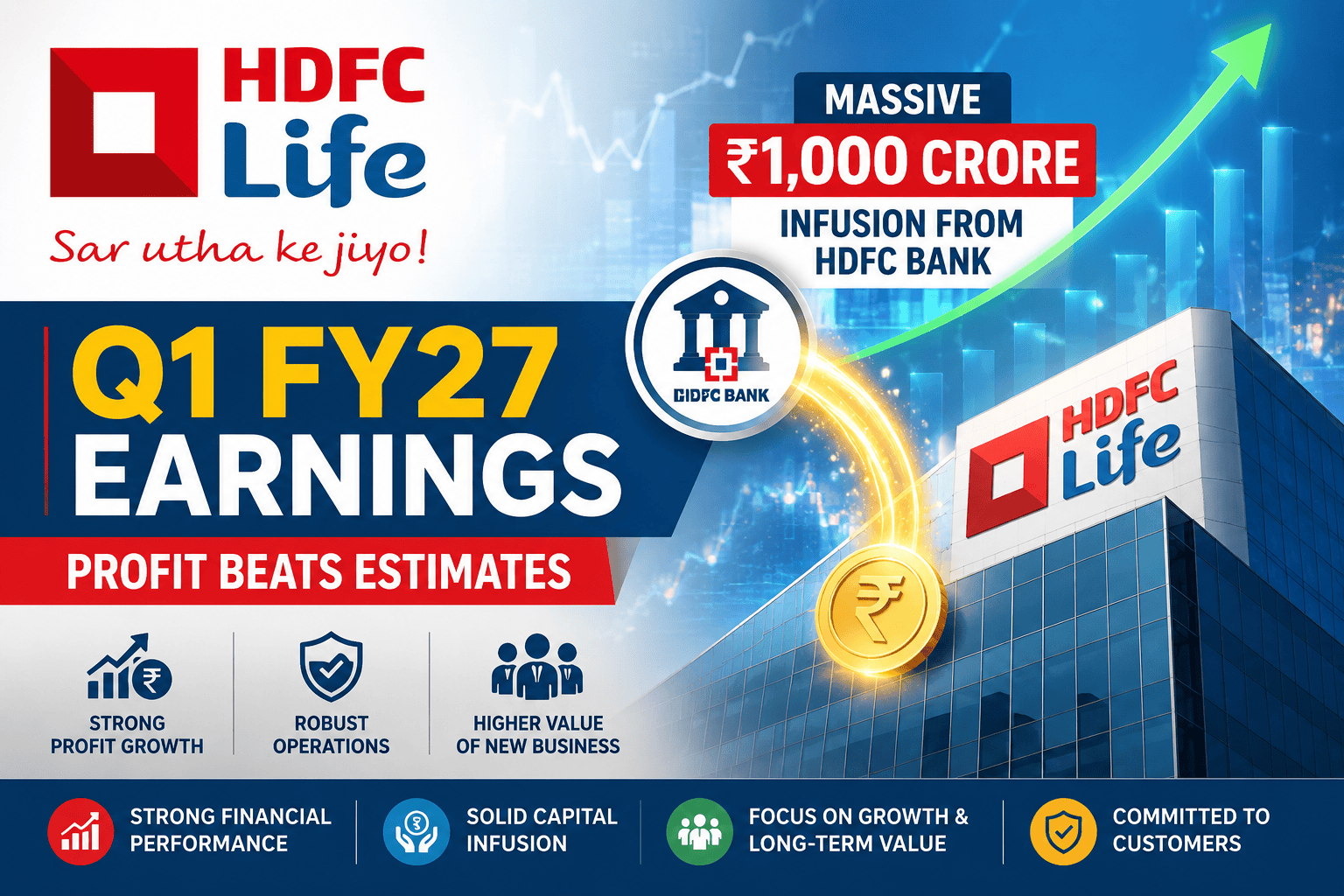
In the highly regulated and intensely competitive Indian life insurance sector, sustained premium growth is the ultimate indicator of structural business health. On July 15, 2026, HDFC Life Insurance Company Limited delivered exactly that, reporting a robust 11.4% year-on-year growth in consolidated net profit, reaching ₹61,119 lakhs (₹611.19 crore) for the first quarter of Fiscal Year 2027.
However, the most critical takeaway for long-term investors isn’t just the bottom line—it is the underlying quality of the earnings and a major strategic capital maneuver. Driven by a massive 15% surge in net premium income and anchored by a ₹1,000 crore preferential allotment to its promoter, HDFC Bank, the company is aggressively fortifying its balance sheet for the next decade of growth. For value investors, SIP allocators, and financial professionals, unpacking these Q1 FY27 metrics is essential to understanding whether HDFC Life remains a premier wealth compounder in the Indian financial landscape.
Key Numbers at a Glance
Consolidated Net Profit: ₹611.19 Crore
Net Premium Income: ₹16,727.63 Crore
Solvency Ratio: 185%
AUM (Policyholders + Linked): ~₹3.79 Lakh Crore
2. Executive Summary
For market professionals and retail investors who need the immediate facts, here are the core, verified highlights from HDFC Life’s Q1 FY27 statutory exchange filings:
Steady Profit Expansion: Consolidated Profit After Tax (PAT) stood at ₹61,119 lakhs (₹611.19 crore), up from ₹54,835 lakhs in Q1 FY26.
Accelerated Premium Collection: Consolidated Net Premium Income jumped to ₹1,672,763 lakhs (₹16,727.63 crore), a significant increase from ₹1,453,942 lakhs in the corresponding quarter last year.
Renewal Premium Dominance: The lifeblood of an insurer, Renewal Premium, grew impressively to ₹9,03,326 lakhs, up from ₹7,60,602 lakhs in Q1 FY26, indicating strong customer retention.
Strategic Capital Injection: The Board approved the allotment of 1.45 crore fully paid-up equity shares at ₹688.52 per share to HDFC Bank Limited, infusing ₹1,000 crore on a preferential basis.
Robust Solvency Margin: The company maintains a Solvency Ratio of 185%, comfortably above the IRDAI regulatory minimum of 150%.
Dividend Confirmation: A final dividend of ₹2.10 per equity share (face value ₹10) was confirmed, pending final shareholder approval at the July 16, 2026 AGM.
Persistency Metrics: The 13th-month persistency ratio (premium basis) stood at 80.0%, while the 61st-month persistency improved to 65.5%.
3. Company Snapshot
To contextualize the earnings, it is vital to understand HDFC Life’s operational framework.
Business Overview: HDFC Life Insurance Company Limited is one of India’s leading long-term life insurance solutions providers, offering a range of individual and group insurance solutions that meet various customer needs such as Protection, Pension, Savings, Investment, and Health.
Industry: Life Insurance and Financial Services.
Market Position: Top-tier private life insurer in India, known for product innovation and leveraging the massive bancassurance network of HDFC Bank.
Promoter Holding: HDFC Bank Limited is the primary promoter, further solidifying its stake with the recent ₹1,000 crore preferential allotment.
Key Competitors: SBI Life Insurance, ICICI Prudential Life Insurance, Max Life, and the Life Insurance Corporation of India (LIC).
4. Q1 FY27 Financial Highlights
The following professional tables break down the company’s financial performance.
Note: All figures are in ₹ Lakhs unless otherwise specified, based on Consolidated Unaudited Results for the quarter ended June 30, 2026. Value of New Business (VNB), VNB Margin, and Embedded Value (EV) are traditionally disclosed in supplementary investor presentations and are not present in this specific statutory exchange outcome.
Table 1: Core Revenue & Profit Metrics (Consolidated)
| Financial Metric | Q1 FY27 (June 30, 2026) | Q4 FY26 (March 31, 2026) | QoQ Growth | Q1 FY26 (June 30, 2025) | YoY Growth |
| First Year Premium | ₹2,74,634 | ₹4,45,667 | -38.37% | ₹2,55,949 | +7.30% |
| Renewal Premium | ₹9,03,326 | ₹1,488,442 | -39.31% | ₹7,60,602 | +18.76% |
| Single Premium | ₹5,45,269 | ₹7,12,257 | -23.44% | ₹4,72,191 | +15.47% |
| Net Premium Income | ₹1,672,763 | ₹2,599,842 | -35.65% | ₹1,453,942 | +15.05% |
| Income from Investments | ₹1,668,548 | (₹648,758) | Rebound | ₹1,460,228 | +14.26% |
| Profit After Tax (PAT) | ₹61,119 | ₹49,749 | +22.85% | ₹54,835 | +11.45% |
| Basic EPS (in ₹) | 2.83 | 2.31 | +22.51% | 2.55 | +10.98% |
Financial Translation in Simple English: Insurance is a seasonal business in India. Q4 (January-March) is historically the strongest quarter due to tax-saving investments, which explains the quarter-on-quarter (QoQ) drop. The true measure of health is the Year-on-Year (YoY) growth. A 15.05% YoY growth in Net Premium Income is a highly positive signal of expanding market reach.
Table 2: Capital Efficiency & Health Ratios (Consolidated)
| Key Metric | Q1 FY27 | Q4 FY26 | Q1 FY26 | Full Year FY26 |
| Solvency Ratio | 185% | 177% | 192% | 177% |
| Expenses of Management Ratio | 22.5% | 18.6% | 21.9% | 21.2% |
| 13th Month Persistency (Premium) | 80.0% | 81.6% | 82.7% | 84.9% |
| 61st Month Persistency (Premium) | 65.5% | 64.9% | 61.0% | 64.4% |
Key Takeaway: The Solvency Ratio has improved sequentially from 177% in March 2026 to 185% in June 2026, showcasing a stronger capital buffer against liabilities. Additionally, long-term customer retention (61st month persistency) saw a notable YoY improvement, climbing from 61.0% to 65.5%.
5. Segment-wise Analysis
Life insurance companies manage complex portfolios. HDFC Life categorizes its business into distinct segments, each with unique risk profiles and profitability margins. Here is a forensic breakdown of their standalone segment performance based on Net Premium:
1. Non-Participating – Individual & Group Life (The Margin Driver)
Net Premium: ₹6,63,220 Lakhs.
Analysis: “Non-Par” policies do not share in the company’s profits (no bonuses). They offer guaranteed returns to the customer. Because the insurer takes on the investment risk, these products typically command higher margins. This segment remains the largest premium contributor outside of ULIPs.
2. Unit Linked – Individual Life (ULIPs – The Market Proxy)
Net Premium: ₹3,93,030 Lakhs.
Analysis: Unit Linked Insurance Plans (ULIPs) pass the investment risk directly to the policyholder, linking returns to capital markets. In bull markets, ULIP sales soar. This segment generated a massive ₹9,69,579 lakhs in investment income during Q1 FY27, reflecting strong equity market performance.
3. Participating – Individual & Group Life (The Traditional Engine)
Net Premium: ₹2,39,183 Lakhs.
Analysis: “Par” products share the company’s profits with policyholders through bonuses. This is a stable, traditional segment that provides consistent, sticky capital over decades.
4. Non-Participating – Individual & Group Annuity (The Retirement Play)
Net Premium: ₹147,143 Lakhs.
Analysis: As India’s population demographics shift, annuity (pension) products are becoming crucial. This segment generated a healthy surplus of ₹2,212 lakhs for the quarter.
5. Emerging Segments (Health & Group Variable)
Non-Par Health Net Premium: ₹484 Lakhs.
Unit Linked Group Life Net Premium: ₹84,617 Lakhs.
Analysis: While Health remains a very small fraction of the total pie, group life products provide scale and corporate relationships that can be leveraged for cross-selling.
6. Strategic Capital Allocation: The HDFC Bank Infusion
One of the most consequential announcements in this regulatory filing is the preferential allotment of shares.
The Event: During the quarter ended June 30, 2026, HDFC Life allotted 1,45,23,906 fully paid-up equity shares (face value ₹10) at a premium price of ₹688.52 per share to its promoter, HDFC Bank Limited. The Value: This aggregates to a massive capital infusion of exactly ₹1,000 crore.
Why Does This Matter?
Valuation Benchmark: The allotment price of ₹688.52 sets a strong institutional floor and highlights the promoter’s confidence in the intrinsic value of the business.
Tier 1 Capital Strengthening: Life insurance is a capital-intensive business. To write new policies, insurers must maintain strict solvency margins. This ₹1,000 crore directly bolsters the shareholder equity base, giving HDFC Life immense firepower to pursue aggressive growth, digital expansion, or potential inorganic acquisitions without threatening its solvency ratio.
Bancassurance Synergy: Deepening the equity relationship with HDFC Bank ensures that HDFC Life remains the preferred insurance product pushed through India’s largest private bank branch network.
7. Financial Analysis & Capital Efficiency
Analyzing an insurance balance sheet is entirely different from analyzing a manufacturing company. We must look at liabilities and investment quality.
Asset Under Management (AUM) & Investment Quality
HDFC Life manages an enormous pool of domestic capital. On a consolidated basis:
Policyholders’ Investments: ₹2,62,46,058 Lakhs.
Assets held to cover Linked Liabilities: ₹1,17,17,512 Lakhs.
Shareholders’ Investments: ₹21,54,334 Lakhs.
Total AUM Proxy: Summing these up, the company is managing over ₹4.01 Lakh Crore in assets.
Yield on Investments (Policyholders’ Fund)
The company must generate returns to meet its guaranteed obligations.
Without Unrealized Gains: The yield on Non-Par linked funds stood at 2.5%, while Par funds yielded 2.1%.
With Unrealized Gains: Accounting for market movements, the yield on Linked Non-Par funds was an impressive 10.0%, reflecting strong equity market performance in Q1 FY27.
Asset Quality (NPAs) A massive positive for HDFC Life is its pristine asset quality. The Net Non-Performing Assets (NPAs) across all linked and non-linked policyholder and shareholder funds stand exactly at NIL. This indicates superior risk management and institutional-grade fixed-income underwriting.
Key Takeaway: HDFC Life is operating a highly conservative, exceptionally clean balance sheet. A NIL Net NPA ratio across a ₹4 Lakh Crore portfolio is the hallmark of premium financial management.
8. Industry Analysis
The Indian life insurance industry is at a structural inflection point.
Under-penetration: India remains heavily under-insured compared to global averages in terms of both mortality protection and retirement savings.
Regulatory Changes: IRDAI has been pushing for higher surrender values and lower commission structures to benefit policyholders. While this creates short-term margin compression, it increases long-term trust and product uptake.
Ind AS Transition: Pursuant to IRDAI Notification dated March 30, 2026, insurance companies are required to adopt the new accounting standard (Ind AS). HDFC Life has been granted forbearance for one year and will adopt Ind AS effective April 1, 2027. This delay allows the company ample time to align its reporting structures without immediate volatility.
Competitive Edge: HDFC Life’s product innovation (especially in Non-Par guaranteed products) and its seamless digital integration with the HDFC ecosystem give it a distinct moat against both private peers (SBI Life, ICICI Pru) and the public giant (LIC).
9. Valuation Perspectives
Disclaimer: Valuation parameters require real-time market prices. The following is based on the fundamental data provided in the Q1 FY27 results.
Traditional metrics like P/E (Price to Earnings) are less relevant for life insurers. Instead, investors focus on Price-to-Embedded Value (P/EV) and Value of New Business (VNB) multiples.
While specific EV and VNB figures are reserved for the investor presentation (not included in this statutory release), we can deduce valuation strength from two facts:
The Preferential Issue: HDFC Bank injected ₹1,000 crore at ₹688.52 per share. Institutional investors and traders often view such promoter allotments as a baseline fair value support level.
Basic EPS Growth: Basic EPS (not annualized for the quarter) grew from ₹2.55 to ₹2.83. Consistent EPS compounding justifies premium valuations compared to broader financial sector peers.
10. Technical Analysis (Educational)
Educational Note: Technical analysis reflects historical market behavior and is strictly educational, not a guarantee of future performance.
For a stock historically trading around the ₹680-₹720 mark (anchored by the ₹688.52 preferential issue price):
Trend: The steady flow of renewal premiums and the ₹1,000 crore capital injection provide strong fundamental support, which often translates into lower beta (volatility) on the charts.
Support: The ₹688 level acts as a psychological and structural support zone due to the recent promoter capital infusion.
Moving Averages: Long-term investors generally watch the 200-day Simple Moving Average (SMA). Sustained trading above this line indicates a secular bull trend.
11. Risks
No investment is without risk. Based on the statutory filings, investors should monitor:
Regulatory Risks: Any further mandates from IRDAI regarding surrender values or commission caps could compress the “Expenses of Management” margins, which currently sit at 22.5%.
Market Risk (ULIPs): A significant portion of premium comes from Unit Linked plans (₹3,99,586 Lakhs on a consolidated basis). A severe stock market crash could deter new retail investors from buying ULIPs, impacting top-line growth.
Interest Rate Risk: Non-Par products offer guaranteed returns. If interest rates fall drastically, the company may face reinvestment risks, finding it difficult to generate the yields required to pay policyholders.
12. Opportunities
Pension & Annuity Market: With rising life expectancy and the lack of a universal social security system in India, the demand for annuity products (which brought in ₹1,47,143 Lakhs this quarter) will explode over the next decade.
Tier 2 & Tier 3 Expansion: Leveraging HDFC Bank’s expanding rural and semi-urban branch network allows HDFC Life to acquire customers at a much lower Customer Acquisition Cost (CAC).
Digitization: Continued investment in AI-driven underwriting and digital claims processing will drive down the operating expenses ratio over time.
13. Analyst Consensus & Market View
While independent analyst targets vary, the consensus among major brokerage houses traditionally assigns a “Buy” or “Accumulate” rating to HDFC Life. The structural tailwinds of Indian financialization, combined with the company’s pristine asset quality (NIL net NPAs) and aggressive push into high-margin Non-Par products, make it a staple in institutional portfolios.
14. Investor Takeaways
For Long-Term & Value Investors: The ₹1,000 crore infusion by HDFC Bank is a massive vote of confidence. The business is fundamentally sound, with zero net NPAs and improving long-term persistency. It remains a classic “buy and hold” wealth compounder.
For SIP Investors: Insurance stocks can be cyclical based on market conditions. Accumulating through SIPs smooths out this volatility.
For Swing Traders: Watch the price action around the ₹688 level (the preferential allotment price). Strong earnings beats like this 11% profit growth often act as immediate catalysts for upward momentum.
For Beginners: Understand that life insurance companies make money slowly. They collect premiums today and pay out claims decades later. HDFC Life is highly efficient at managing this long-term float.
15. Future Outlook
Q2 Expectations: Investors should watch for the continued normalization of first-year premiums and the growth of high-margin Non-Par products.
Ind AS Transition: Keep an eye on the company’s preparation for the new Ind AS accounting standards effective April 2027, which will change how insurance revenues are recognized.
Growth Catalysts: The deployment of the newly raised ₹1,000 crore capital into digital infrastructure and product innovation will be the primary catalyst for FY27.
16. Editorial Opinion (Clearly Labeled)
Editorial Perspective: HDFC Life’s Q1 FY27 results are a testament to clinical execution. In a quarter that is traditionally sluggish for the Indian life insurance industry (post the Q4 tax-saving rush), delivering an 18.76% YoY growth in renewal premiums is remarkable. It proves that customers are paying their subsequent premiums, trusting the brand long-term.
Furthermore, the ₹1,000 crore capital raise from HDFC Bank at a premium valuation acts as a formidable moat. It effectively removes any near-term capitalization concerns and allows management to focus entirely on market share acquisition. The NIL net NPA status proves that their investment committee is not chasing reckless yields to fund their guaranteed products. This is institutional-grade risk management.
17. Conclusion
HDFC Life Insurance Company Limited has kicked off FY27 on an exceptionally strong note.
Biggest Positives: An 11.4% surge in net profit to ₹61,119 lakhs, a 15% jump in net premium income, and pristine asset quality with NIL net NPAs.
Biggest Risks: Vulnerability to sudden IRDAI regulatory shifts regarding surrender values and heavy reliance on ULIPs during potential equity market downturns.
The Bottom Line: Backed by the unmatched distribution power of the HDFC ecosystem and a freshly fortified balance sheet, HDFC Life remains a premier structural growth story in the Indian financial markets.