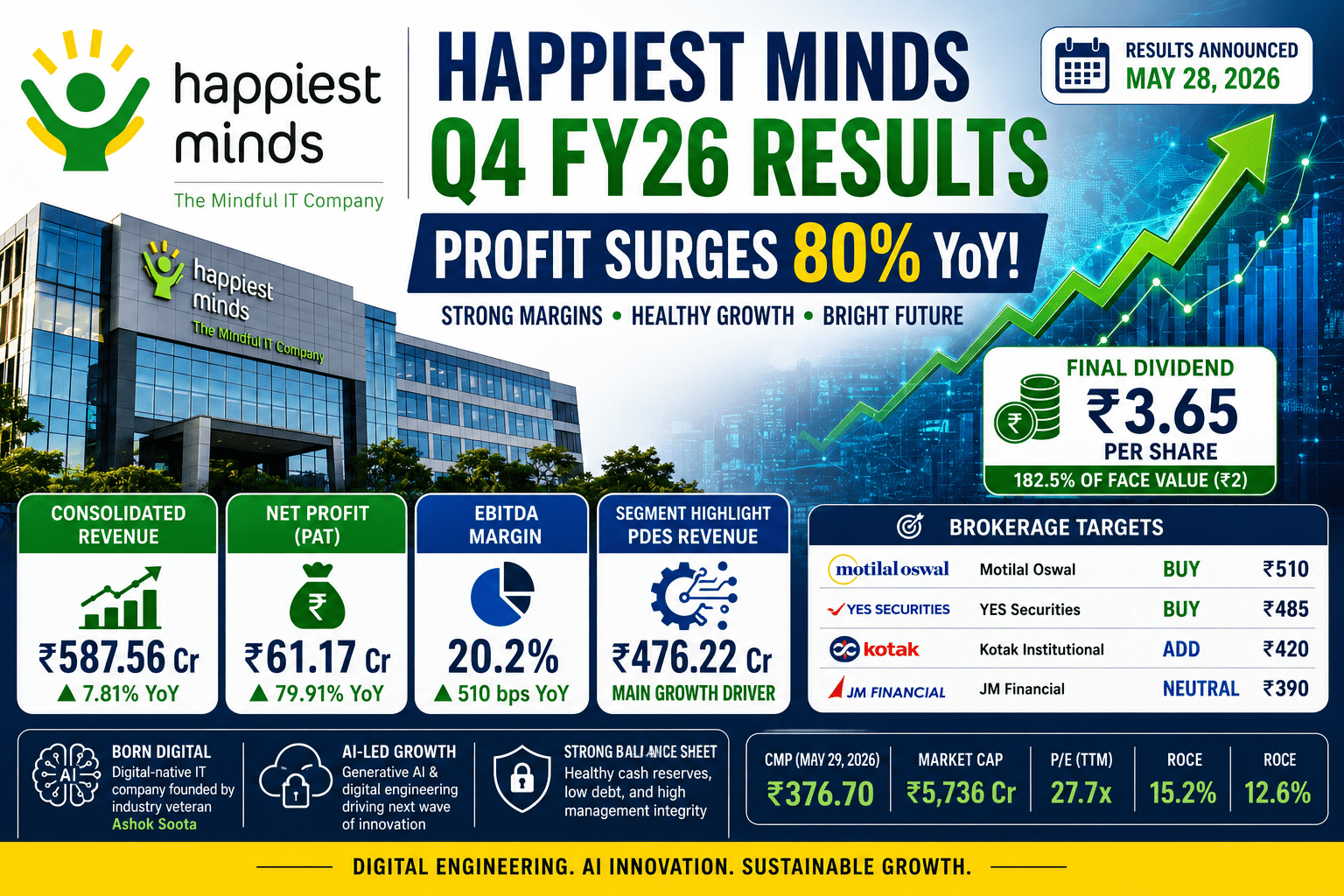
If you have been holding Indian IT stocks through the uncertainty of the last year, Happiest Minds Technologies may have just given you a reason to look at the sector again. While several technology companies have struggled with delayed client spending, cautious enterprise budgets, and weak global demand, Happiest Minds Technologies Limited surprised the market with one of the strongest earnings performances seen in the mid-cap IT space this quarter. The company reported a stunning 80% year-on-year jump in net profit, significant margin expansion, and a generous dividend announcement, signaling that its turnaround strategy may finally be delivering tangible results.
The Q4 FY26 results arrive at a time when investors are actively searching for technology companies capable of delivering both growth and profitability. Happiest Minds appears to be moving in exactly that direction. Strong execution, disciplined cost management, growing AI-related opportunities, and a healthier business mix helped the company outperform expectations and reignite investor interest.
Happiest Minds Q4 FY26: Key Financial Highlights
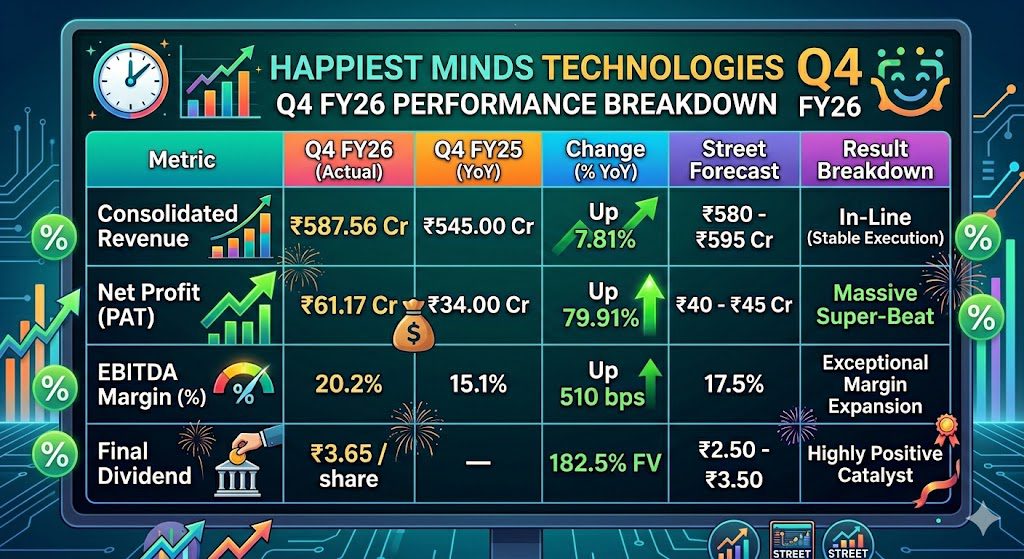
The headline numbers were impressive across several metrics. Consolidated revenue for Q4 FY26 came in at ₹587.56 crore compared to ₹545 crore during the same quarter last year, reflecting growth of approximately 7.81%. While revenue growth remained steady rather than spectacular, profitability expanded dramatically.
Net profit after tax surged to ₹61.17 crore from ₹34 crore in Q4 FY25, representing a remarkable increase of nearly 80%. The earnings figure significantly exceeded analyst expectations, which were largely positioned between ₹40 crore and ₹45 crore. EBITDA margins improved sharply to 20.2% compared to 15.1% last year, reflecting margin expansion of approximately 510 basis points. The board also rewarded shareholders by announcing a final dividend of ₹3.65 per share on a face value of ₹2.
For investors, these numbers indicate something important: Happiest Minds is not merely growing revenue but is becoming substantially more efficient at converting revenue into profits.
Company Overview: A Digital-Native IT Company Built for the Future
Unlike many traditional Indian IT companies that began as outsourcing providers before pivoting toward digital services, Happiest Minds Technologies Limited was designed from the beginning as a digital-first organization. Founded by legendary IT entrepreneur Ashok Soota, the company positioned itself around emerging technologies long before digital transformation became a global corporate priority.
Today, Happiest Minds operates through three primary business pillars. The largest contributor remains Product and Digital Engineering Services (PDES), which generated approximately ₹476.22 crore during the quarter. This segment focuses on software product engineering, cloud transformation, data analytics, artificial intelligence, and digital modernization projects for global clients.
The second pillar is Infrastructure Management and Security Services (IMSS), which helps enterprises manage cloud infrastructure, cybersecurity, and IT operations. As organizations increasingly migrate toward hybrid cloud environments, this segment continues gaining strategic importance.
Perhaps the most exciting business division is the company’s recently established Generative AI Business Services (GABS) unit. This segment focuses on enterprise AI solutions, agentic AI models, automation systems, and next-generation artificial intelligence applications. As global enterprises accelerate AI adoption, this division could emerge as one of the company’s most powerful future growth engines.
Breaking Down the 80% Profit Explosion
The most important question investors are asking is simple: how did Happiest Minds increase profits by 80% when revenue grew by less than 8%?
The answer lies primarily in margin expansion and operational efficiency.
Over the last few quarters, management has aggressively optimized costs across multiple business functions. Internal automation initiatives reduced repetitive operational tasks, resource utilization improved significantly, and the company strategically moved away from lower-margin legacy contracts that contributed revenue but offered limited profitability.
These efforts produced a dramatic improvement in EBITDA margins. Moving from 15.1% to 20.2% may not sound extraordinary at first glance, but in the IT services industry, a 510-basis-point margin expansion is a significant achievement. It indicates that management successfully improved pricing discipline, project selection, and resource allocation.
Another contributor to profit growth was the reduction in exceptional charges and non-recurring costs compared to previous periods. As these temporary pressures eased, more of the company’s operational gains flowed directly into net profit.
The result was a near doubling of earnings despite relatively modest revenue growth.
Dividend Announcement Strengthens Investor Confidence
The board announced a final dividend of ₹3.65 per share, representing 182.5% of the face value. This dividend declaration sends a positive signal regarding management’s confidence in future cash generation and overall business health.
Although investors are still awaiting the formal record date and book closure details, the dividend itself highlights a key advantage of Happiest Minds. Unlike many high-growth technology firms that reinvest every rupee back into expansion, Happiest Minds appears capable of balancing growth investments while simultaneously rewarding shareholders.
For long-term investors seeking both capital appreciation and income generation, this combination becomes particularly attractive.
Fundamental Analysis: Is the Stock Finally Becoming Attractive Again?
Over the past year, Happiest Minds experienced a painful correction, with the stock falling approximately 37% from previous highs. However, this correction may have created an opportunity for investors who previously considered the stock too expensive.
At the current market capitalization of roughly ₹5,736 crore, the stock trades at a trailing Price-to-Earnings ratio near 27.7x. Compared with premium digital engineering companies such as Persistent Systems Limited, which trades at substantially higher valuation multiples, Happiest Minds now appears much more reasonably valued.
Return metrics remain healthy. Return on Capital Employed (ROCE) stands near 15.2%, while Return on Equity (ROE) remains around 12.6%. Although these figures are not industry-leading, they demonstrate consistent capital efficiency and indicate that management is generating respectable returns from shareholder capital.
The balance sheet also remains strong. Cash reserves are healthy, debt levels remain manageable, and promoter credibility continues to be one of the company’s strongest intangible assets. The company’s financial flexibility could become particularly important as management explores future AI-related investments, acquisitions, and expansion opportunities.
Technical Analysis: Important Trading Levels for Investors
From a technical perspective, the stock appears to be showing early signs of recovery after a prolonged correction. The share price has been consolidating around the ₹376.70 level while gradually building a stronger base.
More importantly, the stock appears to have formed a double-bottom pattern near its 52-week low around ₹330.20. Following the earnings release, price action has improved and the stock has moved above several short-term moving averages, suggesting that momentum may be shifting in favor of buyers.
The most important technical pivot currently remains near ₹376.
y=376y=376
A sustained close above this level could open the path toward immediate resistance zones near ₹388 and ₹412. If bullish momentum continues, traders may eventually target the larger gap-resistance zone near ₹450.
On the downside, immediate support remains near ₹362, followed by ₹348 and the major structural support near ₹330. Traders should monitor these levels carefully when planning short-term positions.
Management’s Vision: The Road to $1 Billion Revenue
One of the most important aspects of the earnings conference discussion was management’s continued commitment to achieving a $1 billion revenue run-rate by 2031. While this target remains ambitious, management believes the combination of digital engineering, cybersecurity, cloud modernization, and artificial intelligence services provides a realistic pathway toward that objective.
Management also expects FY27 revenue growth to accelerate into the 15%–20% range on a constant-currency basis as enterprise technology spending gradually normalizes across the United States and Europe. If this outlook materializes, the company could enter a much stronger growth phase than what investors have witnessed over the last two years.
Generative AI remains a particularly important growth opportunity. Corporate demand for AI integration, intelligent automation, enterprise copilots, and agentic AI solutions continues rising rapidly. Happiest Minds is positioning itself aggressively to capture this emerging demand wave.
Brokerage Views and Institutional Outlook
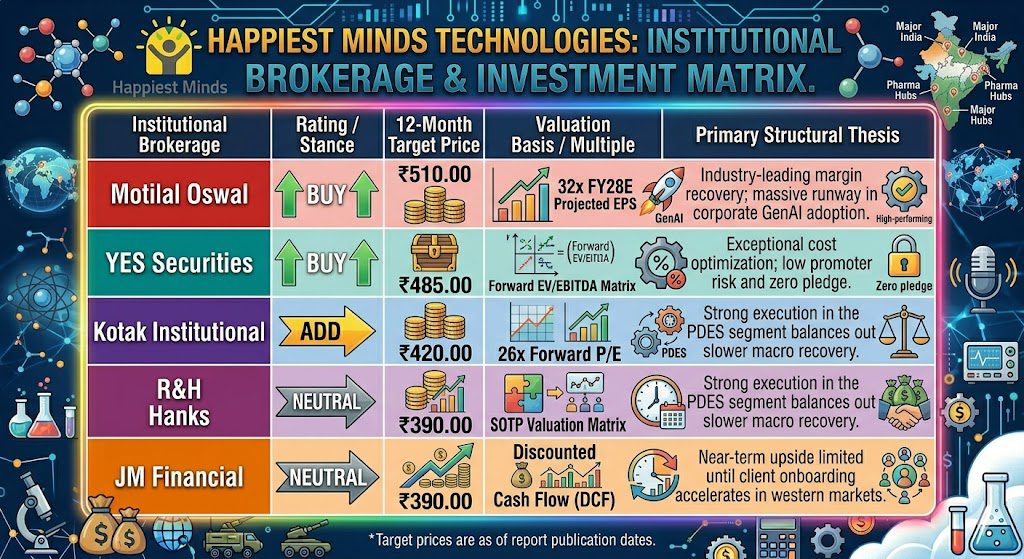
Institutional analysts have responded positively to the earnings surprise and are beginning to revise their valuation models.
Motilal Oswal maintained a BUY rating with a target price of ₹510, citing strong margin recovery and substantial opportunities in enterprise AI adoption. YES Securities also maintained a BUY recommendation with a target near ₹485, highlighting exceptional cost discipline and low governance risk.
Kotak Institutional retained an ADD rating with a target of ₹420, while JM Financial maintained a Neutral stance with a target near ₹390. The variation in targets reflects differing views on the speed of global IT spending recovery, but the overall institutional tone remains constructive.
Final Verdict: Buy, Hold, or Sell?
For long-term investors, Happiest Minds appears increasingly attractive after its significant correction and subsequent earnings recovery. Revenue growth remains stable, profitability is improving rapidly, margins are expanding, and management is positioning the company aggressively within high-growth AI and digital transformation markets.
The latest results strongly suggest that the worst of the margin compression cycle may now be behind the company. Investors willing to hold for several years may find the ₹340–₹370 accumulation zone particularly attractive, especially if management successfully executes its AI strategy and progresses toward its long-term revenue targets.
For active traders, the key level remains ₹376. A strong breakout above this zone could trigger momentum toward ₹388, ₹412, and potentially higher targets. However, maintaining discipline with stop-loss levels near ₹362 remains essential given the broader volatility still present within global technology markets.
Overall, Q4 FY26 marks one of the strongest quarters for Happiest Minds Technologies Limited in recent years. Strong profit growth, expanding margins, healthy dividend payouts, improving technical structure, and growing exposure to artificial intelligence together suggest that this digital-native IT company may be entering a new phase of growth after a challenging period. For investors searching for an emerging AI and digital transformation story within India’s mid-cap IT space, Happiest Minds deserves close attention.