The Indian pharmaceutical sector has witnessed several remarkable turnaround stories over the years, but Glenmark Pharmaceuticals may have just delivered one of the most impressive transformations of FY26. The company announced its Q4 FY26 results on May 29, 2026, and the numbers immediately grabbed the attention of investors, analysts, and institutional fund managers across Dalal Street.
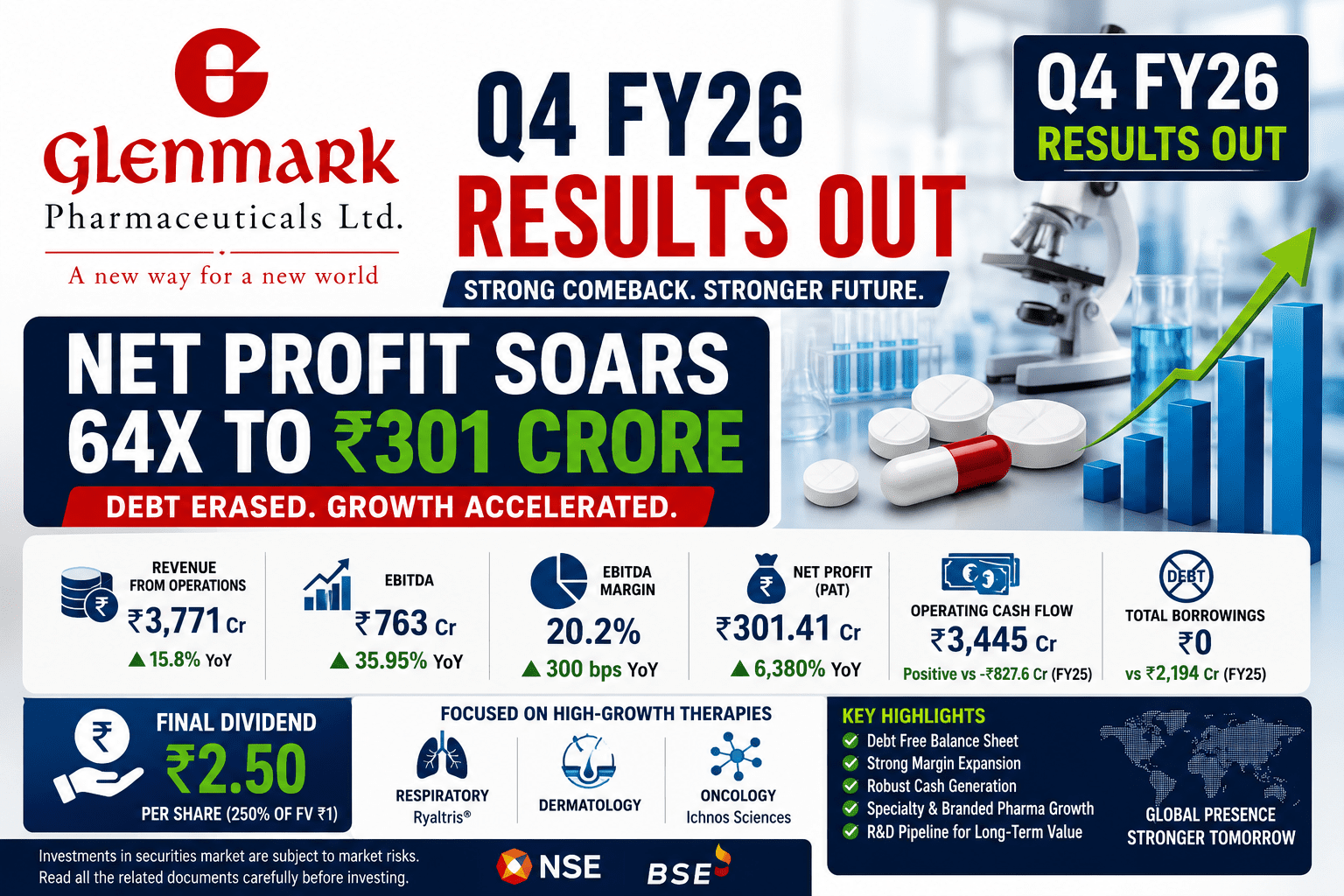
At first glance, the headline figure looks almost unbelievable. Glenmark’s net profit surged from just ₹4.65 crore in Q4 FY25 to ₹301.41 crore in Q4 FY26, representing an extraordinary growth of nearly 6,380% or approximately 64 times on a year-on-year basis. However, the story becomes even more interesting when investors move beyond the profit figure and examine the company’s balance sheet transformation.
During FY26, Glenmark achieved something few large pharmaceutical companies manage in such a short period. The company completely eliminated its formal debt burden of more than ₹2,194 crore, effectively becoming debt free. Simultaneously, operating cash flow turned sharply positive, margins expanded significantly, and management continued rewarding shareholders through dividend payouts.
While the stock corrected by 4.61% after the earnings announcement due to profit booking and broader market weakness, long-term investors are now asking a critical question: Has Glenmark completed one of the biggest pharmaceutical turnarounds in recent years?
The latest results suggest the answer could be yes.
Q4 FY26 Financial Performance: A Quarter That Changed the Narrative
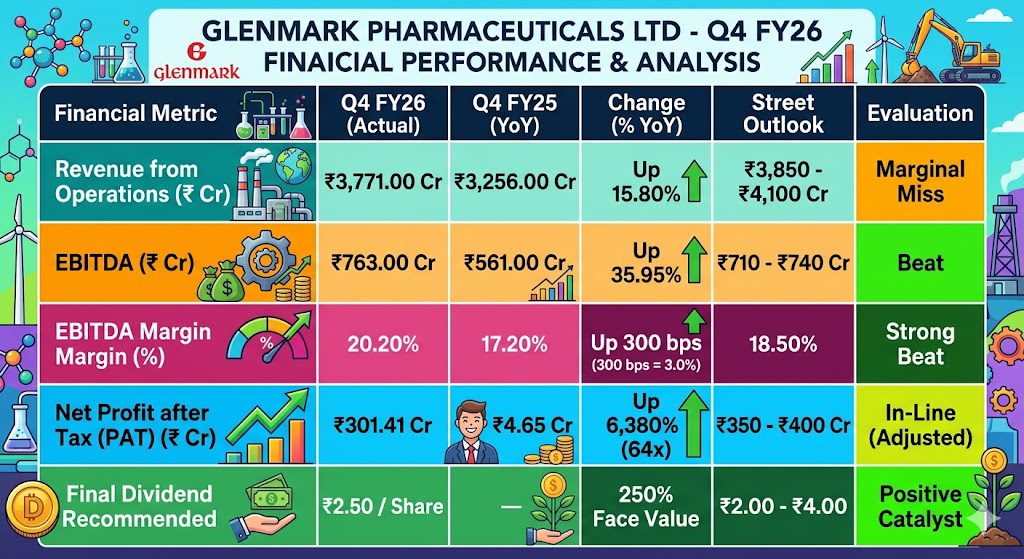
Glenmark’s Q4 FY26 scorecard reflects a company that has significantly strengthened both its operational performance and financial position. Revenue from operations increased to ₹3,771 crore compared with ₹3,256 crore reported during the corresponding quarter last year. This represents healthy year-on-year growth of 15.8%, driven by strong contributions from branded formulations, respiratory therapies, and international markets.
Although revenue came slightly below the upper range of analyst expectations, profitability was the real highlight of the quarter. EBITDA increased sharply to ₹763 crore from ₹561 crore in Q4 FY25, delivering growth of nearly 35.95%. More importantly, EBITDA margins expanded from 17.2% to 20.2%, representing an impressive improvement of 300 basis points.
Margin expansion is often a stronger indicator of business quality than revenue growth because it reflects improvements in operational efficiency, product mix, and cost management. In Glenmark’s case, all three factors contributed positively during the quarter.
The most striking number was the profit after tax. Net profit reached ₹301.41 crore compared with only ₹4.65 crore during the same quarter last year. While part of this growth reflects the normalization of earnings after previous exceptional charges and restructuring costs, it nevertheless demonstrates the magnitude of the company’s operational recovery.
The board also rewarded shareholders by recommending a final dividend of ₹2.50 per equity share, representing 250% of the face value of ₹1 per share. The dividend announcement reinforces management’s confidence in the company’s future cash generation capabilities.
Corporate Profile: The Specialty Pharma Engine Behind Glenmark’s Growth
Unlike many Indian pharmaceutical companies that rely heavily on commoditized generic medicines, Glenmark has gradually built a differentiated business model centered around specialty pharmaceuticals and branded formulations.
The company has established strong positions in high-value therapeutic categories such as dermatology, respiratory medicine, and allergy management. One of its most successful products, Ryaltris, has emerged as an important growth driver across multiple international markets. The nasal spray continues gaining market share and contributes significantly to the company’s improving product mix.
Beyond commercial products, Glenmark has also invested heavily in innovation through its research subsidiary, Ichnos Sciences. The company continues developing novel therapies in areas such as immuno-oncology and advanced biologics. While research investments often create short-term earnings pressure, they provide long-term opportunities for value creation if successful commercialization occurs.
This combination of branded formulations, specialty products, global respiratory franchises, and innovative research creates a stronger competitive moat than traditional generic-focused pharmaceutical companies. It also provides investors with exposure to both stable cash-generating businesses and future growth opportunities.
Earnings Analysis: Understanding the 64x Profit Surge
The dramatic increase in profitability did not occur by accident. Several operational improvements came together during FY26 to create one of Glenmark’s strongest quarters in recent memory.
The first factor was the normalization of earnings. During the previous fiscal year, profitability was significantly impacted by remediation expenses, restructuring costs, and exceptional charges. As these temporary pressures subsided, the underlying earnings power of the business became more visible.
The second factor was product mix improvement. Higher sales from branded respiratory products, including Ryaltris, helped increase overall profitability. Specialty pharmaceutical products generally carry significantly higher margins than conventional generic medicines, allowing the company to improve earnings even without extraordinary revenue growth.
The third factor was cost efficiency. Raw material consumption fell to approximately 24.8% of net sales compared with more than 32% during the previous year. This substantial reduction reflects improved procurement efficiency, manufacturing optimization, and favorable product mix changes.
When combined, these factors enabled Glenmark to expand EBITDA margins to 20.2%, one of the strongest levels reported by the company in recent years. The margin improvement demonstrates that management’s operational restructuring efforts are beginning to produce tangible financial results.
Dividend Announcement: A Positive Signal for Shareholders
In addition to strong earnings growth, Glenmark announced a final dividend of ₹2.50 per equity share for FY26. While the dividend itself may not be the largest within the pharmaceutical sector, its significance extends beyond the payout amount.
Companies undergoing major balance-sheet restructuring often prioritize debt reduction over shareholder distributions. The fact that Glenmark has simultaneously eliminated debt and maintained shareholder rewards indicates improving financial flexibility.
For investors, dividend continuity often serves as a signal that management remains confident about future cash flows and earnings sustainability. Combined with the company’s debt-free status, the dividend announcement strengthens the overall investment case.
Fundamental Analysis: The Balance Sheet Revolution
Perhaps the most important development in Glenmark’s FY26 results has nothing to do with revenue or profit. Instead, it lies within the balance sheet.
The company has completely eliminated all formal borrowings.
Total current and non-current borrowings declined from ₹2,194.2 crore to zero. This transformation fundamentally changes Glenmark’s financial risk profile. Interest expenses decline, refinancing risks disappear, and management gains greater flexibility to allocate capital toward growth opportunities, research initiatives, acquisitions, and shareholder returns.
Equally impressive is the turnaround in operating cash flow. During FY25, Glenmark reported negative operating cash flow of ₹827.6 crore. In FY26, the company generated positive operating cash flow of ₹3,445 crore.
Such a dramatic reversal indicates that the business is now capable of funding its own growth without relying heavily on external financing. Strong cash generation combined with a debt-free balance sheet creates a powerful foundation for long-term shareholder value creation.
However, investors should not ignore potential risks. Trade receivables increased by 48.5% year-on-year to ₹4,963.4 crore, significantly outpacing revenue growth. This trend deserves careful monitoring because rising receivables can indicate slower customer collections, increased credit risk, or inventory channel buildup in international markets.
While the overall balance-sheet transformation remains overwhelmingly positive, receivable management will likely become an important focus area during FY27.