GAIL (India) Limited announced its Q4 FY26 financial results on May 21, 2026, and the earnings report immediately became one of the most closely watched developments in India’s energy sector. The quarter reflected the harsh reality of how global geopolitical tensions can directly impact India’s energy ecosystem, industrial supply chains, and corporate profitability.
The state-owned Maharatna energy giant reported a sharp decline in earnings after severe LNG supply disruptions and escalating geopolitical tensions across West Asia created extraordinary pressure on global gas markets. While the company’s core gas-transmission business remained operationally resilient and continued delivering healthy revenue growth, the collapse in LNG availability and rising spot-market procurement costs significantly damaged margins across the gas-marketing and petrochemical businesses.
At first glance, the earnings report appeared disappointing. Both consolidated and standalone profits declined sharply, petrochemical revenues weakened substantially, and the company missed most Street expectations. However, experienced long-term investors understand that the latest weakness was largely driven by extraordinary geopolitical disruptions rather than structural deterioration inside GAIL’s business model.
Beneath the weak headline numbers, the company’s strategic monopoly over India’s natural-gas infrastructure remains completely intact. Transmission volumes stayed resilient, pipeline tariffs improved, the balance sheet remained stable, and management accelerated efforts to diversify LNG sourcing away from the Middle East.
For long-term investors, the latest quarter may eventually be remembered as a temporary geopolitical disruption rather than a structural business crisis. For short-term traders, however, the stock now enters a technically sensitive zone where volatility may remain elevated in the coming sessions.
GAIL Q4 FY26 Financial Performance Snapshot
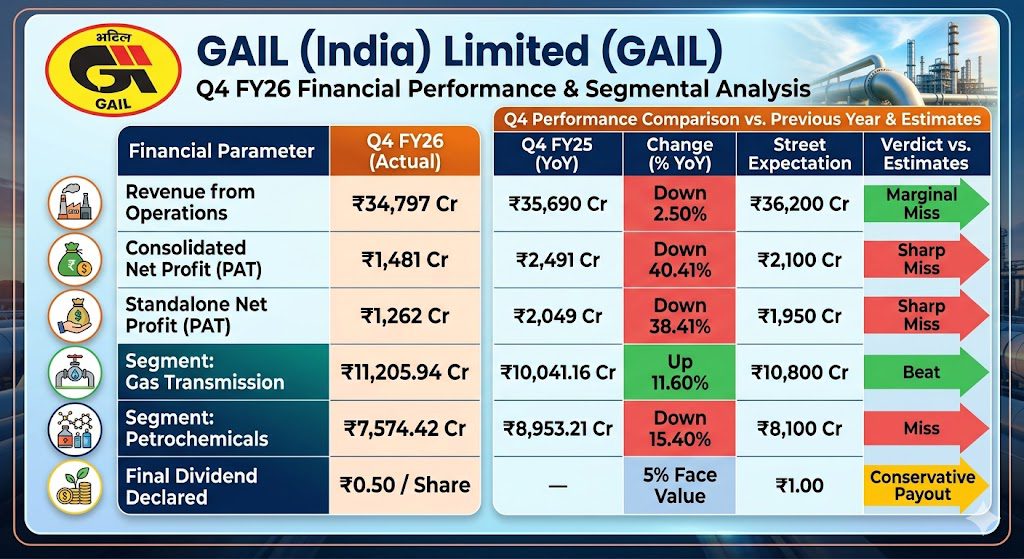
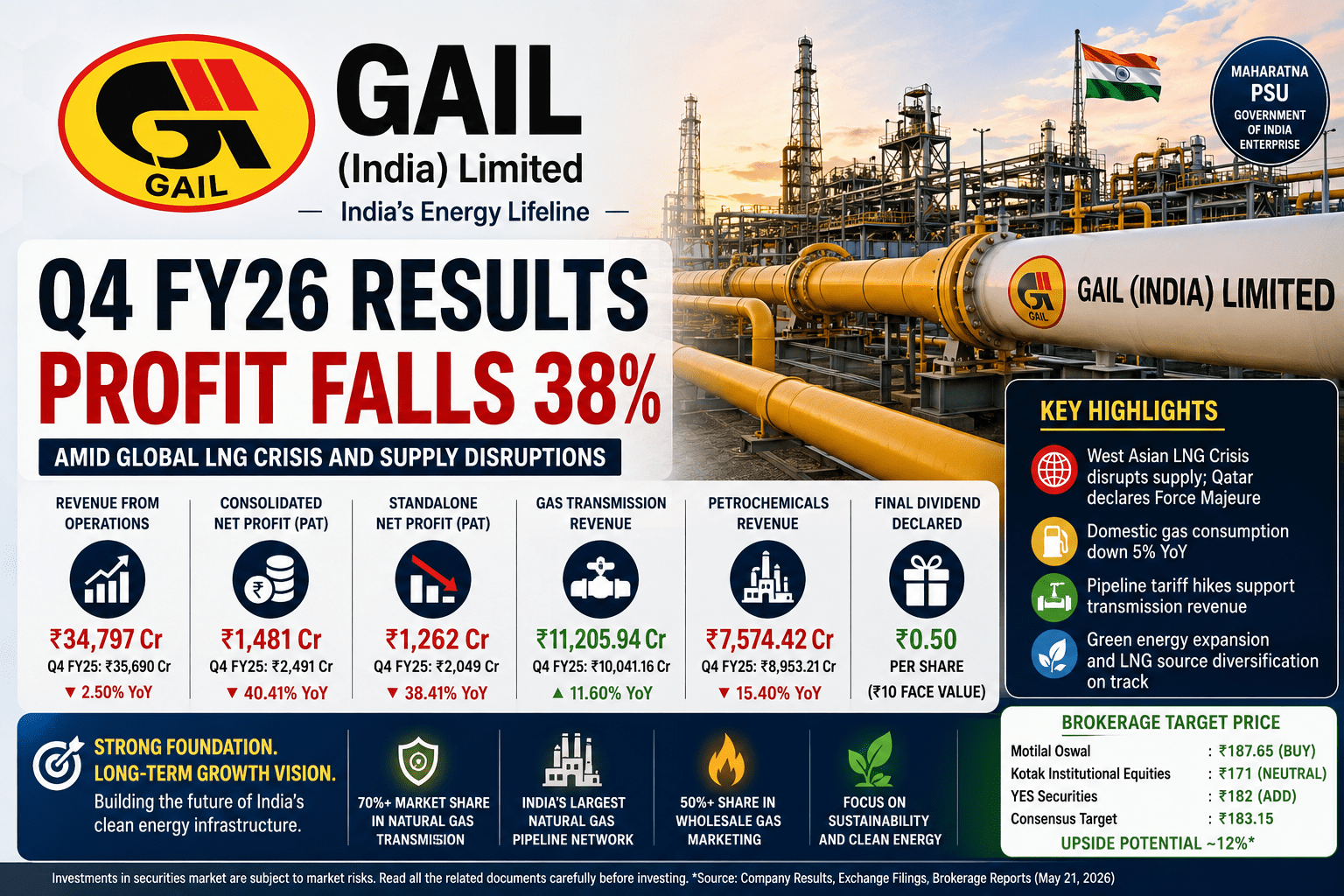
GAIL (India) Limited reported revenue from operations of ₹34,797 crore during Q4 FY26 compared to ₹35,690 crore during the same quarter last year, reflecting a marginal year-on-year decline of approximately 2.50%.
Although the revenue decline remained relatively limited, the number still fell below Street expectations of nearly ₹36,200 crore.
The biggest disappointment emerged in profitability.
Consolidated net profit after tax declined sharply to ₹1,481 crore compared to ₹2,491 crore during Q4 FY25, reflecting a steep decline of approximately 40.41%.
Standalone net profit also weakened significantly to ₹1,262 crore from ₹2,049 crore during the previous year, representing a contraction of nearly 38.41%.
The earnings decline came substantially below analyst estimates, which were positioned closer to ₹1,950–₹2,100 crore.
However, not every segment performed poorly.
The company’s Gas Transmission business remained exceptionally resilient during the quarter.
Segment revenue increased to ₹11,205.94 crore compared to ₹10,041.16 crore during the previous year, reflecting strong growth of approximately 11.60%.
This improvement was primarily supported by pipeline tariff revisions approved earlier by the Petroleum and Natural Gas Regulatory Board.
In contrast, the Petrochemicals division witnessed significant weakness.
Segment revenue declined sharply to ₹7,574.42 crore compared to ₹8,953.21 crore during Q4 FY25, reflecting a contraction of approximately 15.40%.
The company also declared a final dividend of ₹0.50 per equity share for FY26. Although the payout appeared conservative, it came in addition to the ₹5 interim dividend already distributed earlier during the fiscal year.
Understanding GAIL’s Structural Importance in India’s Energy Economy
GAIL (India) Limited remains one of the most strategically important companies within India’s energy ecosystem.
The company operates as the backbone of India’s natural-gas infrastructure, commanding more than 70% market share in natural-gas transmission and over 50% share in wholesale gas marketing across the country.
Its business model spans multiple integrated verticals including Natural Gas Pipelines, LNG sourcing, Petrochemicals, Liquid Hydrocarbons, and City Gas Distribution networks.
However, the company’s biggest long-term strength remains its irreplaceable pipeline infrastructure network.
This system effectively functions like an energy toll-road model for India’s industrial gas consumption and city-gas ecosystem.
Regardless of temporary fluctuations in LNG prices or geopolitical instability, India’s long-term transition toward cleaner energy continues supporting rising natural-gas demand.
This creates a durable structural moat around GAIL’s transmission business.
Earnings Analysis: Why GAIL’s Profit Collapsed During Q4 FY26
The biggest reason behind GAIL’s sharp earnings decline was the geopolitical crisis surrounding the Strait of Hormuz and broader West Asian LNG supply disruptions.
During March 2026, escalating tensions across the region reportedly disrupted major LNG production facilities in Qatar after multiple attacks damaged critical infrastructure.
Because Qatar remains India’s largest LNG supplier, the disruption immediately created severe pressure on Indian LNG-import contracts.
Qatar subsequently declared Force Majeure across portions of its export operations, creating supply shortages for downstream buyers including GAIL.
This forced the company into an extremely difficult operating environment.
Management either had to procure highly expensive spot-market LNG cargoes or reduce supply allocations to large domestic industrial consumers.
Both outcomes negatively impacted profitability.
The LNG shortage also created a cascading effect across multiple business segments.
Domestic gas consumption reportedly declined approximately 5% during the quarter as industrial consumers reduced offtake amid supply uncertainty and elevated energy costs.
While the regulated Gas Transmission business remained relatively protected because of tariff-linked revenue structures, high-margin Gas Marketing and Petrochemical operations suffered significant pressure.
Petrochemical revenues declined approximately 15.40% because of weaker feedstock availability and lower operational utilization.
Gas Marketing revenues also weakened because lower LNG availability restricted overall sales volumes.
This divergence between resilient transmission operations and weak trading businesses became the defining theme of GAIL’s Q4 FY26 earnings report.
Dividend Update: Conservative but Stable Shareholder Returns
Despite the difficult operating environment, GAIL (India) Limited continued maintaining shareholder payouts.
The Board recommended a final dividend of ₹0.50 per equity share on a face value of ₹10.
Although the payout appeared modest compared to previous years, investors must consider the extraordinary geopolitical disruptions impacting profitability during the quarter.
Importantly, this final dividend comes in addition to the ₹5 interim dividend already distributed earlier during FY26.
As a result, the company’s total FY26 dividend payout ratio remains relatively healthy near 51.9%.
The official dividend record date is expected to be announced following the upcoming Annual General Meeting.
For long-term dividend-focused PSU investors, the company’s ability to maintain shareholder payouts despite severe earnings pressure remains an encouraging sign of underlying financial stability.
Fundamental Analysis: Why Long-Term Investors Still See Value
Following the sharp correction from its 52-week high near ₹245 to current trading levels around ₹163, GAIL (India) Limited now trades at a trailing Price-to-Earnings multiple near 14x.
This valuation broadly aligns with the company’s historical average and provides relatively strong downside protection for long-term investors.
At current levels, a large portion of the geopolitical fear already appears priced into the stock.
This is one of the major reasons institutional investors continue viewing GAIL as a long-term accumulation opportunity rather than a structural sell candidate.
One of the biggest reasons analysts remain constructive on GAIL’s long-term outlook is because the company’s pipeline monopoly remains fundamentally unaffected.
Even during the current LNG crisis, the Gas Transmission business continued delivering double-digit revenue growth because of tariff revisions and resilient structural demand.
India’s long-term push toward cleaner energy, industrial gasification, and city-gas distribution expansion continues supporting multi-year growth opportunities for GAIL’s transmission infrastructure.
This makes the regulated transmission business one of the company’s strongest long-duration value drivers.
Another important long-term development is the company’s accelerating green-energy diversification strategy.
Management continues allocating significant capital toward renewable-energy infrastructure including a 178.2 MW wind-power project in Maharashtra and coal-gasification initiatives.
These projects remain strategically important because they gradually reduce the company’s long-term dependence on imported LNG markets.
Technical Analysis: Key Trading Levels for the Coming Week
Following the earnings announcement, GAIL shares entered the new trading week with clear short-term bearish momentum.
The stock currently trades below its 200-day Simple Moving Average near ₹169, placing near-term bullish momentum under pressure.
However, the Daily Relative Strength Index currently remains near 53.12, indicating that the stock is approaching a neutral-to-oversold zone where value buying could gradually emerge.
The most important market pivot currently stands near ₹162.20.
On the upside, immediate resistance levels remain near ₹163.34, ₹164.54, and eventually ₹165.68.
On the downside, critical support zones remain near ₹161, ₹159.86, and the major structural support level near ₹158.
For short-term swing traders, the ₹158–₹160 region now becomes extremely important.
If the stock opens weak but successfully defends ₹158 on strong institutional volume, traders could potentially witness a mean-reversion rebound toward ₹164.
However, a decisive closing breakdown below ₹158 may open the door for extended downside toward ₹152.
Management Guidance & Strategic Roadmap for FY27
Chairman and Managing Director Deepak Gupta addressed the difficult global environment during the earnings conference call while outlining management’s broader strategy for FY27.
One of the biggest positives remains pipeline monetization.
Management confirmed that revised transmission tariffs approved earlier by the Petroleum and Natural Gas Regulatory Board will begin contributing more meaningfully from Q2 FY27 onward.
This should provide a relatively stable earnings cushion against volatile LNG trading margins.
The company is also aggressively diversifying LNG sourcing arrangements away from excessive Middle East dependence.
Management confirmed ongoing negotiations with alternative suppliers including United States Henry Hub-linked exporters and African LNG producers.
This diversification strategy is strategically important because it reduces the company’s future vulnerability to geopolitical disruptions surrounding the Strait of Hormuz.
Institutional View: Brokerage Ratings & Target Prices
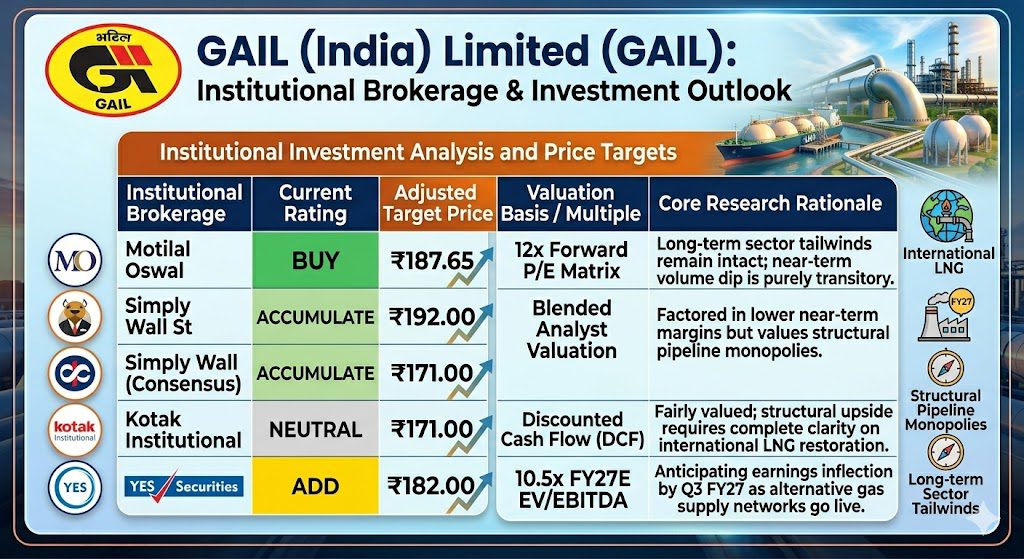
Institutional research firms recalibrated their earnings models following GAIL’s weak quarterly performance but largely maintained constructive long-term views.
Motilal Oswal Financial Services maintained a BUY recommendation with a target price of ₹187.65, arguing that the current weakness remains primarily geopolitical and temporary.
Kotak Institutional Equities retained a NEUTRAL recommendation with a target price of ₹171 while waiting for clearer visibility regarding LNG supply normalization.
YES Securities maintained an ADD recommendation with a target price of ₹182 because alternative LNG supply agreements could improve earnings from FY27 onward.
Meanwhile, broader analyst consensus data compiled by Simply Wall St currently indicates a blended target price near ₹192.
The broader institutional consensus target now stands near ₹183.15, implying potential upside of approximately 12% from current market prices.
Final Verdict: Buy, Hold, or Sell?
For long-term value investors, the sharp earnings contraction inside GAIL (India) Limited should largely be viewed as a geopolitical disruption rather than a structural collapse in the business.
The company’s pipeline monopoly, transmission infrastructure, regulated tariff ecosystem, and long-term role within India’s energy transition remain fully intact.
The current weakness therefore appears more cyclical and externally driven than structural.
Gradual accumulation within the ₹155–₹160 zone may continue offering attractive long-term risk-reward for patient investors with a multi-year investment horizon.
For short-term traders, however, caution remains important.
The stock currently trades inside a technically weak structure and could remain volatile until institutional selling pressure stabilizes.
Aggressive long positions may therefore become safer only after the stock successfully defends the ₹158 support zone and confirms bullish reversal patterns on lower timeframes.
Overall, GAIL’s Q4 FY26 results reflected one of the most geopolitically disrupted quarters in the company’s recent history. Yet beneath the temporary earnings collapse, the company’s strategic monopoly, infrastructure strength, and long-term energy-transition relevance continue remaining firmly intact.